
Anthony Licciardello | April 30, 2026
Long Beach Island
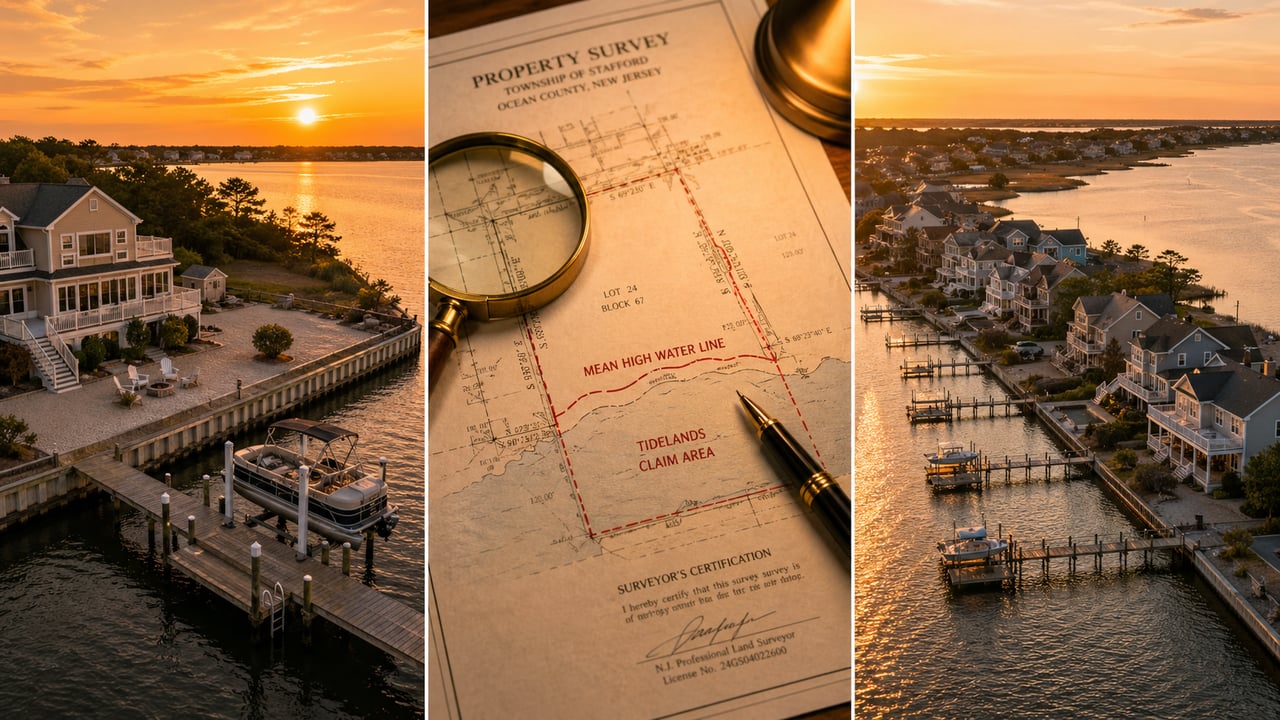

Long Beach Island bayfront buyers ask about the right things — flood zone, dune protection, wave exposure, dock condition. The question that catches more buyers off guard than any of those is whether the dock, the bulkhead, the lift, and sometimes a portion of the lot itself actually belong to the property at all, or whether they sit on tidelands owned by the State of New Jersey.
It's not a hypothetical. Tidelands claims exist in 17 of New Jersey's 21 counties. Barnegat Bay is one of the most heavily claimed waterways in the state. And as of 2026, the rules around resolving those claims have tightened in ways that make existing documentation far more valuable than buyers realize — and missing documentation far more expensive to fix.
This is the procedural breakdown I walk every LBI bayfront buyer through before they sign a contract.
The framework starts with the Public Trust Doctrine — a legal principle older than New Jersey itself. Under the Doctrine, every tidal waterway in the state is owned in fee simple by the State of New Jersey, in trust for the public, up to the historical mean high water line. Barnegat Bay qualifies. So does Little Egg Harbor, the back bays behind Long Beach Township, and the lagoons cut into bayfront communities decades ago.
What this means in practice: if any portion of a property's dock, bulkhead, ramp, lift, mooring piles, or even a portion of the lot itself extends below the historical mean high water line, that area is state-owned land. The state recognizes three categories — currently flowed tidelands (still under tidal water today), formerly flowed tidelands (filled in at some point in the past, now upland), and uplands that were never tidal. The category determines what kind of permission a property owner needs to legally use the land, and what kind of clouds may exist on title.
The governing statutes are N.J.S.A. 12:3-1 through 12:3-28 (riparian lands) and N.J.S.A. 13:1B-13.1 through 13.14 (Bureau of Tidelands Management oversight). The administrative framework lives in the Coastal Permit Program Rules at N.J.A.C. 7:7. These are the rules every LBI bayfront transaction is governed by, whether buyer and seller realize it or not.
The state issues four different instruments, each conferring a different level of right. Understanding the difference is the single most important piece of vocabulary an LBI bayfront buyer can have.
| INSTRUMENT | WHAT IT IS | DURATION | SECURITY |
|---|---|---|---|
| Riparian Grant | Deed conveying tidelands from state to owner | Permanent | Highest — clears title |
| Riparian Lease | Long-term rental of currently flowed tidelands | Typically 20 years, renewable | High — must be renewed |
| Tidelands License | Short-term rental for docks, lifts, bulkheads | 1–10 years | Lowest — revocable |
| Statement of No Interest | Confirms state has no claim on parcel | Permanent | Highest — proves no claim exists |
The grant is the gold standard. It transfers state ownership of the tideland area to the property owner permanently, gets recorded against the deed, and runs with the land. A lease is a long-term rental — typically 20-year terms for homes constructed over water, with renewal payments owed to the state. A license is the lowest tier, a short-term rental usually attached to fixed structures like docks and lifts. A Statement of No Interest is the cleanest possible outcome of a tidelands search: a recordable document from the state confirming no tidelands claim affects the parcel at all.
The state's current policy on riparian grants is the structural reason the documentation question matters more in 2026 than it did even five years ago. NJDEP's Bureau of Tidelands Management has stated unequivocally: New Jersey no longer sells currently flowed tidelands. Grants are now issued only for formerly flowed tidelands — areas that have been filled in and converted to upland. If a property has water over it today, the state will not sell that parcel to a private owner under any circumstances.
The implication for LBI bayfront is direct. Existing parcels with documented riparian grants covering the dock, bulkhead, and lift area are functionally non-replicable — you cannot manufacture a new grant for currently flowed water. Properties that have a grant in place hold a structural advantage over neighboring parcels operating on annual licenses or lapsed leases. That advantage shows up at the closing table whether or not it shows up explicitly in the listing description.
This same scarcity logic is part of the reason the bayfront segment is appreciating on a per-linear-foot basis even as the headline averages move sideways — a pattern covered in detail in the LBI oceanfront vs. bayfront 2026 analysis. The dirt is finite. The documentation that legitimizes it is, increasingly, equally finite.
The good news is that the search itself is fast. The bad news is that what the search reveals can take far longer to resolve. Here's the procedure I run on every bayfront transaction.
This is the foundational document. A tidelands search runs against the NJDEP Tidelands Data Viewer and historical claims maps, returning whether the parcel sits within a claimed area and whether any prior grants, leases, or licenses have been recorded against it. Most third-party providers — Western Technologies Group, NJ Property Fax, MyFloodStatus — return a search report within 24 to 48 hours. Cost runs in the low hundreds of dollars. The title company will typically order this as part of the closing process, but a buyer can and should request the search be initiated as early as possible after attorney review begins.
The tidelands search will identify the claim boundary, but only a current property survey will show whether the existing structures — bulkhead, dock, ramp, lift — fall inside or outside that boundary. If a grant exists, verify the granted area covers everything currently built. Bulkhead replacements that extended further into the bay than the original grant covered are one of the most common documentation problems on LBI.
If the parcel operates on a lease or license rather than a grant, confirm payments are current. Lapsed leases require renewal applications and back payments. License transfers between owners require an active license — expired licenses must be renewed, not assigned. NJDEP has online services for license transfers, renewals, and lease applications, and the Bureau of Tidelands Management can confirm payment status directly.
Tidelands instruments authorize the use of state-owned land. Waterfront Development Permits, issued under N.J.S.A. 12:5-3 (the Waterfront Development Law of 1914), authorize the physical construction. Any dock, pier, bulkhead extension, lift, or ramp built or modified on a tidally flowed waterway requires one. Verify the seller has copies for every existing structure. Missing permits don't always void the structure, but they create a path for future state enforcement that the new owner inherits.
After 20-plus years and several thousand New Jersey transactions, the same three patterns surface on bayfront properties more than any others.
Problem one: a dock or lift exists with no riparian instrument on file. Sometimes the structure was built decades ago when enforcement was lighter. Sometimes a previous owner never applied. The structure is technically unauthorized. Resolution requires applying for a tidelands license retroactively — the state may approve, may approve with conditions, or may require structural modifications. Cost and timeline are unpredictable.
Problem two: a grant exists but the structure has been expanded beyond the granted area. Common with bulkhead replacements that extended further into the bay than the original document authorized. The unauthorized portion may need to be rented under a license while a grant amendment is pursued. The state can require removal in extreme cases.
Problem three: a lease has lapsed and was never renewed. Owners pay nothing for years, sometimes decades, and assume the right runs with the land. It does not. The state can demand back payments and require new permitting before a closing proceeds. Title companies will hold escrow against the unresolved claim, and lenders may decline to finance until it's cleared.
When documentation gaps surface during attorney review, the typical price adjustment runs 5% to 15% of the bayfront's purchase price — the buyer's allowance for resolution costs, time risk, and uncertainty. On a $2.5M bayfront, that's $125K to $375K. The number is large enough that the right move is almost always to identify the issue before signing the contract, not after.
Tidelands instruments and Waterfront Development Permits are only part of the regulatory picture on LBI. The Coastal Area Facility Review Act — N.J.S.A. 13:19, with administrative rules at N.J.A.C. 7:7 — applies to virtually every coastal construction project on the island. CAFRA review covers the upland portion of a bayfront project; the Waterfront Development Permit covers the in-water portion. Both are typically required for the same project.
For most residential dock or bulkhead work, the simpler path is a Coastal General Permit-by-Certification or General Permit, which can move in weeks rather than months when the project meets the qualifying conditions. Larger projects, expansions beyond existing footprints, or work in environmentally sensitive areas trigger Individual Permits, which routinely take six to eighteen months and require formal public notice.
The buyer-side translation: "we'll add a dock after closing" is rarely simple. Even an existing dock that needs replacement triggers Waterfront Development review. A new dock on a parcel that has never had one requires CAFRA review, a Waterfront Development Permit, and a tidelands license — three separate authorizations. Plan timeline and cost accordingly.
Sellers who can produce all eight documents inside a week tend to be sellers whose properties close fast and at full price. Sellers who can't are sellers whose properties either need a price adjustment or need a documentation cleanup before they should hit the market at all. From the listing side, this is where I tell every client: the time to find the gaps is before the listing photos are scheduled, not after attorney review on a signed contract.
Missing documentation is rarely a deal-killer. It's almost always a price-killer. The judgment call is reading which gaps are recoverable and which ones aren't.
Walk-away signals: substantial dock encroachment beyond the riparian boundary into navigable channels; no grant or lease ever existed for a structure that occupies a meaningful tideland area; an active CAFRA enforcement notice on file against the property; pending litigation involving the bulkhead or shoreline. These are scenarios where resolution is uncertain and the timeline is unpredictable. The buyer is taking on the seller's regulatory exposure with no assurance of resolution.
Negotiate-through signals: a lapsed lease that can be renewed with back payment; a small encroachment recoverable through state cooperation; missing Waterfront Development paperwork on an older but otherwise compliant structure; a bulkhead extension that needs a license rather than the existing grant. These resolve with money and time, both of which can be priced into the contract through escrow holdbacks, seller credits, or contingencies.
The advantage of identifying the gaps before signing isn't legal; it's leverage. A seller who has already accepted an offer is a seller who has already made the emotional decision to sell. Documentation gaps that surface during attorney review almost always result in price reductions rather than dead deals. Missing the gaps until after closing eliminates the leverage entirely.
Long Beach Island bayfront is a finite asset. The dirt is non-replicable, the riparian documentation that legitimizes it is non-replicable, and in 2026 the State of New Jersey is no longer issuing new grants for currently flowed tidelands. That combination is exactly what makes documented bayfront so valuable — and exactly what makes undocumented bayfront so risky for an unprepared buyer.
The procedural answer is straightforward. Order the tidelands search early. Cross-reference against the survey. Verify every instrument is current. Confirm Waterfront Development and CAFRA permits exist for every in-water structure. If the seller can't produce the documentation, the transaction needs a price adjustment, an escrow holdback, or — in the worst cases — a different transaction entirely.
For broader context on the LBI market, the 2026 Long Beach Island market report covers islandwide sales data and pricing trends. For the closing-side mechanics that apply to every NJ waterfront transaction, the 2026 NJ closing costs breakdown covers RTF, GPF, mansion tax, and the line items LBI buyers and sellers pay at the table. And for sellers planning a 2026 bayfront listing, the three regulatory changes rewriting the Jersey Shore real estate playbook directly affect waterfront disclosure requirements in 2026.
Data and regulatory sources: New Jersey Department of Environmental Protection, Bureau of Tidelands Management; NJDEP Watershed and Land Management Coastal Zone program; Stewart Title Guaranty Company "Water Rights in NJ" continuing-education materials, 2026; New Jersey Coastal Permit Program Rules N.J.A.C. 7:7; Riparian Statutes N.J.S.A. 12:3-1 et seq. and N.J.S.A. 13:1B-13.1 et seq.; Waterfront Development Law N.J.S.A. 12:5-3; Coastal Area Facility Review Act N.J.S.A. 13:19. Tidelands search timelines confirmed via Western Technologies Group and NJ Property Fax current service standards. Riparian grant application timeline of approximately one year per NJDEP guidance; longer timelines (two to three years) commonly cited by NJ title industry sources. This article is informational and does not constitute legal advice. Bayfront buyers should engage a New Jersey real estate attorney experienced in tidelands matters for any specific transaction.
Prodigy Real Estate is an innovative real estate company offering high-end video production, home valuation services, purchasing, and home sales. Serving New York and New Jersey.