
Anthony Licciardello | September 19, 2026
Kennilworth, NJ
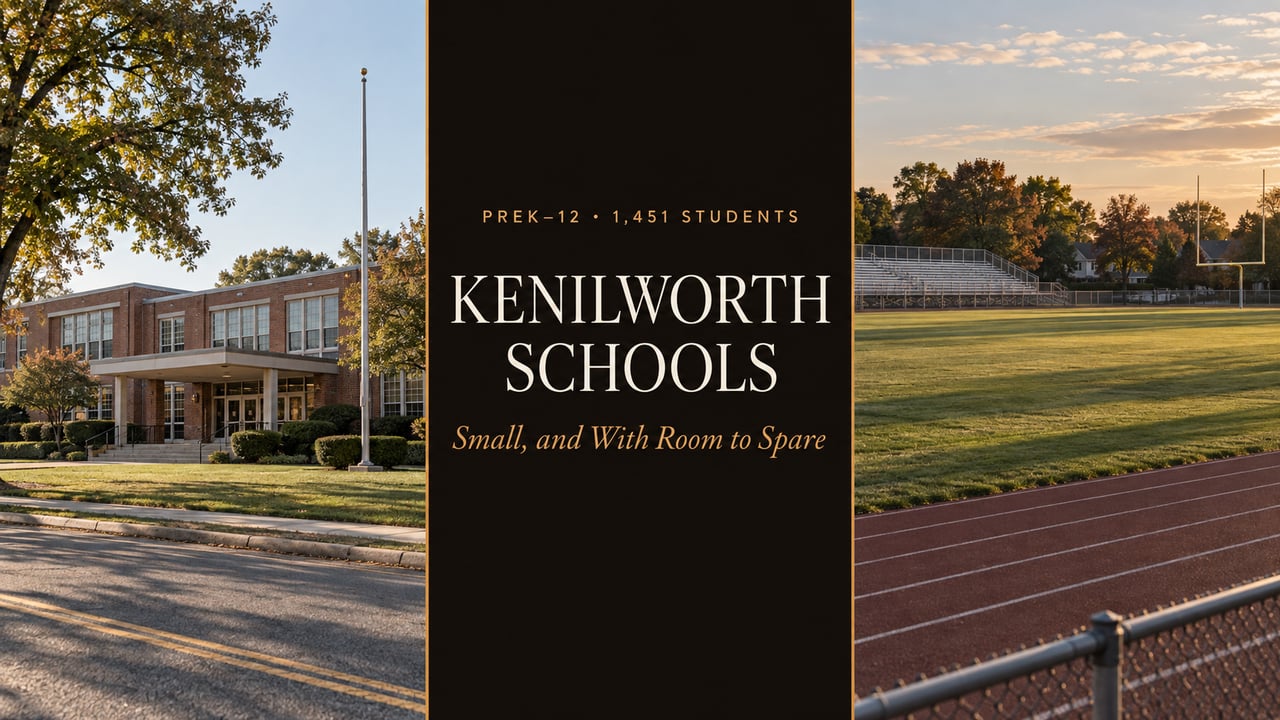
Two square miles, eight thousand residents, and its own PreK-through-12 school district. That alone is unusual in Union County. What is genuinely rare is what follows from it: Kenilworth's secondary school takes students from outside the borough — by treaty with a neighbouring township, and by open application from anywhere in New Jersey.
Kenilworth runs three schools and about 1,451 students across PreK–12 in a borough of 2.06 square miles. Warren G. Harding Elementary handles PreK–5 with roughly 659 students; David Brearley Middle/High takes it from there through graduation. And here is what almost nobody knows: Brearley enrolls students from outside Kenilworth — from Winfield Township under a sending/receiving relationship, and from anywhere in the state through New Jersey's Interdistrict Public School Choice Program, approved for grades 7–12. A district that accepts choice students is a district with room — which is the opposite of the capacity problem that dominates school conversations elsewhere in this county.
This describes how the district is structured — enrollment, grade spans, ratios and access — not how it performs. We do not publish school quality claims, rankings or test scores, and enrollment figures change annually. Confirm attendance assignment, current enrollment and program availability for any specific address directly with Kenilworth Public Schools.
Most municipalities this size do not run their own district. They send students to a regional high school shared with three or four neighbours, or they are a section of a larger township. Kenilworth does neither — it operates a full PreK-through-12 district of roughly 1,451 students under its own board, with about 133 full-time-equivalent faculty and a district student–teacher ratio near 10.9 to 1.
Roughly 659 students on the Boulevard, which also houses the district offices. One elementary school for the entire borough — so there are no attendance-zone boundaries to research within Kenilworth, and no "which side of the street" question. In a county where elementary zoning drives price differences street by street, that absence is worth noticing.
On Monroe Avenue, with about 774 students in the high school grades and a student–teacher ratio near 11.1 to 1. Established in 1966 as David Brearley Regional High School and reconstituted as a combined middle-high school in 1997. Named for David Brearley, a signer of the United States Constitution — colors navy and gold, teams the Bears, competing in the Union County Interscholastic Athletic Conference.
The combined middle-high structure is the thing to understand before you tour. Students move from Harding into Brearley at seventh grade and stay in the same building through twelfth. For some families that continuity is the appeal — a small, known environment with the same staff for six years. For others, a twelve-year-old sharing a building with seventeen-year-olds is the question to ask about. There is no right answer, but it is the structural fact that most distinguishes Kenilworth from the regional-high-school model around it, and it is worth raising on a tour rather than discovering later.
Two separate mechanisms bring students into Brearley from beyond the borough line, and together they tell you something a ranking never would.
The first is a sending/receiving relationship with Winfield Township, a neighbouring municipality without its own high school. Winfield students attend Brearley as a matter of long-standing arrangement — a legacy of the school's 1966 founding as a regional high school, which is where the name still comes from. Sending/receiving relationships are common in New Jersey and are governed by agreement between districts.
Kenilworth participates in New Jersey's Interdistrict Public School Choice Program, with approved choice grades of 7 through 12. Under that programme, students from other districts may apply to attend, and the state limits how many seats each participating district may fill. The district's published profile lists a Choice parent information contact and states that the programme is open to students entering grades seven through ten each year.
Here is why that matters to a buyer, and it is not obvious. Districts do not offer choice seats they do not have. Participation is a statement that the building has capacity — which is the reverse of the situation across much of Union and Middlesex County, where enrolment growth, referendum fights and portable classrooms dominate the conversation. Kenilworth is not managing overcrowding. It has room, and it uses it.
Two programme options sit alongside the standard curriculum. The district operates the Kenilworth Scholars' Academy, an accelerated academic track with published entry requirements, and offers Advanced Placement, honours and virtual coursework. Separately, students interested in vocational and technical education may attend Union County Vocational-Technical High School on a shared-time basis — a route that exists in many Union County districts and is frequently overlooked by buyers who assume a small district means fewer paths.
The practical implication for a family relocating. If you are weighing Kenilworth against a neighbouring town and the school is your deciding factor, you may not need to move here to access it — the Choice Program exists precisely for that. Equally, if you do buy here, your child's seat is not contingent on a lottery. Ask the district about current choice seat availability, because it changes annually and the numbers are published before each application deadline.
One elementary school for the whole borough means no attendance-zone question — and that is a selling point most listings never make.
In towns where elementary zoning moves price street by street, buyers spend weeks decoding boundary maps. Kenilworth has one elementary school and one secondary school — every address in the borough goes to the same two buildings. That simplicity is worth stating plainly in your marketing, alongside the actual tax bill and a price built from recent closed sales rather than an estimate running six figures behind. Backed by the New York metro buyer pool we bring to every listing.
Roughly 774 students across four high school grades works out to about 190 per grade. Set that against the regional high schools common in this part of New Jersey, which frequently run three to eight times larger. That is not a small difference in degree — it is a different kind of school, and it produces genuine tradeoffs in both directions.
A ratio near 11 to 1. Staff who know every student by name. Far easier access to teams, productions, clubs and leadership positions — in a school of 190 per grade, a student who wants to be on a varsity roster or in the school newspaper generally can be. The district fields more than a dozen sports and a full arts programme, which is a lot of opportunity spread across relatively few students.
A narrower course catalogue than a large regional can carry — which is precisely why the AP, honours, virtual and vocational-technical options matter, and why the Vo-Tech shared-time route is worth asking about specifically. A smaller peer group, which suits some students and not others. Ask the district for the current course offerings list rather than assuming either way.
And one structural consequence worth thinking through. A district of 1,451 students has a smaller budget base than a district of 5,000 — which is part of why Kenilworth's tax rate looks the way it does, and part of why the shared arrangements exist. Small districts are more exposed to enrolment swings and to the cost of any single capital project, which is a reason to look at the district's budget and any bond or referendum activity before you buy, not after. Our Kenilworth property tax guide covers how the levy actually lands on a bill.
The comparison buyers usually want. Cranford, three miles away, runs a considerably larger township district and prices accordingly — the full breakdown is in our Kenilworth and Cranford comparison. Whether larger is better depends entirely on the student, and it is not a question a price gap can answer for you.
How is the 7–12 building organised day to day? Whether the middle and high grades share corridors, lunch and start times is the single question a parent of a seventh-grader most wants answered.
What is the current course catalogue, including AP and honours? Ask for the list, not a characterisation.
How does the Kenilworth Scholars' Academy work, and what are the entry requirements? They are published, and they matter if you are relocating an academically accelerated student.
How does the Vo-Tech shared-time arrangement work in practice? Scheduling, transport and which programmes are available.
What is current choice seat availability, and what does that imply about capacity? Published before each deadline, and a straightforward read on whether the building has room.
And the thing we would tell any client: tour the building. In a borough with one elementary and one secondary school, your address does not change your outcome — there is no better street or worse zone to research. What varies is whether this particular school suits this particular child, and that is not a question any published figure, ranking or article can answer. Two hours inside the building will tell you more than a month of reading.
Borough context — the market, the commute and the Parkway-versus-rail tradeoff — sits in our Kenilworth guide, and current inventory is on our listings page.
Ask the district for the current choice seat numbers — they are published before each application deadline, and they are the most honest capacity indicator you will find anywhere. Enrolment projections are estimates and referendum debates are arguments. Choice seats are a district telling the state, in writing, exactly how many students it has room for. A district offering seats is not one you will be reading about in a portable-classroom story three years from now — and in a county where school capacity fights have driven referendum battles and bond questions, that is a genuinely useful thing to know before you buy rather than after.
"Two square miles running its own PreK-through-12 district — that's already unusual. But the part nobody mentions is that Brearley takes students from outside the borough. Winfield sends its high schoolers there, and Kenilworth's in the state Choice program for grades seven through twelve, so families from other districts apply in. Think about what that means. Districts don't offer seats they don't have. Everywhere else around here the school conversation is overcrowding, referendums, portable classrooms. Kenilworth has room and it's renting it out. One elementary, one secondary — every address in town goes to the same two buildings, so there's no zone to decode. Just go tour it and see if it fits your kid."
— Anthony Licciardello, Broker, The Prodigy Team

Reading how a district is actually structured — grade spans, capacity, access routes — rather than repeating a ranking is the work: I'm Anthony Licciardello, Broker of The Prodigy Team, a former Director of Community Affairs in the Bloomberg Administration, now dual-licensed in New York and New Jersey and a leading broker for cross-border New York–New Jersey transactions.
Anthony Licciardello · Broker, The Prodigy Team · 718-873-7345
One elementary, one secondary, no attendance zones to decode — and a market whose estimates run six figures behind its closings.
What schools serve Kenilworth, NJ?
Kenilworth Public Schools runs a full PreK–12 district of roughly 1,451 students across three schools. Warren G. Harding Elementary on the Boulevard serves PreK–5 with about 659 students; David Brearley Middle/High School on Monroe Avenue serves grades 7–12, with about 774 students in the high school grades. There is one elementary school for the entire borough, so no attendance-zone boundaries to research. Confirm current assignment and enrollment with the district.
Can students from other districts attend David Brearley?
Yes, by two routes. Winfield Township students attend under a long-standing sending/receiving relationship, a legacy of the school's 1966 founding as a regional high school. And Kenilworth participates in New Jersey's Interdistrict Public School Choice Program with approved grades 7–12, under which students from other districts may apply for a limited number of state-allocated seats. Participation signals that the building has capacity — districts do not offer seats they do not have. Seat availability is published before each deadline.
How big is David Brearley High School?
About 774 students across the high school grades — roughly 190 per grade — with a student–teacher ratio near 11.1 to 1 and about 70 full-time-equivalent faculty. That is considerably smaller than the regional high schools common in this part of New Jersey. The tradeoff runs both ways: easier access to teams, productions and leadership positions, against a narrower course catalogue than a large regional can carry — which is why the AP, honours, virtual and Vo-Tech shared-time options matter here.
What academic options does Kenilworth offer?
The district operates the Kenilworth Scholars' Academy, an accelerated academic track with published entry requirements, alongside Advanced Placement, honours and virtual coursework. Students interested in vocational and technical education may attend Union County Vocational-Technical High School on a shared-time basis. Ask the district for the current course catalogue and Scholars' Academy requirements rather than relying on a summary — both change.
What You're Actually Buying in Kenilworth — Four House Types
The Kenilworth Commute — Two Stations, Two Fare Zones
Moving to Kenilworth — The Value Play With No Train Station
Kenilworth Property Taxes — Why the Rate Looks Alarming
Kenilworth vs. Cranford — Three Answers to One Question
Selling a Home in Kenilworth — One Call, and Four Rules
Union County by Price — What Every Town Actually Costs
Kenilworth Homes for Sale — Browse Current Listings
Details as of publication, from the sources noted, and subject to annual change. Kenilworth Public Schools is a PreK–12 district in Union County with three schools and an enrollment of 1,451 as of 2024–25, approximately 133.3 full-time-equivalent faculty and a student–teacher ratio of approximately 10.9 to 1; the district's published Choice profile lists total enrollment of approximately 1,500. Warren G. Harding Elementary School, 426 Boulevard, serves PreK–5 with approximately 659 students per National Center for Education Statistics Common Core of Data for 2024–25. David Brearley Middle/High School, 401 Monroe Avenue, is described by the district as serving grades 7–12; NCES lists a middle school component for grades 6–8, and a New Jersey School Performance Report for 2023–24 lists David Brearley Middle/High School as serving grades 07–12 with 767 total students — grade-span descriptions differ between sources and should be confirmed with the district for a specific child's entry year. David Brearley High School is listed at an enrollment of 774 as of 2024–25 with approximately 69.8 full-time-equivalent faculty and a student–teacher ratio of approximately 11.1 to 1; established 1966 as David Brearley Regional High School and reconstituted in 1997 as David Brearley Middle-High School; named for David Brearley, a signer of the United States Constitution; school colors navy blue and gold, team name Bears, competing in the Union County Interscholastic Athletic Conference and the Big Central Football Conference. Students from Winfield Township attend as part of a sending/receiving relationship. Per the New Jersey Department of Education's Interdistrict Public School Choice district profile for the 2026–27 school year, Kenilworth School District's approved choice grades are 7–12, with the district describing its Choice program as open to students in grades seven through ten each school year and noting that the Department of Education limits the number of choice seats each district may fill; the district also references the Kenilworth Scholars' Academy accelerated academic program with published requirements, Core, AP, honors and virtual coursework, and the opportunity for students interested in vocational/technical education to receive instruction at Union County Vocational Technical High School on a shared-time basis. School performance data, standardized test results, state or third-party school rankings, District Factor Group socioeconomic classifications, and the names of district administrators have been deliberately excluded, as we exclude such material for every community we cover; the district's own promotional characterizations of program quality are likewise not reproduced. Enrollment, grade spans, programs, choice seat availability and attendance assignments change annually. Nothing in this article is educational, legal or investment advice. Confirm attendance assignment, current enrollment, grade configuration and program availability for any specific address directly with Kenilworth Public Schools before relying on any figure above.
Prodigy Real Estate is an innovative real estate company offering high-end video production, home valuation services, purchasing, and home sales. Serving New York and New Jersey.