
Anthony Licciardello | September 19, 2026
Kennilworth, NJ
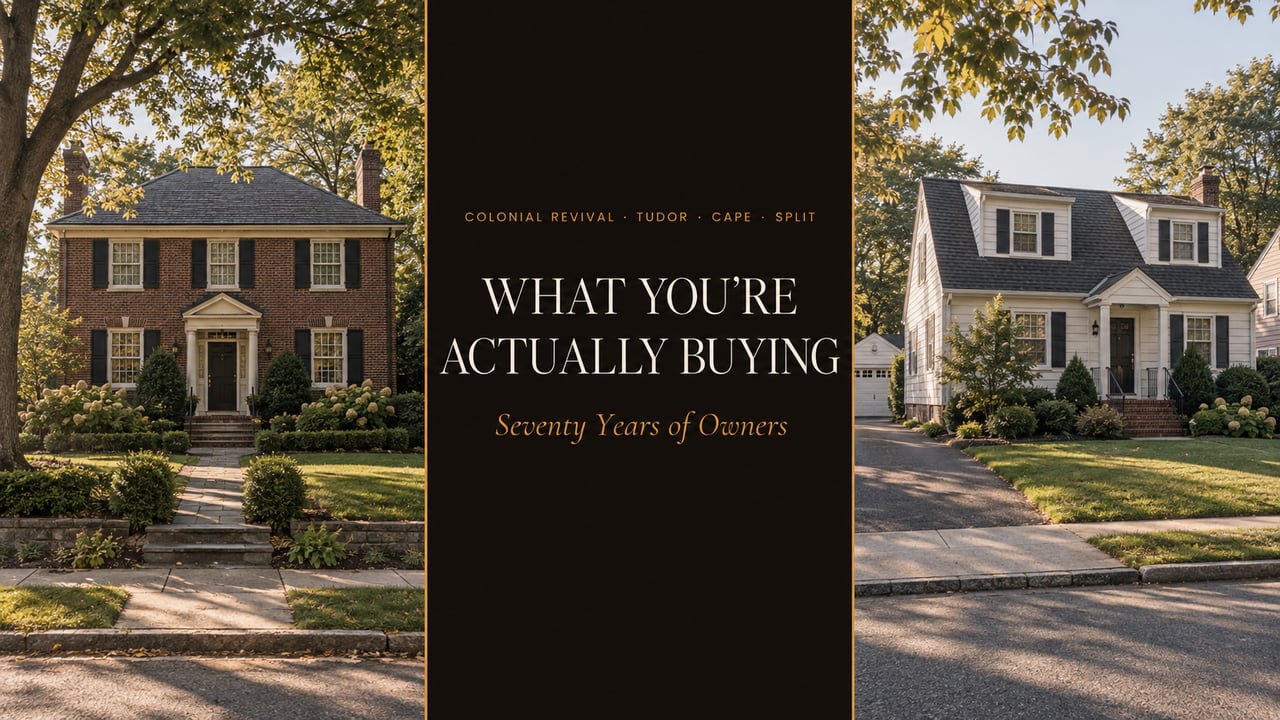
A 2008 architectural survey of Kenilworth found that the borough's most prevalent style is Colonial Revival, and its second most prevalent is Tudor Revival. That is not what most people expect from a two-square-mile borough in the entry tier of Union County — and it is the first sign that what you are buying here is older, better built, and more specific than the price band suggests.
Kenilworth's stock is older and more architecturally deliberate than its price implies, and unusually concentrated in time. The Borough's own adopted Housing Element records that more than 60% of existing housing was built in the 1940s and 1950s, with growth stalled since 2000. The Historical Society's 2008 survey puts Colonial Revival first and Tudor Revival second among styles, in subdivisions platted from the 1890s through the 1950s. Three consequences follow, and they are the same three every buyer here meets: the federal lead disclosure applies to nearly every house, the pre-1977 alarm specification is the borough's dominant tier, and renovation — not new construction — is the only value path available.
Architectural styles describe tendencies, not guarantees, and every house is its own case. Build years, structural conditions, permit histories and renovation feasibility must be verified for any specific property by inspection and with the Borough. Nothing here substitutes for that.
Kenilworth was not built at once, and the layering is legible on the ground once you know the subdivisions. The Historical Society's research names three of them with their build periods, and they explain most of what you will see driving the borough.
The longest build window in the borough. Before the annexations of the 1920s there were already a handful of homes on the west side — which means the oldest structures in Kenilworth predate the borough's modern boundaries. A street here can hold a 1900s house and a 1950s house side by side.
A concentrated 1920s subdivision, and where you will find some of the borough's better Tudor Revival work — including a documented speculative Tudor on Abingdon Avenue. Tight build window, consistent character.
The subdivision that most defines Kenilworth's architectural reputation: many Colonial Revival and Tudor Revival homes, built across three decades. Documented examples include a smaller Colonial Revival on Maclean Avenue designed by H. Bowen.
Then the mid-century wave, and it dominates everything. The Borough's own adopted Housing Element and Fair Share Housing Plan records that more than 60% of the existing stock was built in the 1950s and 1940s, and notes plainly that housing growth appears to have stalled since 2000. That is a municipality describing itself as largely finished — and it is the single most consequential fact about buying here.
One vanished landmark explains a pocket of the borough. Kenilworth once had its own nine-hole golf course — the Kenilworth Golf Club, sitting between Kenilworth Avenue, Oxford Road, Leicester Road and Lake Michigan. Houses stand on it now; a documented 1920s Colonial Revival on Raleigh Road occupies part of the former site. If you are touring that quadrant and the lots feel different, that is why. Golf-course subdivisions tend to produce curved streets and generous parcels that the surrounding grid does not.
The Cape Cod was revived in the 1920s as a starter house and mass-produced after the war: entry hall, living room, dining room, kitchen, two bedrooms and a bath below, with the upper half-storey created by adding dormers to the roofline. Kenilworth has them in quantity, many expanded. Read the upstairs carefully. Local listings describe "an open area bedroom with large closets… potential for a 4th bedroom" — which is honest language for a space that may not be a legal bedroom yet. Check ceiling height under the slope, egress, heat and whether the expansion was permitted. A dormer added without a permit is a problem you inherit, not one you discover later.
Half-flights instead of one staircase, with the lower level partly below grade. The lower level is where the questions are: whether it has been finished, whether that work was permitted, how it drains, and whether the mechanicals down there sit above or below the surrounding grade. Splits are also the type most often reconfigured over seventy years — ask what walls have moved and when.
Popular here from the 1920s, and many of Kenilworth's examples from that period are brick rather than clapboard — a durability advantage that pays off across a century, and a maintenance profile quite different from a sided house. Symmetrical, formal, generally well proportioned. The questions are the ones any 1920s–40s house raises: original systems, window condition, insulation, and what a century of paint sits on.
Brick or stone, asymmetrical, steeply pitched roofs, decorative half-timbering. That a borough at this price point carries Tudor Revival as its second most common style is genuinely unusual, and it is the strongest architectural argument for Kenilworth. Steep roofs and detailed exteriors cost more to maintain — get the roof and any half-timbering inspected specifically, because both are expensive to do properly and conspicuous when done badly.
A fifth category is worth naming: newer traditional homes with colonial detailing, scattered through the borough rather than concentrated. These are the houses that fall outside the pre-1978 rules below, and their build year changes both your alarm requirement and your lead obligation — which is exactly why the tax record matters more here than the listing photographs.
Three consequences follow from that 60% figure, and they run through every Kenilworth transaction. They are usually discussed separately. They are the same fact.
Under Section 1018 of Title X, before a buyer signs a contract on most pre-1978 housing the seller and agent must disclose known lead-based paint and hazards, provide any available records, hand over the EPA's Protect Your Family From Lead In Your Home pamphlet, and allow a 10-day period for a lead inspection or risk assessment. In a borough where 60% of the stock predates 1960, this is the default rather than the exception, and it gives your buyer a ten-day window written into the transaction. Full detail in our Kenilworth seller's guide.
New Jersey's resale alarm requirement is tiered by construction year. Pre-1977 homes need battery-operated detectors with ten-year sealed batteries on every level; 1977–1990 homes need hardwired interconnected alarms with battery backup, where a battery unit is not an acceptable substitute; post-1990 adds an alarm inside every bedroom. Most of Kenilworth sits in the first tier — but "most" is not "all," and the newer traditional homes and any 1980s infill do not. Check the tax record before buying a single alarm.
At 2.06 square miles with essentially no vacant land, Kenilworth cannot build its way to more inventory. The Housing Element says so plainly. That has two consequences worth holding together: supply is structurally constrained, which supports value over time; and the only way a Kenilworth house gets materially better is renovation — dormers, kitchens, baths, systems, and the occasional full gut.
And when unpermitted work does surface, the cost is not one number — it is a spectrum, and where you land on it is the whole question. Missing paperwork is one situation. Having to open walls, correct electrical or plumbing work, or address something structural is another entirely — and on top of the construction there are architectural fees, additional inspections, and carrying costs if the closing slips. Nobody can give you a firm figure until the building department has identified what is required and contractors have priced the corrections.
Which is exactly why the advice runs the other way for a seller: check permits and approvals before you list. Then you understand the potential expense before you are negotiating it with a buyer who has just discovered it and now holds the timing. The same work costs less on your schedule than on theirs.
Which puts permit history at the centre of diligence in this borough. Seventy years of owner improvements across a stock of capes and splits produces a lot of finished basements, converted attics and enclosed porches — some permitted, some not. The Borough's own fire-prevention chapter allows the enforcing agency to refer property maintenance, health, ICC and zoning violations observed during the inspection required for a sale. Unpermitted work is not the subject of that visit, and it is not invisible during it.
And the Borough itself notes the maintenance reality. Its Housing Element observes that homes over forty years old require more frequent maintenance and repairs than newer ones, and that owners can reasonably be assumed to spend considerable time and money maintaining them. That is not a warning about Kenilworth — it is a description of pre-war and mid-century housing everywhere, stated candidly by the municipality that owns it. Budget for it, and price the house you are buying rather than the one in the photographs.
An automated valuation cannot tell a brick Colonial Revival from an unexpanded Cape. In this borough that is the whole difference.
Kenilworth's stock spans the 1890s to the 1950s across four distinct types, and value models average across all of it — which is part of why estimates here run more than $100,000 behind actual closings. We comp within your type and your vintage, gather the permit history before it becomes a closing problem, and market the architecture rather than the square footage. Backed by the New York metro buyer pool we bring to every listing.
For buyers, the sequence that works here is type first, vintage second, permits third. Establish which of the four you are looking at, because a Tudor Revival and an expanded Cape are not comparable products even at the same price. Then pull the build year from the tax record — it settles your alarm tier, your lead obligation and your buyer's inspection rights in one number. Then ask for the permit file.
Was the second floor or basement finish permitted? The two most common improvements in this stock, and the two most commonly done without paperwork.
Is the upstairs space a legal bedroom? Ceiling height, egress and heat decide it — not the listing's bedroom count.
What has been done to the systems, and when? In a 1950s house the boiler, panel and supply line are the real budget, not the kitchen.
On a Tudor or a brick Colonial, what condition is the roof and the masonry in? Steep roofs, chimneys and half-timbering are the expensive items on the borough's two most prevalent styles.
For sellers, the architecture is an asset your listing probably is not using. "Colonial" and "Cape" appear in every listing in Union County. "A brick Colonial Revival in the Brier Street subdivision, built when Kenilworth's Colonial Revivals were brick rather than clapboard" tells a New York buyer something specific and true. In a borough whose second most prevalent style is Tudor Revival, naming the style properly is free differentiation — and it attracts the buyer who is choosing Kenilworth over a newer, blander house elsewhere.
And get the permit question answered before you list, not during attorney review. If a previous owner finished a basement or dormered an attic without paperwork, that is far cheaper to resolve on your own schedule than under contract with a closing date agreed. The inspection required for a sale gives the enforcing agency express authority to refer what it observes — the process detail is in our seller's guide, and the borough's wider picture in our Kenilworth guide.
When a Kenilworth listing says "potential for a fourth bedroom," treat that as a question rather than a feature. It usually describes the upper half-storey of an expanded Cape — a real space, often a pleasant one, that may not meet the requirements of a legal bedroom on ceiling height, egress or heat. That distinction does not change how the room feels. It changes what an appraiser counts, what a future buyer will pay, and occasionally whether the work was permitted at all. Stand up in it, look for a window you could climb out of, feel whether there is a heat source, and ask when the dormer went on. Four minutes, and it separates a three-bedroom house from a four-bedroom house at the price you are paying.
"People underrate this borough architecturally. A 2008 survey found the most common style here is Colonial Revival and the second is Tudor Revival — brick, stone, steep roofs, half-timbering — in a town sitting in the entry tier of Union County. But you're buying a 1940s or 50s house in more than half of cases, and the borough's own housing plan says growth stalled after 2000. So every improvement to this stock is a renovation somebody did over seventy years. Pull the permits. And understand what you're pulling them for — missing paperwork is one thing, opening walls to correct electrical or plumbing is another, and structural is another again. Add architect fees, re-inspections, and carrying cost if the closing slips. Nobody can price it until the building department says what's required. Which is why you check before you list, not after somebody else finds it."
— Anthony Licciardello, Broker, The Prodigy Team

Knowing what a house actually is — its type, its vintage, and what seventy years of owners did to it — is where a valuation is won or lost: I'm Anthony Licciardello, Broker of The Prodigy Team, dual-licensed in New York and New Jersey, a former Director of Community Affairs in the Bloomberg Administration, and a leading broker for cross-border New York–New Jersey transactions.
Anthony Licciardello · Broker, The Prodigy Team · 718-873-7345
We comp within your type and your vintage — and pull the permit history before it becomes a closing problem.
What kinds of homes are in Kenilworth, NJ?
Four types dominate: Cape Cods (many expanded with dormers), split levels, Colonial Revivals and Tudor Revivals, plus scattered newer traditional homes with colonial detailing. Per a 2008 architectural survey, Colonial Revival is the borough's most prevalent style and Tudor Revival the second. The Borough's adopted Housing Element records that more than 60% of existing stock was built in the 1950s and 1940s, with subdivisions platted from the 1890s (West Kenilworth) through the 1920s (Kenilworth Beach) and late 1920s–1950s (Brier Street).
How old are Kenilworth homes, and does it matter?
Old, and yes — in three specific ways. With more than 60% built in the 1940s and 1950s, nearly every Kenilworth sale triggers the federal pre-1978 lead-based paint disclosure and its 10-day buyer inspection window; most houses fall in the pre-1977 alarm tier requiring ten-year sealed battery detectors on every level; and because the Borough notes housing growth has stalled since 2000, improvement comes through renovation rather than new construction. Check the build year on the tax record — it settles all three at once.
What does "potential for a fourth bedroom" mean in a Kenilworth listing?
It usually describes the upper half-storey of an expanded Cape Cod — the space created by adding dormers to the roofline, which is how these houses gained a second floor. It is often a real and pleasant room, but it may not meet the requirements of a legal bedroom on ceiling height, egress or heat. Check those three, and ask whether the dormer work was permitted. The distinction affects what an appraiser counts and what a future buyer will pay.
Why does permit history matter so much in Kenilworth?
Because a stock built in the 1940s and 50s has absorbed seventy years of owner improvements — finished basements, dormered attics, enclosed porches — some permitted, some not. And because the Borough's fire-prevention chapter, which requires an inspection for the sale of any building, allows the enforcing agency to refer property maintenance, health, ICC and zoning violations observed during that inspection. Unpermitted work is not the subject of the visit, but it is not invisible during it. Resolve it before listing, not under contract.
Moving to Kenilworth — The Value Play With No Train Station
Selling a Home in Kenilworth — One Call, and Four Rules
Kenilworth Property Taxes — Why the Rate Looks Alarming
The Kenilworth Commute — Two Stations, Two Fare Zones
Kenilworth Schools — The District Other Districts Send To
Kenilworth Homes for Sale — Browse Current Listings
Details as of publication, from the sources noted. Architectural findings per the Kenilworth Historical Society's Centennial Homes research, which cites a 2008 survey identifying Colonial Revival as the most prevalent architectural style in Kenilworth and Tudor Revival as the second most prevalent, and which documents: the West Kenilworth subdivision, where homes were built from the 1890s through the 1950s and where a handful of homes existed on the west side before the annexations of the 1920s; the Kenilworth Beach subdivision, largely constructed in the 1920s, including 132 Abingdon Avenue, built as a speculative house in the Tudor Revival style by A. L. Klewer; the Brier Street subdivision, developed from the latter half of the 1920s through the 1950s and containing many Colonial Revival and Tudor Revival homes, including 713 Maclean Avenue, a smaller Colonial Revival designed by H. Bowen; 235 Raleigh Road, built for Viola Jordan in the Colonial Revival style by Raymond Gregari on the former site of the Kenilworth Golf Club, a nine-hole course located between Kenilworth Avenue, Oxford Road, Leicester Road and Lake Michigan; and 140 Kenilworth Avenue, built in the Italian Renaissance Revival style by E. N. Brancho. The Society notes that many of Kenilworth's Colonial Revivals from the 1920s have brick exteriors rather than clapboard siding, and characterises Tudor Revival homes as often brick or stone, asymmetrical, with steeply pitched roofs, decorative half-timbering and quaint detailing. Housing age and growth figures per the Borough of Kenilworth Housing Element and Fair Share Housing Plan, adopted June 2025, as published in the New Jersey Courts affordable housing library, which states that more than 60% of the existing stock was built in the 1950s and 1940s, that housing growth appears to have stalled since 2000, and that homes over forty years old typically require more frequent maintenance and repairs than newer homes. Housing type characterisation — Cape Cods, split levels, Colonial Revivals and newer traditional homes with colonial accents — per Homes.com's Kenilworth market description; the quoted listing language regarding an upper-level open-area bedroom with potential for a fourth bedroom is drawn from a Kenilworth listing description on the same source. Cape Cod construction history — the 1920s revival as a starter house with entry hall, living room, dining room, kitchen, two bedrooms and bath, and one-and-a-half storey versions created by adding dormers to the roofline — per published architectural history of postwar American housing styles. Regulatory points — the federal Lead-Based Paint Disclosure Rule (Section 1018 of Title X) applicable to most pre-1978 housing with its 10-day inspection period; New Jersey's resale smoke and carbon monoxide alarm requirements tiered by construction year; and the Borough of Kenilworth Code Chapter 94 (Fires and Fire Prevention) provision that the local enforcing agency inspects for the sale of any building and may refer violations of the property maintenance code, health codes, ICC code and zoning violations observed — are set out in full with their sources in our Kenilworth seller's guide. Architectural styles describe tendencies rather than guarantees; individual properties vary widely in construction, condition, modification history and legal status of finished spaces. No representation is made about any specific property. Build year, permit history, legal bedroom status, structural condition and renovation feasibility must be verified by inspection and with the Borough of Kenilworth for any property you are considering. This is general information and market commentary, not legal, construction, appraisal or investment advice.
Prodigy Real Estate is an innovative real estate company offering high-end video production, home valuation services, purchasing, and home sales. Serving New York and New Jersey.