
Anthony Licciardello | September 5, 2026
Kennilworth, NJ
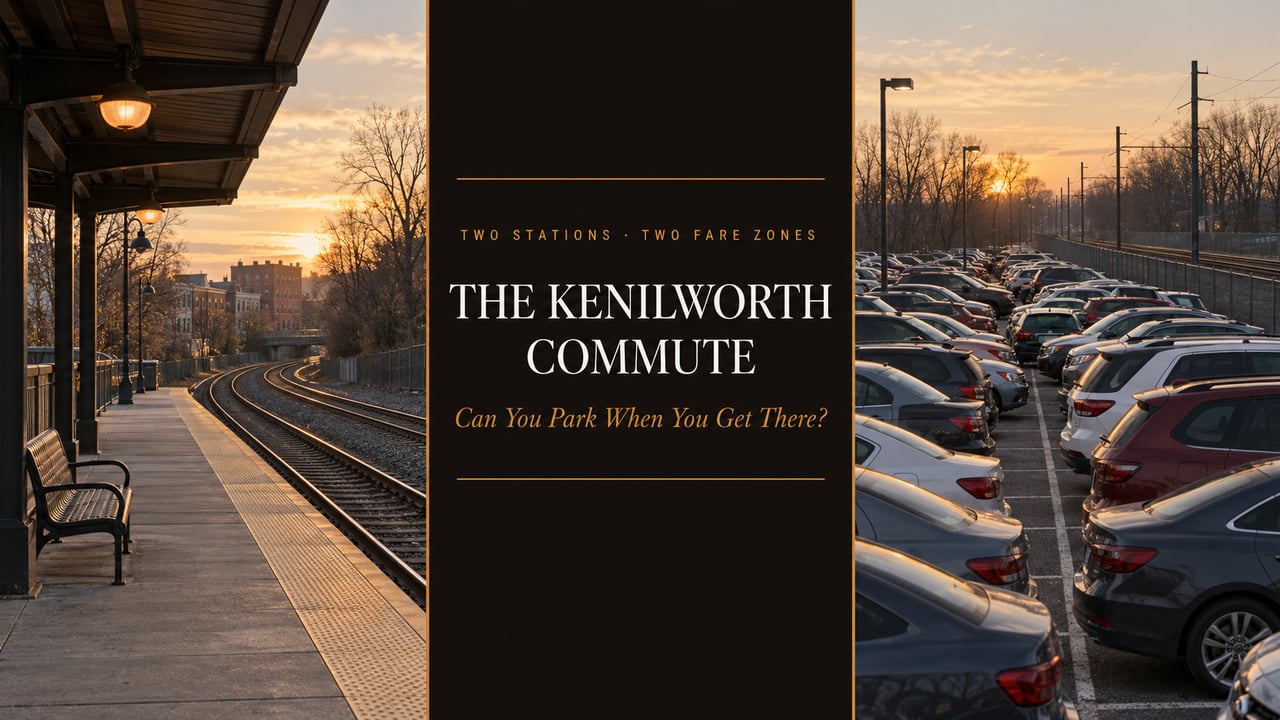
Every guide to Kenilworth — including ours — tells you the borough sits four to six minutes from a train station. That is true, and it is not the number that decides anything. The number that decides it is whether you can park when you get there.
Kenilworth has two usable Raritan Valley Line stations within a short drive — and they are not interchangeable. Roselle Park sits in fare zone 6, Cranford in zone 7, so the closer-in station is also the cheaper ticket. Cranford is ADA accessible; Roselle Park is not. Roselle Park has 192 spaces total. Cranford publishes a 12-hour commuter permit at $610 a year — explicitly available to non-residents at the same price as residents, which is genuinely unusual in New Jersey. But permits carry a waiting list, and that is the fact that decides whether a Kenilworth address works for a rail commuter. Ask about the list before you make an offer, not after.
Parking rules, permit fees, waiting lists, fare zones and schedules all change, and some of what follows is time-sensitive. Verify every figure here directly with the Township of Cranford, the Borough of Roselle Park and NJ Transit before relying on it. This is general information, not advice.
Kenilworth's two nearest Raritan Valley Line stations are Cranford and Roselle Park. Both are a short drive. Beyond that they differ in ways that matter every working day for as long as you own the house.
Two side platforms, two tracks · accessible · bike facilities available
Bus connections: 59 and 113, plus Olympia Trails Westfield Commuter Service
Ticket office 6:00 AM – 1:30 PM weekdays, closed weekends
Roughly 728 average weekday boardings (2024)
A walkable downtown at the platform — coffee, shops, and somewhere to wait
One island platform, two tracks · 17.2 miles from New York Penn Station
192 parking spaces (190 standard, 2 accessible) · bike racks and lockers available
Not ADA accessible — a real constraint for some travellers
Bus connections: 94 and 113
Ticket office 6:00 AM – 9:30 AM weekdays only, closed weekends
Roughly 600 average weekday boardings (2024)
Roselle Park is fare zone 6. Cranford is fare zone 7. NJ Transit prices by zone, so the same trip from the closer-in station costs less — and on a monthly pass, over years of commuting, that gap compounds into real money. Almost nobody raises this when comparing the two, because most people compare drive times and stop there. Pull the current fares for both zones from NJ Transit and run your own arithmetic before you assume the nearer or nicer station is the right one.
The accessibility difference deserves equal weight and gets even less attention. Cranford is accessible; Roselle Park is not. If anyone in the household uses a wheelchair, travels with a stroller regularly, or would struggle with stairs, that single fact removes one of the two stations from your list entirely — and it will not appear in any listing description of a Kenilworth house.
Here is where the Kenilworth commute is actually won or lost, and it has nothing to do with the four-minute drive. A station you can reach quickly but cannot park at is not a station you can use. So the real question for anyone buying here is: can I get a permit, and how long is the wait?
12-hour permits — $610 annually, $310 bi-annually, plus a $10 administrative fee per permit
Available to residents and non-residents at the same price
Locations include Lot 2 (2 South Avenue West), the Municipal Parking Garage levels 2, 5 and 6, Lot 4 (201 East South Avenue), Lot 6 (41 High Street), and on-street at Chestnut Street and West South Avenue
9-hour permits also available for Lots 1, 3, 7, 11, 14, the garage, and on-street at Eastman and Miln Streets
Permits sold annually or semi-annually; payment online by credit card
That non-resident provision is genuinely unusual, and it is the strongest single fact in favour of a Kenilworth address. Across New Jersey's commuter towns the norm is the opposite: published guidance for comparable Midtown Direct municipalities notes that Chatham Borough issues station permits to residents only and that non-residents cannot buy annual commuter permits in Maplewood. Cranford's schedule sets one price "for residents and non-residents." A Kenilworth commuter is not, on the face of the published rules, a second-class applicant.
Cranford permits have been reported to carry a waiting list, with one real-estate account citing a conversation with the Police Records Department describing an expected wait of roughly one and a half to two years. That figure dates from 2020 and we are not republishing it as current — six years is far too long for a queue length to survive unchanged, in either direction.
What matters is that a list exists at all, because it converts "four minutes from a station" into "four minutes from a station, once a permit comes available." Call the Cranford Police Department Records Division and ask two questions: is there currently a waiting list for 12-hour commuter permits, and how long is it? Five minutes on the phone, and it is the single most decision-relevant fact about a Kenilworth purchase for a rail commuter.
And ask the same about Roselle Park, where the constraint is arithmetic rather than administrative. The station has 192 spaces in total. That is not a large number, and it is shared among Roselle Park's own commuters and everyone driving in from surrounding towns. Confirm with the Borough what is permit-only, what is daily, and how early the lot fills — a first-come lot that is full by 7:15 is functionally a lot you do not have.
If you already hold a Cranford commuter permit, that is a marketing asset — and almost no Kenilworth listing mentions it.
Rail-commuting buyers looking at Kenilworth have one live worry, and it is parking. A seller who can say precisely which station they use, what the permit costs, and how the queue worked for them removes that worry in a sentence. Confirm whether a permit can transfer or whether the buyer starts fresh — the answer is worth knowing before the first showing. We price from recent closed sales rather than an estimate running six figures behind, and bring the New York metro buyer pool that cares most about exactly this. Backed by 22 years and 5,000 transactions across both sides of the Hudson.
The rail conversation dominates, and it obscures the option that solves the parking problem entirely.
Route 113 runs along the Boulevard in Kenilworth to the Port Authority Bus Terminal — no drive, no permit, no queue. And note that 113 also serves both Cranford and Roselle Park stations, so it functions as a rail feeder as well as a direct Manhattan connection. For a Midtown destination, this deserves a serious look before you assume rail is the answer; for anyone bound for downtown, rail via Newark will usually win. Check current schedules and journey times with NJ Transit — bus timings vary far more with traffic than rail does.
Route 94 serves Roselle Park station alongside 113. Separately, Olympia Trails' Westfield Commuter Service connects at Cranford station — a private operator running alongside NJ Transit. Both are worth pricing against a rail pass, particularly if your Manhattan destination is closer to the bus terminal than to Penn Station.
Garden State Parkway Exit 138 sits inside the borough, with Route 22 along the northern edge. That is highway access most Union County towns would trade for, and it is the single clearest reason a driving commuter should look here rather than at the rail towns. For anyone not boarding a train, Kenilworth's supposed weakness is not a weakness at all.
Which reframes the whole question. Kenilworth is not a town with a commuting problem — it is a town whose commute is unusually varied: two rail stations in two fare zones, a direct bus to Port Authority from a stop in the borough, a private commuter coach, and a Parkway exit at home. The work is matching the option to your actual destination and schedule, and it rewards fifteen minutes of arithmetic more than almost any other Union County town.
Route 113 leaves from the Boulevard and arrives at Port Authority. No parking permit, no queue, no second vehicle. If your office is walkable from the bus terminal, this may beat rail outright — and it is the option that makes a five-day Kenilworth commute work without waiting for a permit.
Rail is your route, so parking is your gating factor. Call Cranford about the 12-hour permit list and Roselle Park about daily availability before you write an offer, not during attorney review. If both answers are discouraging, that is worth knowing while you can still walk away.
Daily parking rather than an annual permit becomes viable at two or three trips a week, and the arithmetic that makes the borough a value play holds. This is the buyer Kenilworth suits best, and the case is worked through in our Kenilworth and Cranford comparison.
Parkway Exit 138 is inside the borough and Route 22 is on the edge. You are buying the best road access in the price band and paying nothing for a platform you will never use. Take the savings.
Whichever applies, do the trip once before you commit. Drive from the house to the station you would use, at the hour you would use it, and try to park. Then ride the line to your actual office and walk the last stretch. An hour and a half on a weekday morning answers a question that no article, including this one, can answer for you — and it is the cheapest diligence available on a purchase this size.
Borough context sits in our Kenilworth guide, the tax picture in our property tax breakdown, and the wider county ladder — which this station question largely explains — in Union County by Price.
Ask the seller which station they use and whether they hold a permit — then ask what happens to it at closing. Commuter permits are typically issued to a person and a vehicle rather than attached to a property, so a buyer usually starts at the back of the queue no matter how long the seller has held theirs. That is not a reason to avoid the house; it is a reason to know before you plan your first commute around a permit you may not have for months. Confirm the transfer rules with the issuing municipality — and if the answer is that you start fresh, price the daily-parking or bus alternative into your first year rather than discovering it in week one.
"Everyone says Kenilworth is four minutes from a train. I've said it myself. But a station you can't park at isn't a station — and Cranford permits have had a waiting list. Here's what nobody tells you though: Cranford sells those permits to non-residents at the same price as residents, six-ten a year. That's rare. Chatham won't do it, Maplewood won't do it. Kenilworth commuters aren't second in line on the published rules — they're just in the same queue. Two other things people miss. Roselle Park's a cheaper fare zone than Cranford, which is money every single month. And Roselle Park isn't accessible, which for some families ends the conversation. Then there's the one I'd check first — the 113 bus runs down the Boulevard straight to Port Authority. No permit, no parking, no queue. If you work near the terminal, do that math before you do any other."
— Anthony Licciardello, Broker, The Prodigy Team

Commuting is where a New York buyer's decision actually gets made, and I work both sides of it: I'm Anthony Licciardello, Broker of The Prodigy Team, dual-licensed in New York and New Jersey, a former Director of Community Affairs in the Bloomberg Administration, and a leading broker for cross-border New York–New Jersey transactions.
Anthony Licciardello · Broker, The Prodigy Team · 718-873-7345
We make the parking calls before you make an offer — not during attorney review.
Which train station do Kenilworth residents use?
Kenilworth has no station of its own. The two nearest Raritan Valley Line stations are Cranford (South Avenue at High Street, fare zone 7, two side platforms, ADA accessible, bike facilities, buses 59 and 113 plus the Olympia Trails Westfield Commuter Service) and Roselle Park (West Lincoln Avenue at Chestnut, fare zone 6, one island platform, 192 parking spaces, not accessible, buses 94 and 113). Roselle Park sits one fare zone closer in, so the same trip costs less — worth pricing before choosing.
Can a Kenilworth resident get a Cranford station parking permit?
On the published rules, yes — and at the same price as a Cranford resident. The Township's parking schedule lists 12-hour permits at $610 annually or $310 bi-annually "for residents and non-residents", plus a $10 administrative fee, covering lots, the municipal garage and certain on-street locations. That is unusual in New Jersey, where comparable commuter towns often restrict annual permits to residents. However, permits have been reported to carry a waiting list — call the Cranford Police Department Records Division to confirm current availability and queue length before relying on one.
Can you commute from Kenilworth to Manhattan without a car?
Yes. NJ Transit bus route 113 runs along the Boulevard in Kenilworth to the Port Authority Bus Terminal — no drive, no parking permit, no waiting list. Route 113 also serves both Cranford and Roselle Park stations, so it doubles as a rail feeder. For a Midtown destination the bus deserves serious consideration before rail; for downtown, rail via Newark usually wins. Bus journey times vary with traffic far more than rail does — check current schedules with NJ Transit.
Is Kenilworth good for a driving commuter?
Unusually so. Garden State Parkway Exit 138 sits inside the borough and Route 22 runs along the northern edge — highway access most Union County towns would trade for. For anyone who does not board a train, the absence of a station costs nothing while the price advantage remains. The premium other towns charge is for a platform a driving commuter will never use.
What You're Actually Buying in Kenilworth — Four House Types
Moving to Kenilworth — The Value Play With No Train Station
Kenilworth Property Taxes — Why the Rate Looks Alarming
Kenilworth Schools — The District Other Districts Send To
Kenilworth vs. Cranford — Three Answers to One Question
Selling a Home in Kenilworth — One Call, and Four Rules
Kenilworth Homes for Sale — Browse Current Listings
Details as of publication, from the sources noted, and subject to change without notice. Cranford Station: South Avenue (CR 610) and High Street, Raritan Valley Line, fare zone 7, two side platforms and two tracks, accessible, cycle facilities available, NJ Transit bus connections 59 and 113 plus Olympia Trails Westfield Commuter Service, approximately 728 average weekday passengers in 2024; ticket office hours per NJ Transit 6:00 AM–1:30 PM Monday–Friday, closed weekends. Roselle Park Station: West Lincoln Avenue and Donald Place (NJ Transit lists Chestnut and Lincoln), fare zone 6, 17.2 miles from New York Penn Station, one island platform and two tracks, 192 parking spaces (190 standard, 2 accessible), not accessible, bike racks and lockers available, NJ Transit bus connections 94 and 113, approximately 600 average weekday passengers in 2024; ticket office hours per NJ Transit 6:00 AM–9:30 AM Monday–Friday, closed weekends. Cranford parking: per the Township of Cranford's published parking information, 12-hour permits are available at Lot 2 (2 South Avenue West), Municipal Parking Garage levels 2, 5 and 6, Lot 4 (201 East South Avenue), Lot 6 (41 High Street) and on-street at Chestnut Street and West South Avenue, and 9-hour permits at Lots 1, 3, 7, 11 and 14, the garage, and on-street at Eastman Street and Miln Street; permits are sold annually or semi-annually with a yearly cost of $610 ($310 bi-annual) "for residents and non-residents in lots, garage, and on the street," payable online by credit card, with an administrative fee of $10 per permit assessed for 2022 and subsequent years per Chapter 410, Article V of the Township Code. Residential permit parking on designated streets is separate, free to residents of those streets, and not valid in other zones. ⚠️ Waiting list: a real-estate account citing a February 2020 conversation with the Cranford Police Records Department described an expected commuter permit waiting list of approximately 1.5 to 2 years. That figure is from 2020 and is NOT represented here as current; it is cited only as evidence that a waiting list mechanism exists. Confirm current availability and queue length directly with the Cranford Police Department Records Division. Comparative non-resident permit practice in other New Jersey commuter municipalities — including that Chatham Borough issues station permits to residents only and that non-residents cannot purchase annual commuter permits in Maplewood — is drawn from a January 2026 published guide to resident and non-resident train parking and should be confirmed with those municipalities directly. Kenilworth is served by NJ Transit bus route 113 along the Boulevard to the Port Authority Bus Terminal, and has Garden State Parkway Exit 138 within the borough with Route 22 along its northern edge. NJ Transit notes that parking information for locations it does not own is provided for general information and is subject to change, and recommends contacting local parking operators to verify rates and hours in advance. Fares, zones, schedules, permit fees, waiting lists, parking availability and accessibility status change; no commute time, fare, permit availability or parking outcome is promised. This is general information and market commentary, not legal, financial or transportation advice — verify all current details with NJ Transit, the Township of Cranford, the Borough of Roselle Park and the Borough of Kenilworth before relying on them.
Prodigy Real Estate is an innovative real estate company offering high-end video production, home valuation services, purchasing, and home sales. Serving New York and New Jersey.