
Anthony Licciardello | August 17, 2026
Island Heights, NJ
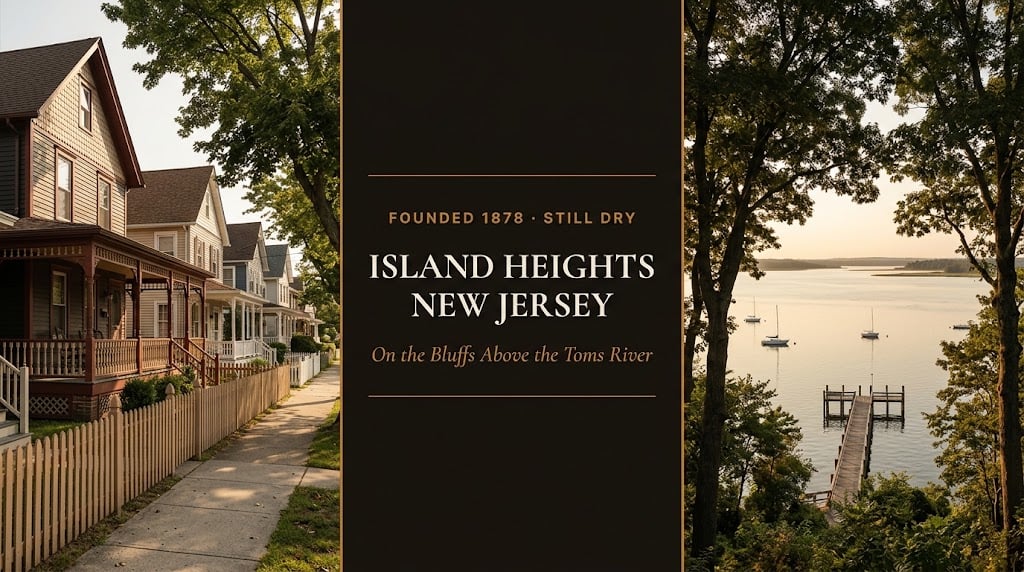
In 1878 a Methodist minister bought an island of bluffs at the mouth of the Toms River, laid out a camp meeting ground, and wrote a prohibition on liquor into every deed he sold. Nearly a century and a half later, Island Heights is still a dry town — and many of those deeds still carry the clause. This is the most unusual borough on the corridor, and the one where the history is not decoration but the actual product you're buying.
Three things. The origin: in 1877 the Reverend Jacob B. Graw looked across the Toms River from its southern shore, saw the bluffs opposite, and decided they would make a camp meeting site. He enlisted twelve fellow ministers and seventeen businessmen; the Island Heights Association was incorporated July 1, 1878; it bought 172 acres on capital of $9,000, cleared ten acres atop the bluffs, and held its first camp meeting that August — more than 1,500 people arriving by horse and buggy and chartered boat. The covenant: Graw intended a Christian family resort under temperance influences, and the Association wrote a liquor prohibition into every deed of sale. Many deeds in Island Heights still contain that restriction, and the borough remains dry today — including within a mile and a half of the old camp ground. The market: the borough's median house or condo value stood near $621,601 in 2024, up from $168,200 in 2000, making it the most valuable of the corridor's small boroughs. What you are actually buying here is a 375-structure historic district, built almost entirely within twenty-five years of 1878 and nominated to the National Register in 1982 — a resort town preserved nearly whole, on the highest ground on this stretch of shore.
Island Heights is the outlier of the boroughs covered in our Route 9 corridor guide — not a Toms River Regional member town, not a conventional suburb, and not comparable to its neighbours on most measures. Deed restrictions, historic-district rules and school arrangements are property-specific and change; verify everything current with the borough, your title company and your attorney.
The ground was significant long before the camp meeting. Lying on the north side of the Toms River at the mouth of Barnegat Bay, it formed part of a 1690 land patent to John Johnston, a Proprietor of East Jersey — and, separated from the mainland by a creek, it became known as Dr. Johnston's Island. A 1748 survey recorded it as Toms River Island.
In 1762 the island was bought by the Dillon family, British sympathizers whose son William led the Tory attack on the Toms River Block House in 1782 — one of the last actions of the Revolution on this coast. After the war the Dillons fled to Canada, and the 320-acre island was divided into three tracts. The Dillon house still stands, considerably altered, and Dillon's Creek runs through the north-central part of the borough carrying the name. The island stayed largely in its natural state through the mid-1800s.
One geographic footnote worth knowing, because it connects this borough to the barrier island: the property was separated from the mainland by a northern channel before the Cranberry Inlet closed — the same vanished inlet that shaped the history of Ortley Beach, covered in our Ortley Beach guide. The coastline here has been rearranging itself for a very long time.
In 1877, the Reverend Jacob B. Graw — Presiding Elder of the New Brunswick District of the Methodist Church — stood on the southern shore of the Toms River, looked across at the bluffs opposite, and concluded they would make an ideal camp meeting site and summer resort. He moved quickly, enlisting twelve additional ministers of the New Jersey Conference of the Methodist Episcopal Church and seventeen prominent businessmen from Philadelphia, Camden, Mount Holly, Trenton and Toms River.
On July 1, 1878 they incorporated as the Island Heights Association. With capital of $9,000 the Association bought 154 acres from the Brinleys and 18 acres from the Westray estate — 172 acres in all — then staked out a ten-acre plot atop the bluffs, cleared it, and opened two roads to reach it. That August the first camp meeting was held under the direction of Rev. Samuel Van Sant, and more than 1,500 people came, by horse and buggy and by chartered boat. On August 20, 1878, one hundred lots sold, producing $10,000 — all of it spent improving the campground. The Association went on to build docks, roads, an auditorium, and a railroad station and trestle for the Pennsylvania Railroad's extension.
Graw's stated intention was a Christian family resort under temperance influences. He was, by his son's account, an indefatigable advocate of temperance — holding annual temperance meetings for a week after each camp meeting and editing a widely circulated weekly paper on the subject.
So the Association included in every deed of sale a clause prohibiting the use of liquor. Many deeds in Island Heights today still contain that restriction, and the sale of alcohol remains forbidden in the borough and within a mile and a half of the camp ground — a practice shared with other Methodist-founded towns in New Jersey.
For a buyer this is not trivia, it is title. If you are purchasing here, have your attorney and title company review the deed restrictions on the specific parcel — what they say, whether they are enforceable, and what if anything they affect beyond alcohol. It takes one review and it is the single most Island-Heights-specific item on any diligence list.
The rest followed quickly. The first permanent house went up in 1879, built by Rev. Van Sant. The cornerstone of the First Methodist Church was laid in 1882. And in 1887, Island Heights became a borough.
Island Heights carries the highest housing values of the corridor's small boroughs. Census-derived estimates put the median house or condo value at approximately $621,601 in 2024, against $168,200 in 2000. Mean values across all housing units ran about $559,954, with detached houses averaging $610,540. Median gross rent was roughly $1,798, and the borough's cost-of-living index sat at 119.1 — above the national average.
Two notes on reading those figures. First, these are estimated values across the housing stock, not transacted sale medians — a different measurement from the sale prices we publish for Beachwood, Pine Beach and Toms River Township, and not directly comparable to them. Second, in a borough this small, transaction counts are low enough that any published sale median deserves the same sample-size scrutiny we apply across this cluster.
Why the values sit where they do is not mysterious. The borough is small, effectively built out since the early twentieth century, sits on the highest ground on this stretch of shore, and holds a nearly intact Victorian resort townscape with water on multiple sides. There is no mechanism by which meaningful new supply arrives. Scarcity of that kind, applied over decades, produces exactly the curve from $168,200 to $621,601 — and it is the same structural logic that makes tiny Pine Beach outprice the county seat.
You own inside a 375-structure historic district that cannot be replicated. That is the listing — and most marketing here buries it.
Island Heights sells on architecture, water and scarcity, not square footage — and it draws a buyer who is looking specifically for it. Get a valuation matched on period, position and condition, plus marketing that puts the history and the setting where they belong: at the front. Backed by the New York metro buyer pool we bring to every listing.
The historic district. Island Heights is described as a highly intact community of primarily residential buildings, the majority of its 375 structures built within a quarter century of its 1878 founding. Those structures were nominated for the National Register of Historic Places in 1982. That concentration — a Victorian camp-meeting resort still substantially as built — is the borough's defining asset and the reason its housing does not behave like its neighbours'. Buyers should confirm what historic-district designation means for a specific property: what review applies to exterior work, what does not, and how it interacts with renovation plans.
The artists' town. The quiet setting drew painters. John Frederick Peto first came in the summer of 1889 — he played the cornet at a Methodist camp meeting — and later settled here; his studio survives today as the John F. Peto Studio Museum. The Cottage Museum preserves an early camp-meeting-era cottage. For a borough of this size, that is an unusual density of cultural institutions, and it is part of what the buyer here is paying for.
The water, and a boast worth repeating. By the early 1920s the borough was promoting itself as a modern resort free of noisy seaside amusements — a local board of trade pamphlet advertised splendid roads, concrete sidewalks, a boardwalk, electric lights and gas, an excellent water supply and a sewer system, and claimed more public docks than any other community in the state. The waterfront orientation that produced that claim still defines the place, at the mouth of the Toms River where it opens toward Barnegat Bay.
Two practical points. First, the borough is dry — no alcohol sales within it. Whether that is a feature or a friction is personal, but it should not be a surprise found after closing. Second, Island Heights is not one of the four Toms River Regional member towns covered in our four-towns guide; its school arrangements differ and should be confirmed directly with the borough and the relevant district for any specific address rather than assumed from a neighbouring town. And because much of the borough sits close to the water, the flood-zone and elevation check in our flood guide belongs on every purchase here.
Read the deed before you read the inspection report. Island Heights is the rare American town where a covenant written in 1878 may still be sitting in your chain of title — the Association put a liquor prohibition into every deed it sold, and many of those deeds still carry it. That specific clause is unlikely to affect how you live. But a property whose deed contains one nineteenth-century restriction may contain others, and a historic-district property may carry review obligations on top of them. Have your attorney pull and read the full restrictions on the parcel, not just the survey. In most towns that is thoroughness. Here it is the actual job.
"I've worked this whole corridor and Island Heights is unlike anything else in it. A minister stood on the far bank in 1877, liked the look of the bluffs, and by the next August fifteen hundred people were arriving by boat and buggy for a camp meeting. He wrote a temperance clause into every deed, and the town is still dry today. Three hundred and seventy-five buildings, most of them up within twenty-five years of the founding, and no way to add more. That's not charm — that's a supply constraint with a hundred and fifty years of history behind it. When I list here I don't lead with square footage. Nobody buying in Island Heights is counting square feet."
— Anthony Licciardello, Broker, The Prodigy Team
Historic property, deed restrictions and scarcity-driven pricing are exactly the work I do: I'm Anthony Licciardello, Broker of The Prodigy Team — dual-licensed in New York and New Jersey, a former Director of Community Affairs in the Bloomberg Administration, and a leading broker for cross-border New York–New Jersey transactions, bringing the New York market to New Jersey sellers.
Our Above the Streets cinematic drone series is made for a town like this one — where the bluffs, the water and the intact streetscape are the whole story.
Anthony Licciardello · Broker, The Prodigy Team · 718-873-7345
We read the deed restrictions, comp on period and position, and market the history where buyers can see it.
Is Island Heights, NJ a dry town?
Yes. The borough was founded in 1878 as a Methodist camp meeting resort under temperance influences, and the Island Heights Association wrote a clause prohibiting the use of liquor into every deed of sale. Many deeds in Island Heights still contain that restriction, and the sale of alcohol remains forbidden in the borough and within a mile and a half of the camp ground. Buyers should have an attorney review the specific deed restrictions on any parcel.
How was Island Heights founded?
In 1877 the Reverend Jacob B. Graw, Presiding Elder of the New Brunswick District of the Methodist Church, selected the bluffs on the north side of the Toms River as a camp meeting site. He enlisted twelve fellow ministers and seventeen businessmen, and on July 1, 1878 they incorporated the Island Heights Association. With $9,000 in capital it bought 172 acres, cleared ten acres atop the bluffs, and held its first camp meeting that August — more than 1,500 people arriving by horse and buggy and chartered boat. Island Heights became a borough in 1887.
How much do homes cost in Island Heights?
Census-derived estimates put the borough's median house or condo value near $621,601 in 2024, up from $168,200 in 2000, with mean values across all housing units around $559,954 and detached houses averaging $610,540. Median gross rent was roughly $1,798. Note these are estimated values across the housing stock rather than transacted sale medians, and are not directly comparable to sale prices published for neighbouring towns.
What is the Island Heights Historic District?
Island Heights is a highly intact community of primarily residential buildings, the majority of its 375 structures built within a quarter century of the borough's 1878 founding, and nominated for the National Register of Historic Places in 1982. The borough also holds the John F. Peto Studio Museum — painter John Frederick Peto first came in the summer of 1889 — and the Cottage Museum. Buyers should confirm what historic-district designation means for a specific property before planning exterior work.
What You Can and Can't Do to a House in Island Heights
The Route 9 Corridor — Five Boroughs, Six Cores
The Four Towns of Toms River Regional
Pine Beach — The Smallest Town That Outprices the County Seat
South Toms River — The District's Entry Point
Moving to Toms River — The Complete Township Guide
Toms River Homes for Sale — Browse Current Listings
Details as of publication for Island Heights Borough, Ocean County, NJ, from the sources noted. Early history: the island described as lying on the north side of the Toms River at the mouth of Barnegat Bay, forming part of a 1690 land patent to John Johnston, a Proprietor of East Jersey, and becoming known as Dr. Johnston's Island; recorded as Toms River Island in a 1748 survey; purchased in 1762 by the Dillon family, British sympathizers whose son William led the Tory attack against the Toms River Block House in 1782, after which the family fled to Canada and the 320-acre island was divided into three tracts; the Dillon house still standing though considerably altered, with Dillon's Creek running through the north-central portion of the borough; and the property separated from the mainland by a northern channel before the Cranberry Inlet closed — per the John F. Peto Studio Museum, the Borough of Island Heights, and Living Places. Founding: the Reverend Jacob B. Graw, Presiding Elder of the New Brunswick District of the Methodist Church, selecting the site in 1877 after viewing the bluffs from the southern shore of the Toms River, and enlisting twelve additional ministers of the New Jersey Conference of the Methodist Episcopal Church together with seventeen prominent businessmen from Philadelphia, Camden, Mount Holly, Trenton and Toms River; the Island Heights Association incorporated July 1, 1878; the Association purchasing 154 acres from the Brinleys and 18 acres from the Westray estate — 172 acres — with capital of $9,000, staking out and clearing a ten-acre plot atop the bluffs and opening two roads to it; the first camp meeting held in August 1878 under the direction of Rev. Samuel Van Sant, attended by more than 1,500 people arriving by horse and buggy and chartered boat; 100 lots sold August 20, 1878 producing $10,000 applied to campground improvements; the Association building docks, roads, an auditorium, and a railroad station and trestle for the Pennsylvania Railroad extension; the first permanent house built in 1879 by Rev. Van Sant; the cornerstone of the First Methodist Church laid 1882; and borough status in 1887 — per the Borough of Island Heights, the Cottage Museum, Living Places and the Island Heights Historic District record. Temperance: Graw described as intending a Christian family resort under temperance influences, holding annual temperance meetings for a week after each camp meeting and editing a widely circulated weekly temperance paper; the Association including in every deed of sale a clause prohibiting the use of liquor, with many deeds in Island Heights today still containing that restriction; and the sale of alcohol remaining forbidden in the borough and within one and a half miles of the camp ground. Historic district and culture: the borough described as a highly intact community of primarily residential buildings with the majority of its 375 structures built within a quarter century of its 1878 founding, nominated for the National Register of Historic Places in 1982; painter John Frederick Peto first arriving in the summer of 1889 and playing the cornet at a Methodist camp meeting, with his studio now the John F. Peto Studio Museum; the Cottage Museum preserving an early camp-meeting-era cottage; and an early-1920s local board of trade pamphlet advertising splendid roads, concrete sidewalks, a boardwalk, electric lights and gas, an excellent water supply and a sewer system, and claiming more public docks than any other community in the state — per the Historic American Buildings Survey record (HABS No. NJ-1018) and the sources above. Market figures: census-derived estimates of a median house or condo value of approximately $621,601 in 2024 against $168,200 in 2000; mean values of approximately $559,954 across all housing units and $610,540 for detached houses; a median gross rent of approximately $1,798; and a December 2024 cost of living index of 119.1 — per City-Data. These are estimated values across the housing stock rather than transacted sale medians, and are not directly comparable to sale-price figures published for neighbouring municipalities. Island Heights is not one of the four member towns of Toms River Regional Schools; school arrangements differ and should be confirmed directly with the borough and the relevant district for any specific address. Deed restrictions, historic-district review requirements, flood zone status, assessments and tax bills are property-specific, change over time, and must be verified for any particular parcel. All figures are point-in-time; values and estimates are not appraisals; and no value, price, or outcome is promised. This is general information and market commentary, not legal, title, tax, or investment advice — verify all current details with the Borough of Island Heights, your title company, your attorney and your own professionals before buying or selling.
Prodigy Real Estate is an innovative real estate company offering high-end video production, home valuation services, purchasing, and home sales. Serving New York and New Jersey.