
Anthony Licciardello | August 16, 2026
Toms River, NJ
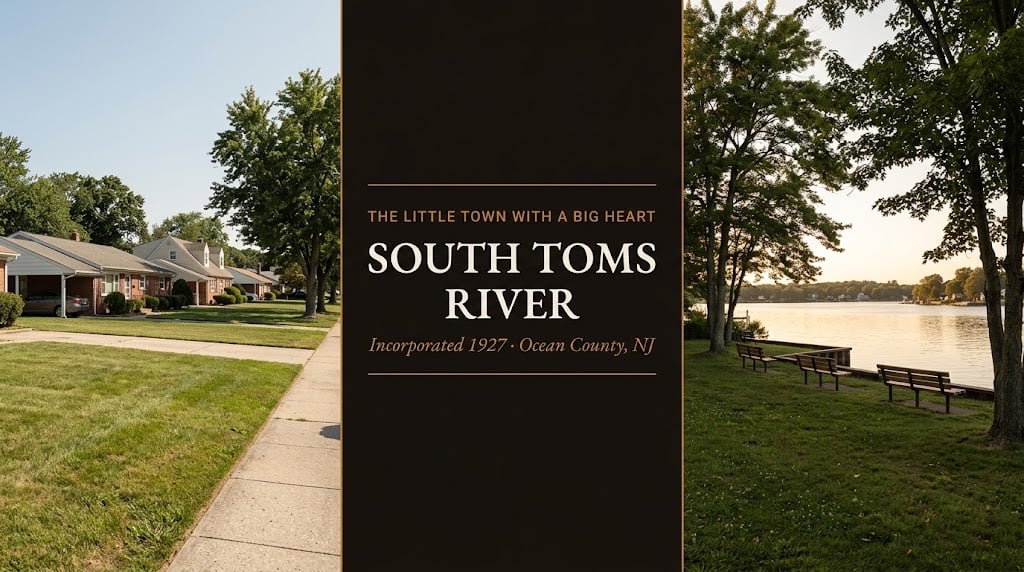
South Toms River is the entry point to the Toms River Regional school district — the most affordable of its four member towns, and the one carrying the highest tax rate. It also has the thinnest transaction data of the four. That combination means something specific for anyone buying or selling here: the arithmetic matters more in this borough than anywhere else in the corridor, and almost nobody does it.
South Toms River is the most affordable of the four Toms River Regional towns and carries the highest general rate of them — 3.170 per $100 against Toms River Township's 1.681 — plus the steepest school levy increase, 11.4% against 4.9% district-wide. Buyers get the same three high schools as the county seat at the district's lowest entry price, and pay for it in carrying cost. The place: 1.16 square miles and 3,643 residents on the Toms River, incorporated 1927 from Berkeley Township, motto on the seal — "The Little Town With a Big Heart." And a data problem worth stating: this borough has the least usable transaction record of the four, which is why the actual tax bill on the actual parcel is the only number worth acting on here.
South Toms River is the fourth municipality in our Toms River Regional four-towns guide, and the least covered of them anywhere. Figures carry their sources and their sample sizes; where the data is too thin to price against, we say so plainly rather than publishing a number that looks more solid than it is.
South Toms River occupies 1.21 square miles total — 1.16 of land and about 0.05 of water — placing it 485th of New Jersey's 565 municipalities by area and 21st of 33 in Ocean County. Its population was 3,643 at the 2020 census, down 41 (−1.1%) from 3,684 in 2010, which had itself risen 50 (+1.4%) from 3,634 in 2000; a 2023 estimate puts it at 3,736. Elevation is 52 feet. Dover Road, County Route 530, runs through it.
The borough sits on the Toms River between Toms River Township and Beachwood, which gives it something the map doesn't immediately show: river frontage and access toward Barnegat Bay without barrier-island pricing. Mathis Park is the borough's outlook on the water, with river views and — in season — an ice cream truck that has become a local fixture. For boating and water access at the low end of the corridor's price range, that combination is the borough's clearest advantage.
The housing is consistent, which helps enormously in a market this small. South Toms River is predominantly ranch-style homes with occasional Cape Cods — a stock that reflects its build-out era and makes matched comparison unusually clean when you can find the comps. There is no meaningful subdivision of the borough into named sections; analytically it functions as a single neighborhood, which is both a simplification and, as Chapter III explains, part of the data problem.
The corridor's small boroughs all trace back to the same sequence — transportation, then speculation, then independence — and South Toms River is the clearest example. Its story begins in the Gilded Age, and the hinge is 1881, when the railroad arrived. Rail access is what turned this stretch of ground from farmland into something a developer could sell, and the payoff came four decades later during the suburban boom of the 1920s, when the area became prime real estate.
Independence followed the growth. South Toms River was incorporated as a borough in 1927 from portions of Berkeley Township — the same parent municipality that gave up land for Beachwood in 1917 and Pine Beach in 1925. (The record carries two dates: a legislative act of March 28, 1927 and a referendum of May 3, 1927; sources present them in that order, and we reproduce both rather than choosing.)
Read the three boroughs together and a pattern emerges. Berkeley Township shed Beachwood in 1917, Pine Beach in 1925 and South Toms River in 1927 — three independent municipalities carved out of one township inside a decade, each on the back of the same early-century development wave. That is why the corridor today contains so many small governments with their own tax rates sharing a single school district, and it is the historical root of the rate spread documented in our four-towns guide.
Here is the four-town picture with South Toms River in it, and an honest account of what we can and can't establish:
3,643 residents · 1.16 mi² · the district's entry point and its highest rate
10,859 residents · 2.76 mi² · average sale $480,207, about 30 days on market
95,438 residents · 40.7 mi² · the county seat, lowest rate of the four
2,139 residents · 0.64 mi² · the smallest town and the highest median
The best figure available puts a South Toms River median sale price near $422,247 for May 2026, down about 1.8% year over year. A separate reading of single-story inventory showed a $377,000 listing median across three listings at 36 days, with two homes sold in the prior month.
Neither is a level you can price against. Under the sample-sufficiency rule we apply across this cluster — under roughly ten sales, a median is an anecdote — both are directional signals only. South Toms River has the least usable transaction record of the four member towns, and unlike Beachwood and Pine Beach, we have not found a source with an annual sample worth anchoring to.
What that means practically: automated valuations here are averaging a handful of transactions and will swing hard on a single unusual sale. Use matched comparable sales — same street pattern, same vintage, same condition, same water status — or pull current Ocean County MLS data for your specific band. Do not accept a website's number.
The rate caveat matters as much here as anywhere. General rates are struck against assessed value, not market value, and are not directly comparable across municipalities whose equalization ratios differ. Treat the 3.170 as directional evidence that South Toms River carries the heaviest burden of the four, not as a precise multiple of Toms River's 1.681. The number that pays is the actual bill on the actual parcel.
And the school levy compounds it. As our schools guide documents, the 2026-27 regional levy rose 4.9% district-wide but 11.4% in South Toms River, which carried a deferred increase from the prior year — roughly $20.64 more per month on a home assessed at $171,200. Same district, same schools, and more than double the increase.
Your buyer gets the same three high schools as the county seat — at the lowest entry price in the district. Almost no listing here says that.
This is the borough where automated estimates are least reliable, because they're averaging a handful of sales. Get a valuation built on matched comparable sales and a listing plan that states the shared-district advantage plainly — it's the strongest argument your address holds, and it's routinely left unsaid. Backed by the New York metro buyer pool we bring to every listing.
Buyers: the trade here is explicit and worth stating clearly — the lowest entry price of the four member towns, the same three high schools, and the highest carrying cost. That can be a good deal or a poor one depending entirely on the specific parcel, which is why the single most valuable thing you can do in this borough is pull the actual current tax bill from the tax record before you write an offer. Not a rate multiplied by a price. Not an online estimate. The bill. Given a general rate of 3.170 and a school levy that just rose 11.4%, that document changes offers here more often than it does anywhere else in the corridor.
Sellers: your strongest argument is the one your listing probably doesn't make. A buyer in South Toms River gets Toms River Regional Schools — the same district, the same three high schools, the same teachers as an address in the county seat — at the district's most accessible price point. That is a factual, defensible, and genuinely appealing pitch, and it reframes the conversation away from the tax rate and onto what the household actually receives. Say it explicitly.
Everyone: because the borough functions as a single neighborhood with consistent ranch-and-Cape housing stock, matched comparison is actually easier here than in a town with several submarkets — if you can find recent sales. When you can't, widen the window to trailing twelve months rather than reaching for an automated figure. And add the river to your diligence: parts of the borough sit near the water, which makes the flood-zone check in our flood guide a required step. Township context sits in our complete guide, and current inventory on our listings page.
Run the four-town comparison on monthly cost, not purchase price — it is the only way to see this borough clearly. Take a South Toms River house and a comparable one in Toms River Township, and build both all-in monthlies: principal and interest, the real tax bill from each parcel's record, insurance quoted on each structure. Sometimes the lower purchase price still wins comfortably. Sometimes the rate closes the whole gap and the county seat is the better buy. You cannot know which without running it, and the asking prices will not tell you. That five-minute exercise is worth more here than in any other town in the corridor.
"South Toms River gets written about less than any town in this corridor, and what does get written is usually about the tax rate. Here's what I'd want an owner here to know: your buyer is getting the same three high schools as somebody paying a hundred thousand dollars more one town over. That's not a consolation prize, it's the pitch — and I almost never see it in a listing. The other thing is the data. When a town records a handful of sales a month, the estimate on your house is a guess wearing a number's clothing. Get real comps, get the real bill, and price off those two things. Everything else here is noise."
— Anthony Licciardello, Broker, The Prodigy Team
Reading tax bills and municipal budgets — and translating them into what a household actually pays each month — is native ground for me: I'm Anthony Licciardello, Broker of The Prodigy Team, a former Director of Community Affairs in the Bloomberg Administration, now dual-licensed in New York and New Jersey and a leading broker for cross-border New York–New Jersey transactions, bringing the New York market to New Jersey sellers.
Our Above the Streets cinematic drone series covers the small boroughs of this corridor the way nobody else does.
Anthony Licciardello · Broker, The Prodigy Team · 718-873-7345
We pull the actual bill, build the real monthly, and comp against matched sales — never an automated estimate.
How much do homes cost in South Toms River, NJ?
The best figure available puts the median sale price near $422,247 for May 2026, down about 1.8% year over year, with a separate single-story listing median of $377,000 across only three listings. Both rest on samples too small to price against and should be treated as directional. South Toms River is the most affordable of the four Toms River Regional towns, but it has the thinnest transaction record of them — use matched comparable sales or current Ocean County MLS data for your specific band.
Why are South Toms River property taxes high?
South Toms River carries the highest general tax rate of the four Toms River Regional towns — 3.170 per $100 of assessed value, against 2.741 in Beachwood, 1.754 in Pine Beach and 1.681 in Toms River Township — because each is an independent municipality with its own budget and rateable base despite sharing a school district. The 2026-27 regional school levy also rose 11.4% here against 4.9% district-wide, reflecting a deferred increase. General rates are struck against assessed value and are not directly comparable across towns with different equalization ratios; verify the actual bill on the specific parcel.
What schools serve South Toms River?
South Toms River is one of the four member towns of Toms River Regional Schools, alongside Toms River Township, Beachwood and Pine Beach — one of New Jersey's largest districts and the largest that is not an Abbott district, with 18 schools and 14,654 students (2023-24). South Toms River Elementary on Dover Road sits within the borough before students join the district's shared intermediate and high schools. Verify the current assignment for any specific address with the district.
What is South Toms River like?
A compact borough of about 1.16 square miles of land and 3,643 residents on the Toms River between Toms River Township and Beachwood, incorporated in 1927 from Berkeley Township and carrying the motto "The Little Town With a Big Heart." Housing is predominantly ranch-style with occasional Cape Cods. Mathis Park offers river views, and the borough has water access toward Barnegat Bay for boating. Dover Road, County Route 530, runs through it, with Toms River's downtown and county services minutes away.
South Toms River Homes for Sale — Browse Current Listings
Ocean Gate — Three Numbers, Ten Listings, Seven Feet
Island Heights — The Town Built on a Temperance Clause
The Four Towns of Toms River Regional — Same Schools, Double the Rate
Pine Beach — The Smallest Town That Outprices the County Seat
Moving to Toms River — The Complete Township Guide
Toms River Schools — The Complete Guide for Buyers
The Route 9 Corridor — Five Boroughs, Six Cores
Toms River Homes for Sale — Browse Current Listings
Details as of publication for South Toms River Borough, Ocean County, NJ, from the sources noted: population of 3,643 at the 2020 census, a decrease of 41 (−1.1%) from 3,684 in 2010, which in turn reflected an increase of 50 (+1.4%) from 3,634 in 2000, with a 2023 estimate of 3,736; total area 1.21 square miles (1.16 land, 0.050 water, 4.21%), ranking 485th of 565 New Jersey municipalities and 21st of 33 in the county by area; elevation 52 feet; Borough form of government with a Borough Council; the borough motto "The Little Town With a Big Heart"; Dover Road (County Route 530) running through the borough; and incorporation from portions of Berkeley Township in 1927, with sources citing an act of the New Jersey Legislature dated March 28, 1927 and a referendum held May 3, 1927 — both dates are reproduced here as published rather than reconciled — per Wikipedia's borough entry. Character and housing: the borough described as located on the Toms River between Toms River Township and Beachwood, with a history dating to the Gilded Age and the arrival of the railroad in 1881 transforming the area into prime real estate during the suburban boom of the 1920s; housing described as primarily ranch-style with occasional Cape Cods; Mathis Park offering scenic views of the Toms River; and water access toward Barnegat Bay for boating, per Homes.com's community description (which gives the borough's area as approximately 1.5 square miles, against the 1.21-square-mile figure used here from census-derived data). Market figures: a Redfin median sale price of approximately $422,247 for May 2026, down approximately 1.8% year over year, and a separate single-story listing median of $377,000 across three listings at 36 days with two homes sold in the prior month. Both figures rest on samples far below the threshold at which a median becomes reliable, and are presented as directional signals rather than levels; no source with an annual transaction sample sufficient to anchor a South Toms River median was identified for this article. General tax rates per $100 of assessed value reported as South Toms River 3.170, Beachwood 2.741, Pine Beach 1.754 and Toms River Township 1.681 per a published New Jersey municipal rate table; general rates are struck against assessed value rather than market value and are not directly comparable across municipalities with differing equalization ratios. Comparison medians: Pine Beach $549,900 with an average of $650,331 on 30 sales over twelve months; Toms River Township approximately $505,000 for the three months ending May 2026; Beachwood $475,000 with an average of $480,207 and approximately 30 days on market (July 2026). A 2026-27 Toms River Regional tax levy increase of 4.9% overall and 11.4% in South Toms River, the latter including a deferred increase from 2025-26 and equating to approximately $20.64 per month on a home assessed at $171,200, per Patch reporting. Toms River Regional Schools serving Toms River, Beachwood, Pine Beach and South Toms River with 18 schools and 14,654 students (2023-24), with South Toms River Elementary located on Dover Road within the borough. All figures are point-in-time and subject to change; medians are not appraisals; flood zone status, assessments, tax bills and school attendance assignments must be verified for any specific property. This is general information and market commentary, not legal, tax, or investment advice — verify all current details with South Toms River Borough, Toms River Regional Schools, and your own professionals before buying or selling.
Prodigy Real Estate is an innovative real estate company offering high-end video production, home valuation services, purchasing, and home sales. Serving New York and New Jersey.