
Anthony Licciardello | May 24, 2026
Colts Neck, NJ
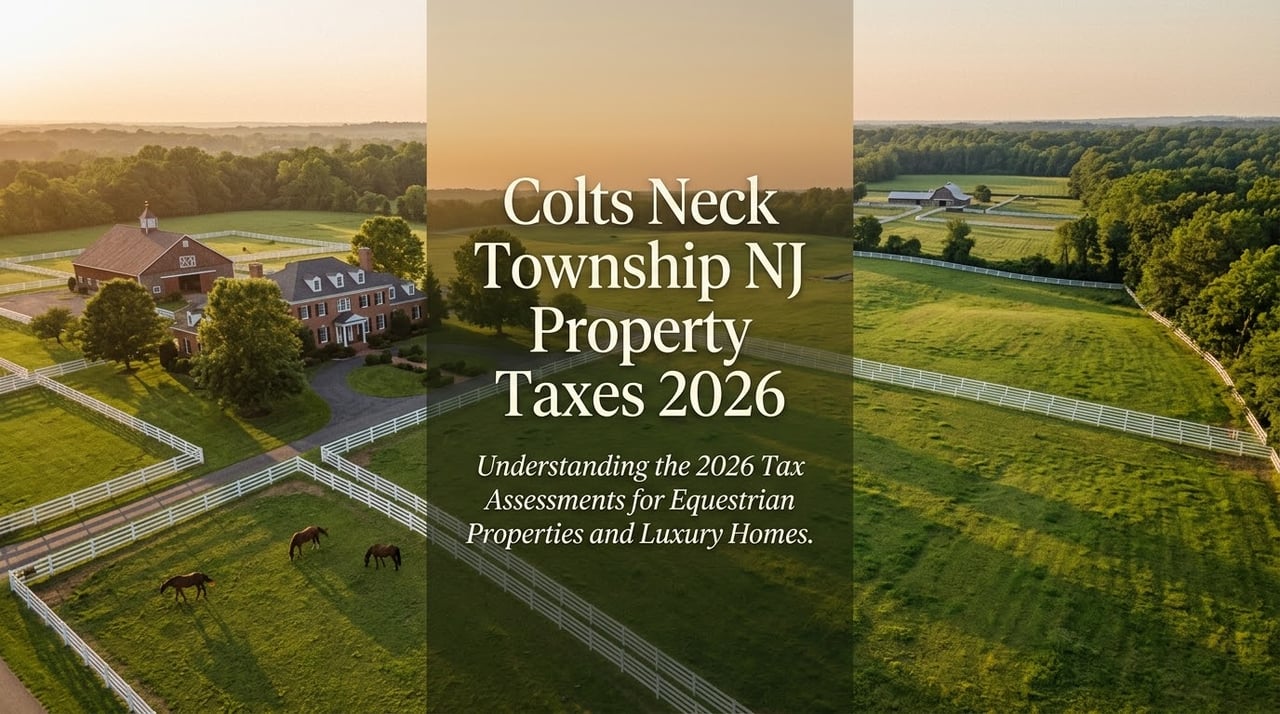
The Prodigy Team · Monmouth County Property Tax Series · Colts Neck, NJ
A below-average rate, an above-average bill, and three structural features — a naval weapons station, protected farmland, and a two-district school system — that explain the gap.

The Argument in Brief
Colts Neck's tax story is about what you're buying, not about an aggressive rate. Its 2025 general rate of $1.394 sits below Holmdel's $1.539 and Middletown's $1.614, and its effective rate of about 1.49% is among the lighter ones in central Monmouth — yet its 2024 average residential bill of $16,668 was the fifth-highest of the county's 53 municipalities, because assessed values here are high. Three structural features shape the math: roughly 4,900 acres of Naval Weapons Station Earle that sit outside the tax base, a farmland assessment program that can dramatically lower taxes on qualifying farms (with rollback exposure when use changes), and a two-district school structure. For 2026, the state measured Colts Neck assessments running about 6% above sale prices — a 105.85% ratio — which matters to anyone weighing an appeal.
Colts Neck is horse country with a Monmouth County address — about 10,000 residents spread across roughly 31 square miles of estates, working farms, and preserved open space. The tax bill that comes with it surprises people in both directions. Buyers coming from Manhattan or Staten Island expect New Jersey's famous rates and are relieved to find the Colts Neck rate is moderate. Then they see the dollar figure on a specific estate and realize the bill is large for a simple reason: the homes and the land underneath them are worth a great deal.
This guide separates the rate from the bill, walks through the levies that make up a Colts Neck tax bill, and explains the three features — the federal land at NWS Earle, farmland assessment under the township's Right to Farm framework, and the K–8 plus regional high school structure — that make this township's math unlike its neighbors'. Every figure is tied to a government source listed at the end.
🎬 Above the Streets · Colts Neck From the Air
An aerial tour of Colts Neck from The Prodigy Team's Above the Streets series — the estates, farms, and open land behind the numbers in this guide.
The figures below come from the Monmouth County Board of Taxation's 2026 County Equalization Table, certified May 22, 2026, and the New Jersey Division of Taxation's average residential tax report for tax year 2024. The 2025 general rate and 2025 Director's Ratio are carried in the 2026 table as the prior-year figures; multiplying them produces the 2025 effective rate.
Colts Neck Measure | Figure | Context |
|---|---|---|
2025 general tax rate | $1.394 per $100 | Holmdel $1.539 · Middletown $1.614 |
2025 Director's Ratio | 107.02% | Assessments averaged above sale prices |
2025 effective tax rate | ~1.49% | Holmdel ~1.66% · Middletown ~1.74% |
2024 average residential bill | $16,668 | 5th of 53; county average $10,930 |
2026 Director's Ratio | 105.85% | Used for 2026 county equalization |
2026 net taxable value | $4.88 billion | Land $2.63B · improvements $2.25B |
The pattern is clear once rate and bill are separated. Colts Neck's 2024 average bill sat about 53% above the Monmouth County average, but its effective rate is lower than most of the towns around it. Value per property is the reason, and much of it is land: in the 2026 table, land accounts for $2.63 billion of Colts Neck's $4.88 billion in taxable value — more than the buildings on it, a reflection of the township's large-lot, agricultural character.
📊 2025 Effective Tax Rate · Colts Neck and Neighbors
Effective rate = 2025 general tax rate × 2025 Director's Ratio, both from the Monmouth County Board of Taxation 2026 Final County Equalization Table.
Broker's Note
"When a family from the city first sees a Colts Neck tax bill, I always walk them back to the land. In this township the acreage often carries as much of the assessment as the house itself. Once they see that, the number stops being scary and starts making sense."
— Anthony Licciardello, Broker, The Prodigy Team
A Colts Neck property tax bill bundles several separately budgeted levies into one general rate. The township tax collector bills and collects all of them, but each is set by a different body:
Colts Neck Township School District (K–8). The local district covering pre-K through eighth grade. Its proposed 2026–27 budget carries a general-fund tax levy of $24,627,041 — the same figure as in 2024–25 and 2025–26, per the state Department of Education's budget summary.
Freehold Regional High School District. Colts Neck students in grades 9–12 attend Colts Neck High School, which is operated by the Freehold Regional High School District. Colts Neck pays its apportioned share of the regional district's levy.
Municipal purposes. Township government — police, public works, recreation, planning, and administration — set by the Township Committee through the annual municipal budget.
Monmouth County, library and open space. The county share is apportioned among all 53 Monmouth municipalities according to each town's share of total equalized value — which is why the county board's 2026 ratio finding for Colts Neck, covered in Chapter V, matters.
Because each levy moves on its own budget calendar, a Colts Neck bill can change even when nothing about your house does. The practical habit: when you are evaluating a purchase, look at the most recent full-year bill for that specific address rather than estimating from a rate or a town average.
Naval Weapons Station Earle supplies ordnance to the Navy's fleet. Its inland main base, known as Mainside, covers 10,160 acres according to the Navy, and borders four municipalities: Colts Neck, Howell, Wall, and Tinton Falls. Most of Mainside lies within Colts Neck — which is why the base uses a Colts Neck address — and the township's farmland preservation plan puts Earle's footprint inside Colts Neck at more than 4,900 acres. Against a township of about 20,700 acres, that is close to a quarter of Colts Neck's land.
Federal land is not subject to local property tax, so that acreage contributes nothing to Colts Neck's ratable base. Mainside connects to Earle's Waterfront pier complex in the Leonardo section of Middletown by Normandy Road, a 15-mile Navy-controlled road and rail corridor. Earle property also hosts the Ben Moreell Solar Farm, a 20-megawatt array that began operating in 2020.
For homeowners, the takeaway is structural rather than dramatic: a meaningful slice of the township's land will never be developed into taxable homes or businesses, which keeps Colts Neck rural and keeps the tax base concentrated on private residential and agricultural property.
Colts Neck formally recognizes the right to farm in Chapter 180 of its township code, adopted in 2002 and subject to the township's development regulations. The ordinance protects generally accepted agricultural operations — including farm stands and agriculture-related activities — and reinforces New Jersey's statewide Right to Farm Act.
The tax consequence comes from a separate law, the Farmland Assessment Act of 1964. Qualifying farmland is assessed at its agricultural productivity value, set annually by the State Farmland Evaluation Committee, rather than at market value. That can produce a dramatically lower land assessment than a comparable non-farm parcel. The Act covers the land only — homes and other buildings are still assessed normally.
To qualify, according to the New Jersey Division of Taxation:
The owner must hold at least five contiguous acres actively devoted to agricultural or horticultural use, with that use in place for at least the two prior years.
Gross sales of products from the land must total at least $1,000 a year for the first five acres, plus $5 per acre beyond that (woodland has a lower threshold).
The owner must file Form FA-1 with the township tax assessor every year, on or before August 1 of the year before the tax year.
The rollback rule. When farmland-assessed land is changed to a non-agricultural use, New Jersey imposes rollback taxes: the difference between the taxes paid under farmland assessment and the taxes that would have been due at full value, for the year of the change and the two tax years before it, to the extent the land was farmland-assessed in those years. On a large Colts Neck parcel, that difference can be substantial.
If you are buying a Colts Neck property with an equestrian or agricultural component, verify three things with the assessor before you sign: whether the land currently carries farmland assessment, whether FA-1 filings are current, and what the land would be assessed at without it. If you do not plan to continue a qualifying agricultural use, have your attorney address rollback exposure in the contract.
Broker's Note
"The buyer I worry about in Colts Neck is the one who falls in love with a farm property and plans to stop farming it. Farmland assessment is a wonderful benefit, but the rollback reaches back over three tax years. We put that conversation on the table with the attorney before the contract — never on closing day."
— Anthony Licciardello, Broker, The Prodigy Team
Colts Neck is reassessed annually under Monmouth County's Assessment Demonstration Program, so assessments are meant to track the market every year. The state's own yardstick says they have recently run ahead of it. The Director's Ratio — the average relationship between assessed values and actual sale prices — was 107.02% for Colts Neck in 2025 and 105.85% for 2026. In plain terms, assessments averaged roughly 6% to 7% above what comparable homes sold for.
The county board applied that ratio in its 2026 equalization table: Colts Neck's $4.88 billion of assessed value was equalized down to about $4.61 billion of true value, a reduction of roughly $270 million for purposes of apportioning the county levy. For individual owners, a township-wide ratio above 100% is a reason to look closely at your own assessment against recent comparable sales — it is not, by itself, proof that any specific property is over-assessed.
The deadlines. Monmouth County runs an earlier appeal calendar than most of New Jersey. Assessment notices arrive by mid-November of the year before the tax year, and the key dates are:
January 15 — the deadline to appeal to the Monmouth County Board of Taxation, for any property regardless of assessed value.
April 1 — the deadline to file directly with the Tax Court of New Jersey, an option available only when the assessment exceeds $1 million.
For the county-specific mechanics, see our guide to Monmouth County's appeal calendar and January 15 deadline. For Colts Neck estates with bills above $18,000, our premium-market appeal playbook covers Tax Court filing, attorney economics, and the Freeze Act.
Paying the bill. New Jersey property taxes are due quarterly on February 1, May 1, August 1, and November 1. Confirm any grace period with the Colts Neck tax collector — interest generally runs from the original due date once a grace period is missed.
Many Colts Neck sales clear $1 million, which brings New Jersey's restructured "mansion tax" into play. Legislation signed June 30, 2025 and effective July 10, 2025 renamed it the Graduated Percent Fee, shifted it from the buyer to the seller, and replaced the flat 1% with tiers. The rate applies to the entire sale price, not just the portion above a threshold.
Sale Price | Seller-Paid Rate |
|---|---|
Over $1M to $2M | 1.0% |
Over $2M to $2.5M | 2.0% |
Over $2.5M to $3M | 2.5% |
Over $3M to $3.5M | 3.0% |
Over $3.5M | 3.5% |
A $2.6 million Colts Neck estate, for example, now carries a $65,000 seller-paid fee at 2.5% — before the separate Realty Transfer Fee — where the old flat 1% would have been $26,000, paid by the buyer. Because the rate steps up on the whole price, pricing just above a threshold can cost a seller more than it gains. For the full closing sequence, see our 2026 New Jersey closing timeline.
Colts Neck homeowners have access to the standard New Jersey relief framework. Locally, qualifying veterans and qualifying seniors or disabled homeowners can each receive a $250 annual deduction, and veterans with a 100% service-connected permanent disability can qualify for a full exemption on their primary residence.
At the state level, ANCHOR, Senior Freeze, and Stay NJ are claimed through a single combined application, Form PAS-1, and the deadline for the current application is November 2, 2026. Stay NJ helps homeowners age 65 and older with up to half of their property tax bill, but the Fiscal Year 2027 state budget, signed June 30, 2026, narrowed it: for the 2025 tax year, household income must be $200,000 or less, and the maximum benefit is $6,500 for incomes up to $100,000, $5,000 from $100,000 to $150,000, and $4,000 from $150,000 to $200,000. Stay NJ is calculated after ANCHOR and Senior Freeze. Because these rules are set in each state budget, confirm the current terms with the New Jersey Division of Taxation before you file.
For owners of qualifying agricultural land, farmland assessment (Chapter IV) is the most significant relief mechanism of all.
The Bottom Line
Colts Neck's rate is moderate and its effective rate is lighter than Holmdel's or Middletown's; the bill is large because Colts Neck property — and especially Colts Neck land — is valuable. Know whether a property carries farmland assessment and what happens if it stops. Remember that the state measured Colts Neck assessments running above sale prices for 2025 and 2026. And mark January 15 on the calendar every year.
The Rate
The 2025 general tax rate was $1.394 per $100 of assessed value. With a 2025 Director's Ratio of 107.02%, the effective rate was about 1.49%, below Holmdel's and Middletown's.
The Bill
The 2024 average residential bill was $16,668, per the New Jersey Division of Taxation — fifth-highest of Monmouth's 53 municipalities, behind Deal, Rumson, Allenhurst, and Fair Haven, and about 53% above the county average of $10,930.
Federal Land
Earle's Mainside base covers 10,160 acres across Colts Neck, Howell, Wall, and Tinton Falls, with most of it in Colts Neck. The township's farmland preservation plan puts Earle's footprint in Colts Neck at more than 4,900 acres — close to a quarter of the township. Federal land pays no local property tax.
Farmland
Qualifying land — at least five contiguous acres in active agricultural use for two prior years, with at least $1,000 a year in gross sales on the first five acres plus $5 per additional acre — is assessed at agricultural value instead of market value. Owners must file Form FA-1 by August 1 of the pre-tax year.
Rollback
When farmland-assessed land changes to a non-agricultural use, the owner owes the difference between farmland-assessment taxes and full-value taxes for the year of the change and the two prior tax years in which the land was farmland-assessed.
Schools
Two: the Colts Neck Township School District for pre-K through grade 8, and the Freehold Regional High School District, which operates Colts Neck High School for grades 9–12.
Appeals
January 15 for appeals to the Monmouth County Board of Taxation, for any property. Owners whose assessment exceeds $1 million may instead file directly with the Tax Court of New Jersey by April 1.
Anthony Licciardello
Broker, The Prodigy Team
The Prodigy Team runs one of the region's most active digital pipelines for New York buyers headed to New Jersey — ProdigyRE.com, a YouTube channel with 400,000+ views over the trailing year, a 26,500+ member Facebook relocation community, and 17 million+ Pinterest impressions. That reach puts Colts Neck listings in front of the buyers already searching for land and space.
Our cinematic drone series, Above the Streets, tells the story of whole towns from the air — Colts Neck included.
Explore Nearby — Central Monmouth County
Tinton Falls property taxes and the Fort Monmouth redevelopment
Middletown Township property taxes for 2026
Sources
Monmouth County Board of Taxation, Tax Year 2026 Final County Equalization Table, certified May 22, 2026 (nj.gov/treasury/taxation/pdf/lpt/county_equalized/2026/2026Monmouth.pdf) · New Jersey Division of Taxation, MOD-IV Average Residential Tax Report, Tax Year 2024 · U.S. Navy, Naval Weapons Station Earle, "About" (cnrma.cnic.navy.mil) · Naval Facilities Engineering Systems Command, NWS Earle Environmental Restoration Program · State Agriculture Development Committee, Colts Neck Township Farmland Preservation Plan · Township of Colts Neck Code, Chapter 180, Right to Farm (eCode360) · New Jersey Division of Taxation, Farmland Assessment · New Jersey Department of Education, 2026–27 User Friendly Budget Summary, Colts Neck Township School District · New Jersey Division of Taxation, Assessment and Appeals · New Jersey Division of Taxation, Stay NJ · New Jersey Realtors and Genova Burns LLC, analyses of P.L. 2025, c. 69 (Graduated Percent Fee) · U.S. Energy Information Administration Form 860M data, Ben Moreell Solar Farm
Colts Neck Tax Review
Find Out Where Your Colts Neck Assessment Should Land
With Colts Neck assessments measured above sale prices for 2025 and 2026, now is the time to check yours against real comparable sales — and, for farm and equestrian properties, to confirm your farmland assessment status. We'll pull the sales, run the numbers, and tell you honestly whether an appeal makes sense before January 15.
Or call direct: (718) 873-7345
Prodigy Real Estate is an innovative real estate company offering high-end video production, home valuation services, purchasing, and home sales. Serving New York and New Jersey.