
Anthony Licciardello | April 28, 2026
Westfield, NJ
By Anthony Licciardello, The Prodigy Team · April 29, 2026
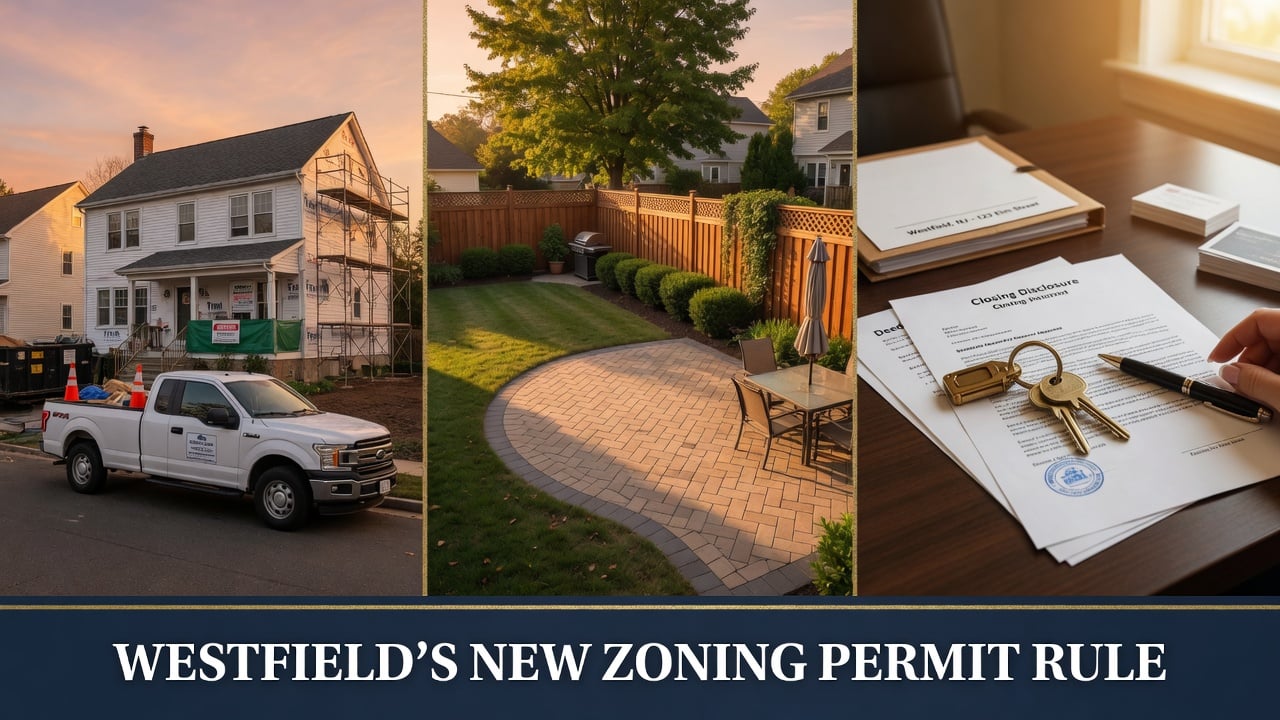
A homeowner on the south side of Westfield decides to expand the back patio. They have a contractor lined up, materials ordered, and a weekend cleared. Three months earlier, that project would have moved straight into a construction permit review. As of December 11, 2025, it doesn't. It now requires a separate, mandatory zoning permit from the Westfield Zoning Officer before any construction permit can be issued. Same for a fence. Same for a shed. Same for a driveway expansion, a retaining wall, a finished basement, or converting an enclosed porch into year-round living space. Same for a commercial tenant flipping a retail space into a restaurant.
This is the most consequential change to Westfield land use procedure in years, and most homeowners in town don't know it happened. The rule is short, the consequences are not — particularly at the closing table, where unpermitted improvements from prior years now surface as standard buyer due diligence items. Here is what triggers the new requirement, what doesn't, and what every Westfield owner and buyer should be doing differently in 2026.
For broader market context — why Westfield's downtown, walkability, and rail access have made it one of the highest-barrier suburbs in New Jersey — our Above the Streets deep dive lays out the full picture.
The Rule 01
Effective Thursday, December 11, 2025, a zoning permit application is now required for any proposed use, construction, or alteration of a building or structure within the Town of Westfield. The permit is issued by the Zoning Officer, who confirms in writing that the proposed project complies with the town's Land Use Ordinance — meaning it is allowed in the specific zone district where the property sits and meets all applicable bulk, coverage, and use standards.*
A zoning permit is not the same thing as a construction permit. The construction permit, issued by the Building Department at 959 North Avenue West, certifies that the work meets the New Jersey Uniform Construction Code. The zoning permit comes first and answers a different question: is this project even allowed on this lot, in this zone, at this size? In practice, every applicable project now flows through two reviews instead of one.
The Reasoning 02
The old model was reactive. A homeowner installed a fence too close to the property line, paved a driveway wider than ordinance allowed, or put up a shed in a setback area, and the town only intervened after a neighbor complained or a violation was spotted. Resolution then required removal, modification, or a variance application — all expensive, all backward-looking. The new rule flips the sequence. Compliance gets confirmed on paper before construction begins, which means non-compliant projects get caught at the design stage instead of after the concrete cures.
Stormwater drove much of the policy change. The town council heard repeatedly from residents whose properties suffered water intrusion and basement flooding caused by neighbors' backyard improvements — patios, paved walkways, expanded driveways, retaining walls. Impervious surfaces redirect rainfall instead of absorbing it, and when several neighbors make similar improvements over a short window, runoff can compound across an entire block. Site improvements over 200 square feet are now referred to the Town Engineer specifically to evaluate stormwater impact before a zoning permit is issued.
What Triggers 03
The list is broader than most homeowners assume. Anything that adds to a structure, occupies new ground, or changes how a space is used now flows through zoning review first. The most common triggers we see in the Westfield pipeline:
| Project Type | Why It's Triggered |
|---|---|
| Patios over 200 sq ft | Impervious coverage and stormwater impact on adjacent properties |
| Driveway installation or expansion | Width and coverage limits set by the Land Use Ordinance; runoff review |
| Fences | Height, location, and setback rules vary by zone; corner-lot rules differ |
| Sheds and accessory structures | Setback distances, lot coverage limits, height caps |
| Pools and pool decks | Setbacks, fencing requirements, coverage calculations |
| Decks and porches | Yard encroachment rules; enclosing a porch later revokes coverage exemptions |
| Retaining walls | Stormwater redirection, setback from property lines |
| Additions and dormers | FAR, height, side-yard setbacks, expansion of pre-existing nonconforming bulk |
| Tenant fit-outs (commercial) | Confirmation that the new tenant's use is permitted in the zone district |
| Change of use | Retail to restaurant, office to medical, single-family to two-family, etc. |
The Land Use Ordinance also calls out a specific trap that catches sellers regularly: enclosing or converting a deck, porch, or ingress/egress platform that was previously exempt from coverage limits revokes that exemption and subjects the entire property to standard coverage rules. A sunroom built without a zoning permit, in other words, can pull the whole lot back into compliance review at the moment the next owner pulls the SDL record.
Exemptions 04
Not every backyard project triggers the new requirement. Smaller, portable, or temporary improvements — particularly those under 200 square feet — may be exempt or subject to a simplified review. Ordinary maintenance, defined under the New Jersey Uniform Construction Code at N.J.A.C. 5:23-2.7, generally does not require any permit at all. Painting, replacing roof shingles in kind, swapping a like-for-like appliance, fixing a fence section without changing height or location — these are typically maintenance.
At the December 2025 council meeting, a resident asked specifically whether a small children's trampoline counted as a structure requiring a permit. The answer turned on portability and size — temporary, freestanding, easily removable items that are not anchored to the ground are generally not regulated as structures. A portable on-demand storage unit (a "POD") used temporarily during a move is permitted in residential zones under specific standards, and the supplier is required to register the placement before delivery.
At Closing 05
The new rule is forward-looking on its face — it governs what owners do from December 2025 forward. The bigger impact is backward-looking. Westfield buyers' attorneys are now routinely pulling the SDL Portal record on every property under contract, and any structure on the lot that doesn't appear in the permitted history becomes a disclosure issue. Fences installed without a permit ten years ago. Sheds dropped onto a slab without zoning review. Patios expanded without records. Finished basements that were never inspected. Decks enclosed into sunrooms without revisiting coverage calculations.
The expensive scenario plays out the same way every time. Buyer signs contract. Buyer's attorney pulls SDL during attorney review. Attorney flags an unpermitted improvement. Seller now has three options: pay for a retroactive zoning permit application (often achievable, sometimes not), credit the buyer for removal or remediation, or face a deal that falls apart. None of these outcomes are good for the seller. All of them are avoidable with a pre-listing audit.
This is now a standard pre-listing item in any Westfield engagement we take. We pull the SDL portal record on every listing before signing the agreement, walk the property with the record open, identify anything visible on the lot that doesn't appear in permit history, and address it on paper before the home goes live. The cost of a retroactive permit at the front end is small. The cost of a renegotiation during attorney review can run several thousand dollars or kill the deal entirely — a dynamic we covered in detail in what it really costs to sell a home in Westfield.
The Tool 06
The town operates a free public portal called SDL at sdl.town/westfield. Anyone with an email address can create an account and search property history — construction permits, zoning permits, inspections, violations, certificates of occupancy. The portal eliminates the need to file an Open Public Records Act request through the Town Clerk's Office for routine permit lookups, which used to be the standard path before SDL went live.
For sellers, the workflow is simple. Pull the SDL record on your property the same week you start interviewing agents. Compare the record against what's actually on the lot. Flag anything that doesn't match — a deck, a fence section, a finished basement, a converted attic, a pool, a shed, a patio, an addition, a paved area larger than 200 square feet. Take that list to the Zoning Office and ask what each item requires. Some will need retroactive zoning permits. A few may need variance applications. Most will resolve quickly if addressed before listing.
For buyers, the workflow runs during the inspection contingency. Pull the SDL record on the property as soon as the contract is fully executed. Walk the property with the record open. Note any structure or improvement that appears on the lot but not in permit history, and raise those items in attorney review. The fees for the search are zero. The leverage from catching a discrepancy before the contingency expires is substantial.
Buyer Playbook 07
Three additions to the standard inspection-period checklist make sense in Westfield in 2026. First, pull the SDL Portal record before the inspection itself. Hand a copy to the inspector and ask them to flag any structure visible on the property that doesn't appear in the record. Inspectors are not zoning officers, but they are trained observers and they will catch most discrepancies once they know to look.
Second, ask the listing side directly whether any improvements were made in the last ten years without permits. Sellers are required to disclose what they know on the seller's property disclosure statement, and a direct written question creates a paper trail if anything later proves to have been concealed. Many sellers genuinely do not know what their predecessors did to the property — but the disclosure statement still governs.
Third, before closing, identify any post-purchase renovations you plan to make and run them past the Zoning Office in advance. A new patio, a fence, a finished basement, a driveway expansion — all of these now require zoning permits before construction permits, and confirming the project is allowed before you close can change which property you actually want to buy. The same logic applies to property tax planning, which we cover separately in Westfield property taxes explained.
The Bigger Picture 08
The zoning permit rule isn't an isolated policy change. It arrives in the same year the town adopted its Fourth Round Mount Laurel obligation, rezoned five sites near the train station for affordable multi-family housing, and began processing the largest downtown redevelopment in a generation at One Westfield Place. Westfield is, quietly, in the middle of the most consequential land use cycle since the original 1998 ordinance was adopted — a story we walk through in our analysis of Westfield's affordable housing overlay zones and the 380-unit obligation.
The common thread across all of it is documentation. The town has shifted from reactive enforcement to proactive review on the residential side, from after-the-fact violations to before-the-fact zoning permits, from informal compliance to formal SDL Portal records. None of this changes whether your sunroom looks good or your fence functions correctly. It changes whether either of them is on file when the next buyer's attorney goes looking — and in Westfield in 2026, the next buyer's attorney always looks. The closing-cost reality across the rest of New Jersey, by comparison, is covered in our 2026 NJ closing costs guide.
The rule itself is a sentence long. The follow-through on every property in town is going to take years.
*Sources: Town of Westfield Planning and Zoning Department official guidance and Zoning Permits page (effective December 11, 2025); Town of Westfield Land Use Ordinance, Chapter LUL, including Article 6 (procedures), Article 7 (variance applications), Article 11 (zone district regulations), Article 12 (general zoning regulations), and Article 21 (enforcement and penalty provisions); New Jersey Uniform Construction Code, N.J.A.C. 5:23-2.7 (ordinary maintenance definition); Westfield Building Department FAQ documentation; Town of Westfield SDL Portal at sdl.town/westfield; Westfield Town Council meeting records, December 2025; New Jersey Department of Community Affairs construction permit application materials; and public planning and zoning records.
Frequently Asked
Do I need a zoning permit for a fence in Westfield NJ?
Yes. As of December 11, 2025, fence installations require a zoning permit application from the Westfield Zoning Officer before any construction permit is issued. The Land Use Ordinance regulates fence height, location, and setback rules that vary by zone district and corner-lot status, so the zoning review confirms compliance before the work begins. Replacing a fence section in kind without changing height or location may qualify as ordinary maintenance — verify with the Zoning Office.
What happens if I built something without a zoning permit before December 2025?
Pre-existing improvements without permits become a disclosure and due diligence issue at the time of sale. Buyer's attorneys routinely pull SDL Portal records during attorney review, and unpermitted structures typically require a retroactive zoning permit application or, in worse cases, removal at the seller's expense. Address these items before listing — costs to resolve in advance are almost always lower than negotiating a buyer credit during contract.
Is a zoning permit the same as a construction permit?
No. The zoning permit is issued by the Westfield Zoning Officer and confirms that a proposed project complies with the Land Use Ordinance — meaning it is allowed in the specific zone and meets all bulk, coverage, and use requirements. The construction permit is issued by the Building Department at 959 North Avenue West and certifies compliance with the New Jersey Uniform Construction Code. The zoning permit comes first; the construction permit follows.
Will an unpermitted shed kill my home sale in Westfield?
Not automatically, but it can. The most common outcomes are a retroactive zoning permit application filed by the seller before closing, a buyer credit to cover removal or remediation, or in some cases a deal that falls apart during attorney review. Pulling the SDL Portal record before listing and resolving any unpermitted improvements on the front end is the single most reliable way to avoid these issues at closing.
Prodigy Real Estate is an innovative real estate company offering high-end video production, home valuation services, purchasing, and home sales. Serving New York and New Jersey.