
Anthony Licciardello | May 6, 2026
West Long Branch, NJ
By Anthony Licciardello, NYS/NJ Licensed Broker · The Prodigy Team · April 25, 2026
West Long Branch and Its Ascent into the New Jersey Luxury Home Market — produced by The Prodigy Team
West Long Branch NJ real estate operates inside a tightly defined 2.89-square-mile borough, sitting two miles inland from the Atlantic, bordered by Eatontown to the west, Long Branch to the east, Ocean Township to the south, and Oceanport to the northwest. Permanent population at the 2020 census was 8,587, the highest decennial count in the borough's history. The borough was incorporated on April 7, 1908 after a referendum separated it from Eatontown over a tax-revenue dispute — the West Long Branch section had grown to include several large estates whose tax base Eatontown was reluctant to release. Those estate parcels are still functionally embedded in the borough's housing stock more than a century later, alongside the 170-acre Monmouth University campus that occupies its geographic center.
The pricing data tells the actual story. Median list price ran $1,380,000 in April 2026 with median price-per-square-foot at $554. Median closed-sale price ran approximately $1,127,500 over the same period. Year-over-year price growth sits at 15.6 percent, materially above the +10 percent statewide pace and meaningfully above broader Monmouth County's appreciation trajectory. Days on market averaged 38, with a sale-to-list ratio of 93.5 percent — meaning buyers are negotiating roughly 6.5 percent below asking on a typical transaction. The price-drop rate sits at 29.4 percent of active listings, double the statewide 14.2 percent average, telling you sellers who price aggressively are correcting back to market.
For buyers and sellers approaching this market with comp logic borrowed from Long Branch's much larger and more stratified market, the result is consistent mispricing in both directions. West Long Branch is not a Long Branch submarket. It is a separate municipality with its own school district, its own governance, and its own demand drivers — chief among them the university campus that anchors local employment and pulls in a structural rental and faculty-buyer cohort that doesn't exist anywhere else on the corridor. For broader regional context, our Long Branch citywide market report covers the larger neighbor to the east.
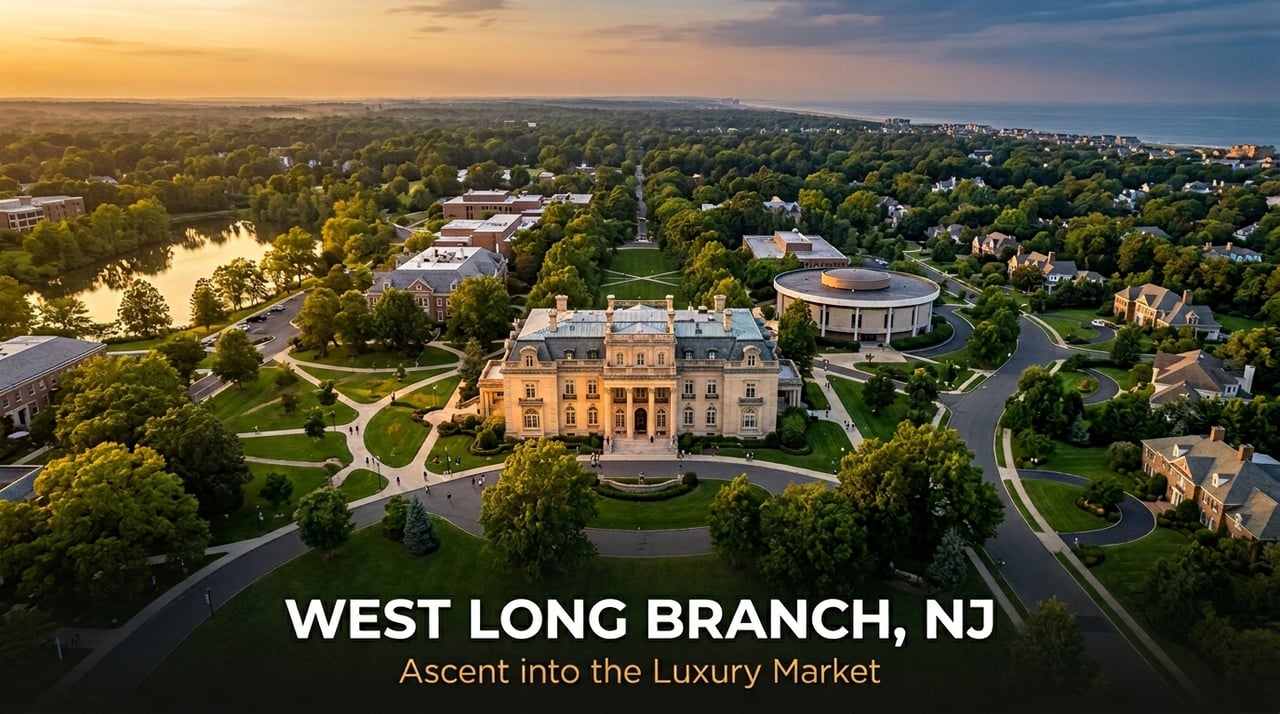
Monmouth University acquired its West Long Branch campus in 1955 when it relocated from Long Branch to the Shadow Lawn estate, paying $350,000 for the property — roughly $4.2 million in 2025 dollars. President Woodrow Wilson stayed at the original Shadow Lawn mansion during his 1916 campaign, and the building bearing his name (renamed Great Hall in 2020) remains the campus's signature structure. The Murry Guggenheim mansion at the heart of the campus, built in 1903 and designed by Carrère and Hastings, is on the National Register of Historic Places and now houses the university's library wing. Total enrollment runs approximately 4,660 undergraduates and 1,750 graduate students, with 302 full-time faculty across 170 acres and 75-plus buildings.
For West Long Branch real estate, the university is functionally an economic anchor that produces three distinct demand vectors. First, faculty and staff buyers who want to live within walking distance or a short drive of campus — this cohort tends to favor the borough's mid-tier single-family stock at the $700K to $1.2M band. Second, parents purchasing investment properties for student housing, particularly in proximity to Cedar Avenue and the Norwood Park section — a small but consistent transaction stream that doesn't exist anywhere else on the corridor. Third, alumni buyers returning to the area later in life, often after careers in New York City, who want the borough's small-town governance combined with the university's cultural amenities. None of these demand vectors operate in Long Branch, Eatontown, or Ocean Township in the same way.
The structural implication: the university is a recession-resistant employer that stabilizes local housing demand even when broader Monmouth County markets soften. That stabilization shows up in the borough's price-appreciation premium — the +15.6 percent year-over-year growth that runs above county and state averages.
West Long Branch organizes around three operational tiers driven by lot size, proximity to campus, and the borough's historic estate footprint. The borough is too small to support distinct named neighborhoods the way Long Branch does — what it has instead is a three-tier price map that reads cleanly across the active listing inventory.
| Property Tier | Active 2026 Range* | Dominant Buyer |
|---|---|---|
| Estate streets / large lot | $2.0M – $4M+ | Generational owner / custom rebuild / executive end-user |
| University-adjacent / mid-tier | $900K – $1.6M | Faculty / alumni return / move-up family |
| Family Cape, Colonial & ranch | $650K – $900K | First-time buyer / young family / inland commuter |
*Ranges reflect closed-sale data and active listing data through Q1 2026. Tier boundaries are operational broker categories driven by lot size and university proximity, not formal zoning designations.
The estate-streets tier is the borough's signature inventory — a finite cluster of large-lot properties carrying lineage back to the original Gilded Age summer-resort era. The university-adjacent mid-tier is where most transaction volume actually clears, with renovated Capes, expanded Colonials, and modernized ranches between Cedar Avenue and the Long Branch border doing most of the work. The family entry-tier represents the borough's best buyer-friendly opportunity in 2026, particularly for households priced out of Long Branch's West End or Holmdel's named communities. Our Holmdel precision-luxury market report covers an adjacent Monmouth County submarket where similar buyer profiles often shop in parallel.
West Long Branch operates its own K–8 public school district, with Betty McElmon Elementary serving Kindergarten through fourth grade and Frank Antonides School handling fifth through eighth. Ninth through twelfth graders feed into Shore Regional High School, which serves a four-borough constituency that also includes Monmouth Beach, Sea Bright, and Oceanport. That regional-high-school structure is a meaningful differentiator from neighboring Long Branch, where students attend Long Branch Public Schools, and from Eatontown, which has its own K–8 district feeding into Monmouth Regional High School.
For family buyers, the school structure is often the single most consequential variable in the borough-versus-borough decision. Households selecting between West Long Branch and Long Branch on otherwise comparable inventory frequently make the choice on school district lines alone. The borough's compact footprint and walkable elementary-school catchment is an additional draw for buyers prioritizing community-scale governance and short school commutes. Combined with proximity to the Monmouth County Vocational School District magnets — including High Technology High School in Lincroft and Marine Academy of Science and Technology at Sandy Hook — the regional school inventory available to West Long Branch families is among the strongest in central Monmouth County.
West Long Branch and Long Branch share a name and a corridor. They diverge sharply on almost everything else, and that divergence drives the buyer's decision between them. Long Branch is the institutional-luxury, density-tolerant, Atlantic-oceanfront market — with Pier Village's master-planned condominium ecosystem, the high-rise oceanfront corridor, the PILOT tax abatement framework on most of the institutional condo product, and the new Transit-Oriented Development district forming downtown around the NJ Transit station. The buyer who wants oceanfront walkability, urban-style luxury at the shore, or PILOT-driven carrying-cost advantages belongs in Long Branch. Our Long Branch 2026 regulatory guide covers all of that mechanics in detail.
West Long Branch is the family-oriented, university-anchored, conventional-taxation alternative. There is no Pier Village. There is no PILOT framework. There are no high-rise condominium towers. There is, instead, a tightly-held 8,587-resident borough with a separate K–8 school district feeding into Shore Regional, a 170-acre university campus that anchors local employment, and a housing stock dominated by single-family homes on residential streets. The buyer who wants a school district, the small-borough governance, the campus-adjacent cultural amenities, and a quieter inland setting — that buyer belongs in West Long Branch. The two-mile distance to the Atlantic is functionally irrelevant for most owner-occupant decisions; the structural difference between the two markets is everything.
West Long Branch's inland geography removes most of the coastal-specific regulatory layer that drives Long Branch and Monmouth Beach transactions. The NJDEP REAL Rule's +4 foot elevation standard above FEMA base flood elevation applies primarily to coastal flood-zone properties and is largely a non-factor in this borough's typical transaction. The Flood Disclosure Law that took effect March 20, 2024 does still apply — sellers are required to disclose flood history and FEMA flood zone designation regardless of how far inland the property sits — but the operational impact is substantially smaller than in barrier-strip municipalities.
The two regulatory layers that hit West Long Branch transactions hardest are different. First, the Real Estate Consumer Protection Enhancement Act, effective August 1, 2024, which requires written brokerage agreements before substantive property tours and tightens the agency disclosure framework on every residential transaction. Second, the New Jersey Mansion Tax overhaul effective July 10, 2025 — restructuring the supplemental Realty Transfer Fee into five graduated tiers running from 1 percent above $1 million up to 3.5 percent above $3.5 million, with the obligation shifted from buyer to seller. Each tier rate applies to the entire sale price rather than just the portion above the threshold, which produces sharp cliff effects at $2.0M, $2.5M, $3.0M, and $3.5M.
In a borough where the median list price runs $1.38 million and the estate-streets tier reaches $4 million, the Mansion Tax cliff is operationally significant on a meaningful share of annual transactions. A West Long Branch listing closing at $1,990,000 incurs a 1 percent Mansion Tax of $19,900 on the seller. The same property at $2,010,000 jumps to the 2 percent tier and incurs $40,200 on the full price — a $20,300 swing in seller-paid tax for $20,000 of additional gross proceeds. Modeling net-proceeds outcomes at three or four price points before final list-price discussion is now standard practice on any West Long Branch listing within $50,000 of a tier threshold. For closer mechanics on how the cliff structure interacts with the broader closing-cost framework, see our NJ closing costs guide for 2026.
Three demand drivers are stacking on top of West Long Branch's already-elevated +15.6 percent year-over-year price trajectory in 2026. First, the Netflix studio campus development at the former Fort Monmouth site in Oceanport and Eatontown — a $1 billion investment with twelve soundstages totaling nearly 500,000 square feet, expected to generate thousands of production-related jobs once operational. The development sits directly on West Long Branch's western and northwestern borough borders, and any housing-demand spillover from production professionals seeking proximity-to-campus housing lands disproportionately in West Long Branch given the borough's school district and inland location. Our Monmouth County development projects report covers the full pipeline.
Second, Monmouth University itself remains a structural employer that adds approximately 300 full-time faculty, several hundred staff positions, and a continuous student-rental demand stream. The university's recurring capital improvements — including campus residence halls, athletic facilities, and the recent Kessler Stadium dedication — sustain a baseline of construction-trade employment that further stabilizes local housing demand.
Third, the inland premium that has emerged across coastal Monmouth County in 2026 reflects buyer preference for properties outside the most acute flood-zone exposure. Coastal regulatory tightening — the REAL Rule, the Flood Disclosure Law, the post-Sandy seawall reconstruction context — has made inland Monmouth municipalities relatively more attractive to risk-conscious owner-occupants, particularly families with school-age children. West Long Branch's two-mile distance from the Atlantic, combined with its school district and university anchor, makes it one of the cleaner inland-premium plays on the corridor.
Twenty years working New York and New Jersey markets gives you a calibrated read on which inland boroughs are over-positioned and which are under-positioned. My read on West Long Branch in 2026 is that the family-tier inventory between $650K and $900K is the borough's strongest buy-side opportunity. That tier is being squeezed by households priced out of Long Branch's West End, families exiting the Holmdel and Manalapan named-community markets, and Netflix-effect spillover from Eatontown and Oceanport. The +15.6 percent year-over-year appreciation pace is unlikely to continue indefinitely, but the structural drivers under it — the school district, the university anchor, the inland premium, and the regional development pipeline — are durable.
The estate-streets tier is the borough's most idiosyncratic submarket. Pricing at $2 million-plus in West Long Branch carries a sticker risk: the buyer pool that would otherwise be shopping Rumson, Holmdel, or coastal Long Branch may need to be educated on why West Long Branch's price-per-square-foot supports a comparable transaction. Sellers in this tier should expect longer days-on-market and should price intentionally to avoid the Mansion Tax cliff thresholds. The mid-tier between $900K and $1.6M is where transaction velocity is strongest, and where the borough's school-district and university-adjacent demand vectors converge most cleanly.
For sellers, the strategic imperative in 2026 is precision. The 29.4 percent active-listing price-drop rate tells you the market is rejecting overpriced inventory at twice the statewide pace. Pricing within the Mansion Tax cliff range without modeling the structure is a meaningful net-proceeds error. For buyers, the imperative is to map the property to the right tier and the right buyer profile before bringing an offer — a renovated Cape near campus is a fundamentally different transaction than an estate-streets rebuild, and the negotiation strategy on each is different by an order of magnitude.
Median list price ran $1,380,000 in April 2026 with median price-per-square-foot at $554. Median closed-sale price ran approximately $1,127,500 over the same period. Year-over-year price growth was +15.6 percent, materially above the +10 percent statewide pace. Days on market averaged 38 days, with sellers receiving roughly 93.5 percent of asking on a typical transaction.
West Long Branch is a separate 2.89-square-mile borough with its own K–8 school district feeding into Shore Regional High School, its own borough council governance, and a 170-acre Monmouth University campus at its center. Long Branch is a much larger coastal city with Atlantic oceanfront, Pier Village's institutional-luxury condominium corridor, PILOT tax abatements on most of its high-rise condo product, and a separate Long Branch Public School district. The two municipalities share a name and a corridor but operate as distinct real estate markets with different buyer profiles.
Monmouth University is a structural net positive. The 170-acre campus anchors approximately 300 full-time faculty positions, several hundred staff jobs, and a continuous demand stream for faculty housing, alumni-return purchases, and student-investment properties. The university's recession-resistant employment profile stabilizes local housing demand even when broader Monmouth County markets soften. The university's historic campus — including Woodrow Wilson Hall and the Guggenheim mansion on the National Register of Historic Places — also contributes to the borough's character premium.
The Netflix studio campus development at the former Fort Monmouth site in Oceanport and Eatontown — a $1 billion investment expected to generate thousands of production-related jobs — sits directly on West Long Branch's western borough borders. Housing-demand spillover from production professionals seeking proximity-to-campus housing tends to land in West Long Branch given the borough's school district and inland location. The borough's +15.6 percent year-over-year price growth in 2026 already reflects partial absorption of this anticipated demand. The Netflix effect is one of three primary drivers behind the borough's appreciation premium relative to county and state averages.
Prodigy Real Estate is an innovative real estate company offering high-end video production, home valuation services, purchasing, and home sales. Serving New York and New Jersey.