
March 31, 2026
Long Branch, NJ
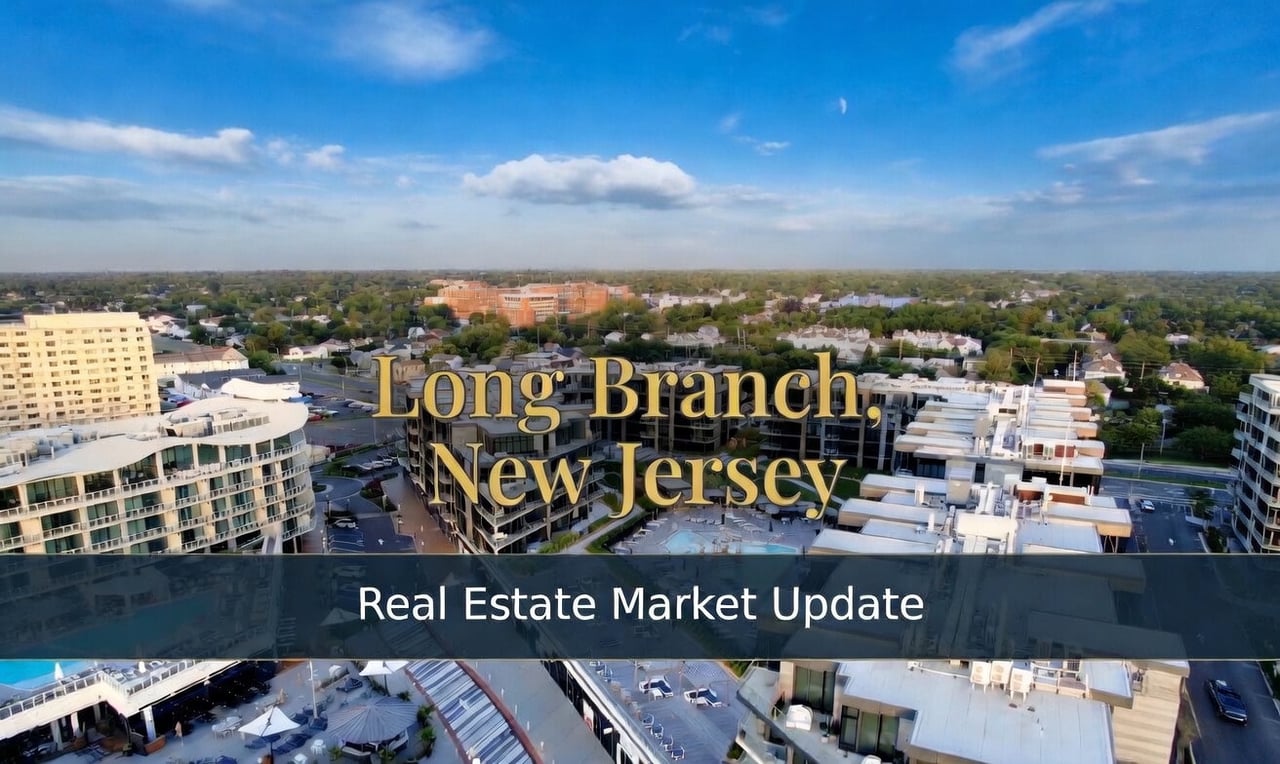
Oceanfront towers, West End gentrification, and an inland value corridor — Long Branch isn't one market. It's three, and they're moving at completely different speeds.
Long Branch has always been complicated. One of the Jersey Shore's oldest resort towns, it spent decades cycling through boom and blight before Kushner Companies planted a flag on the oceanfront and rewired the city's economic identity. That was a generation ago. In 2026, the project Kushner started at Pier Village has metastasized into something more layered — a city running three distinct real estate ecosystems simultaneously, each with its own buyer profile, its own price ceiling, and its own trajectory.
Understanding Long Branch right now means understanding which of those three markets you're actually in.
01
The strip running along Ocean Avenue and into Pier Village is a different country from the rest of Long Branch. Active listings at buildings like The Reef, The Atlantic Club, and The Lofts at Pier Village are consistently priced between $2.5M and $5.5M — numbers that would be at home on the Jersey Shore's most prestigious barrier islands and increasingly are. These aren't inflated ask prices; they're trading in that range.
Kushner Companies has not let up. The continued buildout on the beachfront — including the Onada Surf Club, which extends the curated hospitality-retail ecosystem that defines Pier Village — keeps confirming what the market already knows: oceanfront land in Long Branch has reached peak institutional valuation. The buyers here aren't local families stretching for a shore house. They're second-home purchasers, cash investors, and lifestyle-driven buyers priced out of the Hamptons looking south for equivalent product at a discount that is, year by year, getting smaller.
Oceanfront land in Long Branch has reached peak institutional valuation. The buyers coming in now aren't chasing value. They've already found it.
02
Pull back from the beach and move into the West End and the blur of neighborhood that blends into North Long Branch and Elberon, and you're in the second market — one that's been in a slow, structural appreciation cycle for years and hasn't stopped. New construction and premium renovations here are firmly priced between $1.1M and $1.8M, while the quieter pockets at the North Long Branch and Elberon border — larger lots, more architectural character, genuine separation from the beach town crowds — are regularly clearing $1.5M to $3M+.
This is the submarket that draws the buyer who doesn't want the high-rise lifestyle but still wants the proximity to the water and the walkability that Long Branch has built. The West End has its own restaurant scene, its own rhythm, and it's attracting the kind of local developer — renovate a Victorian, price it at $1.4M, move on — who has been extracting genuine returns for the last several years. It won't stay at these prices. The ceiling here is still rising.
For clients tracking the broader Monmouth County market, the West End is where you watch to understand how deep the institutional spillover from the oceanfront actually goes. Right now: pretty deep.
03
Move inland and the numbers change completely. The older housing stock running through Long Branch's interior corridors represents the city's remaining entry-level zone — with active pricing clustered between $475K and $750K. These are smaller homes, older systems, and properties that haven't been touched in years. That's exactly why investors are watching.
The value-add play here is straightforward: acquire at the lower end, renovate to regional standard, and reprice into a market that has demonstrated durable demand at the $800K to $1.1M level as gentrification pressure continues bleeding inland from the West End. It's a patient trade, but the directional move in Long Branch's development story — and the regulatory framework actively enabling it — makes the math increasingly compelling.
The inland corridor is Long Branch's last sub-$750K zone. When gentrification pressure from the West End reaches it fully — and the zoning suggests it will — that window closes.
04
What separates Long Branch from virtually every comparable coastal community in Monmouth County isn't the beach or the brand. It's the zoning. Long Branch has aggressively deployed designated Redevelopment Zones with height and density flexibility that neighboring shore towns simply don't have. While Sea Girt and Spring Lake are constrained to low-density single-family residential codes that haven't changed in decades, Long Branch can greenlight a ten-story mixed-use tower downtown. And it does.
That regulatory framework is exactly what's enabling the transit-oriented development now taking shape around the NJ Transit station. In March 2026, a new 78-unit rental project broke ground downtown near the station — the kind of density that would be politically and legally impossible in the surrounding towns. It validates what development-watchers have been saying for two years: TOD isn't the next phase of Long Branch's growth. It's the current one.
For buyers and investors tracking Red Bank's parallel development arc, the Long Branch model is instructive: when a municipality decides to grow, it grows fast, and the early positions are the ones that pay.
2026 Submarket Snapshot · Long Branch, NJ
Active listing price ranges across Long Branch's three distinct submarkets, March 2026.
Price Range by Submarket (Active Listings)
Oceanfront &
Pier Village
West End &
Elberon
Inland
Corridor
Full Price Spectrum — Long Branch 2026
05
The $2M+ spread between Long Branch's lowest and highest submarkets isn't a curiosity. It's a strategic map. An oceanfront buyer and an inland value-add investor are not operating in the same city in any practical sense — their comps, their financing profiles, their timelines, and their exit strategies share almost nothing. The mistake most buyers make is treating Long Branch as a single market and pricing accordingly.
For sellers, submarket positioning is everything right now. A West End home selling against inland comps is leaving real money on the table. A Pier Village unit selling without a full institutional buyer pool engaged is doing the same. Precision matters in a market this stratified.
For buyers who missed the early Pier Village cycle and feel priced out — the West End is the current analog. It has the neighborhood character, the development momentum, and the price ceiling that still has room to move. Across the NJ Shore, there are fewer towns that can make that claim in 2026. Long Branch is one of them.
Prodigy Real Estate works buyers and sellers across all three Long Branch submarkets, with hyperlocal data on what's actually trading versus what's sitting. If you're trying to position correctly in this market, let's talk before the spring inventory moves.
Prodigy Real Estate is an innovative real estate company offering high-end video production, home valuation services, purchasing, and home sales. Serving New York and New Jersey.