
Anthony Licciardello | July 15, 2026
Westfield, NJ
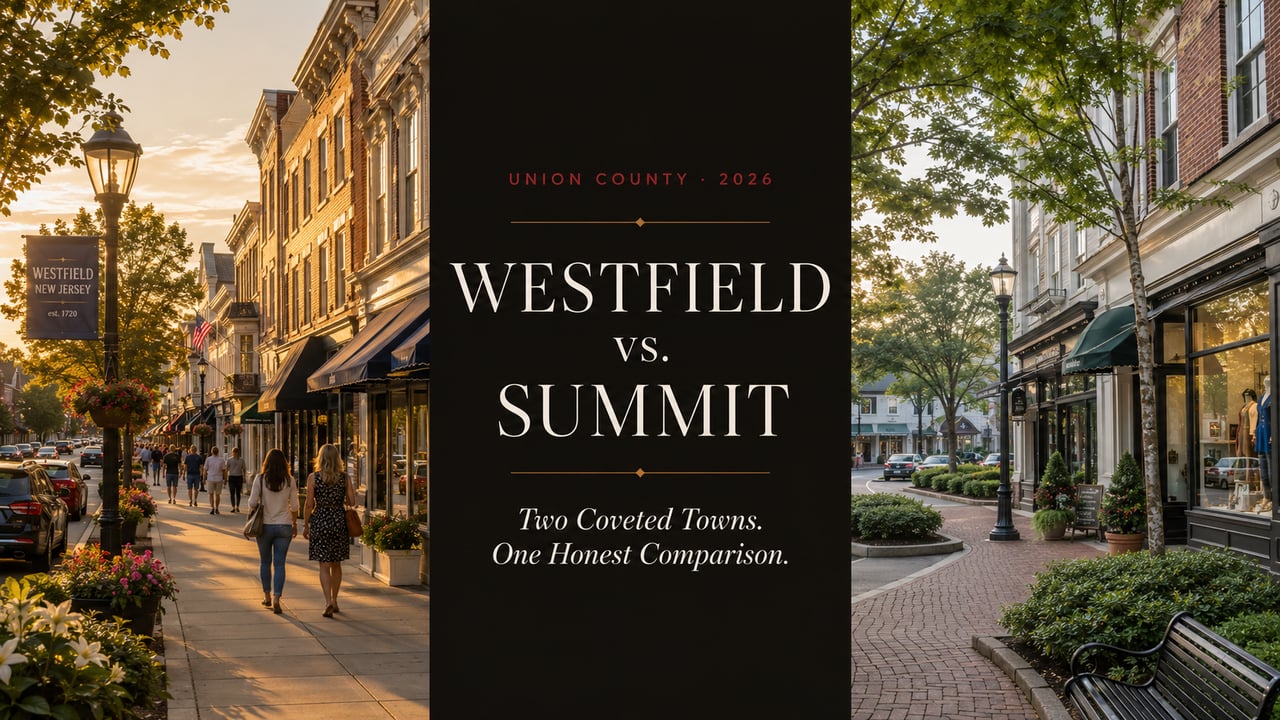
Two of Union County's most coveted addresses, forever on the same shortlist — and the honest differences that actually decide it. Summit's one-seat train and quiet prestige against Westfield's grand downtown and value math. A data-first comparison for the buyer who has to choose.
These two towns sit on nearly every relocating family's shortlist, and the decision feels agonizingly close — both deliver top-20 schools, a walkable downtown, grand older homes, and a train to Manhattan. But they are not the same purchase. Summit is the smaller, station-centered, quietly prestigious town whose signature advantage is a one-seat Midtown Direct ride into Penn Station. Westfield is the larger town with the bigger downtown, a somewhat newer housing profile, a lower price of entry — and a commute that today usually means a quick Newark transfer, with direct service arriving in phases. Pick the axis that governs your life — the train or the town — and the choice stops feeling close.
If Summit and Westfield are both on your list, you're in good company — they're the two names that dominate the Union County premium-suburb conversation. This is a data-first, honest comparison, written by a team that moves New York families into both markets. It's a companion to our complete guide to moving to Westfield — here we set it head-to-head against its most-searched rival.
This is the single cleanest difference between the towns, and for a five-day Manhattan commuter it can end the debate on its own. Summit sits on NJ Transit's Morris & Essex / Midtown Direct corridor, with direct one-seat trains into New York Penn Station in roughly 35 to 45 minutes and no transfer — the service that reshaped this corridor's real estate the moment it launched in 1996. Westfield sits on the Raritan Valley Line, where most peak-hour trains today require a quick cross-platform transfer at Newark Penn to reach New York Penn, putting door-to-Midtown in the 45-to-60-minute band. The honest 2026 nuance, which we cover in full in our Westfield relocation guide: NJ Transit has committed to introducing "shoulder-of-peak" one-seat trains on the RVL in late 2026, and off-peak one-seat service already runs — but full, all-day direct service depends on the Gateway tunnel work and remains years out. If a transfer-free daily ride is non-negotiable, Summit wins today. If you can flex your hours, or value the town over the twenty minutes, the gap narrows.
Both markets are expensive, competitive, and inventory-starved — but Westfield generally reads as the relative value. Westfield's median sale runs near $1.4 million; Summit's home values run higher, with recent value indices near $970,000–$995,000 but current list medians pushing well past $1.5 million as its scarce, premium inventory turns over. The pattern buyers feel on the ground: Summit tends to command a higher price per square foot, driven by larger lots, a higher-end housing profile, and the commute premium that one-seat ride commands. Westfield's own price story — sub-three-months supply, homes closing at 106–107% of ask, roughly 6.7% annual appreciation — lives in our 2026 Westfield market update. The bottom line for a cross-shopping buyer: comparable family homes overlap in the $1.2M–$1.5M band, but at the top of the market Summit runs richer, and a given dollar generally buys a bit more house in Westfield.
Here's the counterintuitive part most comparisons get backwards. On the raw bill, Summit is the highest-taxed municipality in Union County — an average bill near $19,700 — with Westfield second at roughly $18,900. So Summit "costs more" in dollars. But on effective rate — the bill as a share of true market value, the number that actually measures tax efficiency — the order flips: Summit's rate is lower than Westfield's 1.810%, because Summit's large commercial corridor and very high home values spread the levy across an enormous ratable base. In plain terms: Summit's bills are big because its houses are expensive, not because its rate is punishing; Westfield's rate is moderate for the county but sits above Summit's. Both still land far above the New Jersey average — the full mechanics, and where every Westfield tax dollar goes, are in our premium-market property tax appeal playbook. The lesson for a serious cross-town equity analysis: compare the effective rate and the actual bill on the specific home, never the town's reputation.
Sources: Union County Board of Taxation / NJ Division of Taxation, 2025 figures. Note the paradox: Summit's bill is highest, yet its effective rate (bill ÷ market value) runs below Westfield's 1.810% — big bills on big values, not a punishing rate.
Schools: closer than the reputations suggest. Both run standalone PreK-12 districts inside New Jersey's top tier, with graduation rates in the mid-90s and comparable state-test performance. Westfield High ranked 38th of 411 New Jersey high schools in U.S. News's 2025 list, with the district at Niche #19 statewide — the building-by-building record is in our Westfield schools deep-dive. Summit posts similarly strong numbers; families rarely lose on academics either way, so the tiebreaker is usually building fit and program specifics, not rank. Downtown & character: this is the real personality split. Westfield's downtown is the larger and livelier of the two — a long, shop- and restaurant-lined core with a farmers market, AddamsFest, and a genuine destination feel serving a town of ~31,000. Summit's center is smaller, polished, and station-centered — more boutique, more hushed, more European in feel, for a town of ~23,000. Summit reads as quiet prestige; Westfield reads as vibrant, storied, big-downtown suburbia. Neither is better — they're different daily lives.
Factor | Westfield | Summit |
|---|---|---|
NYC commute | Raritan Valley Line; peak transfer at Newark; ~45–60 min; one-seat phasing in | Midtown Direct one-seat; ~35–45 min; no transfer |
Median / price feel | ~$1.4M; relative value | Runs higher; premium $/sq ft |
Avg. tax bill | ~$18,900 (2nd in county) | ~$19,700 (highest in county) |
Effective tax rate | 1.810% | Lower — commercial-base advantage |
Downtown | Larger, livelier, destination core | Smaller, polished, station-centered |
Population (2020) | ~31,000 | ~22,700 |
Schools | WHS #38 NJ (U.S. News); Niche #19 district | Comparable top-tier; mid-90s grad rate |
Character | Vibrant, storied, big-downtown suburbia | Quiet prestige, boutique feel |
Run the decision on one axis first. If you're a five-day, fixed-hours Manhattan commuter, weight the train heavily and Summit usually wins. If you're hybrid, flexible-hours, or downtown-life-driven, the commute gap shrinks and Westfield's bigger downtown and value math often win — especially with the RVL's one-seat service phasing in through late 2026. Everything else — schools, taxes, home style — is close enough that it rarely breaks the tie by itself. Pressure-test both towns' live inventory before deciding: start with Westfield homes for sale.
Before you weigh it against Summit, see what Westfield actually offers a relocating New York family — the downtown, the streets, the scale — from the air.
"I've had the same conversation a hundred times: a family torn between Summit and Westfield, treating it like a referendum on which town is 'better.' It isn't. Summit sells you the twenty minutes back on the train; Westfield sells you the bigger downtown and more house for the money. Once a family tells me honestly how they'll ride to work and how they want to spend a Saturday, the right answer picks itself."
— Anthony Licciardello, Broker, The Prodigy Team

Every guide on this site is part of a system: town-by-town content clusters, dedicated neighborhood pages, and cross-state marketing engineered for one outcome — putting your New Jersey listing in front of the motivated New York families already searching for it. I'm Anthony Licciardello, Broker of The Prodigy Team — a former Bloomberg Administration Director of Community Affairs and a leading broker for cross-border New York–New Jersey transactions, bringing New York buyers to New Jersey sellers — and this pipeline is what 22 years and 5,000 closings taught me to build. Whether your buyer is weighing Westfield against Summit or has already chosen, we reach the exact New York household running that comparison right now.
Our Above the Streets cinematic drone series extends that reach — aerial storytelling that markets entire towns, not just listings, with audience performance exceeding industry benchmarks for real estate media.
Anthony Licciardello · Broker, The Prodigy Team · 718-873-7345
Tell us your commute, your budget, and your ideal Saturday — we'll run Westfield and Summit side by side on the numbers that actually decide it for you.
Is Westfield or Summit better?
Neither is objectively better — they suit different buyers. Summit wins on commute (a one-seat Midtown Direct ride, ~35–45 minutes, no transfer) and quiet prestige. Westfield wins on downtown size and liveliness, a somewhat newer housing profile, and relative value, with its median near $1.4M running below Summit's premium tier. Both offer top-20 schools and grand older homes. Decide on your commute and lifestyle priorities first.
Does Summit or Westfield have the better NYC train?
Summit, today. It sits on the Midtown Direct corridor with direct one-seat trains into New York Penn in roughly 35–45 minutes and no transfer. Westfield's Raritan Valley Line usually requires a quick Newark transfer at peak (about 45–60 minutes door-to-Midtown), though NJ Transit has committed to shoulder-of-peak one-seat service by late 2026 and off-peak one-seat trains already run.
Is Summit more expensive than Westfield?
Generally yes at the top of the market — Summit tends to command a higher price per square foot and a higher premium tier, driven by larger lots, high-end housing stock, and its one-seat commute. Westfield's median runs near $1.4M and reads as the relative value. Comparable family homes overlap in the $1.2M–$1.5M range, but a given dollar usually buys a bit more house in Westfield.
Which town has higher property taxes, Westfield or Summit?
Summit has the higher average bill (~$19,700, the county's highest) with Westfield second (~$18,900) — but Summit's effective rate is actually lower than Westfield's 1.810%, because Summit's large commercial base and high home values spread the levy widely. Summit's big bills reflect expensive homes, not a punishing rate. Always compare the effective rate and the actual bill on the specific property.
Are Westfield or Summit schools better?
They're close — both are standalone PreK-12 districts in New Jersey's top tier with graduation rates in the mid-90s and comparable state-test results. Westfield High ranked 38th in New Jersey (U.S. News 2025) with the district at Niche #19; Summit posts similarly strong numbers. Families rarely lose on academics either way, so the tiebreaker is usually the specific school fit and programs, not the ranking.
An Investor Just Paid $5.26 Million to Sit Beside the Westfield Station
Short Hills vs. Summit — The Other Side of the Triangle
Moving to Short Hills — The Complete Guide
Westfield NJ Homes for Sale
Moving to Westfield — The New York Buyer's Guide
The Westfield Schools Deep-Dive
When Your NJ Tax Bill Is Over $18,000 — The Appeal Math
Commute details per NJ Transit service patterns (Morris & Essex / Midtown Direct and Raritan Valley Line), 2026; RVL one-seat expansion per NJ Transit public commitments — confirm current schedules before relying. Population per 2020 U.S. Census (Westfield ~31,000; Summit ~22,700). Median and price figures per MLS-based and public valuation data, point-in-time spring 2026 — Westfield median ~$1.4M; Summit value indices ~$970K–$995K with higher list medians. Tax figures per Union County Board of Taxation / NJ Division of Taxation 2025 data (Summit avg. bill ~$19,700, highest in county; Westfield ~$18,900; Westfield effective rate 1.810%; Summit's effective rate lower per its commercial base). School data per U.S. News 2025 and Niche 2025 (Westfield) and NJDOE reports. Figures approximate and change; verify property-specific numbers before contract. This post is general information, not financial advice.
Prodigy Real Estate is an innovative real estate company offering high-end video production, home valuation services, purchasing, and home sales. Serving New York and New Jersey.