
Anthony Licciardello | May 10, 2026
Rental Market
By Anthony Licciardello, NYS/NJ Licensed Broker · The Prodigy Team · May 3, 2026
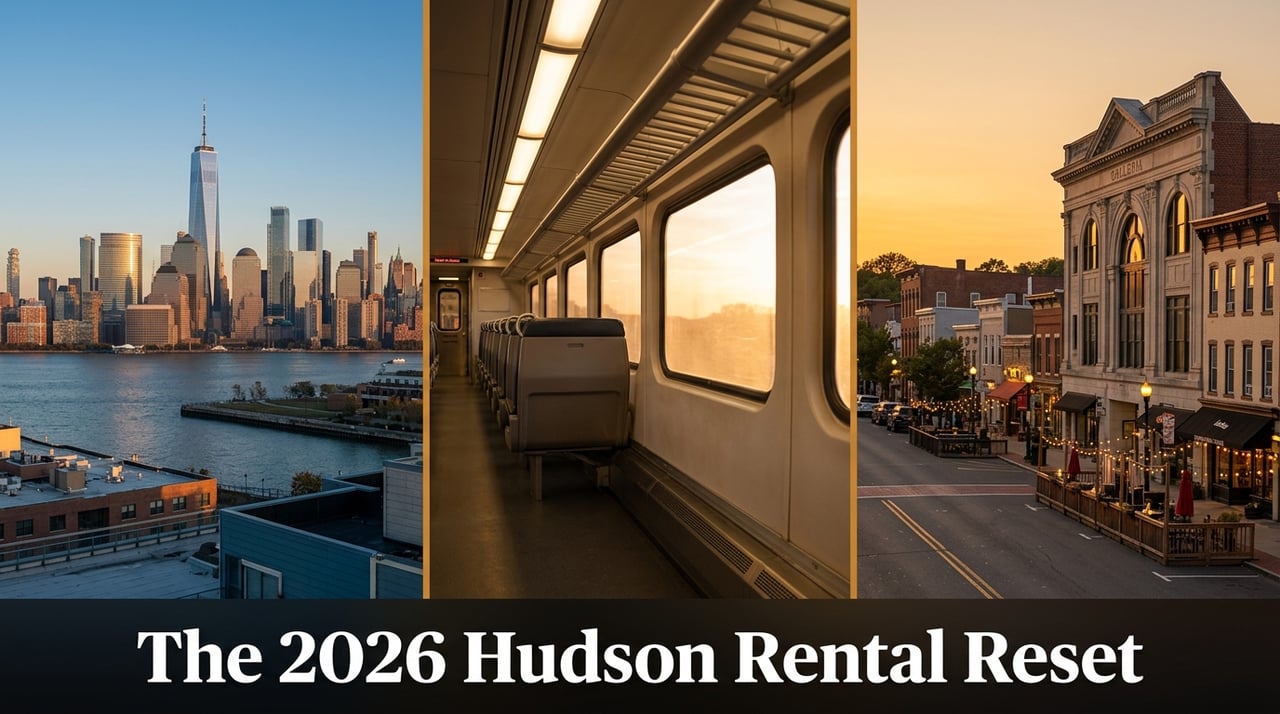
Hudson County's rental market is doing something it hasn't done in years. As of April 2026, the median apartment rent in Jersey City is $2,745 — down roughly 10% year-over-year per national rent index data*. Class A vacancy across Northern New Jersey has climbed to 10.7%. Two months of free rent — the kind of concession landlords largely stopped offering after 2021 — is back at lease-ups in Journal Square, Hoboken, and along the Weehawken waterfront.
Buried in a March 2026 Trepp report on commercial mortgage delinquencies is the line that explains why: New York and New Jersey together account for 48% of all new multifamily distress in the country.
That's the macro. The local effect is Hudson renters making decisions they were not making 18 months ago — and a meaningful share of those decisions involve a one-way move out of Hudson County altogether.
Above the Streets: Red Bank and the Netflix-driven migration into Monmouth County.
Most renters in Jersey City and Hoboken haven't noticed the cooling because the headline numbers conceal it. Posted asking rents at most luxury towers look roughly flat from last year. The story shows up only when you look at what landlords are actually accepting — and what they're throwing in to close a deal.
According to the Q3 2025 multifamily report from Matthews Real Estate Investment Services, vacancy in newer Class A assets across Northern New Jersey climbed to 10.7%, with the heaviest pressure concentrated in construction-saturated submarkets across Lower Essex County, Greater Newark, and Northeast Morris County. Rent growth across the region as a whole slowed to 2.0% year-over-year by late 2025 — a sharp deceleration from the 4.2% pace Berkadia had recorded the prior year.
Closer to the river, the numbers are starker. April 2026 rental tracking data put Jersey City's median apartment rent at $2,745*, a roughly 10% drop from the prior year. That's the gap between the rent on a sign and the rent in a signed lease — and that gap is being closed almost entirely with concessions.
At The Journal — Kushner's 1,723-unit Journal Square delivery that opened its first tower in mid-2025 and its second in January 2026 — leasing reached the 50% mark by mid-March on the back of two-month free-rent offers. Similar concessions are appearing at Overlook Flats in Jersey City, Henley on Hudson in Weehawken, and along the 600 Harrison corridor in Hoboken. Posted rates of $3,065 to $5,840 for one and two-bedrooms at The Journal have not changed materially. The effective rent has.
Concessions of the size showing up at Class A lease-ups today don't appear when landlords feel comfortable. They appear when capital pressure is real. The clearest read on that pressure comes from the commercial mortgage-backed securities market.
Trepp reported in early April 2026 that the multifamily CMBS delinquency rate hit 7.15% in March — a new high, and a 171 basis point jump from the prior year. The bigger reveal came from Trepp's head of applied research, Stephen Buschbom, in commentary to Multifamily Dive: roughly 48% of the new multifamily delinquent loan balances added in March came from properties in New York and New Jersey alone. Combined with Houston, the two-state corridor accounts for nearly 80% of every new dollar of distress in the multifamily CMBS universe nationally.
That's the part most consumer rental coverage misses. The distress isn't only refinance-driven. It's also operating-pressure driven — and that's harder to disguise. When a landlord's net operating income is being squeezed by insurance costs, property tax escalations, and labor expense growth all at once, the lever they pull to keep occupancy from falling is concession size. Rent on the lease stays high to protect the loan-to-value calculation. Two months of free rent get added at the bottom.
For a renter, that gap between sticker rent and effective rent is real-dollar leverage. For a landlord, it's a structural problem that will keep recurring as long as new supply keeps arriving and operating expenses keep climbing. Northern New Jersey has roughly 8,000 multifamily units still under construction, with Class A representing about two-thirds of that pipeline. Most of those will deliver into 2026 and 2027.
A reasonable first reaction to a softer Hudson rental market is to renegotiate and stay. That math works for some renters. It does not work for the ones our team has been seeing convert to buyers across the state.
The stay-and-renew calculation looks something like this. A two-bedroom in Jersey City that was renting at $4,200 last year is now achievable at $3,900 with a one-month concession built in — an effective rent closer to $3,575 over the lease term. That's a meaningful saving. It's also another twelve months of housing payments that build no equity, against a background where the median listing price in Hudson County is down year-over-year — a dynamic our team broke down in detail in the Jersey City Q1 2026 market report.
The renters making the second-jump decision tend to fall into one of three buckets. The first is hybrid commuters who finally accepted that two or three days a week in Manhattan does not require a fifteen-minute PATH ride. The 70-minute North Jersey Coast Line ride from Red Bank is a different commute on paper than the 12-minute Grove Street PATH ride; on three commuting days a week, the cost difference between an $850,000 Red Bank townhome and a $4,200 Hudson rental closes the gap.
The second bucket is income-qualified families with school-aged children who were always going to leave for schools eventually, and now have a reason to stop waiting. The third is single buyers and couples in their late 20s and 30s who priced out of Hudson sales — where the listing median is still around $696,500 and waterfront premiums climb well past $1 million — and noticed they're no longer priced out of Cranford, Rahway, or Scotch Plains — where property tax planning matters as much as the purchase price.
All three of those buyer profiles share one trait. They've already made a peace with leaving New York. They are not going to relitigate that decision. They are simply asking which New Jersey market actually fits the life they want to live next.
Monmouth County is absorbing the Hudson renters who decided the trade was worth making for lifestyle reasons rather than pure cost. The buyer profile skews hybrid-work, late-30s to mid-40s, and well above the median for Hudson rental income. The North Jersey Coast Line carries them into Penn Station in roughly 65 to 75 minutes from Red Bank, and a meaningful share of the recent buyers our team has worked with commute two or three days a week, not five.
Pricing varies sharply by submarket. Red Bank townhomes and condos are running in the $625,000 to $850,000 range for newer product, with single-family inventory above $900,000. Asbury Park's condominium market is bifurcated — entry-tier units near downtown trade in the high $400,000s while waterfront product clears well past $1 million. Long Branch's condo segment is the closest thing in the county to a direct Hudson substitute, with newer two-bedrooms transacting in the mid-$500,000s. Rumson is its own market and its own conversation.
Worth flagging two value plays in the northern Bayshore corridor that don't usually appear on Hudson-renter radar. Matawan sits on the same North Jersey Coast Line as Red Bank with materially lower entry pricing, and our team has tracked accelerating Staten Island and Hudson buyer interest there throughout early 2026. Cliffwood Beach in Aberdeen is the most overlooked pricing tier in the corridor — Raritan Bay waterfront access at a Bayshore price point.
Netflix's Fort Monmouth studio commitment — closing December 2025 with 1,500 permanent jobs and a $387 million Aspire tax credit — has accelerated the pipeline of secondary demand that supports Monmouth's residential pricing through 2027 and beyond. The Above the Streets: Red Bank video at the top of this post covers that dynamic in more detail. The companion Above the Streets: Asbury Park piece walks the condo market and downtown directly.
Union County is the destination for the Hudson buyer profile that prices out of Hoboken sales but still qualifies comfortably for a $600,000 to $850,000 mortgage. The Raritan Valley and Morris & Essex lines connect into Penn Station and Hoboken Terminal in roughly 40 to 55 minutes, which keeps the commuter math intact for hybrid workers and reasonable for full-time office workers.
The school district hierarchy drives most of the pricing. Westfield and Scotch Plains anchor the high end of Union County family pricing — Westfield single-family medians regularly clear $850,000 and competition for inventory in the $700,000s through $900,000s remains real. Cranford has emerged as the move-in market for younger Hudson exits — strong walkable downtown, NJ Transit station, and pricing that still starts in the $625,000 range for a three-bedroom. Rahway is doing what Cranford did five years ago — condo prices in the high $300,000s and low $400,000s, walkable rail access, and a development pipeline that's bringing fresh product online through 2027.
Garwood is the small-town surprise in this cluster. Half-mile from the Westfield border, on the Raritan Valley Line, with sub-Westfield pricing and accelerating attention from buyers priced out of its larger neighbor. Buyers who could have stretched to a $1.1 million Westfield purchase are increasingly settling on a $725,000 Garwood single-family with the same school district draw region and a meaningfully smaller monthly payment.
Essex County's transit-oriented towns are absorbing the Hudson family buyer who prioritizes school district above almost every other factor. Maplewood's median has settled around $815,000 in early 2026 after a four-year run, with finalized sales between $857,000 and $999,000 depending on neighborhood and architectural style. Montclair pricing remains stratified by neighborhood; Upper Montclair and Estate Section pricing clear $1.4 million regularly while South End and Watchung Plaza submarkets transact in the high $800,000s.
South Orange and Maplewood share a school district, share the South Orange-Maplewood line into Penn Station in 38 to 42 minutes, and share a buyer profile that overlaps almost exactly with the Brooklyn-to-Essex pipeline our team has tracked since 2024. Hudson exits into this cluster behave similarly. They are buyers who already lived in the New York metro, already accepted the cost of New Jersey property tax, and are now choosing a lower density market for school-age planning rather than a financial reset.
Bloomfield is the value floor of the cluster and the single most active Hudson-exit market in Essex County's lower price tier. Single-family pricing starts in the high $400,000s for transit-walkable inventory near the Bloomfield NJ Transit station, with Montclair-border streets pulling into the $625,000 to $725,000 range. The recently completed and currently leasing 110 Washington and Royal Bloomfield rental towers tell a parallel story to the Hudson rental market — luxury concessions, Class A vacancy pressure, and a renter population already comparison-shopping ownership against rent.
There's a reason this conversation matters now rather than next year. New multifamily construction starts in Northern New Jersey have collapsed since the 2022 peak. Matthews' Q3 2025 report notes that completions are expected to step down sharply after 2025's final 5,000-plus unit wave. By 2027 and 2028, the supply curve flips — fewer deliveries, fewer concessions, and a return of pricing power to landlords.
For renters considering the move to ownership in Monmouth, Union, or Essex, the same supply dynamic is working in reverse. The for-sale segments that have softened the most in 2026 — condos, townhouses, and adult community properties — are precisely the ones where today's buyers have leverage. Statewide, the townhouse and condo segment posted a 2.9% year-over-year median price decline in early 2026, with sale-to-list ratios slipping below 100% for the first time in four years. Days on market for the condo segment rose more than 56%.
If you're a Hudson renter on a lease ending between now and Q1 2027, this is the cleanest buyer window I've seen since 2019. The combination of softer condo and townhouse prices, stable mortgage rates, and meaningful Hudson rental concessions to negotiate against has reset the math. By Q3 2027, when the multifamily supply tap turns down and Hudson lease-ups finish absorbing, the leverage moves back to sellers.
There's a tactical wrinkle worth being honest about. At today's mortgage rates and current Monmouth, Union, and Essex pricing, the all-in monthly carry on a starter purchase isn't dramatically lower than the all-in rent on a Class A Hudson one-bedroom. Some scenarios it's modestly higher. The case for buying isn't that the monthly cash flow swings dramatically. The case is that every dollar of principal paid is equity instead of contribution to a landlord's debt service ratio, that property tax and mortgage interest carry meaningful tax treatment, and that the housing cost is fixed at the front end rather than reset every twelve months.
Anthony Licciardello has helped renters from Hoboken, Jersey City, and Newark relocate into ownership in Monmouth, Union, and Essex Counties for over 20 years. NYS/NJ Licensed Broker · The Prodigy Team.
Call (718) 873-7345Yes — but unevenly, and mostly through concessions rather than posted rate cuts. April 2026 national rental tracking data put Jersey City's median apartment rent at $2,745, down roughly 10% year-over-year. Posted asking rents at most luxury towers look closer to flat, but landlords are quietly closing leases at one to two months free, which moves the effective rent significantly below the sticker number. Class A vacancy across Northern New Jersey has climbed to 10.7% per Matthews Real Estate's Q3 2025 report, which is the structural reason for the concession environment.
Not always cheaper on monthly cash flow at current mortgage rates — but generally cheaper on total cost of housing once equity accumulation, tax treatment, and locked-in housing cost are factored in. A renter paying $4,200 in Jersey City typically faces roughly the same all-in monthly carry on a $475,000 to $550,000 purchase in Long Branch, Rahway, or Bloomfield with 10% down. The difference is that the mortgage payment builds equity and the monthly cost is fixed for the loan term, while a renewed Jersey City lease resets every twelve months.
Be careful with this one. The CMBS distress data on multifamily applies almost entirely to rental towers, not for-sale condominiums. Some unsold luxury condos are quietly pivoting to the rental market to cover holding costs — that creates downward pressure on Hudson asking rents, not on Hudson sales prices. Sheriff sale activity at individual luxury condo addresses exists but is sporadic, hard to access, and generally not a competitive entry point for owner-occupant buyers. The cleaner buying opportunity in 2026 is in Monmouth, Union, and Essex condo and townhouse inventory where the segment-wide softening is already visible in median prices and days-on-market data.
Data sources cited in this analysis: Trepp CMBS Delinquency Report (March 2026); Multifamily Dive commentary on Trepp data (April 2026); Matthews Real Estate Investment Services Northern New Jersey Multifamily Report (Q3 2025); Berkadia Northern New Jersey Multifamily Research; Zumper National Rent Report (April 2026); Realtor.com Hudson County listing data (March 2026); Real Estate NJ reporting on The Journal lease-up; Regional Plan Association Hudson Tunnel Project economic analysis; New Jersey Alliance for Action 41st Annual Construction Forecast (November 2025). Figures are reported as of publication date and subject to revision.
Prodigy Real Estate is an innovative real estate company offering high-end video production, home valuation services, purchasing, and home sales. Serving New York and New Jersey.