
Anthony Licciardello | April 10, 2026
City Of Yes
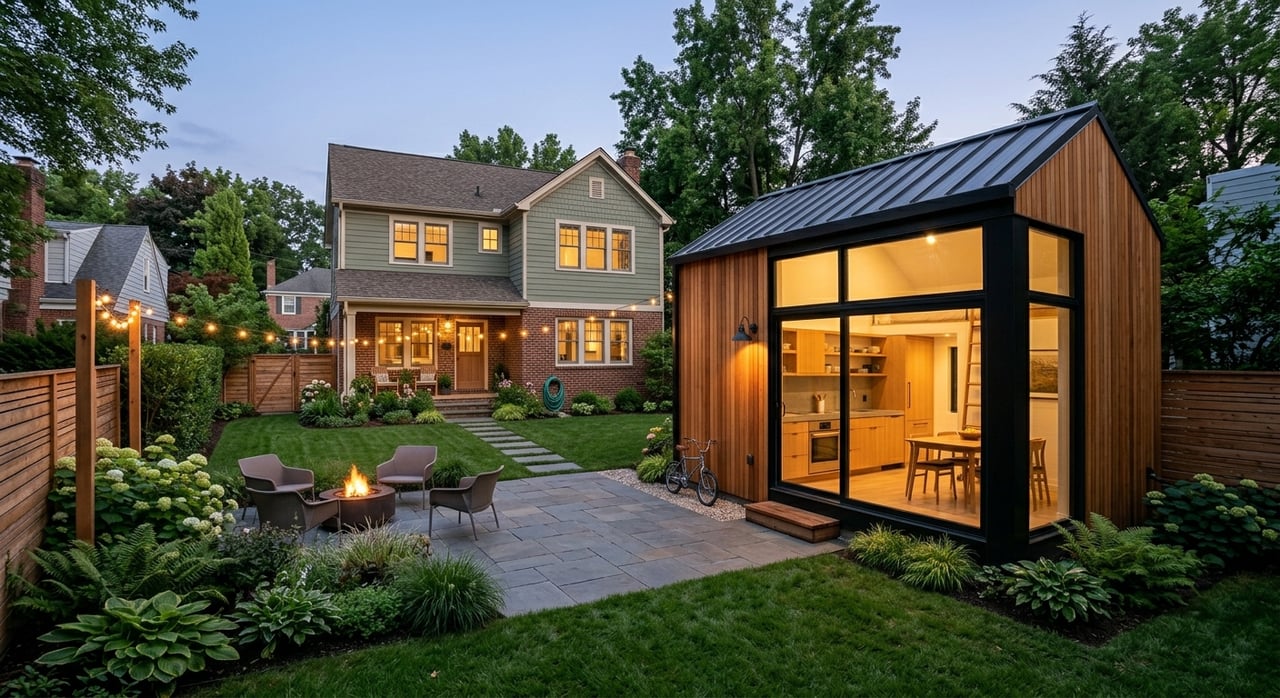
Accessory dwelling units — backyard cottages, converted garages, legalized basement apartments — are now authorized in New York City. The City of Yes for Housing Opportunity, passed December 5, 2024, specifically targets the one- and two-family detached lots that define Staten Island's residential landscape more than any other borough. At the same time, the state and city are offering up to $395,000 in financing through the Plus One ADU Program — reopened in March 2026 for the first time since its initial intake closed two years ago. This guide covers the exact dimensional rules, the building code requirements, the Local Law 126 compliance timeline for existing basement units, and what the filing process looks like this year.
For most of the six decades following New York City's 1961 zoning overhaul, adding an independent second unit to a detached one- or two-family home was either prohibited outright or made practically impossible by off-street parking mandates, floor area ratio constraints, and restrictions that automatically reclassified a third unit as a multiple dwelling. That era ended when the City Council approved the City of Yes for Housing Opportunity on December 5, 2024 — the most sweeping amendment to the city's Zoning Resolution in its history.
The law grants homeowners the as-of-right ability to build ADUs in one- and two-family homes across low-density residential districts R1 through R5. This covers the overwhelming majority of Staten Island's residential fabric. The city projects that the full City of Yes program will enable 80,000 new housing units citywide over 15 years, with approximately 25,000 of those coming specifically from ADUs added to one- and two-family properties. On a borough built overwhelmingly on detached and semi-detached homes, that is a significant number of eligible properties.
Equally important: the City of Yes eliminates the requirement to add a new off-street parking space when constructing an ADU. For homeowners converting an existing garage, the previously required spaces may be omitted entirely if the underlying zoning allows it. The parking mandate was historically one of the most effective — if indirect — barriers to secondary unit construction. Its removal changes the financial calculus on a wide range of conversion projects.
As-of-right authorization does not mean unlimited. The new zoning establishes strict dimensional parameters designed to keep ADUs subordinate to the primary structure and prevent overwhelming neighborhood infrastructure. Understanding these constraints before hiring an architect or selecting a pre-approved plan avoids costly surprises mid-project.
| Constraint Category | City of Yes Requirement |
|---|---|
| Units per lot | One ADU only on single- or two-family properties |
| Building type exclusion | Prohibited on row houses, townhomes, and attached buildings (with limited exceptions) |
| Maximum floor area | 800 square feet of zoning floor area |
| Rear yard coverage | Detached footprint cannot exceed 33% of required rear yard area |
| Height (detached) | 1 story / 15 feet max; above-garage units limited to 2 stories / 25 feet |
| Building separation | 10 feet minimum between detached ADU and other structures on lot |
| Property line setbacks | 5 feet from all lot lines (existing garage conversions may retain non-compliant setbacks) |
| FDNY access — distance | Detached ADU must be within 100 feet of the street curb |
| FDNY access — path | Continuous 5-foot clear access path from street to unit, unobstructed by fences or equipment |
| Owner occupancy | Property owner must reside in primary dwelling or ADU at initial occupancy |
The FDNY access path requirement narrows the field significantly. It effectively rules out detached ADUs on narrow lots and any property where a continuous five-foot clearance from the street to the rear yard cannot be maintained. Homeowners on attached buildings or lots without usable side-yard access will generally not qualify for detached rear yard construction — interior conversion and attic typologies become the more viable path for those properties.
Geographic prohibitions layer on top of dimensional ones. ADUs are not permitted in designated historic districts. Low-density contextual zones — R1A, R2A, and R3A — prohibit ADUs entirely unless the property falls within a Greater Transit Zone. Environmental risk adds a third layer: ADUs in coastal flood zones must be physically elevated above the base flood elevation, and basement or cellar ADUs are prohibited entirely in high flood risk areas, including the 2050 Stormwater Flood area, the 2080 100-year coastal flood zone, and Special Coastal Risk Districts. For Staten Island's South Shore communities, this restriction requires site-specific verification before any project moves forward.
Zoning law determines where an ADU can go. Building code determines how it must be built. Local Law 127 of 2024 added Appendix U to the New York City Building Code, establishing mandatory technical standards for every new ADU in a one- or two-family home.
All habitable rooms in an ADU — including basement units — must achieve a minimum ceiling height of 7 feet. For cellar ADUs specifically, the ceiling must sit at least two feet above the exterior grade plane to qualify as habitable. Kitchens and other habitable spaces require a minimum of 60 square feet of floor area and a minimum horizontal dimension of six feet. Every habitable room must include at least one window facing outdoors, with total glazed area equal to at least 8 percent of the room's floor area. Where mechanical ventilation systems are installed, reduced window requirements apply — a necessary flexibility for deep basement configurations where natural light is limited.
ADUs are not required to pull separate utility service lines from the street, but they must be equipped with independent controls, disconnects, and shutoffs for heating, cooling, electrical, and gas systems. Water supply may be shared but requires its own shutoff valves.
Automatic sprinkler systems are mandatory for most ADU configurations. Detached backyard units, attic ADUs, and subgrade (basement and cellar) units must all carry a full NFPA 13D sprinkler system. If a building has three or more stories and incorporates a cellar ADU, the entire building must be sprinklered — not just the ADU itself. The only configuration that avoids the sprinkler mandate is an above-grade ADU created entirely within the existing envelope of a one-family home.
Egress requirements are equally strict. Every ADU must satisfy Chapter 10 of the Building Code. Cellar ADUs require two completely independent exits. All habitable rooms must feature Emergency Escape and Rescue Openings sized to allow occupant escape and firefighter entry if the primary exit is blocked.
Adding a third unit to a two-family building has historically triggered New York State's Multiple Dwelling Law — reclassifying the building and imposing a set of compliance requirements that made most projects financially unworkable. Appendix U provides a statutory bypass. If the new ADU is separated from the rest of the building by a 1-hour fire-rated wall of non-combustible materials, the building avoids the MDL reclassification and remains regulated under the significantly less burdensome standards for one- and two-family structures. This separation detail is a critical design decision that must be resolved early in the architectural process.
In September 2021, the remnants of Hurricane Ida delivered 3.47 inches of rain per hour in some parts of New York City — nearly double the capacity of the city's sewer infrastructure. At least 11 people drowned in illegal basement and cellar apartments. Five of the six buildings where deaths occurred were unlawfully converted units that lacked proper egress. Most victims were immigrants and low-income New Yorkers with no viable alternative in a rental market that the 2023 Housing and Vacancy Survey would later document as the tightest in over 50 years.
Local Law 126 of 2024, codified as Article 507 of Chapter 5 of Title 28 of the Administrative Code, addresses this crisis through a city-wide amnesty framework. Property owners with existing illegal basement or cellar units can apply for an Authorization for Temporary Residence — a shield from immediate DOB enforcement actions — in exchange for committing to a structured, 10-year compliance schedule that ultimately produces a fully legalized, code-compliant dwelling unit.
To qualify for the pilot, the basement or cellar unit must have existed prior to April 20, 2024. Property owners have until April 20, 2029 to apply. Units located in designated flooding risk areas are ineligible. Before an ATR is issued, the unit must already have hard-wired smoke and gas alarms, central heating, at least one functional means of egress, and separation of the boiler or furnace from the living space. Short-term rentals are prohibited from the outset.
| Deadline | Required Milestone |
|---|---|
| 3 months | Submit initial required documentation to DOB |
| 1 year and 6 months | Obtain plumbing permit for mandatory sprinkler system |
| 2 years | Install sprinkler system; pass DOB/FDNY inspection |
| 3 years | Submit architectural application for Emergency Escape and Rescue Openings (EERO) and window wells |
| 4 years | Final sign-off on EERO, windows, and window wells |
| 7 years | Submit application for second independent cellar egress |
| 8 years | Final sign-off on second cellar egress |
| 9 years | Submit application for Certificate of Occupancy or TCO |
| 10 years | All compliance finalized; ATR ends; unit fully legalized |
If the scope of work requires the tenant to temporarily vacate — for excavating window wells or installing a fire-rated separation wall — the Department of Housing Preservation and Development mandates a Right of First Return. The owner must provide written notice detailing the work scope, its start date, and the tenant's right to re-lease the newly legalized unit once construction is complete.
The financial reality of ADU construction in New York City is severe. A new detached backyard cottage typically costs $200,000 to $300,000 or more, depending on soil conditions, utility trenching depth, prevailing material costs, and union labor rates. Deep subgrade conversions can exceed those figures considerably. For most Staten Island homeowners, traditional commercial financing at current interest rates is not an accessible path.
The Plus One ADU Program closes that gap. Funded by New York State Homes and Community Renewal and administered locally by the NYC Department of Housing Preservation and Development in partnership with Restored Homes HDFC, the program provides qualified homeowners with up to $395,000 in combined financing — low- and zero-interest loans paired with direct construction financing grants. The partnership with Restored Homes HDFC also provides end-to-end technical support: design coordination, contractor bidding and selection, construction oversight, and compliance with MWBE utilization requirements. Homeowners are not handed raw capital and left to navigate the construction industry alone.
Homeowners may earn up to 165 percent of Area Median Income (AMI), with priority preference given to those at 120 percent AMI or below — approximately $182,000 per year for a family of four in New York City in 2026. The applicant must owner-occupy the property, which must be a detached, semi-detached, or semi-attached one- or two-family home. All existing mortgages must be current and there can be no outstanding municipal arrears, unless the owner is enrolled in an active payment plan. ADUs financed through the program are subject to potential rent restrictions to ensure the new units generate community-level affordability rather than pure investment returns.
The first round of Plus One applications, which opened in early 2024, closed in February 2024 after receiving more than 1,300 submissions in just two weeks. Staten Island ranked among the top three boroughs by application volume, alongside Queens and the Bronx — a direct reflection of the borough's concentration of eligible detached lots. The program was then paused while HPD processed applications. Mayor Zohran Mamdani's administration reopened it on March 18, 2026. The current application window closes June 12, 2026.
Beyond the primary grant, the New York State Housing Trust Fund Corporation is actively building a secondary network of Community Development Financial Institutions authorized to originate 0 percent interest amortizing gap loans. This second layer of capital is specifically designed for homeowners who exhaust primary grant funding before their project is complete.
Legal occupancy of any new ADU in New York City requires a Certificate of Occupancy or Temporary Certificate of Occupancy. The process is sequential, dependent on licensed professionals, and strictly enforced. There is no shortcut past the final inspection gauntlet.
The city's ADU for You platform, launched March 18, 2026 by HPD and the Department of Buildings, is the designed entry point. The website includes a site feasibility tool homeowners can use to determine whether their lot qualifies under current zoning, a cost estimating tool, and a Pre-Approved Plan Library — a growing collection of designs already reviewed and generically approved by the DOB for building code compliance. Selecting a pre-approved design allows the applicant to bypass the full design review process and connect directly with the Registered Design Professional who created it, dramatically reducing permitting timelines. Custom builds and interior conversions still require full architectural drawings from scratch.
All ADU applications under Local Law 127 must be filed through the DOB NOW: Build portal using an NYC.ID account. The homeowner's Registered Design Professional submits the initial Plan/Work Application (PW1), declaring the scope as an ADU and triggering additional required data fields — including the pre-approved plan number, ADU location on the lot, and primary entrance orientation. After the DOB completes its plan examination, all active permits — General Construction, Plumbing, and Electrical — must be pulled before work begins.
Final inspections include sign-offs on construction, plumbing, electrical, and fire protection systems — specifically the NFPA 13D sprinkler installation. There can be no open applications or outstanding violations on the property at the time of CO application. All municipal fees must be paid and the Owner's Cost Affidavit must be on file. Any violation found during a final inspection triggers a mandatory remediation and reinspection cycle before the CO is issued.
The Great Kills and Eltingville sections of Staten Island — with their concentration of detached one- and two-family homes on lots with rear yard depth — represent some of the highest ADU potential in the borough. The Prodigy team works with homeowners across Staten Island on the real estate implications of ADU additions, from how a new unit affects assessed value to how to position the property for an eventual sale.
Prodigy Real Estate is an innovative real estate company offering high-end video production, home valuation services, purchasing, and home sales. Serving New York and New Jersey.