
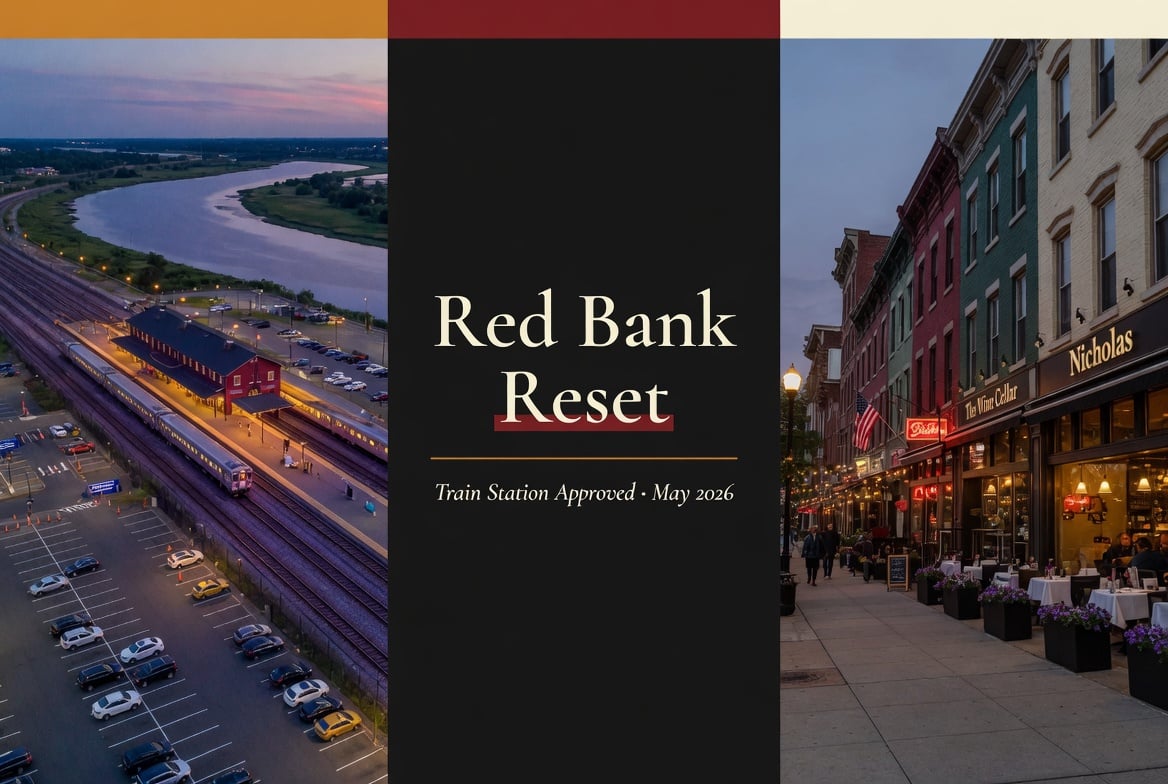
A planning board greenlight, a 40-unit riverfront proposal, a $2.99M closing, and a 153-unit affordable housing mandate sitting behind every approval. The May 2026 beat from one of New Jersey's most consequential redevelopment zones.

Red Bank has spent the last decade as one of the most-discussed but least-decided boroughs in Monmouth County. The downtown has always punched above its weight — restaurants, walkability, Two River Theater, the Count Basie, the Navesink behind it, and one of the most layered restaurant ecosystems at the Shore — but the actual built environment has lagged the vision. That changed this month. With the Planning Board's approval of the Train Station Redevelopment Plan, the borough has formally moved from talking about transit-oriented density to permitting it. Combined with active proposals on Shrewsbury Avenue, the borough's S50/A4 fair-share obligation, and a still-resilient luxury sale segment, May 2026 reads less like a normal monthly beat and more like an inflection point in the broader Red Bank rebuild.
This is the deep-beat read on what was approved, what's pending, what closed, and how it changes the calculus for anyone holding, buying, listing, or developing inside the Red Bank radius — including the surrounding pull-zones, where boroughs like Fair Haven and Rumson already absorb spillover demand the central market cannot satisfy.
The Train Station Redevelopment Plan Is Approved — And It's Bigger Than the Headlines Suggest
The Planning Board's approval of the Train Station Redevelopment Plan formally clears the largest land-use ambition Red Bank has carried in decades. The footprint — roughly 25 acres anchored by NJ Transit's parking lots and the North Jersey Coast Line and extending into properties around West Street and Oratory Way — is not a single tower or a single block. It is, functionally, the redrawing of an entire district around the rail line.
The plan, led by developer Denholtz, contemplates hundreds of new apartments distributed across mixed-use buildings, ground-floor retail, public plazas, structured parking, and a new internal street network. The earlier concept was reportedly scaled back in response to public concern over density and traffic — a meaningful detail. It tells you the borough is committed to the project shape but flexible on the dial.
Why this is the inflection point, not just a headline
For most of the last cycle, Red Bank's redevelopment posture was reactive: project by project, parcel by parcel, mostly downtown-adjacent. The approved plan is the opposite. It establishes a redevelopment area, with rules of engagement that will govern individual site approvals for years — the kind of structural shift documented in the borough's 2023 Master Plan, which traces every recent rezoning back to a single coordinating framework.
That shifts the underwriting math for anyone holding land within or adjacent to the zone — and it shifts the school of fish, too. Expect more institutional capital sniffing parcels along Red Bank's West Front, Bridge Avenue, and Shrewsbury Avenue corridors over the next 12 to 24 months than the borough has seen in any prior period. The pattern mirrors what's playing out across the rest of Monmouth County's major redevelopment sites, from Fort Monmouth to Monmouth Park.
There is also a quieter signal in the approval itself: the borough is voting with its planning code that it sees its long-term tax base as urban-density-driven rather than preserved-suburban. That is a directional bet, and once made, it is hard to unwind.
Shrewsbury Avenue Quietly Becomes Red Bank's Other Redevelopment Corridor
While the train station plan absorbs the headlines, an approximately 40-unit residential redevelopment proposal along Shrewsbury Avenue continues moving through active review. Earlier discussions emphasized riverfront connectivity, pedestrian access, public walkway improvements, and higher-density housing situated close to downtown — all of which align directly with the design priorities in the borough's redevelopment framework.
Treated as a one-off, the Shrewsbury project is a 40-unit apartment building. Treated as part of a pattern, it is something more interesting: confirmation that Red Bank is now operating with two simultaneously active redevelopment corridors — the rail district and the river-adjacent western edge. That dual-corridor reality is what separates this cycle from prior ones.
For agents and sellers in the surrounding micro-markets, the message is the same: walkability premium is no longer hypothetical. It is being capitalized. That tracks with the broader pattern of NYC buyer migration into transit-anchored Monmouth boroughs — buyers who, on a spreadsheet, will pay for the rail and the downtown in the same line item.
A 32-Unit Neurodiverse-Supportive Housing Approval — Smaller Project, Larger Signal
A separate Shrewsbury Avenue approval involves 32 one-bedroom units of neurodiverse-supportive housing — a specialized residential model that received conditional zoning approval despite public concerns over parking, traffic, and neighborhood density.
It is a small project numerically and a meaningful one structurally. Approvals like this reflect a broader New Jersey trend toward inclusionary housing, specialized residential typologies, and zoning flexibility around use-cases that don't fit cleanly into traditional multifamily templates. The state's S50/A4 affordable housing legislation, passed in March 2024, rewrote how municipalities calculate fair-share obligations and handed Red Bank a 153-unit affordable target within two years. The neurodiverse-supportive project, the Shrewsbury Avenue 40-unit, and the train station plan are not three unrelated approvals. They are three pieces of the same compliance arithmetic.
The same flexibility pattern is also visible in adjacent housing policy — see, for example, the ADU friendliness gradient across Monmouth and Somerset counties, which tracks the same political appetite for non-traditional density.
The broker-side read: expect more of these in Red Bank and across walkable Monmouth boroughs — including premium-priced ones like Fair Haven, which carry their own fair-share math — over the next several years.
What the Borough Is Actually Telling You Through Its Zoning
Step back from individual projects and the pattern becomes clearer. Three policy currents are running simultaneously through Red Bank's planning posture, and each one materially changes underwriting and listing strategy in the surrounding market.
1. Transit-oriented development is now the default lens
Density near the rail, mixed-use ground floors, and pedestrian-first plans are not concessions to a developer's preferred concept — they are the borough's articulated preference, reinforced by the fact that Red Bank's NYC commuter profile is one of the borough's most durable competitive moats. The same playbook is running in nearby Eatontown, where Bell Works and Monmouth Square are reshaping a corridor an order of magnitude larger.
2. Building heights are creeping up — quietly
Newer redevelopment zones are accommodating four to six story buildings, greater residential density, and reduced parking ratios in some areas. None of those numbers are dramatic by urban standards. All of them are meaningful by Red Bank standards.
3. Regional Center status — the strategic prize underneath all of this
Red Bank held New Jersey State Planning Commission "Regional Center" status for nearly three decades before it expired in March 2023, and regaining it is a central organizing goal — final endorsement is expected in early 2026. Regional Center status unlocks state technical assistance, prioritized infrastructure funding, and regulatory alignment. Combined with the broader Monmouth County development pipeline, that designation explains a great deal about why the train station plan moved when it did.
Notable Recent Sales — The Numbers That Tell You Demand Hasn't Cooled
The clearest evidence that Red Bank's underlying demand thesis is intact sits in the closed-sale data. The luxury segment is still pricing; the move-up segment is still trading; and the river-adjacent product remains the most resilient sub-category in the borough.
| Address | Sale Price | Segment Read |
|---|---|---|
| 50 Northover Place | $2.99M | Top closed comp · luxury still pricing |
| 7 Buchhop Lane | ~$2.66M | High-end segment still active |
| 78 West Front Street | ~$2.0M | Prime downtown/waterfront corridor |
| 33 Washington Street | ~$811K | Move-up segment functional |
| 33 Chapin Avenue | ~$783K | River-view townhouse demand holding |
The diagonal that matters: a $2.99M closing and a $783K river-view townhouse in the same monthly tape, in the same borough, while the borough simultaneously approves its largest density expansion in decades. That is not a market struggling for direction. The spillover dynamic into Fair Haven's roughly $1.4M median — where active inventory routinely sits in the single digits — confirms that pricing strength is regional, not isolated.
Pricing Strength, Rate Resilience, and a 14-Day Median Days-to-Pending
Strip the development beat away and the housing market itself is the second story. Average home value sits at approximately $704,000, up roughly 6.8% year-over-year. Median days to pending hover near 14. Those three numbers, taken together, describe a market that is supply-constrained, rate-resilient, and still operating in seller's-market mechanics.
New Jersey inventory has been slowly expanding statewide, which gives buyers in many submarkets slightly more leverage than they had in 2024 or 2025. Red Bank has not meaningfully participated in that softening. Walkable, transit-anchored boroughs with downtown amenity density continue to clear quickly. The same pricing logic is visible across the corridor and within the broader NYC-to-NJ migration patterns driving demand into Monmouth.
The Brooklyn and Staten Island buyer cohort is a particularly active force in this segment of the market — a profile that behaves differently than Manhattan-to-Bergen luxury movers and is pointing more directly at Monmouth than any other receiving county.
If you are a seller in this market, the operative truth is that pricing strategy has not yet had to adjust to a softer demand profile. If you are a buyer, the operative truth is that waiting for Red Bank to "give back" pricing is — based on the actual tape — not a strategy that has worked at any point in the last 18 months.
The Public Objections — Real, Documented, and Unlikely to Reverse the Direction
No honest beat report on Red Bank can ignore the public-comment environment. Concerns surfacing at hearings continue to cluster around traffic congestion, parking shortages, school system impact, preservation of Red Bank's character, and broader affordability. These are not fringe objections — they are organized, articulate, and have already shaped at least one revision (the scaled-back train-station concept).
But the directional read is that borough leadership remains committed to redevelopment momentum, particularly near transit and along commercial corridors. There is also a hard constraint behind the politics: missing the S50/A4 153-unit fair-share target opens the borough up to "builder's remedy" litigation, where developers effectively dictate the terms of compliance. That risk gives leadership functional cover to keep approvals moving even where public objection runs hot.
Public pressure has produced refinements, not reversals. The likely outcome is more rigorous traffic studies, more attention to design quality, and probably tighter affordability commitments — none of which slow the underlying density trend. For comparison-shoppers studying lower-density Monmouth options like Holmdel, the Red Bank trajectory is now visibly diverging from preserved-suburban peers.
What to Watch Between Now and the End of Summer
Three forward indicators will tell you whether the May 2026 inflection point holds — or whether it accelerates.
1. Train station refinements and traffic studies
Expect architectural and infrastructure detail, additional hearings, and the first formal traffic modeling. The quality and rigor of the traffic work will set the tone for public reception heading into year-end. Watch also for the State Planning Commission's expected final endorsement of Red Bank's Regional Center designation — a procedural milestone with real implications for infrastructure funding.
2. Riverfront and Shrewsbury Avenue acquisitions
Continued multifamily proposals and likely additional adaptive-reuse acquisitions along the western corridor. Watch for any single transaction north of $5M in this zone — it would meaningfully reset the assemblage math. The broader Monmouth County redevelopment pipeline suggests the institutional capital is increasingly willing to underwrite that price.
3. The next $2M+ closing
Renovated historic homes, downtown walkable inventory, and river-adjacent properties remain the three categories where pricing is most resilient. The next high-end closing — and there will be one — establishes the operating ceiling other listings will price against. Sellers in the surrounding luxury halo, particularly across the Fair Haven–Rumson axis, should be watching this comp set closely.
Red Bank is no longer studying a transformation. It is permitting one. The train station approval, the Shrewsbury Avenue pipeline, the S50/A4 affordable mandate, and the still-clearing luxury tape all point at the same conclusion: the borough has shifted from suburban downtown to transit-oriented mixed-use regional hub, and the next 18 to 24 months will be the most consequential development window Monmouth County has produced in a decade.
Red Bank Development & Market — Reader Questions
What exactly did the Red Bank Planning Board approve in May 2026?
The Planning Board approved the Train Station Redevelopment Plan covering roughly 25 acres anchored by NJ Transit's parking lots and extending into properties near West Street and Oratory Way. The plan contemplates hundreds of new apartments, mixed-use buildings, ground-floor retail, public plazas, structured parking, and a new internal street network. Developer Denholtz continues to lead the project, and the approval fits inside the borough's 2023 Master Plan framework.
How is this likely to affect Red Bank property values nearby?
Areas surrounding West Front Street, Shrewsbury Avenue, Bridge Avenue, and the broader train station corridor are the most likely to see sustained investor activity, redevelopment assemblage attempts, and adaptive reuse opportunities. The directional pressure is upward, though specific block-level impact varies.
Is the Red Bank luxury market still pricing in mid-2026?
Yes. Recent closings include 50 Northover Place at approximately $2.99M, 7 Buchhop Lane near $2.66M, and 78 West Front Street around $2M. Renovated historic homes, downtown walkable inventory, and river-adjacent properties remain the three most resilient luxury sub-categories — a strength that extends into the surrounding Fair Haven and Rumson markets.
What is the S50/A4 mandate and why does it matter for Red Bank approvals?
Senate Bill S50 and Assembly Bill A4, passed in March 2024, rewrote how New Jersey calculates municipal fair-share housing obligations. Red Bank's recalculated mandate is 153 affordable units within a two-year window. Missing the target opens the borough to "builder's remedy" litigation. That hard constraint is the structural reason multiple density approvals are moving simultaneously — including the train station plan and the Shrewsbury Avenue projects.
Could public opposition stop the train station redevelopment?
The plan is approved, which means the principal land-use vote has happened. Public concern around traffic, parking, schools, and character remains active and will continue to shape refinements — most notably traffic studies and possible additional design conditions. The historical pattern suggests these concerns produce project modifications rather than reversals, particularly given the S50/A4 compliance pressure backing borough leadership.
Is now a good time to list a Red Bank-area home for sale?
For most sellers in Red Bank and its immediate halo, the answer is functionally yes. Pricing has not softened, days-to-pending remain compressed, and the redevelopment announcement is a tailwind for sustained buyer interest. The precise timing question is property-specific. A 15-minute conversation with Anthony Licciardello at The Prodigy Team is the most useful next step.
The Prodigy Team Lists Where Monmouth's Next Cycle Is Being Priced
In-house 4K drone and cinematic listing production. A hyperlocal SEO content engine. A NY/NJ/FL social community most brokerages cannot match. Built for sellers in transitioning markets.
Why Sell With Us →