
Anthony Licciardello | May 5, 2026
NJ Real Estate News
By Anthony Licciardello, NYS/NJ Licensed Broker · The Prodigy Team · May 3, 2026
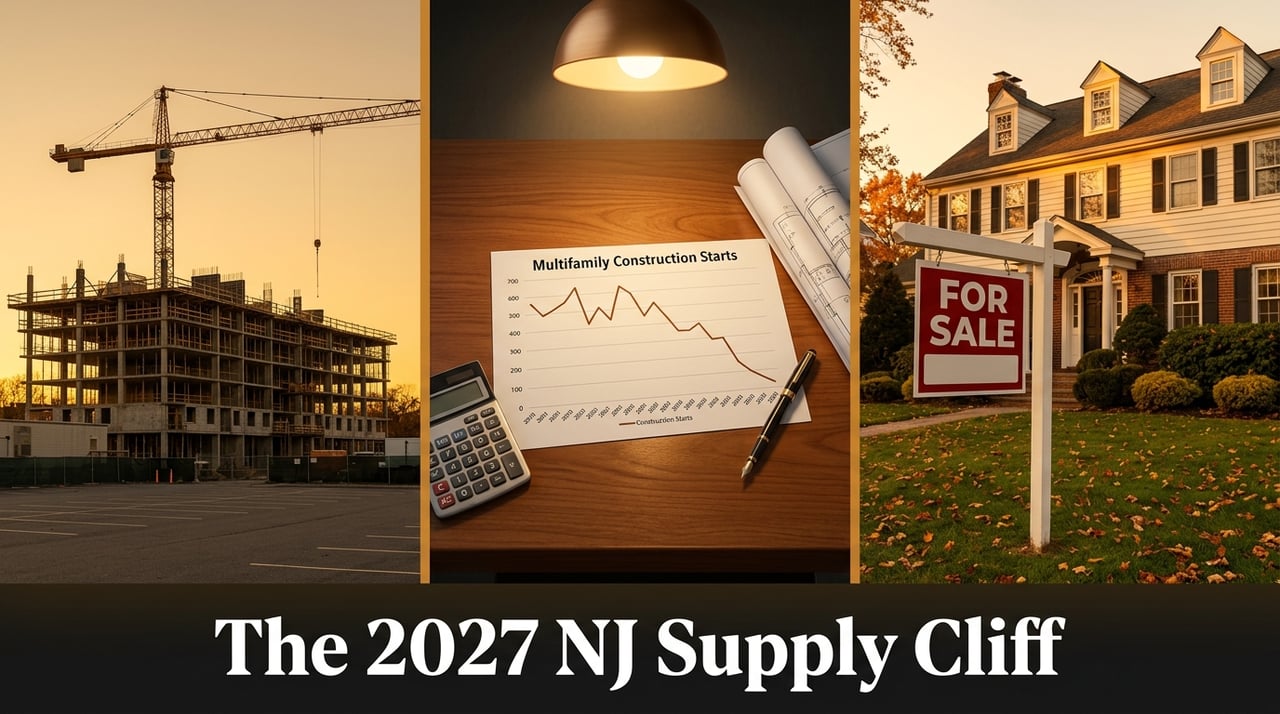
The most consequential New Jersey real estate story of 2027 is one that hasn't happened yet. Apartment construction starts across the country have collapsed since the 2022 peak, the Northeast region has fallen harder than any other, and the math behind that collapse has already locked in a supply environment for 2027 and 2028 that nothing happening this year can undo.
For buyers and renters making a 2026 decision in Northern and Central New Jersey, that future supply environment is the variable that should change how the math gets calculated today. Soft rental concessions don't last forever. Class A vacancy at 10.7% does not become a permanent condition. Sellers who are flexible in 2026 are not necessarily going to be flexible in 2028.
The buyer window opening in 2026 has a closing date attached to it. Here's what the data actually says.
A supply cliff is the predictable downstream effect of a construction starts collapse. Apartments take roughly two to three years from groundbreaking to delivery. The completions hitting the market in 2026 were started in 2023 and 2024. The completions hitting the market in 2027 and 2028 will be the projects that broke ground in 2025 and 2026 — which is precisely the period when starts collapsed.
The numbers are unambiguous. Multifamily construction starts peaked nationally at approximately 547,000 units in 2022 — the highest level in 30 years — according to Harvard's Joint Center for Housing Studies. Starts then fell 14% in 2023, and another 25% in 2024 to roughly 355,000 units. By May 2025, the annualized starts rate had fallen further to 316,000.
Construction takes time. Completions in 2024 hit a 30-year-plus high precisely because so many projects had been started in 2021 and 2022. That elevated completion pipeline is now working through the system. Industry forecasts have apartment deliveries falling from over 500,000 units in 2024 to roughly 300,000 by 2027 — the lowest delivery level in nearly a decade.
Translation for the New Jersey resident: the rental concessions and Class A vacancy that have shaped the 2026 leasing environment will not be available in 2028. The supply that creates them simply will not exist.
Within the national construction collapse, one regional number is doing more of the work than any other. Per CoStar data published in mid-2025, multifamily construction starts in the Northeast region — which includes New Jersey, New York, Pennsylvania, and the New England states — dropped 51.7% year-over-year between the second quarter of 2024 and the second quarter of 2025. That is the steepest regional decline in the country.
By comparison, the West fell 32.8% in the same period, the South fell 32.4%, and the Midwest declined 14.6%. The Northeast figure is roughly 60% sharper than the next-worst region. That gap matters because it tells us where the post-2026 supply shortage will be most acute.
Why the Northeast specifically? Three structural factors stack on top of one another. The first is operating cost — property taxes and insurance carry costs are higher in New Jersey and New York than in Sun Belt comparables, and those expenses have grown faster than rent over the past three years. The second is regulatory complexity — entitlement timelines that are routine in Texas or Florida can take twice as long in suburban New Jersey, which raises the carrying cost of land before construction even begins. The third is the state of the regional debt market — as covered in our companion analysis on the Hudson rental reset, New York and New Jersey together accounted for 48% of all new multifamily mortgage delinquencies nationally in March 2026, which has chilled lender appetite for new construction in the region specifically.
Stack those three together and you get a -51.7% number. New construction is not arriving in time to refill the post-2026 supply pipeline.
Northern New Jersey currently has roughly 8,000 multifamily units under active construction across Hudson, Essex, Union, Bergen, and adjacent counties, with Class A representing approximately two-thirds of that pipeline. Most of those units will deliver into 2026 and the first half of 2027. After that wave finishes, the pipeline runs dry.
Market-rate apartment deliveries across Northern New Jersey are projected to decline by approximately 60% in 2026 compared to 2024 levels. By 2027 and 2028, the regional delivery pipeline will be predominantly affordable housing and partially affordable inclusionary projects rather than the speculative Class A luxury product that defined the 2022 through 2025 supply cycle.
The submarket geography of this matters. The cities that received the most Class A supply between 2023 and 2025 — Jersey City, Hoboken, Newark, parts of New Brunswick — are also the cities where 2026 concession environments are most aggressive. Those concessions will compress as remaining 2026 lease-ups stabilize and 2027 pipeline thinness becomes visible to landlord operators. The pattern is predictable. Concessions narrow in late 2026, posted rents firm up in 2027, and effective rents return to growth by 2028.
For the for-sale market, the dynamic runs in parallel but with one important wrinkle. The condo and townhouse segments that have softened most in early 2026 — particularly in Hudson County, where our Jersey City Q1 2026 market report tracked the inventory dynamics in detail, parts of Monmouth, and southern Ocean County — were softening because of broader inventory dynamics, not directly because of multifamily delivery pressure. The supply cliff still affects them indirectly. As rental concessions narrow in 2027, more renters convert to buyers, more buyer demand pulls into the for-sale segment, and the inventory cushion that exists today gets absorbed.
Three forces drove the collapse, and all three are still active. First, financing. Construction loans that were available at 3.5% in 2021 are now priced at 6% to 7.5%. That single change in capital cost is enough to push most speculative new-development pro formas from "marginal" to "doesn't pencil." Regional banks have also tightened underwriting standards on construction lending across the board, which means even projects that pencil mathematically face a smaller pool of lenders willing to fund them.
Second, equity hesitation. Institutional equity investors looking at multifamily right now have a choice. They can fund new development at construction-loan rates, accept three years of carrying cost, and hope rent growth catches up by lease-up. Or they can buy existing 2022-vintage assets at a discount of 20% or more from peak valuations, with stabilized cash flow and operating histories. Most institutional capital has chosen the second path. That choice removes the equity that would otherwise fund new starts.
Third, operating cost pressure. New Jersey's property tax landscape — covered in our recent breakdown of Scotch Plains 2026 property tax rates and 2027 revaluation — adds escalating operating expense pressure that erodes net operating income. Insurance has doubled or tripled in many submarkets since 2022. Labor costs have climbed. When a developer pencils a new project, all of those expenses are calibrated against rent growth assumptions that have flattened materially. The result is that fewer projects clear the development hurdle rate.
A snap-back in 2026 or even early 2027 is mathematically unlikely. Even if every condition reversed tomorrow — interest rates fell, equity returned, expenses moderated — the lag between starts and deliveries means the 2027–2028 supply hole is already locked in. New starts in the second half of 2026 would not deliver units until 2028 or 2029.
The supply cliff is not just a rental story. It is the structural reason 2026 represents a meaningful for-sale buyer window across Northern and Central New Jersey, particularly in the condo, townhouse, and entry-level single-family segments where current inventory is most flexible.
Three things are happening in 2026 that will not all be true in 2028. Inventory in the most flexible for-sale segments is elevated relative to the 2021–2024 baseline. Mortgage rates have stabilized in a narrower band, which gives buyers predictability they did not have 18 months ago. And rental concessions are still active enough that the comparative cost-of-housing math runs in favor of ownership for an unusually broad slice of the renter population.
The submarkets that benefit most are precisely the ones absorbing the secondary migration wave from Hudson County: Matawan in the Bayshore corridor, Cliffwood Beach in Aberdeen, the Cranford and Rahway transit corridor in Union County, and the Bloomfield-Montclair school-corridor band in Essex County. These are not luxury investment markets. They are working markets that absorb the New Jersey buyer who needs to make a real-world decision in real time.
By Q3 2027, when the multifamily supply tap turns down meaningfully and Hudson lease-up concessions finish absorbing into stabilized rent rolls, the leverage in the for-sale market shifts back toward sellers. The for-sale inventory cushion that exists in 2026 gets absorbed by the wave of renters making the same decision. Buyers who wait until 2028 are buying into a market with less inventory, less seller flexibility, and less rental-comparison leverage in their negotiation.
The most common question I'm getting from buyers right now is whether to wait. My honest answer: the supply cliff is the strongest argument I've seen since 2019 against waiting. The current inventory cushion in Monmouth, Union, and Essex County condos and townhouses, the current Hudson rental concession environment that gives buyers leverage in a rent-vs-buy comparison, and the current stable mortgage-rate band — none of those three conditions are likely to all be present in late 2027. The combination is what makes 2026 unusual. By 2028, the math reverts.
Not every Hudson, Newark, or Jersey City renter is in a position to convert to ownership in 2026. For the renters who are staying renters, the supply cliff still has direct implications. The concession environment that defines 2026 lease negotiations will not survive into 2028. By Q3 or Q4 2027, as the remaining 2026 deliveries finish lease-up and the 2027–2028 pipeline thins, the lever that landlords are pulling to maintain occupancy — two months free, application fees waived, parking concessions, gym credits — will narrow significantly.
The implication for any renter signing a new lease in 2026 or early 2027 is simple. Negotiate hard now. The concession environment available today is the high-water mark of tenant leverage for this cycle. A two-year lease signed at a strong concession in mid-2026 locks in 2026-pricing through 2028, which is precisely the period when concessions narrow and effective rents accelerate.
Renewing renters should approach 2026 negotiations with the same lens. The leverage you have over your current landlord today is meaningfully greater than what you will have when you renew the same lease in 2028.
Anthony Licciardello has tracked Northern and Central New Jersey market cycles across more than two decades, with deep coverage of Monmouth, Union, Essex, and Ocean Counties. NYS/NJ Licensed Broker · The Prodigy Team.
Call (718) 873-7345The 2027 supply cliff refers to the sharp drop in newly delivered apartment units expected across New Jersey and the broader Northeast in 2027 and 2028, caused by the collapse in multifamily construction starts that began in 2023 and accelerated through 2025. Multifamily construction starts in the Northeast region fell 51.7% year-over-year between Q2 2024 and Q2 2025 per CoStar data. National multifamily completions are projected to drop from over 500,000 units in 2024 to roughly 300,000 by 2027 — the lowest delivery level in nearly a decade. For renters, that means today's concession environment narrows. For buyers, it means the 2026 inventory cushion gets absorbed by 2028.
The supply cliff puts upward pressure on rents first, with the price effect on for-sale single-family and condo markets coming through indirectly as renters convert to buyers and absorb available for-sale inventory. The most likely 2027 scenario across Northern and Central New Jersey is firming rental pricing, narrowing rental concessions, and gradual absorption of the elevated for-sale condo and townhouse inventory that is currently providing buyer leverage in 2026. Prices in the most flexible segments — entry-level single family, condos, and townhouses — are unlikely to drop further. The buyer leverage that exists in 2026 is more likely to compress than expand by 2027.
Buyer timing is always specific to the buyer's situation, but the macro case for waiting until 2028 is weaker than the case for buying in 2026. By 2028, the for-sale inventory cushion in entry-level segments is likely to be substantially absorbed, rental concessions that give buyers leverage in rent-vs-buy negotiations will have narrowed, and the multifamily supply environment will favor landlords and sellers rather than tenants and buyers. The buyers who wait until 2028 are not waiting for a better entry point. They are waiting for the leverage to shift away from them. The exception would be buyers who anticipate a meaningful drop in mortgage rates between 2026 and 2028, but the rate-sensitivity gain in that scenario typically does not offset the loss of inventory leverage and seller flexibility.
Data sources cited in this analysis: Harvard Joint Center for Housing Studies, "The State of the Nation's Housing 2025"; National Association of Home Builders multifamily forecast (February 2025); CoStar Q2 2025 multifamily starts data via NMHC research commentary; U.S. Census Bureau New Residential Construction (May 2025); National Apartment Association multifamily construction trends summer 2025; Callan Institute multi-family market trends (March 2025); Matthews Real Estate Investment Services Northern New Jersey Multifamily Market Report (Q3 2025); Trepp CMBS Delinquency Report (March 2026); New Jersey Alliance for Action 41st Annual Construction Forecast (November 2025). Figures are reported as of publication date and subject to revision.
Prodigy Real Estate is an innovative real estate company offering high-end video production, home valuation services, purchasing, and home sales. Serving New York and New Jersey.