
Anthony Licciardello | April 13, 2026
New Dorp
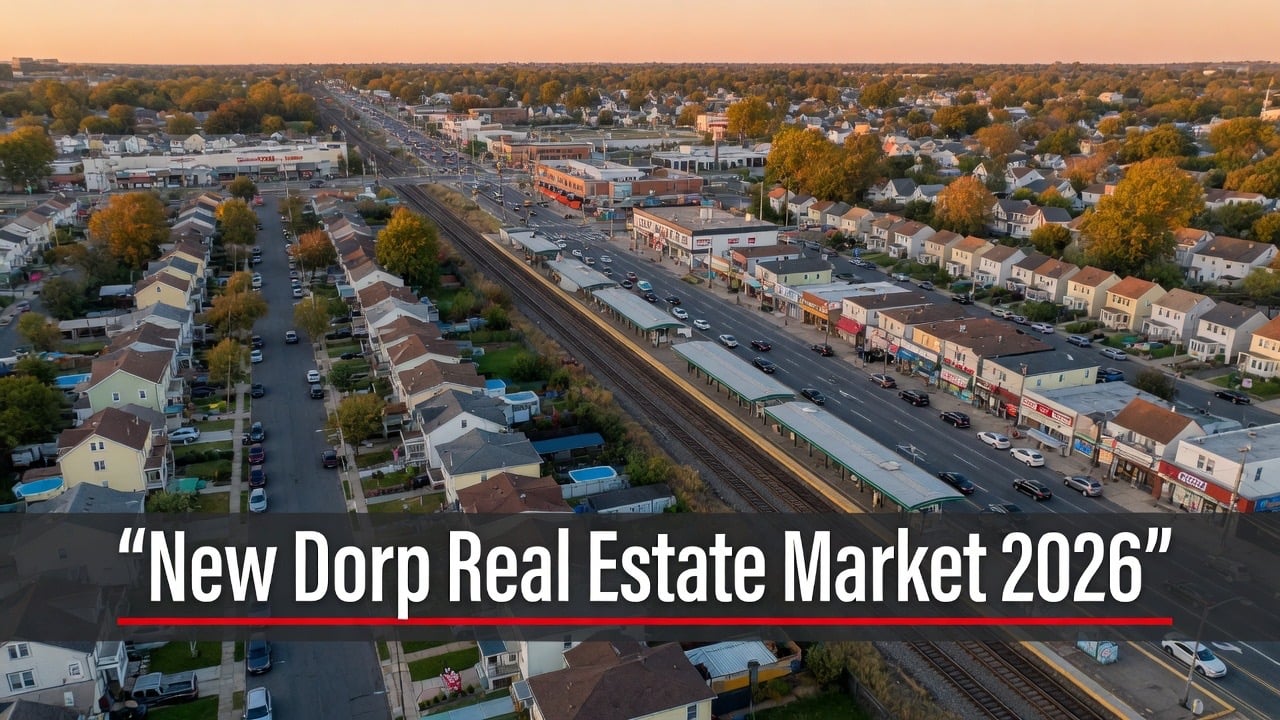
The median home value in ZIP code 10306 sits somewhere between $795,000 and $812,000 heading into spring 2026 — up roughly 4.7% to 5.7% from a year ago, with homes selling in an average of 43 to 45 days and total sales volume climbing 16.2% year-over-year. Those numbers tell a story of a healthy, competitive market. What they don't tell you is that New Dorp is not one market. It's three — and depending on which block you're buying on, the pricing environment, the risk profile, and the buyer calculus are completely different.
The neighborhood divides cleanly into New Dorp Heights, the Central Corridor anchored by New Dorp Lane, and New Dorp Beach. Each operates on different fundamentals. The Heights trades on elevation, lot size, and architectural flexibility. The Lane corridor trades on walkability and transit. The Beach trades on coastal proximity — discounted and increasingly offset by major public infrastructure investment. Buyers who evaluate the ZIP code in aggregate miss the nuance entirely.
The borough-wide context matters too. As of early 2026, Staten Island is carrying roughly 921 active listings — about 26% below what a balanced market requires. Approximately 78% of island homeowners hold mortgages locked below 5%, and with prevailing rates in the low-to-mid 6% range, most of those owners aren't moving unless they have to. That structural squeeze is the defining force behind New Dorp's compressed days-on-market and near-100% sale-to-list ratios. For a broader read on borough-wide dynamics, the Q1 2026 Staten Island market report breaks it down in full.
New Dorp Heights
New Dorp Lane Corridor
New Dorp Beach
New Dorp Heights sits upland from the coastal plain, bordered roughly by Richmond Road to the northwest and Bancroft Avenue to the northeast, with its eastern edge climbing toward the foothills connecting down to Dongan Hills and the base of Todt Hill. The topographical advantage is real and priced accordingly. Aggregate listing data for the upland sector pushes median asking prices toward $979,000, with an active price per square foot around $503. That premium is not incidental — it's structural. The Heights sits outside the high-risk FEMA flood zones that define and discount the coastal tier, which means no mandatory flood insurance, no debt-to-income compression from five-figure annual premiums, and no post-storm psychological discount baked into the price.
The housing stock here runs predominantly detached single-family — over 41% of units in the broader New Dorp area fall into that category, and the Heights accounts for a disproportionate share. The lots are generous by Staten Island standards. The tree canopy is established. And the dominant architectural form, the Hi-Ranch, is one of the most sought-after configurations on the island for a specific and underappreciated reason: it converts.
A Hi-Ranch is not a California-style single-level ranch. It's a vertically split structure — a slightly submerged lower level housing a garage and finished living space, a full upper level containing the primary living quarters. That layout maps almost perfectly onto what the market calls a Mother/Daughter configuration: two legally separate living spaces within a single-family zoning framework.
With childcare and eldercare costs climbing and multi-generational households becoming the norm rather than the exception, Hi-Ranches in New Dorp Heights are generating bidding wars. The wide-line variants — deeper footprints with more lower-level square footage — command the highest premiums. When one hits the market at the right price, it's rarely available for more than a week. History anchors the Heights as well. The Lakeman-Courtelyou-Taylor House at 2286 Richmond Road is one of the few surviving 17th-century Dutch Colonial structures in the borough, a physical reminder that this land was among the first surveyed when New Dorp was established in 1671. For context on how the Heights compares to the island's true luxury ceiling, the Todt Hill market update covers the aspirational benchmark directly above it on the ridge.
Every real estate market has a commercial anchor. New Dorp's is New Dorp Lane — widely considered the Main Street of the East Shore — and it drives residential values in a way that's measurable, not just anecdotal. The blocks immediately surrounding the corridor are denser than the Heights, heavier on attached units, townhomes, and duplexes. About 25% of New Dorp's housing inventory falls into the attached category, and the majority of that stock clusters within walking distance of the Lane. For a specific category of buyer — young professionals, empty nesters downsizing, households prioritizing convenience over square footage — this is exactly what they're shopping for.
The reason comes down to the Staten Island Railway station sitting at the precise center of New Dorp Lane. That station is not a peripheral amenity. It is the engine of the corridor's residential value. A buyer within a ten-minute walk of the New Dorp platform can commute to Midtown or the Financial District without touching a car. In a borough where the average drive to Manhattan via the Verrazzano frequently runs 90 minutes or more, that distinction is worth real money.
The commercial infrastructure along the Lane has been strengthened by institutional investment. The New Dorp Business Improvement District channels dedicated resources into marketing, streetscape maintenance, and small business support. Infrastructure upgrades including pedestrian safety improvements and curb enhancements have incrementally raised the corridor's walkability. Urban economics research is consistent on this point: neighborhoods anchored by vibrant, pedestrian-scaled town centers are meaningfully more resilient to broad market downturns than automobile-dependent strip corridors. New Dorp Lane is the former. It's why the blocks around it hold their value.
New Dorp Beach is the most complicated sub-market in the neighborhood — and the one that has changed most in the past 18 months. The coastal enclave descends southeast from Hylan Boulevard toward the Lower New York Bay, a narrow grid of lanes, beach bungalows, and marshland-adjacent lots that once served as a working-class resort the locals called the "Poor Man's Bermuda." Hurricane Sandy in 2012 ended any lingering illusion that the area could be treated like ordinary residential real estate. The storm surge was catastrophic. The market has been repricing around flood risk ever since.
The mechanics work against older unrenovated properties. The vast majority of the coastline sits inside high-risk 100-year FEMA flood zones. For buyers using federally-backed financing, flood insurance is not optional — it's a closing condition. Annual premiums can run several thousand dollars, and that cost gets folded directly into the debt-to-income calculation, compressing the effective purchase price a buyer can qualify for. The result is a median listing price around $699,000 at approximately $499 per square foot — significantly below the Heights — with a 7.2% vacancy rate reflecting a more transient market than the upland neighborhoods. Buyers shopping the Beach need to model total carrying cost, not just the mortgage payment.
Completed May 2025. 8,701 feet of new storm sewers installed across 40+ blocks. Over 880 homeowners worked with directly to reconstruct driveways and front yards around new street elevations. Milton Ave., Finley Ave., and Cedar Grove Ave. raised over a foot. Hett Ave. lowered approximately ten inches. The chronic nuisance flooding that followed every significant rain event has been systematically eliminated.
The market is already repricing around that reality. Modern construction built post-2012 on raised foundations is trading well above $800,000 and carries substantially lower insurance exposure than the unrenovated stock. Older cottages and on-grade bungalows remain discounted and will continue to be until they're elevated or replaced. That spread between new and old construction creates real opportunity for buyers willing to underwrite a renovation or new build in a now-stabilized drainage environment. The Beach is no longer simply a discount market. It's a bifurcated one.
For context on how similar coastal recovery dynamics play out on the East Shore, the Midland Beach neighborhood guide and the Oakwood neighborhood profile cover adjacent markets with overlapping flood zone characteristics.
Transportation infrastructure is not a soft amenity in New Dorp's real estate calculus. It is the primary driver of the neighborhood's pricing premium relative to deeper South Shore communities that offer larger homes at lower prices. The question buyers are actually answering when they choose New Dorp over Great Kills or Eltingville is: what is reliable, fast Manhattan access worth to me every single month?
For Midtown-bound commuters, the SIM11 express bus runs directly through New Dorp's core along Hylan Boulevard and Mill Road, with peak-hour departures every 20 minutes connecting to Madison and Lexington Avenues. The SIM7 covers similar territory. Both deliver Midtown commutes in under 90 minutes — substantially less on early-morning runs. For households that drive, the Verrazzano-Narrows Bridge charges $12.03 per direction at the current Tolls by Mail rate; Staten Island residents with a registered E-ZPass account pay an effective $2.75 through the state-funded resident discount program. But the more significant variable for drivers is not the toll — it's the Gowanus Expressway, which runs at near-gridlock during peak hours. New Dorp's transit access is the hedge against that unpredictability, and it carries a real dollar premium in the residential market.
School zoning moves real estate prices, and the data on how much is not subtle. Properties zoned for high-performing districts command premiums of 8% to 15% over comparable homes just outside those attendance boundaries. On an $800,000 home, that's $64,000 to $120,000 in structural value derived entirely from a district boundary line.
New Dorp's elementary anchor is PS 41, the Stephanie A. Vierno School on Clawson Street, serving pre-K through fifth grade with solid proficiency ratings that consistently draw young families into the neighborhood. The larger signal is Staten Island Technical High School. Ranked #3 among all public high schools in New York State and #25 nationally by Niche's 2026 rankings, Staten Island Tech posts 99% math proficiency and 95% reading proficiency across its 1,404-student population. Admission is test-based through the SHSAT — not geographically zoned — so proximity doesn't guarantee enrollment. But the school's physical presence still shapes the market. It attracts faculty households, elevates the academic culture of the surrounding blocks, and draws families who believe — accurately — that raising children near this institution matters. Homes near anchors like this are historically easier to sell, more price-resilient in downturns, and less likely to cycle into transient rentals.
New Dorp occupies a positioning that is genuinely rare in the outer boroughs: suburban lot sizes and detached-home architecture alongside a walkable commercial main street and a rapid-transit commute under an hour. That combination is the structural argument for why the neighborhood has appreciated at a sustained 4.7% to 5.7% annually and why that trajectory is unlikely to reverse.
| Neighborhood | Median Ask | $/Sq Ft | Primary Typology | Market Character |
|---|---|---|---|---|
| New Dorp Heights | ~$979K | $503 | Hi-Ranch, Detached SFH | Upland premium, flood-safe, bidding wars |
| New Dorp Beach | ~$699K | $499 | Bungalow, Elevated New Construction | Bifurcated; new builds command $800K+ |
| Dongan Hills | ~$775K | $532 | Hilltop Estates, Bungalows | Highly bifurcated; prestige elevation above boulevard |
| Oakwood | $725K–$749K | $520–$568 | Cape Cod, Contemporary | Coastal transition; post-Sandy buyout residual |
| Midland Beach | ~$649K | $426 | Elevated Construction, Cottages | Investor focus; longer DOM than New Dorp |
| Grant City | ~$388K | $395 | Older SFH, Multi-family, Condos | Lowest barrier to entry; same SIR access |
| * Active listing median asking prices, Q1 2026. Listing prices typically skew above closed medians in low-inventory environments. New Dorp Heights figure reflects aggregate upland sector data. | ||||
For buyers, the sub-market you're targeting determines everything about your strategy. In the Heights, expect competition — well-priced Hi-Ranches configured or convertible to Mother/Daughter absorb in days, not weeks. In the central corridor, you're paying for transit and walkability in a denser footprint. For the Beach, the analysis requires two columns: total carrying cost with full insurance exposure, and the trajectory of that cost as drainage infrastructure continues to stabilize values. New construction elevated above base flood elevation is a legitimate buy at current prices. Older unrenovated stock requires careful underwriting.
For sellers, condition and configuration are the primary levers. In a market with 2.5 months of supply and 78% of competing sellers locked out by low-rate mortgages, appropriately priced move-in-ready inventory has negotiating power. Sellers in the Heights with a completed or obvious Mother/Daughter configuration should make that the lead — it opens a buyer segment most other listings can't access.
Buyers who benchmark New Dorp only against itself miss the full picture. Grant City to the immediate north offers the same SIR access at a dramatically lower entry point. Dongan Hills to the northeast offers elevation prestige at a marginal premium with a notably different commercial character. Understanding where New Dorp sits in that continuum is what separates buyers who find value from those who overpay — or undersell. The New Dorp neighborhood guide on ProdigyRE.com covers the full community profile for buyers still orienting to the area.
* Median listing and sale price data sourced from aggregated closed-sale and active inventory records, Q1 2026. Listing-side median prices reflect active asking prices, which typically skew above closed medians in low-inventory environments. School rankings per Niche 2026. Infrastructure cost and timeline data per NYC DEP, DOT, and DDC official press releases (May 2025). Flood zone classifications per current FEMA Flood Insurance Rate Maps. Transit times reflect typical weekday service.
Q
What is the median home price in New Dorp, Staten Island in 2026?
The aggregate median home value for ZIP code 10306 sits between $795,000 and $812,000 heading into spring 2026, reflecting roughly 4.7% to 5.7% year-over-year appreciation. That figure varies significantly by sub-market — New Dorp Heights median asking prices run near $979,000, while New Dorp Beach median listings sit closer to $699,000. The central corridor falls between those two tiers depending on property type and proximity to the SIR station.
Q
Is New Dorp Beach a good place to buy a home in 2026?
It depends on the specific property and what you're willing to underwrite. The $84 million Roma-Hett storm sewer project, completed in May 2025, has significantly reduced the chronic flooding that previously depressed values across the coastal sector. New construction built on raised foundations meeting current base flood elevation requirements is trading above $800,000 with manageable insurance exposure. Older, unrenovated on-grade structures remain discounted and require a full analysis of mandatory flood insurance costs before making an offer.
Q
How long does it take to commute from New Dorp to Manhattan?
The SIR from New Dorp station reaches St. George in about 23 to 25 minutes. The free Staten Island Ferry from St. George to Whitehall Street in Lower Manhattan takes another 25 minutes, putting total door-to-FiDi time at roughly one to one and a quarter hours on a consistent schedule. For Midtown, the SIM11 and SIM7 express buses service New Dorp's Hylan Boulevard corridor directly with peak-hour runs connecting to Lexington and Madison Avenues. Driving via the Verrazzano and Gowanus frequently runs 90 minutes or more in peak traffic — transit proximity is the most reliable commute hedge in this neighborhood.
Q
Does living near Staten Island Technical High School affect home values in New Dorp?
Indirectly, yes. Admission to Staten Island Tech is test-based through the SHSAT — not geographically zoned — so proximity does not guarantee enrollment. But the school's physical presence drives measurable demand from families who want their children near a community built around academic achievement. Research consistently documents 8% to 15% pricing premiums in neighborhoods anchored by high-performing schools. Staten Island Tech is ranked #3 among New York State public high schools and #25 nationally by Niche in 2026.
Prodigy Real Estate is an innovative real estate company offering high-end video production, home valuation services, purchasing, and home sales. Serving New York and New Jersey.