
Anthony Licciardello | May 4, 2026
Matawan, NJ
DEVELOPMENT PIPELINE ANALYSIS
The development story around the Aberdeen-Matawan train station is not a 2026 story. It is a 25-year story that is arriving at its most visible phase in 2026 — and buyers who are evaluating properties in the station corridor without understanding the full arc of what has been built, what is under construction, and what is planned are making decisions based on incomplete information.
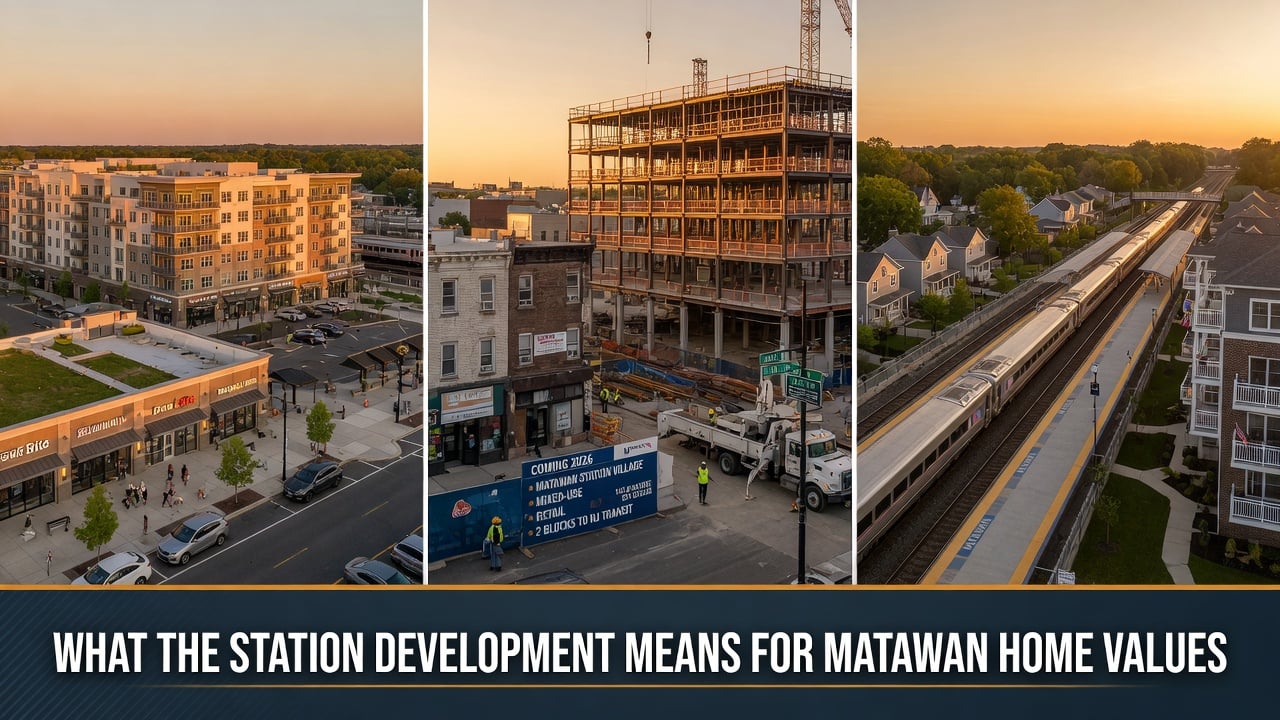
The Borough of Matawan has been pursuing transit-oriented development adjacent to the station since 2001. The NJ Department of Transportation formally designated the station area a Transit Village in 2003 — a designation that prioritizes state investment in compact, walkable, mixed-use development within a half-mile of a qualifying transit station. Active construction work on the Aberdeen side began in August 2016. The Link at Aberdeen Station opened in October 2018. Matawan Junction broke ground in late 2023. And the 7-acre NJ Transit-owned parcel adjacent to the platform — the subject of a formal request for qualifications in 2019 and a confirmed project development agreement by 2020 — remains the corridor's largest single undeveloped opportunity.
For buyers purchasing near the station today, this pipeline is a forward value driver that is well-documented, institutionally supported, and actively delivering. It is also a timeline story — some of these projects are complete, some are under construction, and some are in the agreement phase. Understanding which is which determines how to underwrite the development premium in any specific purchase. For the base market and commute context, see the train station and home values post and the Matawan market report.
■ THE DESIGNATION
The New Jersey Transit Village program, administered by the NJ Department of Transportation, is a competitive designation awarded to municipalities that commit to planning and zoning policies that encourage compact, mixed-use, pedestrian-oriented development within a half-mile of a transit station. The designation comes with state resources, technical assistance, and coordinated agency support that non-designated municipalities do not receive.
The Aberdeen-Matawan station area received this designation in 2003. At that point, the surrounding blocks on both the Aberdeen and Matawan sides of the station were characterized by surface parking lots, underutilized industrial parcels, and low-density commercial uses that made poor use of land adjacent to one of the busiest stations on the North Jersey Coast Line. The Transit Village designation set the policy and planning framework that made the subsequent development activity possible — rezoning for density, coordination between the two municipalities, and a common vision for what the station area could become.
From the buyer's perspective, the Transit Village designation matters because it represents institutional consensus — between the state, the two municipalities, and NJ Transit — that density and mixed-use development adjacent to this station is appropriate, supported, and will continue to be approved. This is not a corridor where a future zoning board might reject the next transit-adjacent residential project on neighborhood character grounds. The character of the corridor has been defined by a 25-year planning framework. The development that is coming is not a surprise or a disruption — it is the intended outcome of two decades of coordinated planning.
■ PROJECT ONE: THE LINK
The Link at Aberdeen Station is the station corridor's proof of concept. Aberdeen Township broke ground on the project in August 2016 on the site of the former Zobel paint factory — an abandoned industrial building that had been a blight on the station's immediate environment for years. Five residential buildings totaling 227 one- and two-bedroom rental apartments, a street-level retail component, a fitness center, a resident lounge, and an outdoor pool opened in October 2018 as part of Aberdeen Township's larger plan to redevelop a 20-acre site on its side of the station into a transit village.
What The Link proved, beyond the physical development itself, is that the market for transit-adjacent luxury rental product at this station is real and deep. Rents starting at $1,800 per month — confirmed in active marketing for the property — represent a rent level that validates the financial model for the subsequent development projects planned for the corridor. A developer evaluating the 7-acre NJ Transit site or the next phase of Aberdeen's 20-acre plan is not making a speculative bet on untested demand. They are looking at a 227-unit building that has been leasing at confirmed rent levels for over six years.
The Link's physical replacement of the Zobel factory also had a direct environmental effect on the station's immediate surroundings. A functioning mixed-use residential building with ground-floor retail and an active resident population replaced a derelict industrial site. The pedestrian environment around the station platform improved measurably. This is the mechanism by which transit-oriented development lifts surrounding residential values: not through abstract market dynamics, but through the physical improvement of what buyers and renters experience when they step off the train.
■ PROJECT TWO: MATAWAN JUNCTION
Matawan Junction is the Borough's answer to Aberdeen Township's Link — a mixed-use development on the Matawan side of the station that fills a lot that has been vacant since 1984. Located at the intersection of Main Street and High Street, approximately two blocks from the train platform, it occupies a position that is both transit-adjacent and Main Street-adjacent. A resident of Matawan Junction can walk to the platform in minutes and walk to the Borough's restaurant and retail ecosystem in the same direction. That double proximity — station and downtown simultaneously — is the highest-value positioning available in this market.
The significance of this project for surrounding residential values is specific. A 39-year vacant lot at a prominent Main Street intersection is a persistent drag on the pedestrian environment of the blocks surrounding it — not because vacancy is catastrophic, but because an active, occupied, street-level building produces foot traffic, retail revenue, and visual vitality that a surface lot does not. When Matawan Junction delivers, the two blocks between Main Street and the station platform — the core of the Borough's walkable residential demand — will have active mixed-use buildings at both ends. That corridor closes, and the walking-distance premium for the residential addresses between them becomes more defensible and more durable.
■ PROJECT THREE: THE 7-ACRE NJ TRANSIT SITE
The 7-acre NJ Transit-owned parcel directly adjacent to the Aberdeen-Matawan station platform is the corridor's largest remaining development opportunity and the one that will most directly affect the walking-distance residential market on both sides of the station when it delivers. The site has been on a defined development track since the Borough of Matawan formally initiated the TOD planning effort in 2001. NJ Transit issued a request for qualifications in April 2019. A project development agreement was confirmed in place by October 2020. As of early 2026, no confirmed construction start date is on record.
The distinction between a project development agreement and a construction start matters significantly for buyers underwriting this development into a purchase decision. A PDA means a developer has been selected and agreed to develop the site under specific terms — it is a meaningful step beyond a request for qualifications, but it is not a shovel in the ground. NJ Transit TOD projects operate on timelines measured in years from agreement to delivery. The Somerville TOD, announced in July 2019 with active developer partnership, took multiple years to reach construction. Buyers should treat the 7-acre site as a confirmed long-term forward value driver — not as a development event with a near-term delivery date.
BUYER NOTE
The 7-acre NJ Transit site is a long-term value driver, not an immediate pricing event. Properties near the station are already reflecting the transit premium that exists today. The additional premium from the 7-acre development will accrue when that project delivers — which, given NJ Transit's TOD development timelines, is likely measured in years from now. Buy for today's market with the TOD as upside, not as a baseline assumption.
■ THE DEVELOPMENT TIMELINE
| Year | Development | Status | Side |
|---|---|---|---|
| 2001 | Borough of Matawan initiates TOD planning | COMPLETE | Both |
| 2003 | NJ DOT Transit Village designation awarded | COMPLETE | Both |
| Aug 2016 | Groundbreaking for The Link at Aberdeen Station | COMPLETE | Aberdeen |
| Oct 2018 | The Link at Aberdeen Station opens — 227 units + retail | DELIVERED | Aberdeen |
| Apr 2019 | NJ Transit issues RFQ for 7-acre station parcel | COMPLETE | Matawan |
| 2020 | Project development agreement confirmed for 7-acre site | COMPLETE | Matawan |
| Late 2023 | Matawan Junction breaks ground — Main & High Sts | UNDER CONSTRUCTION | Matawan |
| TBD | 7-acre NJ Transit site construction start | PRE-CONSTRUCTION | Matawan |
* Timeline based on confirmed NJ Transit press releases, Wikipedia station article (updated March 2026), and Patch reporting. PDA = Project Development Agreement. Construction status as of early 2026.
■ WHAT THIS MEANS FOR BUYERS
The station corridor's development history produces a specific framework for buyers. The delivered projects — The Link and the Transit Village designation — have already been priced into the market to varying degrees. They are existing facts that support the current premium for station-adjacent residential addresses. Matawan Junction is under construction and its effect on the Main Street / station corridor will be visible within the next one to two years. The 7-acre NJ Transit site is further out — a confirmed agreement but an unconfirmed construction timeline.
For buyers purchasing in the station-adjacent historic core of Matawan Borough — the walking-distance colonials and cape cods that represent the market's highest-demand residential tier — the development pipeline is additive to an already strong value case. The transit premium exists today and is documented in listing prices, absorption velocity, and rent levels. The Matawan Junction delivery will improve the immediate pedestrian environment between the station and Main Street. The 7-acre site, when it eventually delivers, will expand the station's walkable residential ecosystem and introduce additional residents who support the local retail and service infrastructure. All three projects move in the same direction for neighboring residential values.
For buyers purchasing in Aberdeen Township neighborhoods that drive to the station — Strathmore, River Gardens, Cliffwood Beach — the development pipeline is a supportive backdrop rather than a direct value driver. The improvements to the station environment benefit all users of the station, but the walking-distance premium flows primarily to the addresses that can actually walk. The broader market appreciation that healthy TOD activity supports is relevant to Township addresses, but the specific station-adjacency premium is not.
The NJ market context for this kind of transit-oriented development story — and how it compares across the state's commuter corridors — is covered in the NJ market split analysis. For the Matawan and Aberdeen neighborhood breakdown that tells you which specific addresses sit within the walking-distance premium zone, see the neighborhood guide. The full Monmouth County map is at prodigyre.com/communities.
If you want to understand which specific addresses in the station corridor fall within the walking-distance premium tier — and how the current comp set reflects the development pipeline that is already delivering — call Anthony Licciardello at (718) 873-7345 before you are scheduling showings, not after.
Development timeline based on confirmed NJ Transit press releases, Wikipedia Aberdeen-Matawan station article (updated March 2026), and contemporaneous reporting. Project Development Agreement status per NJ Transit October 2020 press release. Matawan Junction construction start per Wikipedia station article. Construction timelines for all projects subject to change. This post does not constitute investment advice. Buyers should independently verify current project status with the relevant municipalities and NJ Transit before making purchasing decisions.
FAQ
Q
What is being built near the Matawan train station?
Three distinct development projects define the corridor in 2026. The Link at Aberdeen Station — 227 apartments and street-level retail across five buildings — opened in October 2018 on the Aberdeen side. Matawan Junction, a mixed-use development at Main and High Streets two blocks from the platform on the Borough side, began construction in late 2023 on a lot vacant since 1984. And the 7-acre NJ Transit-owned parcel adjacent to the station — with a project development agreement confirmed in 2020 — remains the corridor's largest single opportunity, targeted for moderate-to-high-density residential, retail, office, and community space, with no confirmed construction start as of early 2026.
Q
How long has the Matawan station area been a Transit Village?
The Aberdeen-Matawan station area was designated a Transit Village by the NJ Department of Transportation in 2003 — more than two decades ago. The designation prioritizes investment and development within a half-mile of the station, encouraging compact, mixed-use, pedestrian-friendly development. It preceded active construction by over a decade; work on the Aberdeen side began in August 2016, with The Link opening in October 2018 and Matawan Junction beginning construction in late 2023.
Q
Does transit-oriented development near a train station increase home values?
Research on TOD and surrounding property values is consistent: well-executed transit-oriented development that improves the station environment, adds active street-level retail, and increases walkable density historically produces positive effects on surrounding residential values. The mechanism is physical — active buildings with ground-floor retail produce foot traffic and visual vitality that surface lots do not. Properties closest to the station see the strongest effects. The Matawan and Aberdeen corridor's 20-plus years of sustained TOD planning, with delivered projects on both sides of the station and active construction underway, represents a long-term structural investment in the area's residential desirability.
Q
What is the Matawan Junction development?
Matawan Junction is a mixed-use development on the Matawan Borough side of the station at the intersection of Main and High Streets, approximately two blocks from the train platform. Construction began in late 2023 on a lot that had been vacant since 1984. Its position at Main Street and within walking distance of both the platform and the Borough's restaurant and retail ecosystem makes it the most transit-integrated development site on the Borough side of the corridor, and the Borough's first significant TOD delivery to complement The Link on the Aberdeen side.
Prodigy Real Estate is an innovative real estate company offering high-end video production, home valuation services, purchasing, and home sales. Serving New York and New Jersey.