
Anthony Licciardello | April 26, 2026
Matawan, NJ
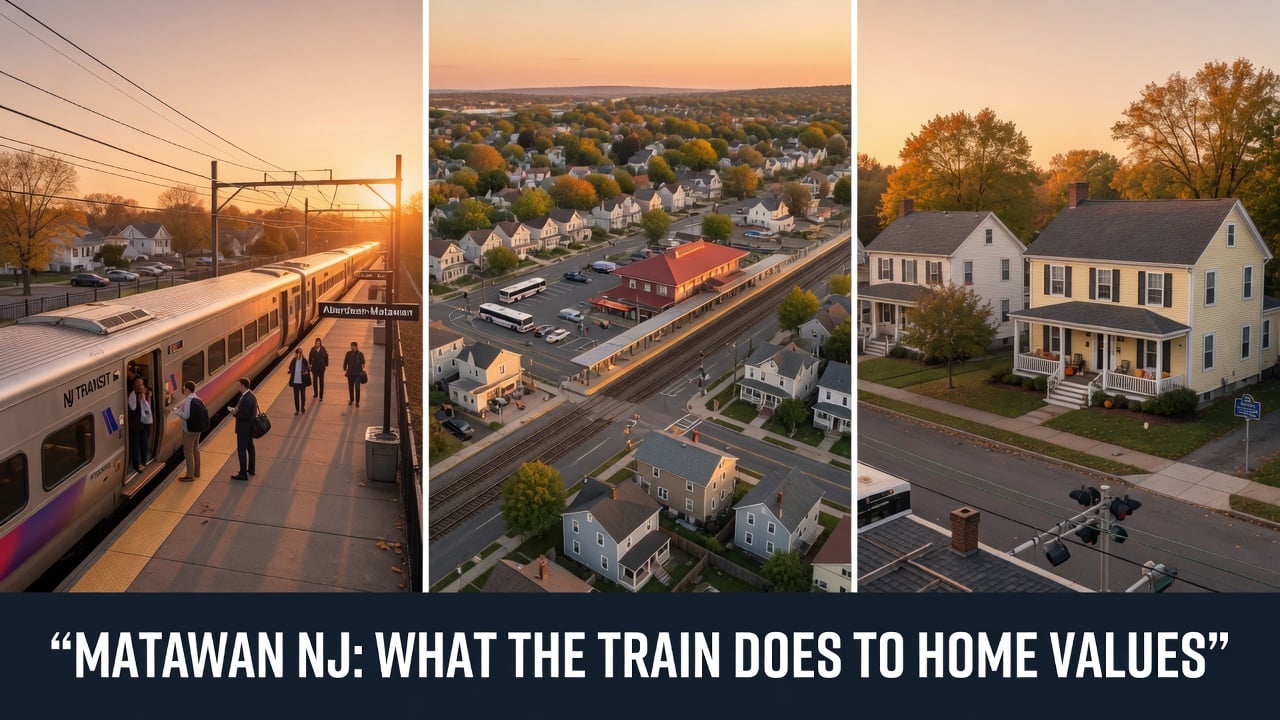
COMMUTER MARKET ANALYSIS
Matawan has a train. That sentence does more work in the Monmouth County real estate market than it might appear. Freehold has no train. Manalapan has no train. Marlboro has no train. Across a wide swath of Central Monmouth County, the market that offers a direct NJ Transit connection to Penn Station at a median home price below $560,000 is essentially one town — and that town is Matawan.
The Aberdeen-Matawan station sits on the North Jersey Coast Line, one of NJ Transit's primary trunk routes serving the Jersey Shore corridor from Bay Head north to New York Penn Station. Trains run throughout the day and into the evening. The scheduled rail time from the platform to Penn Station runs approximately 60 to 75 minutes depending on the specific service. For a buyer who is comparing Matawan against Freehold, Manalapan, or Old Bridge at comparable price points, that train is the difference between a commute that works and a commute that requires a bus, a transfer, or a 90-minute drive depending on the day.
This post explains what that train does to the market — specifically which properties benefit most from station proximity, how the walking-distance premium shows up in listing prices and absorption velocity, and what the active transit-oriented development adjacent to the station means for the surrounding residential market in 2026 and beyond. For the full market data context, see the Matawan NJ market report. This post is the commuter-specific read.
■ THE COMMUTE
The North Jersey Coast Line runs from Bay Head at the Shore's southern end to New York Penn Station, with the Aberdeen-Matawan stop situated at the northern edge of Monmouth County. Trains run through service to Penn Station — stopping at Newark Penn Station and Secaucus Junction along the route before terminating at Penn Station — with no transfer required. Aberdeen-Matawan is confirmed as the busiest station on the line between Bay Head and Rahway, which speaks directly to the depth of commuter demand this platform generates. This is a fundamentally different commuter experience from what buyers in Freehold or Manalapan are working with, where bus-based connections to Port Authority or drives to distant rail stations are the only options.
The scheduled rail time from Aberdeen-Matawan to Penn Station runs approximately 60 to 75 minutes depending on the train. Door-to-desk for a Midtown Manhattan destination — accounting for the walk or drive to the platform, the ride, and the subway or walk from Penn Station — typically runs 75 to 90 minutes. For a Lower Manhattan or Financial District destination, buyers who connect to the subway at Penn Station can reach their desk in roughly the same window. This is not a short commute. But it is a reliable, seated, train commute — a meaningfully different experience from standing on a bus at the Port Authority Bus Terminal at 8:45am.
COMMUTE FROM MATAWAN — REALISTIC TIMES TO NYC*
NJ Transit Rail → Penn Station
60–75 min
Scheduled rail time. Through service to Penn Station, stopping at Secaucus en route.
Door-to-Desk (Midtown)
75–90 min
Station walk/drive + rail + subway to office.
vs. Freehold Bus → PABT
90–120 min
No rail option. Bus only. Traffic-variable.
* Scheduled times per NJ Transit published timetables. Actual door-to-desk times vary by specific origin address, train selection, and Manhattan destination. Peak and off-peak service frequencies differ — verify the specific trains that match your office schedule before purchasing.
The station has ample parking, which matters for buyers who are not within walking distance of the platform. Aberdeen Township's park-and-ride capacity is well-used — it draws riders from a wide catchment area across western Monmouth County, including buyers from Marlboro, Manalapan, and Old Bridge who drive to Aberdeen-Matawan rather than commuting by bus or driving all the way to a more distant rail connection. That regional park-and-ride draw is itself a signal of the station's value: it is the de facto transit hub for a geography far larger than the two municipalities it officially serves.
■ THE WALKING DISTANCE PREMIUM
Station proximity is not a subtle variable in the Matawan market. It is the first and most prominent selling point in listings near the platform. Language like "commuter's dream within walking distance to the train station" is standard in Matawan Borough and the station-adjacent sections of Aberdeen Township — not marketing embellishment, but the literal top-line value proposition that agents lead with because it is what buyers are searching for.
The practical premium breaks down into two components. The first is price. Properties within a half-mile walkable radius of the platform command a consistent premium over comparable properties that require a car to access the station. The second is absorption velocity — station-adjacent homes move faster because their buyer pool is structurally wider. Every NYC-bound commuter looking in this price range who wants train access is a potential buyer for a walking-distance property. The park-and-ride buyer, by contrast, can consider a much wider geographic area and is less specifically attached to any single block or neighborhood.
New construction near the station has begun pricing in this premium explicitly. One recent listing at 49 Lucia Court — marketed as walking distance to the station — led entirely with its commuter positioning. A new construction single-family home less than one mile from the rail was similarly marketed around its transit proximity above all other physical attributes. In a market where the overall median is up 16.9% year-over-year,* station-adjacent new construction is benchmarking against that appreciation ceiling and pricing accordingly.
Matawan Borough colonials, cape cods, and attached townhomes. Highest demand tier. Buyers paying premium for no-car commute access. Fastest absorption in the market. Listing language leads with station proximity.
Aberdeen Township single-family and Matawan Borough outskirts. Station accessible but not walkable. Buyers using park-and-ride. More supply, broader price range, longer average absorption than walking-distance tier.
Outer Aberdeen Township sections including Cliffwood Beach and Strathmore. Regional park-and-ride users from Marlboro and Manalapan also competing for platform access. Station benefit real but diluted by distance and parking dependency.
The Aspen Woods townhome community illustrates the walking-distance tier clearly. The community is marketed specifically around its proximity to both the Matawan and Hazlet train stations — a tri-level townhome with a private elevator, one-car garage, and direct access to the platform corridor. This is not a product that would trade at these price levels in a market without a rail connection. The station is why the Aspen Woods product type exists here and why it commands the pricing it does.
■ THE TOD PIPELINE
The most consequential near-term development story in Matawan is happening directly adjacent to the platform. NJ Transit and the municipality are actively seeking proposals for a seven-acre parcel of land near the Aberdeen-Matawan station earmarked for transit-oriented development. The site represents one of the most significant infill opportunities in northern Monmouth County — a large, rail-adjacent parcel in a market where developable land near existing transit infrastructure is genuinely scarce.
Transit-oriented development at this scale — mixed-use residential, retail, and community amenity concentrated within walkable distance of a functioning commuter rail station — follows a well-documented pattern in comparable NJ markets. When it delivers, it does three specific things to surrounding residential values. It expands the walkable catchment area of the station, making properties slightly further from the platform functionally closer to it. It improves the immediate environment around the station, replacing underutilized land with active street-level use that increases pedestrian traffic and retail viability. And it adds a critical mass of new residents with transit-oriented lifestyle preferences who support the local dining, retail, and service ecosystem that makes the surrounding neighborhood more desirable.
BUYER NOTE
The 7-acre TOD site is in the proposal solicitation phase as of early 2026 — not under construction. Buyers should underwrite their purchase on the market as it exists today, not on a projected development timeline that may shift. The development is a forward-looking value driver, not an immediate pricing event. Properties near the station are already priced based on existing transit access. The TOD upside is the long-term case, not the current one.
The proof of concept is already operating. The Link at Aberdeen Station — a luxury rental community adjacent to the train station corridor — opened with rents starting at $1,800 per month, demonstrating active rental demand at the station level before the larger TOD site has delivered. Hidden Village, another rental development in Aberdeen, has added further residential density to the station's immediate catchment area. These are not speculative projections. They are delivered projects generating real occupancy at real rent levels, confirming that the station-adjacent market can support the density and rent tier that the larger TOD development will target.
■ THE COMPETITIVE COMPARISON
To understand why the Aberdeen-Matawan station matters so much to the surrounding market, it helps to look at what comparable rail access costs in the rest of Monmouth County. The North Jersey Coast Line serves several additional stops in Monmouth — Red Bank, Middletown/Lincroft, and the Shore stations to the south. Each carries a meaningful price premium over Matawan at current market values, and that premium is largely a function of the same factor: rail access to Manhattan.
| Market | Rail Line | Approx. Median | Rail to Penn Station |
|---|---|---|---|
| Matawan / Aberdeen | NJ Coast Line | ~$432K–$560K* | ~60–75 min |
| Red Bank | NJ Coast Line | ~$630K–$680K* | ~70–80 min |
| Middletown (Lincroft) | NJ Coast Line | ~$600K–$750K* | ~75–85 min |
| Freehold / Manalapan | No rail service | ~$489K–$740K* | Bus only, 90–120 min |
* Median price ranges approximate, Q1 2026 closed-sale data. Rail times per NJ Transit published schedules; actual times vary. Individual property values and commute experiences vary by specific address and train selection.
The comparison crystallizes the value proposition. Matawan is the least expensive market on the North Jersey Coast Line in Monmouth County with a functioning commuter station. Its train to Penn Station is comparable in duration to Red Bank's — and Red Bank's median is $250,000 to $300,000 higher. That gap is not fully explained by Red Bank's superior downtown amenity or coastal adjacency alone. Part of it is the premium that accumulates in markets where the transit access story has been known and priced longer. Matawan's 16.9% year-over-year price growth in early 2026 suggests the market is beginning to close that gap as buyers recognize the value arbitrage.
■ THE HYBRID WORK ANGLE
The 60-to-75-minute scheduled rail time from Aberdeen-Matawan to Penn Station was the same in 2019 as it is in 2026. What changed is the office schedule of the buyer making the commute. In 2019, a five-day commuter covering that route was absorbing 10 to 12.5 hours per week in transit. In 2026, the hybrid worker making the same trip two or three days per week is absorbing 4 to 7.5 hours — less than the 2019 daily allocation for many urban workers.
That arithmetic change is what opened Matawan to a class of buyer who would not have considered it before. The professional who commutes three days per week to a Midtown office can live in Matawan, walk to the train on those three days, and work from a home office or a local coffee shop the other two. On the Shore-adjacent days, they are 15 miles from the beach. On the Staten Island family visit days, they are 25 minutes away. The Matawan lifestyle in 2026 serves a hybrid work household in a way that the 2019 version of the same town simply could not — not because anything changed in Matawan, but because the office schedule changed around it. For a deeper look at how this shift is splitting the NJ market between rail-served and car-dependent towns, see how the NJ market is dividing across price tiers in 2026.
For buyers comparing Matawan against non-rail alternatives in Monmouth County, the commute comparison is decisive. See how Freehold's market is pricing at a comparable tier without rail access — and how the commute math there compares to what Matawan's train actually delivers. For the broader county picture and how NYC buyers are distributing across NJ markets, see the county-by-county NYC buyer breakdown. The full Monmouth County neighborhood map is at prodigyre.com/communities.
If you want to map out which specific Matawan and Aberdeen addresses put you within walking distance of the platform — and what the current comp set looks like within that radius — call Anthony Licciardello at (718) 873-7345. The station-adjacent inventory moves fast. That conversation is worth having before you are looking at a listing, not after it goes under contract.
* Year-over-year price growth figure per closed-sale data tracker, Matawan area, February 2026. Median price ranges reflect all home types and vary by source and property class — single-family homes and condominiums produce different medians. Rail times per NJ Transit published timetables; actual times vary by train selection, day of week, and on-time performance. TOD development status reflects publicly available municipal and NJ Transit communications as of early 2026 — project timelines subject to change. All data subject to change. This post does not constitute investment advice.
FAQ
Q
How long is the train ride from Matawan to New York Penn Station?
The scheduled rail time from Aberdeen-Matawan to Penn Station runs approximately 60 to 75 minutes depending on the specific train. Trains run through service to Penn Station stopping at Newark Penn Station and Secaucus Junction along the route — no transfer required. Door-to-desk for a Midtown Manhattan destination typically runs 75 to 90 minutes when accounting for the walk or drive to the station and the subway or walk from Penn Station to a final office. This is meaningfully faster and more reliable than the bus-based commute from Freehold or Manalapan, where 90 to 120 minutes is typical and traffic variability adds uncertainty that rail schedules do not.
Q
Do homes near the Matawan train station sell for more?
Yes. Walking-distance proximity to the Aberdeen-Matawan station commands a consistent premium in both sale and rental markets. Listings within a half-mile of the platform routinely lead with station proximity as the primary selling point. The premium reflects real and practical value — eliminating the daily drive to the station expands the buyer and renter pool to include NYC commuters who want a car-free transit option. Station-adjacent product historically leads appreciation cycles in rail-served markets because its buyer pool is structurally wider than the general market.
Q
What is the NJ Transit development near Matawan train station?
NJ Transit and the municipality are actively seeking development proposals for a seven-acre parcel adjacent to the Aberdeen-Matawan station, targeted for transit-oriented mixed-use development. The Link at Aberdeen Station, a luxury rental community already open near the station with rents starting at $1,800 per month, demonstrates the active demand the station corridor generates. When the larger TOD site delivers, it historically lifts surrounding residential values by expanding the walkable catchment area and improving the immediate station environment.
Q
Is Matawan NJ a good commuter town for NYC workers in 2026?
It is one of the strongest commuter value propositions in Monmouth County. Matawan offers direct NJ Transit North Jersey Coast Line service to Penn Station at a median home price significantly below comparable rail-served markets like Red Bank or Middletown. The combination of functioning rail, a median around $432,500 to $560,000 depending on property type, 25-minute car access to Staten Island, and Shore proximity within 15 miles creates a commuter profile that is difficult to replicate elsewhere in the county at this price point. Hybrid workers commuting two or three days per week find the value proposition especially compelling against the bus-only alternatives.
Prodigy Real Estate is an innovative real estate company offering high-end video production, home valuation services, purchasing, and home sales. Serving New York and New Jersey.