
Anthony Licciardello | April 7, 2026
Matawan, NJ
Market Overview
Matawan NJ real estate doesn't fit neatly into either of the categories that define most Monmouth County conversations. It is not a shore-town scarcity market where beach proximity controls everything. And it is not a full urban redevelopment story on the scale of Red Bank or Asbury Park. In 2026, it occupies a more interesting middle ground — a commuter-driven borough where value is increasingly shaped by transit proximity, downtown redevelopment, and affordable-housing compliance, while traditional single-family streets still trade on their own separate logic.
The borough's current planning agenda makes that split explicit. Recent zoning actions are tied to the train-station redevelopment area, a newly created 160 Main Mixed-Use District, and updated affordable-housing regulations and overlay zones. That combination of conventional resale inventory and emerging redevelopment infrastructure is what makes Matawan worth watching in 2026 — and what makes it harder to summarize with a single headline number.
Market Data
The headline figures for Matawan depend on which source you pull, and in a small-inventory borough those differences matter. The bottom-line read across sources heading into early 2026:
Here is how the three major platforms compared when breaking that data down:
| Source | Median / Avg Value | YoY Change | Days on Market |
|---|---|---|---|
| Redfin | $565,000 median sale price | +10.9% YoY | ~19 days |
| Zillow | ~$554,000–$626,000 est. home value range | Low single digits YoY | — |
| Realtor.com | $499,000 median sold price | 103% sale-to-list ratio | ~40 days |
The spread between those figures is not unusual for a borough this size. Redfin's Matawan market page skews toward closed transactions in a specific window, Zillow's automated valuation model produces a broader estimated range depending on geographic boundaries, and Realtor.com can pull from a wider ZIP-code pool that includes different property mixes. None of them is wrong — they are just measuring slightly different things.
The fair synthesis: Matawan is still a competitive market where homes generally close near ask, and the strongest pricing is concentrated in properties that combine updated condition, commuter access, and proximity to the downtown or train-corridor areas. It is not pricing like a pure luxury coastal market. It is a regional commuter town with selective premium pockets — and the gap between those pockets and the rest of the borough is widening.
Value Drivers
The most important nuance in Matawan is that value is tied less to broad neighborhood branding and more to development context. In practice, the borough breaks into three distinct pricing layers, each responding to different market logic.
The first is the downtown and Main Street layer — the transit-accessible core where mixed-use potential and commuter convenience support stronger land values and redevelopment interest. This is where the borough created the 160 Main Mixed-Use District, and where a site already entitled for 46 apartments with ground-floor retail sold for $2.1 million in late September 2025. Land in this layer is increasingly priced on what can be built, not just what is there now.
The second is conventional single-family Matawan — the interior residential blocks that make up the largest share of the borough's housing stock and that most strongly shape the boroughwide median. These homes trade on lot size, renovation quality, and house type. They are less directly connected to the redevelopment ordinances now being adopted, because those tools are concentrated around specific zones rather than representing any townwide upzoning. This is the segment most clearly captured in the Redfin and Zillow figures.
The third is the corridor and overlay-zoned layer — land that may increasingly price on entitlement potential rather than existing structure. In Matawan, this applies most clearly to the train station redevelopment area, the 160 Main site, and the newly established Highway Improvement District overlay. This is still a small share of the market, but it is the share where future value growth is most explicitly tied to planning decisions rather than conventional resale dynamics. For more on how development activity is reshaping the broader county, see our Monmouth County development report.
Development Pipeline
The most active development story in Matawan in 2026 is 160 Main Street. Ordinance 25-12 created the 160 Main Mixed-Use District on Block 27, Lot 2, establishing the framework for a project that can include up to 46 residential units — 8 affordable rental units and up to 38 market-rate units — along with up to 3,040 square feet of ground-floor retail. The ordinance was adopted as part of a settlement tied to Matawan's affordable-housing compliance obligations.
That entitlement was followed almost immediately by a transaction. The site sold in late September 2025 for $2.1 million, marketed explicitly on the strength of its already-approved 46-unit apartment development and its proximity to the NJ Transit rail station. That sequencing — zoning first, land sale shortly after — is meaningful. It means the development market in Matawan is not purely speculative. At least some of the value created by the new zoning framework is already being reflected in actual land pricing.
From a market standpoint, 160 Main reinforces two things. It confirms that downtown Matawan is where density is most politically and legally supportable. And it demonstrates that values near Main Street can be driven by redevelopment yield — not just the condition of whatever building is currently on the parcel. That second point has significant implications for how sellers, buyers, and investors should think about site selection in the downtown corridor going forward.
Transit Infrastructure
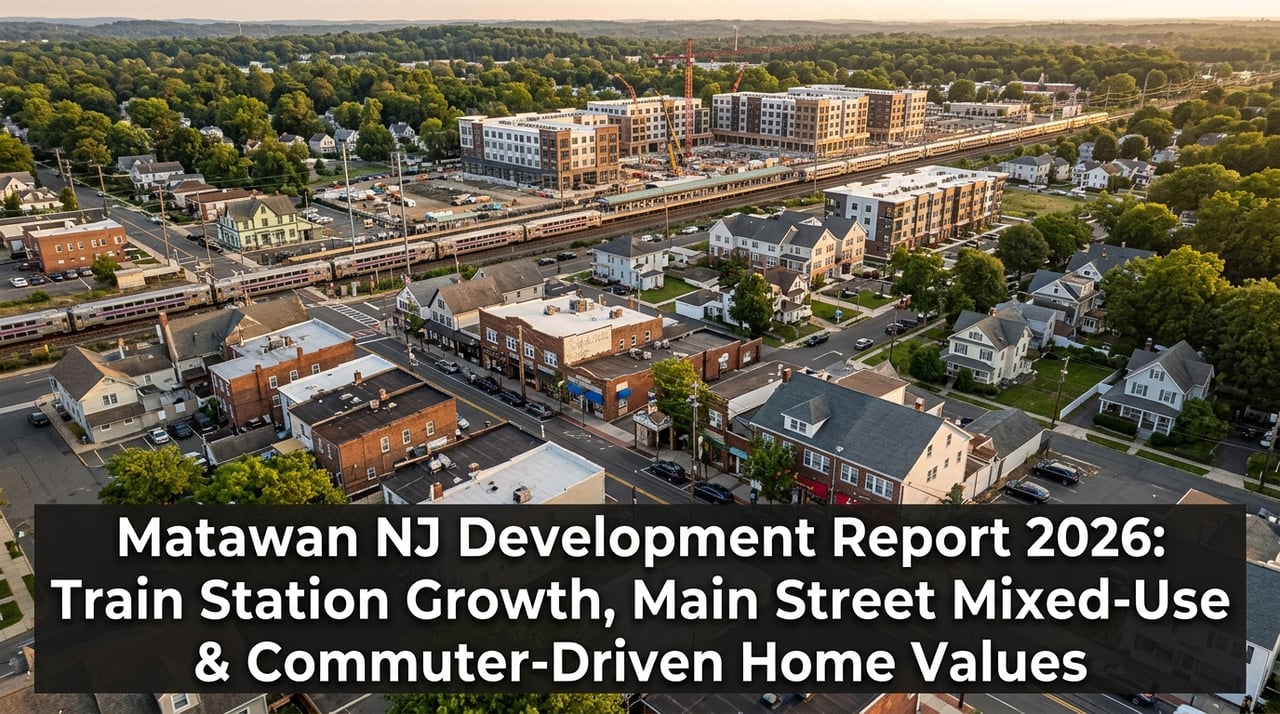
The second major story is the Aberdeen-Matawan station redevelopment area, which has been in various stages of planning for years and is still actively being amended in 2026. The borough's transit station redevelopment plan describes a long-running effort to create a mixed residential and retail neighborhood around the station, with goals that include higher-density development near the rail connection, preservation of environmentally constrained land, commuter parking improvements, and stronger pedestrian links to the downtown core.
Matawan reaffirmed that direction in early 2026 with Ordinance 26-08, which approved another amendment to the redevelopment plan for the designated area in the vicinity of the train station. The borough is still actively modifying that framework — which tells you something about both how complex station-area development tends to be and how seriously Matawan is treating this corridor as a growth priority.
The value implication is straightforward: homes and sites closer to the station corridor increasingly sit inside a different economic logic than properties deeper in traditional residential blocks. Near the station, value is tied to walkability, mixed-use demand, and future redevelopment momentum. Farther from it, value still follows conventional suburban resale factors. That split is not unique to Matawan — it shows up in transit-oriented markets across Monmouth and Union counties — but it is becoming more pronounced here as the planning framework gets more specific.
Regulatory Landscape
Matawan's current planning structure cannot be understood without accounting for Round 4 affordable-housing compliance, because that obligation is now directly driving zoning changes. In January 2025, Matawan adopted a binding resolution setting its Round 4 prospective need obligation at 68 affordable units and its present need obligation at zero. The borough's housing element identifies several candidate sites for meeting that obligation, including the remaining train station redevelopment area and a parcel at 114-116 Main Street.
The planning effort continued into 2026 with three related actions moving together: Ordinance 26-09, which amended the borough's development regulations to address affordable-housing obligations; Ordinance 26-07, which created a revised Highway Improvement District Overlay Zone that permits inclusionary development; and the affordable-housing plan itself, which ties both pieces together. These are not isolated approvals — they represent a coordinated effort to concentrate compliance through targeted growth areas rather than through ad hoc approvals that could appear anywhere in the borough.
That is probably the most important strategic takeaway for Matawan in 2026: the borough is retooling multiple parts of its zoning and redevelopment framework simultaneously so it can absorb its affordable-housing obligation in a controlled, location-specific way. The result is a clearer map of where density is headed — and where it is not.
Price Forecast
Matawan's values are likely to keep moving along two separate tracks, and understanding which track a given property sits on matters more than the boroughwide median.
The first track is conventional resale Matawan. Single-family homes and smaller residential properties in the interior of the borough will continue to price based on condition, school and commuter preference, and standard supply-demand fundamentals. These are the properties most visible in the Redfin and Zillow figures, and they will remain sensitive to mortgage rates and broader Monmouth County market conditions. For context on how those broader conditions are moving, our breakdown of the rate-and-sales feedback loop explains how financing costs are still shaping buyer behavior across markets like this one.
The second track is redevelopment-influenced Matawan: downtown parcels, Main Street sites, and station-adjacent properties where land value increasingly reflects entitlement potential. In those locations, what can be built matters as much as what is already there. The 160 Main zoning and the subsequent land sale are the clearest proof of that to date.
The practical implication for buyers is that proximity to the downtown and station corridor deserves a closer look than conventional comps alone would suggest. For sellers in those zones, understanding the redevelopment context — not just the residential sale history — is increasingly relevant to pricing strategy. And for anyone tracking Matawan over the next several years, the ordinances being adopted now are the ones that will define where value grows fastest.
FAQ
What is the median home price in Matawan, NJ?
Median closed-sale prices vary by source and measurement window. Redfin reported a January 2026 median of $565,000, up 10.9% year-over-year. Zillow's automated value model reads higher, while Realtor.com's broader ZIP-based sampling lands lower. The working consensus across sources is that most Matawan homes are trading in the mid-$500,000s, with downtown and station-adjacent parcels pricing above that based on development potential.
Is Matawan, NJ a good place to buy a home in 2026?
Matawan is a competitive commuter market with active NJ Transit access and an improving downtown. For buyers who want a Monmouth County address below the pricing of towns like Holmdel or Red Bank, with access to the North Jersey Coast Line, it offers solid fundamentals. The key distinction is location within the borough — properties near the downtown and station corridor are on a different appreciation trajectory than interior residential streets, and that split is becoming more defined as new zoning takes hold.
What is the 160 Main Street development in Matawan?
160 Main Street is a mixed-use project approved through a settlement tied to the borough's affordable-housing obligations. The site on Block 27, Lot 2 is entitled for up to 46 residential units — including 8 affordable rentals — with ground-floor retail. The property sold in late September 2025 for $2.1 million. It is the clearest active development signal in Matawan and the strongest evidence that downtown redevelopment is moving from planning into actual transactions.
How far is Matawan, NJ from New York City?
The Aberdeen-Matawan NJ Transit station provides direct service on the North Jersey Coast Line, with typical travel times of 60 to 75 minutes to Penn Station. By car, the commute to the Hudson River tunnels runs 45 to 60 minutes depending on traffic, via the Garden State Parkway or Route 9. That profile positions Matawan as a regional commuter market with genuine NYC access rather than a purely local or Shore-oriented one.
Bottom Line
Matawan's headline numbers still show a competitive market — homes moving in roughly two to six weeks depending on the source, prices stable to rising, and sale-to-list ratios holding near or above 100%. That is the floor of the story. The ceiling is more interesting.
The borough is concentrating new value creation around three specific areas: Main Street and the 160 Main Mixed-Use District, the Aberdeen-Matawan train station redevelopment corridor, and the affordable-housing and inclusionary overlay zones now being formalized through legislation. That combination is what separates Matawan from a simple commuter-town resale market and makes it worth tracking as a redevelopment story with real momentum behind it.
Compared to fully matured shore markets like those along the northern Shore corridor, or to higher-price precision markets like Holmdel, Matawan still offers relative affordability — with a planning structure that is actively channeling new density toward specific zones rather than spreading it borough-wide. For buyers willing to pay attention to where that density is headed, the market is offering something that most Monmouth County towns are not: a clear, documented map of where value is most likely to be created next.
Prodigy Real Estate is an innovative real estate company offering high-end video production, home valuation services, purchasing, and home sales. Serving New York and New Jersey.