
Anthony Licciardello | July 18, 2026
Madison, NJ
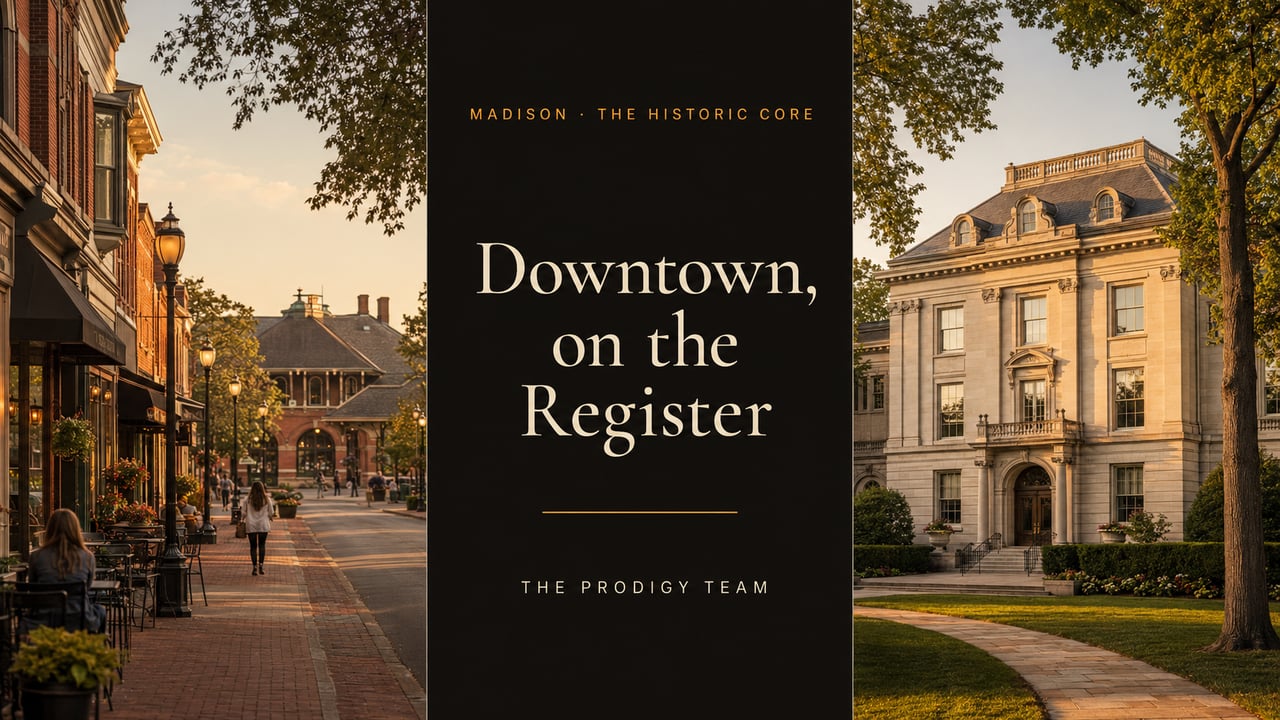
Forty-nine acres, 450 buildings, and a spot on the National Register of Historic Places since 1991 — Madison’s downtown isn’t a shopping district attached to a town; it’s the town’s original core, intact, with the train station and the borough hall facing each other at the middle of it. The complete guide to what’s actually here, how it works day to day, and what a downtown like this does to the value of every house that can walk to it.
Downtown Madison is the rarest kind of Main Street: one that never needed reviving. The 49-acre Madison Civic Commercial District — roughly bounded by Main Street, Kings Road, Green Avenue, Waverly Place, Lincoln Place, and Prospect Street — holds 450 buildings and has been listed on the National Register of Historic Places since 1991, with the 1916 train station and the Hartley Dodge Memorial borough hall facing each other at its heart. Around them: Shanghai Jazz, the Shakespeare Theatre of New Jersey, the Playwrights Theatre, the Museum of Early Trades & Crafts, art galleries, a Thursday farm-and-artisan market, and a merchant base that skews genuinely local and multigenerational.
For a homebuyer, this chapter isn’t color — it’s valuation. A documented, intact, station-anchored downtown is the engine of Madison’s walk-radius premium and the single biggest reason the borough’s housing has never traded like a commodity suburb. This guide covers the district, the calendar, the practical rules, and the value mechanics, in that order.
The test of a downtown is what happens when you take the train out of the picture — and Madison passes it twice. Remove the station and you still have a 450-building historic core with two theatres, a jazz room, a museum, and a Thursday market; put the station back and all of it sits one block from a 55-minute express to Penn. Most New Jersey towns have one of those things. This is the downtown chapter of our complete Madison guide, and it explains the other half of what Madison buyers are actually paying for.
Start with the paperwork, because Madison’s is unusual: the downtown itself is a listed historic district. The Madison Civic Commercial District covers about 49 acres and 450 buildings — the borough’s historic core since the late nineteenth century — and was added to the National Register of Historic Places in 1991. Its centerpiece arrived in 1930, when Geraldine Rockefeller Dodge donated the Hartley Dodge Memorial in memory of her son Marcellus, who died at twenty-two; the building serves to this day as Madison’s borough hall at 50 Kings Road, directly across from the restored 1916 train station. Town government, the railroad, and the commercial street grid, all facing each other — that is the physical arrangement most transit villages spend decades trying to retrofit, and Madison has had it for a century.
One honest clarification: a National Register listing is recognition, not a regulatory freeze — it documents the district’s significance rather than reviewing every renovation the way a locally landmarked district would. The practical point for buyers is what the listing evidences: an intact 450-building core that survived the strip-mall era whole, with a merchant culture — many owners multigenerational — that treats the district as an inheritance rather than a lease.
The cultural density is out of proportion to a town of 17,000. Shanghai Jazz gives the downtown a genuine music room with a regional reputation. The Shakespeare Theatre of New Jersey and the Playwrights Theatre put two producing stages inside or beside the district — a two-theatre downtown in a four-square-mile borough. The Museum of Early Trades & Crafts anchors the historic-education layer, art galleries thread the commercial blocks, and the borough’s Farm & Artisan Market runs Thursdays in season. Layer the civic calendar on top — Bottle Hill Day, the fall street festival named for the settlement’s pre-Madison identity, is the flagship — and the universities’ public programming besides, and the district produces something most suburbs outsource to the city: reasons to be downtown after dinner.
The retail-and-dining base underneath skews independent and local — the borough itself asks new residents to “support our local merchants,” and the merchant families here measurably do stay for generations. That composition matters beyond charm: a locally owned merchant base is stickier through retail cycles than national-tenant strips, which is part of why this downtown’s vacancy story has never resembled the mall-adjacent corridors elsewhere in the county.
The daily mechanics, per the borough: parking downtown is free — on streets and in the municipal shoppers’ lots — governed by time limits rather than meters: two hours on Kings Road, one hour on the other downtown streets, and two hours in the Elmer, Waverly Green, and Cook lots. Overnight parking is not permitted on any Madison street, a rule newcomers from denser towns should internalize before the first ticket. Bike racks sit at the station and across the district, and NJ Transit bus service runs along Main Street/Route 124 for the non-train trips.
Two administrative footnotes that belong in every newcomer’s file: borough government itself operates from the district — the Mayor and Council meet at the Hartley Dodge Memorial, and the zoning office on its second floor is the required first stop before home projects — and Madison’s sewer charges are folded into the property-tax payment rather than billed separately, one more way the borough’s consolidated structure (the utilities story) simplifies the monthly picture compared to its neighbors.
Now the valuation chapter. Madison’s walk-radius premium — the measurable extra that buyers pay to be within a five-to-ten-minute walk of the station — is really a downtown premium wearing a commuter’s coat: the same radius that reaches the platform reaches the theatres, the market, the restaurants, and the school walk. That double-count is why the premium is durable. A pure station premium can be diluted by a fare hike or a schedule cut; a station-and-downtown premium is backstopped by 450 buildings of reasons to stay.
And the structural read from our market hub applies directly: the district’s intactness is a supply statement. Madison cannot build a second downtown, the first one is documented and beloved, and the housing that walks to it is finite — which is precisely the scarcity mechanism that keeps the borough’s prewar core trading at the top of Morris County’s per-town numbers. Even the borough’s founding act points the same direction: Madison seceded from Chatham Township in 1889 specifically to build its own water system — the self-reliant streak that later kept the electric grid, and the reason the town a buyer walks through today feels authored rather than assembled.
“Buyers tour Madison and tell me the downtown feels like a movie set. I tell them it’s the opposite — movie sets are built in a month to look old. This is 450 real buildings that stayed useful for a century because the town kept choosing them. That’s not set dressing; that’s the collateral behind every house within walking distance.”
— Anthony Licciardello, Broker, The Prodigy Team
Every guide on this site is part of a system: town-by-town content clusters, dedicated neighborhood pages, and cross-state marketing engineered for one outcome — putting your listing in front of the motivated New York families already searching for it. I’m Anthony Licciardello, Broker of The Prodigy Team — a former Director of Community Affairs in the Bloomberg Administration and a member of the Staten Island Growth Management Task Force — and this pipeline is what 22 years and 5,000 closings taught me to build.
Our Above the Streets cinematic drone series extends that reach — aerial storytelling that markets entire towns, not just listings, with audience performance exceeding industry benchmarks for real estate media.
Anthony Licciardello · Broker, The Prodigy Team · 718-873-7345
Tell us your budget and your radius — we’ll map the current inventory against the district, the station, and the school walk, and show you what each block of distance is actually worth.
Is downtown Madison, NJ a historic district?
Yes — the Madison Civic Commercial District, about 49 acres and 450 buildings roughly bounded by Main Street, Kings Road, Green Avenue, Waverly Place, Lincoln Place, and Prospect Street, has been listed on the National Register of Historic Places since 1991. Its centerpiece, the 1930 Hartley Dodge Memorial, serves as borough hall directly across from the restored 1916 train station.
What is there to do in downtown Madison?
An unusual amount for a town of 17,000: live jazz at Shanghai Jazz, two producing stages (the Shakespeare Theatre of New Jersey and the Playwrights Theatre), the Museum of Early Trades & Crafts, art galleries, a seasonal Thursday Farm & Artisan Market, the Bottle Hill Day fall street festival, and steady public programming from Drew University and FDU next door.
How does parking work in downtown Madison?
It’s free — on streets and in the municipal shoppers’ lots — and governed by time limits: two hours on Kings Road and in the Elmer, Waverly Green, and Cook lots, one hour on other downtown streets. Overnight parking is not permitted on any Madison street. Bike racks sit at the station and throughout the district.
Does the downtown actually affect Madison home prices?
Directly. The walk radius that reaches the station also reaches the theatres, market, and restaurants, making Madison’s walkability premium a double-counted — and therefore durable — one. And because the 450-building district is intact and irreplaceable, the housing within walking distance is structurally scarce, which is a core reason Madison’s prewar core trades at the top of Morris County’s per-town numbers.
Moving to Madison, NJ: The Complete 2026 Guide
The Madison Commute: Trains, Parking & the Buyer’s Framework
Madison, NJ Real Estate Market Report: The Evergreen Hub
Madison’s Borough-Owned Utilities: One of Nine in NJ
District facts — the 49-acre Madison Civic Commercial District, 450 contributing buildings, 1991 National Register listing, boundaries, and the 1930 Hartley Dodge Memorial gift by Geraldine Rockefeller Dodge — per the National Register of Historic Places listing record. Downtown institutions (Shanghai Jazz, Shakespeare Theatre of New Jersey, Playwrights Theatre, Museum of Early Trades & Crafts, galleries) per Madison civic and chamber materials. Parking rules, market schedule, council and zoning locations, and the sewer-in-taxes note per the Borough of Madison (rosenet.org), 2026 — rules change; confirm current details with the borough. Borough founding (1889 secession to develop a water supply) per documented borough history. This post is general information.
Prodigy Real Estate is an innovative real estate company offering high-end video production, home valuation services, purchasing, and home sales. Serving New York and New Jersey.