
Anthony Licciardello | July 17, 2026
Madison, NJ
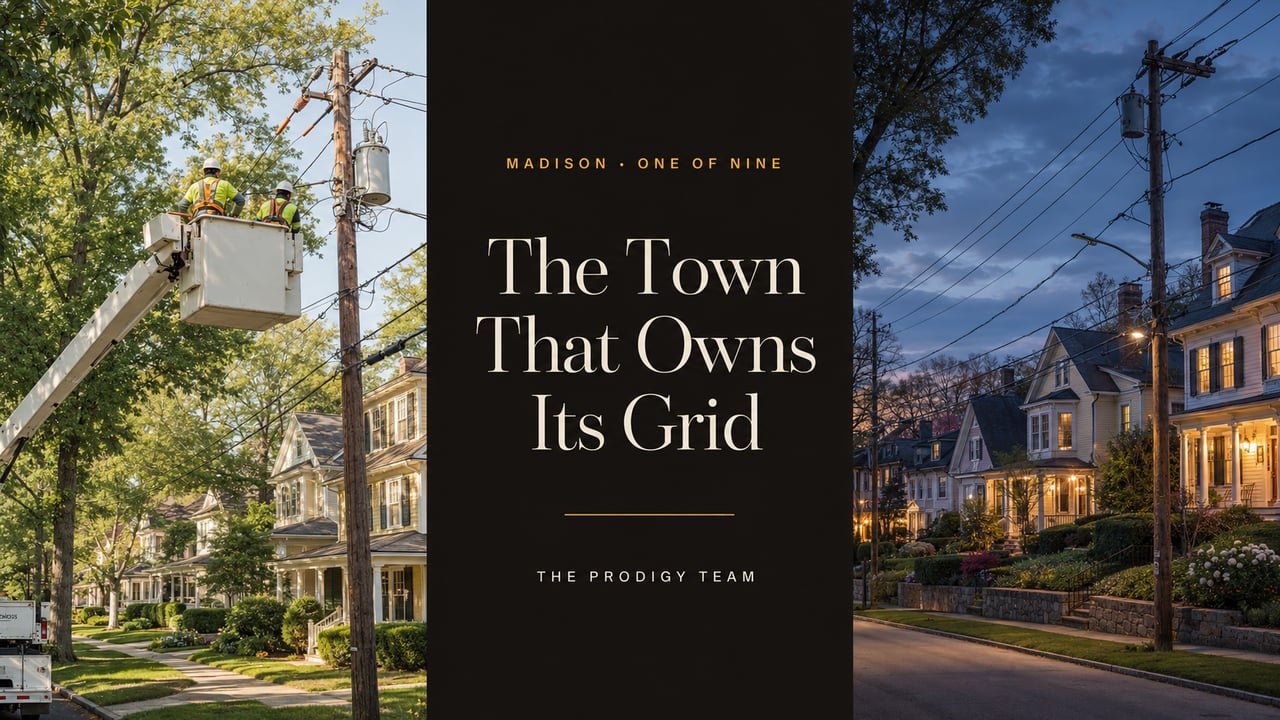
Five hundred and sixty-four municipalities in New Jersey, and exactly nine own their own electric grid. Madison is one of them — and it owns its water system too. What that structural oddity actually means for your monthly bills, your outage response, your closing statement, and, quietly, your tax rate.
Madison is one of only nine municipalities in New Jersey — alongside Butler, Lavallette, Milltown, Park Ridge, Pemberton, Seaside Heights, South River, and Vineland — that own and operate their own electric distribution system as a department of local government, buying wholesale power through the New Jersey Public Power Authority and delivering it over borough-owned lines maintained by a borough crew. Madison runs its own water utility besides. Both bills are paid to the borough, not to an investor-owned utility, and neither system answers to the Board of Public Utilities’ rate process — the Borough Council sets the rates.
For a homeowner this cashes out four ways: locally set rates that third-party aggregators place at the low end of the state’s residential range; outage crews that live near the wires they fix; a revenue loop in which large institutional customers — including tax-exempt ones — help fund borough operations through the meter; and two extra prorations on your closing statement that your attorney needs to know about. This spoke covers all four.
New Jersey has 564 municipalities and a reputation for home rule, yet only nine towns in the entire state kept ownership of their electric wires when the investor-owned giants consolidated everything else over the last century. Madison never sold. That single decision, made generations ago, is now one of the borough’s most durable competitive advantages — and one of the least understood items in any Madison home purchase. This is the utilities chapter of our complete guide to moving to Madison.
The facts first, because the claim sounds like marketing until you source it. Madison’s Electric Department is one of nine municipal electric distribution systems in New Jersey; the nine are the only municipalities eligible for membership in the New Jersey Public Power Authority, which handles wholesale energy management for the group. Collectively these systems — organized since 1985 under the Public Power Association of New Jersey — serve more than 75,000 homes and businesses and deliver over a billion kilowatt-hours a year. And because they are departments of local government rather than investor-owned utilities, they are generally not subject to Board of Public Utilities rate jurisdiction: Madison’s electric rates are set in Madison, by the governing body residents elect.
The practical translation: the borough buys power wholesale through NJPPA, delivers it across distribution infrastructure it owns, and bills residents directly. There is no shareholder return built into the rate, no distant call center between an outage and a truck, and no rate case in Trenton deciding what Hartley-Dodge-adjacent homeowners pay per kilowatt-hour. Third-party rate aggregators currently place Madison’s residential rate at the low end of New Jersey’s range — verify the current tariff at rosenet.org, as rates are the borough’s to change — but the structural point holds regardless of any given year’s number.
Electric. An eight-person borough crew maintains the distribution system — the poles, lines, and transformers inside Madison — which means storm restoration is dispatched from town, for town, rather than triaged across a multi-county investor-owned territory. Residents pay the borough directly, on the borough’s billing cycle, at the borough’s rates.
Water. The borough also owns and operates its water utility — the second bill newcomers don’t expect, billed by and paid to Madison. Between electric and water, a Madison homeowner sends two utility payments to the same borough that collects the property taxes, a consolidation that has one underrated benefit: when something goes wrong with any of the three, the accountable party is a local government you can attend meetings of, not a holding company.
What it is not. Municipal ownership is not a discount coupon or an immunity from regional cost pressures — wholesale power costs move with the market for every utility in the state, municipal or investor-owned. The honest claim is narrower and stronger: Madison’s rates are set locally, its service is delivered locally, and its surplus stays local — which is where the money loop in the next chapter, and the tax story told in our Madison property-tax breakdown, come in.
Here is the part that belongs in every Madison cost-of-ownership analysis and appears in almost none. The utility’s customer base includes the borough’s large institutions — Drew University alone has paid on the order of $1.9 million a year for electric service. Drew, like other non-profits, pays no property taxes; but in Madison, it pays the borough seven figures annually through the meter. Utility surplus has long helped fund borough capital investment — spending that, in a neighboring town, would sit entirely on the property-tax levy.
That is the mechanism behind the number that anchors our tax analysis: Madison’s effective property-tax rate prints among the lowest in Morris County in part because the borough has a second, meter-based revenue stream that most towns surrendered generations ago. The institutions that would elsewhere be pure fiscal weight — beloved, tax-exempt, expensive to serve — are, in Madison, paying customers of the town itself. No listing sheet says this. It is nonetheless one of the most durable financial facts about owning here.
Utility rates, deposits, transfer procedures, and billing schedules are set by the borough and change over time — confirm current residential tariffs and account-setup steps at rosenet.org before budgeting. Surplus transfers are policy choices reviewed in each borough budget cycle, not guarantees. The structural advantage is real; the specific numbers are the borough’s to set, year by year.
At closing: Madison transactions carry two extra prorations — the borough electric and water accounts — alongside the standard property-tax quarter. Final meter readings and account transfers should be on your attorney’s checklist the day the contract is signed, not the week of closing; the borough’s procedures are published at rosenet.org.
Budgeting: model the full triple payment to the borough — taxes (roughly $1,500 per $100,000 of market value, per our tax breakdown), plus electric, plus water — and compare the total against neighboring towns’ tax-plus-investor-owned-utility totals. Run honestly, that comparison is where Madison’s structure shows up: a slightly larger check to one accountable counterparty, frequently smaller in aggregate than the several checks its neighbors write. Due diligence: for any specific house, pull the actual trailing utility usage from the seller — the borough bills make this easy — because in a market this competitive, the buyers who win are the ones whose monthly number is real before they offer.
“Every town sells its schools and its train. Madison is the only town on the Morristown Line that can also sell you its power company. When a tax-exempt university is paying the borough seven figures a year through the meter, that’s not trivia — that’s the quiet subsidy behind the tax rate, and buyers deserve to know it exists.”
— Anthony Licciardello, Broker, The Prodigy Team
Every guide on this site is part of a system: town-by-town content clusters, dedicated neighborhood pages, and cross-state marketing engineered for one outcome — putting your listing in front of the motivated New York families already searching for it. I’m Anthony Licciardello, Broker of The Prodigy Team — a former Director of Community Affairs in the Bloomberg Administration and a member of the Staten Island Growth Management Task Force — and this pipeline is what 22 years and 5,000 closings taught me to build.
Our Above the Streets cinematic drone series extends that reach — aerial storytelling that markets entire towns, not just listings, with audience performance exceeding industry benchmarks for real estate media.
Anthony Licciardello · Broker, The Prodigy Team · 718-873-7345
Send us the listing — we’ll build the full picture: taxes at your purchase price, both borough utilities, and how the total compares to the towns next door.
Does Madison, NJ really have its own electric company?
Yes. Madison is one of only nine New Jersey municipalities — with Butler, Lavallette, Milltown, Park Ridge, Pemberton, Seaside Heights, South River, and Vineland — that own and operate their own electric distribution system as a department of local government, buying wholesale power through the New Jersey Public Power Authority. The borough also owns its water utility; both bills are paid directly to Madison.
Are Madison’s electric rates cheaper than PSE&G or JCP&L?
Madison’s rates are set by the borough rather than through BPU rate cases, and third-party aggregators currently place them at the low end of New Jersey’s residential range — but rates change, so verify the current tariff at rosenet.org. The durable advantages are structural: no shareholder return in the rate, local outage crews, and surplus that stays in the borough.
How do the utilities affect Madison’s property taxes?
Meaningfully. Large institutional customers — including tax-exempt non-profits like Drew University, at roughly $1.9 million a year for electric service — pay the borough through the meter, and utility surplus has long helped fund capital investment that would otherwise sit on the property-tax levy. It is part of why Madison’s effective tax rate prints among the lowest in Morris County.
What happens with the utility accounts when I buy a home in Madison?
Both borough accounts — electric and water — are prorated between buyer and seller at closing, alongside the property-tax quarter, with final meter readings and account transfers handled through the borough. Put them on your attorney’s checklist at contract signing, and request the seller’s trailing usage so your monthly budget is built on real numbers.
Moving to Madison, NJ: The Complete 2026 Guide
Madison, NJ Property Taxes: Big Bill, One of Morris County’s Lowest Rates
New Providence, NJ: Inside an Aggressive Sellers’ Market
How the New Jersey Housing Market Is Splitting in Two
Municipal-utility facts per the Borough of Madison (rosenet.org, including its NJ Public Power Authority page), the New Jersey Public Power Authority, the American Public Power Association’s New Jersey directory, and the Public Power Association of New Jersey (nine member municipal systems, 75,000+ homes and businesses served, one billion+ kWh delivered annually; systems generally outside BPU rate jurisdiction). Drew University electric payment figure as publicly reported. Residential rate positioning per third-party rate aggregators, 2026 — verify current tariffs with the borough. Tax context per our Madison property-tax analysis and the 2025 Morris County Abstract of Ratables. This post is general information, not financial advice.
Prodigy Real Estate is an innovative real estate company offering high-end video production, home valuation services, purchasing, and home sales. Serving New York and New Jersey.