
Anthony Licciardello | July 17, 2026
Madison, NJ
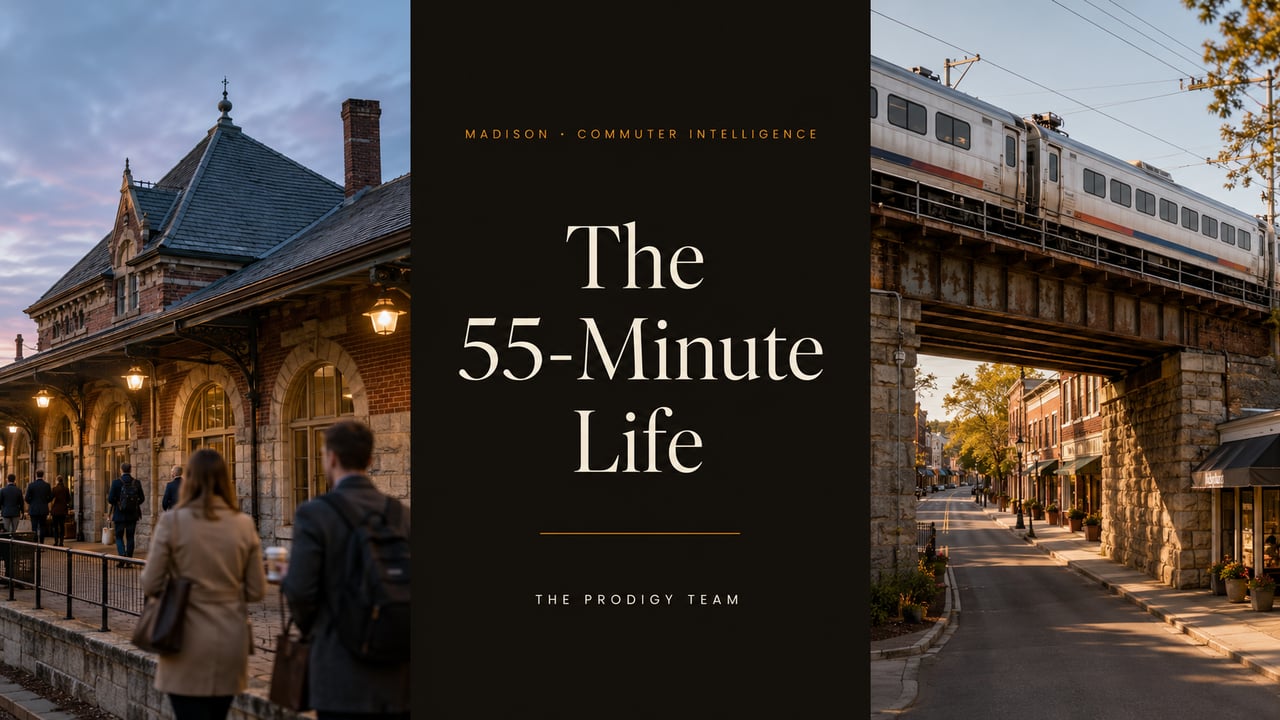
The line has been legally required to stop in Madison since 1836, the station has been on the National Register since 1984, and the weekday express puts Penn Station about 55 minutes away. The complete Madison commute brief — the trains, the fares, the 413-space parking bottleneck, the Plan B network, and the buyer’s framework for pricing all of it.
Madison’s commute rests on two pieces of nineteenth- and early-twentieth-century foresight. The first: an 1836 agreement that required the Morris & Essex — one of America’s first commuter railroads — to stop every train in Madison, a covenant that put the borough on the timetable permanently. The second: the 1916 track elevation that raised the line through downtown, turned every grade crossing into an underpass, and left a station — National Register-listed since 1984 — in the walkable middle of town rather than at its edge.
The modern service: Midtown Direct trains on the Morristown Line reaching New York Penn in roughly 55 minutes on weekday expresses (closer to an hour on locals), rush-hour departures about every 30 minutes, Hoboken-bound runs connecting to PATH for downtown, and fare zone 11 pricing recently around $11.75 a ride or roughly $336 monthly. The bottleneck is not the train — it is the 413 parking spaces, which is why the smartest Madison purchase decision is made with a permit waitlist and a walking radius in mind, not just a school map.
The most valuable clause in Madison real estate was negotiated by a Presbyterian church in 1836: when the Morris & Essex Railroad surveyed its route, the agreement finalized near present-day Kings Road required all trains to stop in Madison. The first passenger run — horse-drawn — came on September 17, 1837, the line grew into one of the nation’s first commuter railroads, and the wealth it carried built the “Millionaire’s Row” corridor stretching toward Morristown. This is the commute chapter of our complete Madison relocation guide — the asset that has anchored the borough’s value for 190 years, read the way a commuting buyer actually needs it.
The history matters because it explains the geography. When the Delaware, Lackawanna & Western elevated the tracks through Madison in 1916 — a project the borough backed with a $159,000 ordinance, real money then — the design deliberately wove the station into the town: Union, Samson and Madison Avenues, Kings and Green Village Roads, Prospect and Elm Streets, and Waverly Place all became underpasses instead of grade crossings, and the depot rose at the heart of the street grid with approaches from four directions. The result, still standing and listed on the New Jersey and National Registers of Historic Places since 1984, is the reason Madison never developed the station-versus-downtown split that afflicts so many rail suburbs: here they are the same place.
For a buyer, that 1916 decision converts directly into optionality: a large share of Madison’s housing stock sits within a genuine walk of the platform, which means the commute can be planned without ever joining the parking conversation in Chapter III — a fact with a measurable price expression this post returns to.
Midtown: Madison is a Midtown Direct stop on NJ Transit’s Morristown Line, with weekday expresses reaching New York Penn Station in roughly 55 minutes and locals running closer to an hour; at rush hour, departures run about every 30 minutes. Downtown: Hoboken-bound trains connect to PATH for Financial District commuters, and transfers at Summit or Newark Broad Street reach whichever terminal a given run doesn’t — the two-terminal flexibility that separates Madison from one-option towns further out.
The practical details: the station sits in fare zone 11 — recent published fares run $11.75 one-way to Penn and about $336 for a monthly pass, though NJ Transit fares change and should be confirmed against the current tariff before you budget. The station keeps a part-time ticket office on weekday mornings (5:30–9:00 AM) with ticket machines in the tunnel walkway otherwise, plus bike racks and lockers. One honest calibration for train-time shoppers: Summit, Millburn, and Short Hills post somewhat faster express times and higher peak frequencies than Madison — the price of being four stops further out — which is precisely why Madison’s combination of price point, downtown, and walkability, rather than raw minutes, is its actual commuter pitch.
Schedules, fares, and Midtown-versus-Hoboken patterns change — and not every train is Midtown Direct, especially off-peak and weekends. Before committing to a house on the strength of a specific commute, pull the current NJ Transit timetable for your actual departure window and confirm which runs are one-seat rides. Ten minutes of timetable reading is worth more than any listing’s “express trains to NYC!” line.
Here is the constraint the listing sheets skip: the station’s three lots, along Kings Road and Prospect Street, hold 413 commuter spaces total — ten of them ADA-accessible — with two lots offering daily parking and all three running borough-administered permit parking. Commuter permits are offered to Madison residents through the borough, recent reporting puts the annual permit around $450, and the program has run a waitlist. Four hundred thirteen spaces, seventeen thousand residents, one of the hottest thin markets in Morris County: the arithmetic is the point.
Third-party options patch the gap — the Boxcar app rents private local spots near the station — but the structural takeaway for a buyer is binary. Either target a home inside a five-to-ten-minute walk of the platform and exit the parking economy entirely, or treat the borough’s permit process and current waitlist status as pre-offer due diligence, verified at rosenet.org before you write, not discovered after you close.
Do not let a listing’s “minutes to the train” stand in for a parking plan. A house a seven-minute drive from the station with no permit is a house with a daily-lot scramble or a Boxcar bill — a genuinely different commute than the same train time with a walk. Verify the permit waitlist before the offer; it is one phone call, and it reprices the house.
Madison’s backup network is unusually good for a town its size. Boxcar’s reserved-seat private buses run weekdays from the station area to Midtown — Wi-Fi, power, restrooms, curbside drop-off — at a premium over the train but with a guaranteed seat; paired with NY Waterway ferry connections, the same network shortens the last mile for downtown commuters. NJ Transit’s local 873 bus adds a Parsippany–Livingston connection six days a week. None of these replace the train; together they mean a service disruption is an inconvenience in Madison, not a crisis.
The buying framework, then: price door-to-door, not station-to-station — add 10–20 minutes to any on-train figure for the walk or drive, parking, and the Manhattan last mile; decide up front whether you are a walk-to-train household (target the five-to-ten-minute radius, expect to pay the premium that radius commands in a market this competitive) or a permit household (verify the waitlist first); and fold the commute into the full Madison cost-of-ownership picture — the tax math and the borough utilities — because the monthly number that matters is the total. The train is the borough’s founding asset; the walk to it is the part you’re actually bidding on.
“In Madison the train is a constant — it’s stopped here since 1836 and it isn’t leaving. What varies house to house is the distance to the platform and the parking plan. That’s the part I make buyers price before they offer, because it’s the part they’ll live with every morning at 6:40.”
— Anthony Licciardello, Broker, The Prodigy Team
Every guide on this site is part of a system: town-by-town content clusters, dedicated neighborhood pages, and cross-state marketing engineered for one outcome — putting your listing in front of the motivated New York families already searching for it. I’m Anthony Licciardello, Broker of The Prodigy Team — a former Director of Community Affairs in the Bloomberg Administration and a member of the Staten Island Growth Management Task Force — and this pipeline is what 22 years and 5,000 closings taught me to build.
Our Above the Streets cinematic drone series extends that reach — aerial storytelling that markets entire towns, not just listings, with audience performance exceeding industry benchmarks for real estate media.
Anthony Licciardello · Broker, The Prodigy Team · 718-873-7345
Send us the listing — we’ll map the real door-to-door: walk time to the platform, the parking picture, the timetable in your actual window, and what that radius premium is worth.
How long is the train from Madison, NJ to New York City?
Roughly 55 minutes to New York Penn Station on weekday Midtown Direct expresses, closer to an hour on local runs, with rush-hour departures about every 30 minutes on NJ Transit’s Morristown Line. Hoboken-bound trains connect to PATH for downtown commuters, and transfers at Summit or Newark Broad Street cover whichever terminal a given train doesn’t serve.
How much does the Madison to NYC commute cost?
Madison sits in NJ Transit fare zone 11; recently published fares run $11.75 one-way to Penn Station and about $336 for a monthly pass — confirm current fares with NJ Transit before budgeting. Drivers should add the borough commuter parking permit, recently around $450 annually for residents, or daily-lot and Boxcar spot-rental costs.
How does commuter parking work at Madison station?
The station’s three lots on Kings Road and Prospect Street hold 413 spaces; two lots offer daily parking and all three run borough-administered permit parking, with resident permits issued through the borough — which has run a waitlist. Verify current fees and waitlist status at rosenet.org before relying on a permit, or target a home within walking distance and skip the parking economy entirely.
What are the backup options if the train is disrupted?
Boxcar operates weekday reserved-seat private buses from Madison to Midtown Manhattan (Wi-Fi, power, restrooms), with NY Waterway ferry pairings for downtown commuters, and NJ Transit’s local 873 bus connects toward Parsippany and Livingston six days a week. The alternatives run at a premium to the train but make service disruptions manageable.
Moving to Madison, NJ: The Complete 2026 Guide
Madison, NJ Property Taxes: The Inversion Explained
Madison’s Borough-Owned Utilities: One of Nine in NJ
New Providence, NJ: Inside an Aggressive Sellers’ Market
Station history — the 1836 stop agreement, the September 17, 1837 first passenger run, the 1916 elevation and $159,000 borough ordinance, underpass conversions, the 1984 New Jersey and National Register listings, fare zone 11, the 413-space three-lot configuration, ticket-office hours, and the Route 873 and Boxcar connections — per NJ Transit station records and the documented history of Madison station (Morris & Essex / DL&W). Service times and frequencies per NJ Transit Morristown Line schedules and local transit guides (weekday expresses ~55 minutes; rush-hour service ~every 30 minutes); confirm current timetables with NJ Transit. Fares and permit fee as recently published locally; both change — verify with NJ Transit and the Borough of Madison (rosenet.org). This post is general information; confirm all schedules, fares, and parking rules before relying on them.
Prodigy Real Estate is an innovative real estate company offering high-end video production, home valuation services, purchasing, and home sales. Serving New York and New Jersey.