
Anthony Licciardello | July 17, 2026
Madison, NJ
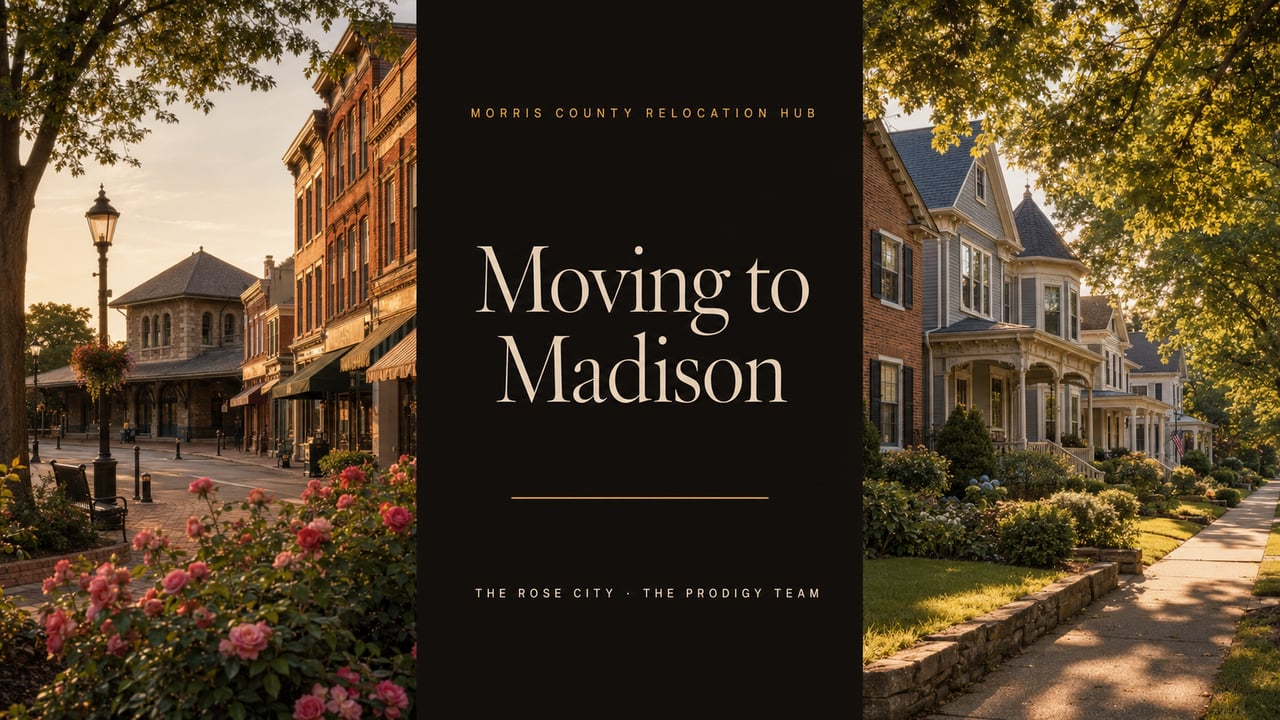
A 4.2-square-mile borough with its own electric grid, a 1916 train station with weekday expresses that put Penn Station about 55 minutes away, and one of the thinnest, hottest luxury markets in Morris County. The complete guide to moving to Madison — the commute, the market’s honest numbers, the schools, and the utility bill nobody expects.
Madison is what happens when a commuter town keeps every promise the category makes. The Midtown Direct train leaves from a 1916 station in the middle of a genuinely walkable downtown; the school district runs a clean three-elementary path to a single high school; two universities — Drew and Fairleigh Dickinson’s Florham campus — anchor the borough’s culture and, quietly, its finances; and the borough owns its own electric and water utilities, a structural oddity that shows up in residents’ favor every month.
The price of all that coherence is the price: Madison trades between roughly $1.0 million and $1.34 million depending on which measure you read, on 130-odd sales a year — a thin, fast market where homes go under contract in about 25 days at roughly 4% over ask, and where single-month medians swing wildly on a handful of closings. This hub is the honest map: the commute, the market, the schools, the utilities, and the playbook for buying into — or selling out of — the Rose City.
Madison earned its nickname the old-fashioned way: after the Civil War, this stretch of Morris County grew and shipped so many roses that “Rose City” stuck — the borough’s own website still lives at rosenet.org. The rose greenhouses are gone; the thing they financed remains. A compact, pre-automobile street grid. A downtown that never hollowed out. Elevated train tracks — raised in 1916 so the railroad would never sever the town — with a station you can walk to from most of the borough’s roughly 5,640 homes. Madison is one of the most complete small commuter towns in New Jersey, and this guide covers what that completeness costs and what it pays. It is part of our statewide coverage of how the New Jersey market is splitting in two — and Madison sits emphatically on the winning side.
Start with the shape of the place: about 4.2 square miles in southeast Morris County, roughly 26 miles west of Manhattan, home to around 17,000 people and two universities. Drew University’s wooded campus sits directly off the downtown; Fairleigh Dickinson’s Madison–Florham Park campus adjoins it. The university presence does what it does in every good college town — lectures, arts, a steady daytime economy — but in Madison it also does something almost no other town can claim, covered in Chapter IV.
The downtown is the borough’s calling card: a genuine multi-block business district of specialty shops and restaurants — Shanghai Jazz is the name outsiders know — anchored by the train station rather than a parking lot. The civic calendar runs through Bottle Hill Day, the fall street festival named for the settlement’s pre-Madison identity, and the parks system covers the daily-life bases: Memorial Park’s community pool, ice rink, and dog park, with the Giralda Farms preserve’s trails on the borough’s edge. Most housing predates the 1960s — Victorians, prewar colonials, and postwar capes on compact lots — with a meaningful layer of contemporary new construction threading into premium pockets like the Hill section.
Madison’s commute is the borough’s founding asset, and it rests on a century-old piece of foresight: when the tracks were elevated through downtown in 1916, the railroad and the street grid stopped competing. No grade crossings, no severed blocks — the station sits in the middle of town, walkable from a large share of the borough’s homes.
The service itself: NJ Transit’s Morristown Line, with Midtown Direct trains reaching New York Penn Station in roughly 55 minutes on weekday expresses — closer to an hour on locals, with rush-hour departures about every 30 minutes, plus Hoboken-bound service connecting to PATH for downtown commuters, and transfers available at Summit or Newark Broad Street to reach whichever terminal a given train doesn’t. That two-terminal flexibility — Midtown or downtown — is the practical difference between Madison and the one-option towns further out the line, and it is the single feature our New York relocation buyers price first.
Here is the honest read, because Madison’s market statistics require one. The borough closes roughly 134 sales a year — thin enough that single-month medians are mostly noise. This past March, one platform printed the monthly median at $1.3 million, “up 49.7% year over year,” on seventeen closings. Madison did not appreciate fifty percent in a year; seventeen sales happened to skew large. Read the trailing-year measures instead, and the market comes into focus.
Sources: Zillow Home Value Index; Movoto market trends (March 2026 closed sales); Homes.com trailing-12-month median. The spread reflects measurement methodology and small-sample volatility, not disagreement about direction — all three read a tight, appreciating market.
What the measures agree on matters more than where they differ: homes go under contract in roughly 25 days — less than half the national pace — the average sale clears about 4% over list, hot listings clear roughly 8% over in about 15 days, and active inventory runs in the dozens, spanning roughly $699,000 for entry product to $3.5 million at the top. The stock explains the ceiling: renovated Victorians and prewar colonials compete with genuinely high-spec new construction in the Hill section and beyond, and the new builds have been resetting the top of the comp table.
For the buyer, that pace means Madison behaves like the most aggressive sellers’ markets we cover — the New Providence playbook applies here almost verbatim: underwritten pre-approval before touring, appraisal-gap strategy drafted before offering, and discipline about which measure of “the median” your offer is actually anchored to.
Madison is one of a very small number of New Jersey municipalities that own and operate their own electric utility — an eight-person borough Electric Department maintains the distribution system, and the borough runs its own water utility besides. For residents this is not a civic trivia point; it is a monthly line item and a structural advantage. A local crew that lives in or near town restores outages; rates are set by the borough, marketed plainly as reliable and affordable; and both bills are paid directly to Madison, not to a regional investor-owned utility.
The quieter benefit is fiscal. The utility’s largest customers include the borough’s non-profit institutions — Drew University alone has paid on the order of $1.9 million a year for electric service — meaning institutions that pay no property taxes still contribute substantially to borough revenue through the utility, whose surplus has long helped fund capital investment. Translated for a homebuyer: some of the municipal burden that lands entirely on homeowners in other towns is shared, in Madison, by the meter. It is the single most underrated line in the borough’s cost-of-ownership math, and almost no listing sheet mentions it.
Utility rates, transfer policies, and billing schedules are set by the borough and change over time — verify current residential rates at rosenet.org before budgeting, and remember that Madison’s utility accounts, like its tax quarters, get prorated at closing. The point is structural, not a promise of any specific rate: Madison’s ownership model is a genuine cost-of-ownership differentiator that belongs in any honest comparison against neighboring towns.
The district runs the clean, legible structure relocating families hope for: three neighborhood elementary schools — Central Avenue, Kings Road, and Torey J. Sabatini — feeding Madison Junior School for grades six through eight, then Madison High School for nine through twelve. One path, one high school, no zone-versus-zone anxiety inside the borough. Elementary assignment is set by address and can shift over time, so confirm the current assignment for any specific home directly with the district rather than assuming from a listing.
Beyond the public district, the university layer adds what small towns rarely have — Drew’s campus events and continuing education, FDU’s programming next door — and the private and parochial options of southeast Morris County sit within a short drive. We don’t grade schools for buyers; we point families to the NJ Department of Education’s School Performance Reports, tell them to visit, and help them time the search to the answer.
Buyers: treat Madison as a preparation contest. At 25 days to contract and 4% over ask, the winning offer is usually written before the house lists — fully underwritten financing, an appraisal-gap plan calibrated to the thin comp set, and clarity about which product you’re actually bidding on, because a renovated 1920s colonial and a 2023 Hill-section build carry different risk profiles at the same price point. Budget honestly: the tax bill on a seven-figure Morris County home is substantial, and the utility structure softens the total cost of ownership without erasing it.
Sellers: your leverage is real and your comps are treacherous — in a 134-sale-a-year market, three wrong comparables can misprice a home by six figures in either direction. The winning approach prices from genuinely similar trailing-year sales, presents to the standard the new-construction competition has set, and markets to the buyer pool that actually pays Madison’s premium: New York households buying the 45-minute train, the walkable downtown, and the one-high-school district — which is precisely the pipeline The Prodigy Team’s cross-state infrastructure was built to deliver.
“Every commuter town sells the same three promises — the train, the downtown, the schools. Madison is the rare one that kept all three and then bought its own power grid for good measure. My job is making sure you pay for the promises that are real — and not a dollar for the folklore.”
— Anthony Licciardello, Broker, The Prodigy Team
Every guide on this site is part of a system: town-by-town content clusters, dedicated neighborhood pages, and cross-state marketing engineered for one outcome — putting your listing in front of the motivated New York families already searching for it. I’m Anthony Licciardello, Broker of The Prodigy Team — a former Director of Community Affairs in the Bloomberg Administration and a member of the Staten Island Growth Management Task Force — and this pipeline is what 22 years and 5,000 closings taught me to build.
Our Above the Streets cinematic drone series extends that reach — aerial storytelling that markets entire towns, not just listings, with audience performance exceeding industry benchmarks for real estate media.
Anthony Licciardello · Broker, The Prodigy Team · 718-873-7345
Send us any Madison listing — we’ll translate it into the real monthly number: taxes, the borough utilities, and what the thin-market comps actually support.
How much does a home in Madison, NJ cost?
Depending on the measure, roughly $1.0 million to $1.34 million: Zillow’s average home value sits at about $1.01 million (up 4.2% year over year), while the trailing-12-month median sale price runs about $1.34 million (up 20%). Active listings span roughly $699,000 to $3.5 million. Because Madison closes only about 134 sales a year, single-month medians swing wildly and should not be used to price an individual home.
How long is the commute from Madison, NJ to New York City?
About 55 minutes to New York Penn Station on weekday Midtown Direct expresses (closer to an hour on locals, with rush-hour service roughly every 30 minutes) via the Morristown Line, from a station in the middle of downtown. Hoboken-bound trains connect to PATH for downtown commuters, with transfers available at Summit or Newark Broad Street — giving Madison two-terminal flexibility many towns further out the line lack.
Does Madison, NJ really have its own electric company?
Yes. The Borough of Madison owns and operates its own electric utility — run by a borough Electric Department — and its own water utility, with bills paid directly to the borough. Large institutional customers, including Drew University at roughly $1.9 million a year for electric service, contribute substantially to borough revenue through the utility, which has long helped fund capital investment. Verify current residential rates at rosenet.org.
How are the schools structured in Madison, NJ?
Madison Public Schools runs three neighborhood elementary schools — Central Avenue, Kings Road, and Torey J. Sabatini — feeding Madison Junior School (grades 6–8) and then Madison High School. Elementary assignment is set by address and can change over time, so confirm the current assignment for any specific home directly with the district. Drew University and FDU’s Madison–Florham Park campus add a university layer most small towns lack.
Is Madison, NJ a good market to sell a home in right now?
The fundamentals strongly favor prepared sellers: roughly 25 days to contract, average sales about 4% over list, and hot listings clearing around 8% over in about 15 days. The caveat is comp discipline — in a market this thin, pricing from the wrong three comparables can miss by six figures, so price from genuinely similar trailing-year sales and present against the new-construction standard.
New Providence, NJ: Inside One of Union County’s Most Aggressive Sellers’ Markets
Cranford, NJ Real Estate Trends & Market Data
How the New Jersey Housing Market Is Splitting in Two
Where New Jersey Real Estate Is Moving Fastest in 2026
Market figures per Homes.com (trailing-12-month median sale, days on market, sales volume), Zillow Home Value Index, Movoto market trends, and Redfin (competition metrics and the March 2026 small-sample example), all 2026. Borough facts — electric and water utilities, Electric Department, utility billing — per the Borough of Madison (rosenet.org); Drew University utility payment figure as publicly reported. Commute and station details per NJ Transit Morristown Line service and Madison station records (elevated 1916). School structure per Madison Public Schools; confirm assignments directly with the district. Neighborhood medians are small-sample statistics and subject to revision. This post is general information, not tax, legal, or financial advice.
Prodigy Real Estate is an innovative real estate company offering high-end video production, home valuation services, purchasing, and home sales. Serving New York and New Jersey.