
Anthony Licciardello | July 13, 2026
Forked River, NJ
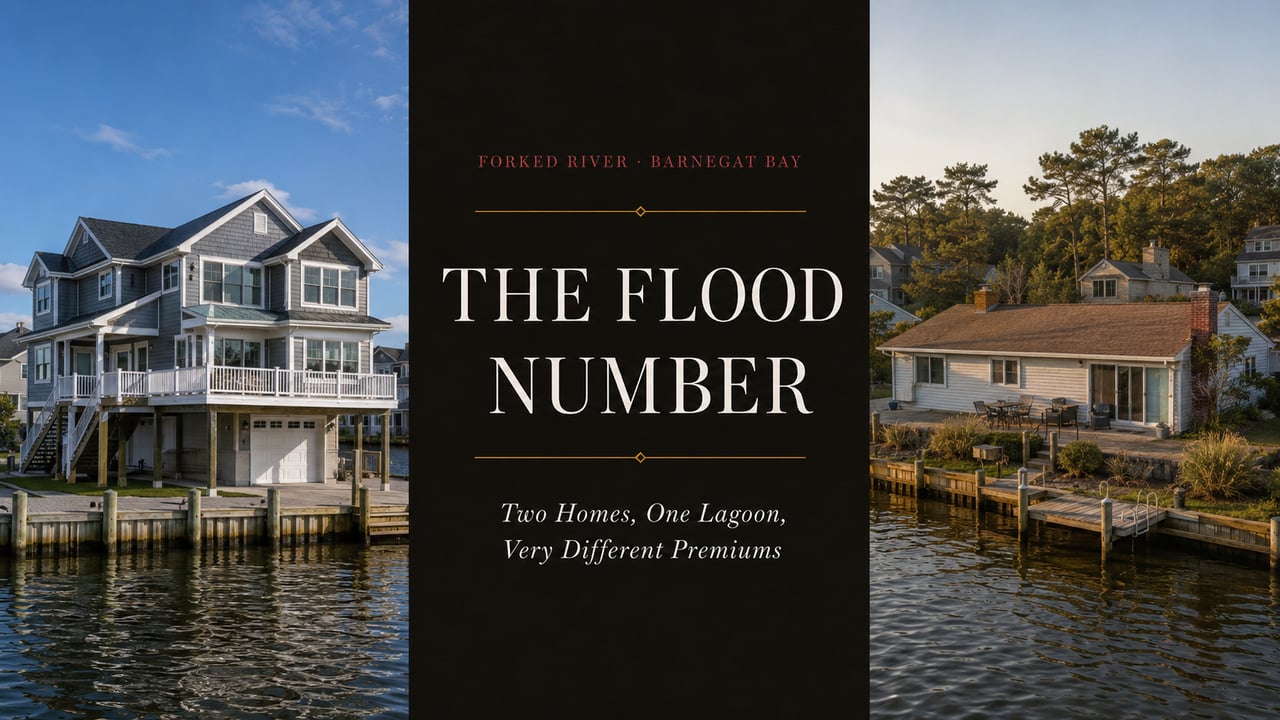
On a Barnegat Bay lagoon, flood insurance isn't a formality — it's part of the purchase price you pay every year, and two houses on the same water can differ by thousands. Here's exactly how the premium is calculated, why one cheap document can save you five figures, and the buyer's playbook that turns a scary line item into a solved problem.
Buying a lagoon home in Forked River means taking on an annual flood-insurance cost that can range from roughly a thousand dollars to many thousands — and, crucially, that number is now set by the specific house, not by the flood zone it sits in. Since FEMA rebuilt its pricing system in 2023, an elevated home and a low, slab-on-grade neighbor on the same lagoon can pay premiums that differ by thousands of dollars a year. That means the flood number is not a fixed cost of "the area" — it's a variable you can investigate, influence, and negotiate. Understand how the premium is built, get the one document that can slash it, shop the private market against the federal program, and you turn the single scariest line item in a waterfront purchase into a solved, budgeted number. This is the buyer's guide to doing exactly that on Barnegat Bay.
This is the deep-dive companion to our Forked River waterfront buyer's guide — expanding the one chapter that trips up more New York buyers than any other. The same pricing mechanics govern the whole Jersey Shore, and we've mapped them for the barrier island in our LBI flood-insurance breakdown; here the focus is the bayside lagoon, where the risk profile — and the opportunity to get the number down — looks a little different.
A Forked River lagoon home sits in a FEMA-mapped high-risk flood area — typically an AE zone on the bay side — where a federally backed mortgage makes flood insurance mandatory, not optional. But bayside lagoon risk is its own category, distinct from the oceanfront. You're generally not exposed to the direct wave action and storm surge that push barrier-island beachfront homes into the costliest V zones; the threat here is bay-driven tidal flooding and rainfall, which tends to price lower than open-coast exposure while still being very real. The practical result is a wide middle band: many bayside high-risk homes in this part of the shore have historically rated in the low-to-mid four figures a year, well below oceanfront numbers — but with enormous spread depending on the individual house. And there's a local wrinkle every buyer should know: since Superstorm Sandy, a large share of older lagoon homes have been raised or rebuilt to modern elevation standards, which is why you'll see so many homes on pilings with a garage-and-storage level below the living space. That "raised" look isn't just style — it's the single biggest lever on the premium, which is what the next chapter is really about.
In 2023, FEMA fully replaced a decades-old system that priced flood insurance mainly by zone and a base-flood-elevation comparison. The new methodology — often called Risk Rating 2.0 — prices each property on its own specific risk, using factors including distance to the water source, the type of flooding, how often the area floods, the building's foundation type, the height of its lowest floor relative to the base flood elevation, its replacement cost, and its prior claims history. The single most important consequence for a buyer is this: two homes in the very same flood zone can now carry completely different premiums. The old shorthand — "what does flood insurance cost in this zone?" — is dead. On a Forked River lagoon, the home elevated eight feet on pilings with flood vents and modern construction can rate at a fraction of the low 1960s ranch three doors down, even though they share a lagoon and a zone. That's not a loophole; it's the design. Which means the premium quoted on the house you toured last weekend tells you almost nothing about the one you're touring this weekend — each must be priced individually, on its own facts.
Reference points, not quotes for any specific home: NJ statewide NFIP average ~$1,347 (2025, FloodPrice); low-risk "preferred" median ~$410 and V-zone average ~$4,738 (NJ historical baseline, Rutgers/NFIP); bayside A-zone typical band ~$1,200–1,300 (Barnegat Bay-area reporting). Under Risk Rating 2.0 an individual home can fall well outside these ranges — always obtain an address-specific quote.
Under the new system, FEMA no longer requires an elevation certificate — it pulls elevation data from its own mapping databases. But that automated data can understate how high your home actually sits, and here's the asymmetry that every waterfront buyer should burn into memory: submitting an elevation certificate can only help you. A licensed surveyor's certificate, typically $300 to $600, documents your building's real elevation. If it shows the home is higher than FEMA assumed, your premium can drop — potentially by enough to save five figures over the life of ownership — and FEMA will even recalculate from your policy's effective date and refund the difference. If the certificate is unfavorable, FEMA does not raise your existing rate. So the only real downside is the cost of the survey itself, against a potentially large and recurring upside. For a Forked River lagoon home — especially an older one where FEMA's model may not reflect a post-Sandy raise — pulling an elevation certificate is often the highest-return few hundred dollars in the entire transaction. The certificate is also reusable: it carries forward to renewals, to any future map appeal, and into the next sale as a marketing asset.
Ask the seller whether an elevation certificate already exists before you pay for a new one — many raised or rebuilt lagoon homes had one done at construction, and it may be sitting in a drawer or with the town. If the seller carries a favorable NFIP policy, ask whether it's assignable: a grandfathered flood policy can transfer to you at closing, locking in a lower rate than a fresh quote would produce. Two questions — "Is there an EC?" and "Can I assume your flood policy?" — can be worth thousands, and almost no out-of-town buyer thinks to ask them.
1. Get an address-specific quote before you're in contract. Not a zone estimate, not the neighbor's number — an actual quote for the actual house, early enough that it informs your offer. This is the non-negotiable first move.
2. Shop private carriers against the NFIP. Private flood insurers have entered the New Jersey market aggressively and frequently beat the federal program on well-built, higher-value homes — though they can also decline to quote, so it isn't guaranteed. Always run both; take the better of the two.
3. Pull an elevation certificate where the numbers are close. Especially on an older or recently raised home, it's a low-risk shot at a materially lower premium.
4. Value the mitigation. Homes elevated on pilings, with mechanicals raised above the lowest floor and engineered flood vents installed, earn credit under the pricing model. A well-mitigated home isn't just safer — it's cheaper to insure, and that lower carrying cost is worth paying a bit more at purchase to secure.
5. Read the flood disclosure. New Jersey now requires sellers to disclose a property's flood history and risk to buyers — read it carefully, and treat any history of past flooding or claims as a prompt for deeper diligence, not a dealbreaker by itself.
Run this playbook and the flood premium stops being a fog of dread and becomes what it should be: a known, budgeted, negotiated number — one more line in a waterfront purchase you've fully understood. Start from the full Forked River waterfront guide, then browse current Forked River homes for sale with the flood question already in hand.
See the lagoon landscape the flood maps describe — the canals, the bulkheads, and the raised homes that read straight into your premium — in our Above the Streets Forked River feature.
"I've watched buyers walk away from a perfect lagoon house because a neighbor scared them with a flood-insurance horror story — and I've watched others overpay because they never asked what the number actually was. Both mistakes come from treating flood insurance as a rumor instead of a quote. Get the real number on the real house, pull the elevation certificate, shop it both ways. Nine times out of ten it's a manageable figure, and knowing it is what lets you buy with confidence instead of fear."
— Anthony Licciardello, Broker, The Prodigy Team
Every guide on this site is part of a system: town-by-town content clusters, dedicated neighborhood pages, and cross-state marketing engineered for one outcome — putting your New Jersey listing in front of the motivated New York families already searching for it. I'm Anthony Licciardello, Broker of The Prodigy Team — a former Director of Community Affairs in the Bloomberg Administration and a member of the Staten Island Growth Management Task Force — and on the water, the difference between a good buy and a bad one is usually the diligence nobody told the buyer to do. Reading a flood number correctly is exactly that kind of edge.
Our Above the Streets cinematic drone series extends that reach — aerial storytelling that markets entire towns, not just listings, with audience performance exceeding industry benchmarks for real estate media.
Anthony Licciardello · Broker, The Prodigy Team · 718-873-7345
We'll help you get an address-specific quote, weigh the elevation-certificate move, and factor the true carrying cost into your Forked River offer — before you're committed.
How much is flood insurance on a Forked River waterfront home?
There's no single answer, which is the whole point of the current system. New Jersey's average NFIP premium is around $1,347, and bayside high-risk homes on this part of the shore have often rated in the low-to-mid four figures — but under Risk Rating 2.0 the premium is set by the individual property, so an elevated, well-built home can pay far less than an older low-lying one on the same lagoon. Always get an address-specific quote rather than relying on a zone estimate or a neighbor's figure.
Do I still need an elevation certificate under the new FEMA rules?
It's no longer required — FEMA uses its own elevation data — but it's often worth getting anyway. A certificate (about $300–$600 from a licensed surveyor) can lower your premium if it shows your home sits higher than FEMA assumed, and submitting one can only help: if the data is unfavorable, FEMA won't raise your existing rate. On older or post-Sandy-raised lagoon homes, it's frequently the highest-return small expense in the purchase.
Why do two homes on the same lagoon pay different flood premiums?
Because FEMA's Risk Rating 2.0 prices each property individually — on its elevation, foundation type, distance to water, replacement cost, and claims history — rather than by flood zone alone. An elevated home on pilings with flood vents and modern construction can rate at a fraction of a low, slab-on-grade neighbor's premium even on the same body of water. The zone no longer determines the price; the specific house does.
Should I use NFIP or private flood insurance in Forked River?
Get both quotes and compare. Private flood carriers have moved into the New Jersey market and often beat the NFIP on well-built, higher-value homes, though they can decline to quote on higher-risk properties. The federal NFIP offers standardized coverage (up to $250,000 building / $100,000 contents for a home) and transferable grandfathered discounts. There's no universal winner — the right choice depends on the specific house, so run them side by side.
Moving to Forked River — The Relocation Guide
The Forked River Waterfront Buyer's Guide
Inland vs. Waterfront — Two Markets Compared
The Forked River Neighborhood Guide
The Forked River Housing Market
Selling a Waterfront Home — The Seller's Playbook
The Forked River Boating Life
Why LBI Flood Insurance Costs What It Does
Forked River NJ Homes for Sale
Flood-insurance mechanics reflect FEMA's National Flood Insurance Program under Risk Rating 2.0, fully implemented April 1, 2023 (premiums set by property-specific factors including distance to water, flood type and frequency, foundation type, lowest-floor height relative to base flood elevation, replacement cost, and prior claims; most primary-residence increases capped at 18% per year; elevation certificates optional but potentially premium-lowering; grandfathered discounts transferable to buyers; NJ now requires seller flood disclosure). Premium reference points are New Jersey averages and historical baselines (statewide NFIP average ~$1,347 per FloodPrice, 2025; preferred-risk median ~$410 and V-zone average ~$4,738 per NJ historical NFIP data; bayside A-zone typical band per Barnegat Bay-area reporting) — they are illustrative, not quotes for any specific property, and an individual home may fall outside them. Confirm flood zone via the FEMA Map Service Center, obtain an address-specific quote, and consult a licensed insurance professional before relying on any figure. This post is general information, not insurance, legal, or financial advice.
Prodigy Real Estate is an innovative real estate company offering high-end video production, home valuation services, purchasing, and home sales. Serving New York and New Jersey.