
Anthony Licciardello | July 14, 2026
Forked River, NJ
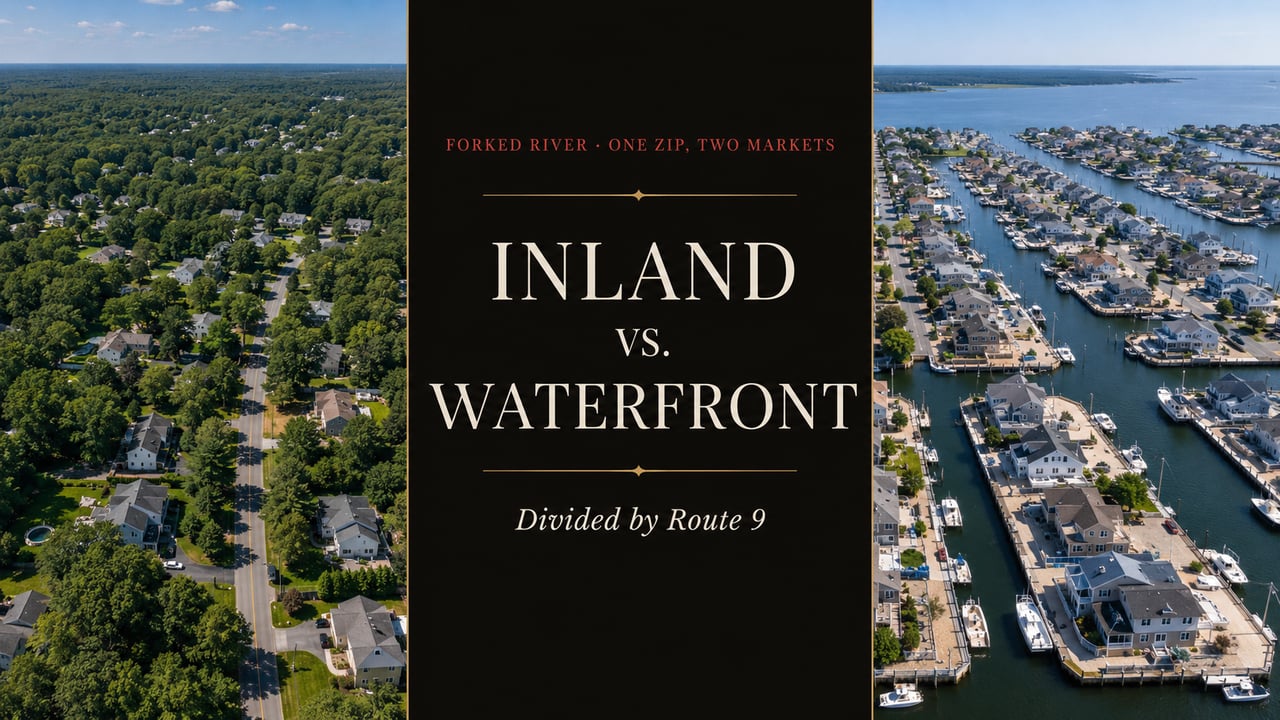
One zip code, two completely different real estate markets — split down the middle by Route 9. On the water, you pay a 50-to-100% premium and take on flood insurance, bulkheads, and higher taxes for a boat off the back deck. Inland, you get space, privacy, and predictable costs. Here's the honest breakdown of both, so you buy into the right one.
Forked River isn't one housing market — it's two, sharing a zip code and divided by U.S. Route 9. To the west lies the inland market: wooded, family-oriented, larger lots, stable carrying costs, and real value for buyers who want to be near the shore without paying the "water tax." To the east lies the lagoon network: a lifestyle-driven waterfront market where the dirt and the water depth often matter more than the house, and where buyers gladly pay a 50-to-100% premium — plus flood insurance, bulkhead upkeep, and higher taxes — for a boat in the backyard with direct access to Barnegat Bay. Comparing the two is apples to oranges. The smartest thing a Forked River buyer can do is decide, honestly, which market they're actually shopping — because the price tag on the listing is only the beginning of the difference.
Our Moving to Forked River guide describes a town of "two worlds" — the salt life of the lagoons and the piney life of the woods. This post puts hard numbers to that divide. If you're weighing where to buy in Forked River, understanding the inland-versus-waterfront split — the price structures, the premium, and the hidden costs — is the single most useful thing you can do before you tour a single home.
The geography here does something unusual: it draws a hard economic line. U.S. Route 9 runs north–south through Forked River, and it functions as the border between two distinct micro-markets. West of Route 9 is traditional wooded suburbia — the inland market. East of Route 9 is the man-made lagoon network feeding Barnegat Bay — the waterfront market. They share schools, a zip code, and a town name, but they price, live, and carry costs completely differently. Taken together, the overall market is competitive and healthy: recent data has shown a blended median sale price in the low-$600,000s and homes selling in roughly 40 days at close to asking, though that headline median swings month to month depending on how many waterfront versus inland homes happen to close. That blended number hides the real story, which only appears when you split the two sides apart — so that's exactly what the rest of this guide does.
Inland Forked River is the value side — a classic suburban shore lifestyle with larger lots, mature tree cover, more privacy, and, crucially, predictable carrying costs. Most of it sits in FEMA's low-to-moderate-risk Zone X, which means flood insurance generally isn't federally required, removing a major monthly expense that the waterfront can't escape. The price structure sorts into clear tiers. Entry-level ($350,000–$450,000): older, smaller ranches, bi-levels, and Cape Cods, often 1,000–1,500 square feet and due for cosmetic updates. Standard single-family ($475,000–$700,000): the inland sweet spot — updated three-to-four-bedroom colonials and large ranches from roughly 1,800 to 2,500 square feet, often with two-car garages, finished basements, even in-ground pools, in neighborhoods like Cranberry Hill and Barnegat Pines. Luxury inland ($750,000–$1,000,000+): newer large-scale custom builds on oversized lots, sometimes an acre or more, especially heading west toward the Parkway and the Pine Barrens. And for downsizers, the age-restricted communities live here too — from budget-friendly Pheasant Run to resort-style Sea Breeze at Lacey, which we cover in the 55+ communities guide. For a family or retiree who wants shore proximity, space, and a stable budget, inland is where the value lives.
The waterfront is a different animal — a luxury, lifestyle-driven market where buyers are purchasing deep, wide lagoons with bridge-free access to the bay and ocean, and where the land and water depth are frequently worth more than the structure on them. Its tiers run higher. Entry-level and teardowns ($450,000–$600,000): increasingly rare as move-in-ready; at this level you're usually buying an un-raised 1960s cottage under 1,200 square feet needing a full renovation, or a lot bought specifically to demolish and rebuild — the teardown economics we cover in our new-construction coverage. Standard lagoon homes ($650,000–$950,000): the bulk of the active waterfront market, in sections like Sunrise Beach and Forked River Beach — updated three-to-four-bedroom homes, 1,500–2,500 square feet, with 50 to 75 feet of frontage, the upper end usually elevated on pilings. Luxury bayfront and riverfront ($1.1M–$2.5M+): large, newer or fully reconstructed custom homes elevated above FEMA standards, with open-bay or river views, rooftop decks, resort-style outdoor living, and heavy-duty boat lifts. The full playbook for buying at any of these tiers is in our waterfront buyer's guide. The common thread: on the water, you're buying a lifestyle, and you pay for it — both up front and every year after.
Tier | Inland (West of Rt. 9) | Waterfront (East of Rt. 9) |
|---|---|---|
Entry | $350K–450K · older ranch/Cape, 1,000–1,500 sq ft | $450K–600K · un-raised '60s cottage or teardown lot |
Standard | $475K–700K · updated 3–4 BR, 1,800–2,500 sq ft (Cranberry Hill, Barnegat Pines) | $650K–950K · updated 3–4 BR, 50–75 ft frontage (Sunrise Beach, Forked River Beach) |
Luxury | $750K–1M+ · custom builds on oversized/1-acre lots | $1.1M–2.5M+ · elevated custom bay/riverfront, boat lifts |
Flood zone | Mostly Zone X — insurance not federally required | Zone AE/VE — flood insurance required with a mortgage |
The sticker price is only the start. Choosing the waterfront layers on premiums and liabilities the inland buyer never sees:
The base premium — 50% to 100%. The clearest way to see it: a fully updated 2,000-square-foot inland home might sell around $500,000; the same house on a lagoon easily commands $850,000 to $950,000. You're paying roughly double for the water, before a single carrying cost.
Flood insurance. Waterfront homes sit in FEMA flood zones (AE or VE), so with a mortgage, flood coverage is legally required. Older ground-level homes can run $2,000–$5,000+ a year; homes raised on pilings above flood level insure for far less — which is exactly why elevated homes sell for top dollar. Inland Zone X homes usually skip this cost entirely. The full mechanics are in our flood-insurance guide.
The bulkhead. Waterfront land is held back from the lagoon by a retaining wall — the bulkhead — and it's the owner's financial responsibility. Replacing a failing timber bulkhead with modern vinyl runs roughly $25,000 to $60,000+ depending on lot width, and its age and condition are scrutinized in every sale and priced directly into the home. Inland lots have simple fencing and none of this.
Property taxes. Because New Jersey taxes assessed value, the waterfront premium flows straight into the tax bill. An inland owner might pay around $7,000 a year; a waterfront owner in the same-sized house can easily pay $12,000–$18,000+.
Marine logistics and privacy. Not all water is equal — a wide, deep lagoon three minutes from open bay prices far above a narrow, shallow creek thirty minutes back under low bridges. And because the lagoon grids were platted as mid-century summer colonies, lots are often narrow (50×100), homes sit close together, and backyards are largely deck and dock — less privacy than a sprawling wooded inland lot.
None of this makes the waterfront a bad buy — for the right buyer, the boat off the back deck is worth every dollar. It makes it a different buy, one you should enter with eyes open. Decide which market fits your life and budget, then shop it deliberately. Start with current Forked River homes for sale.
Illustrative comparison per market analysis of Forked River (08731), 2024–2026: a comparable ~2,000 sq ft home commands a roughly 50–100% premium on the lagoon versus inland, before higher flood insurance, taxes, and bulkhead upkeep. Figures are point-in-time and vary by lot, water access, and elevation — verify against current comps.
Run the all-in monthly number, not the mortgage. Two Forked River homes with the same purchase price — one inland, one on a lagoon — can carry wildly different true costs once you add the waterfront's flood insurance, higher taxes, and a sinking fund for the eventual bulkhead. Before you fall for a water view, have your agent build the real annual carrying cost for both a comparable inland and waterfront home. Sometimes the water is absolutely worth it; sometimes the same money buys a bigger, more private inland house and a boat slip at a marina for a fraction of the cost. Decide with the full number in front of you.
See the Route 9 divide from the air — the lagoon grids to the east, the wooded inland neighborhoods to the west — in our Above the Streets Forked River feature.
"The biggest mistake I see in Forked River is a buyer comparing an inland listing and a waterfront listing as if they're the same product at different prices. They aren't. The water comes with a premium and a whole second set of costs — flood, taxes, the bulkhead nobody thinks about until it's failing. That's not a warning against buying on the water; plenty of my happiest clients did. It's a plea to compare the real all-in numbers, so you're choosing the water on purpose, not by accident."
— Anthony Licciardello, Broker, The Prodigy Team
Every guide on this site is part of a system: town-by-town content clusters, dedicated neighborhood pages, and cross-state marketing engineered for one outcome — putting your New Jersey listing in front of the motivated New York families already searching for it. I'm Anthony Licciardello, Broker of The Prodigy Team — a former Director of Community Affairs in the Bloomberg Administration and a member of the Staten Island Growth Management Task Force — and knowing the true cost gap between an inland and a waterfront home is exactly the kind of local intelligence that protects a buyer's biggest decision. Whether you land west or east of Route 9, we make sure you chose it on the numbers.
Our Above the Streets cinematic drone series extends that reach — aerial storytelling that markets entire towns, not just listings, with audience performance exceeding industry benchmarks for real estate media.
Anthony Licciardello · Broker, The Prodigy Team · 718-873-7345
We'll build the true all-in cost of a comparable inland and waterfront home side by side — premium, taxes, flood, bulkhead — so you buy into the right Forked River market with confidence.
How much more does waterfront cost in Forked River?
Expect a premium of roughly 50% to 100% purely to be on the water. A comparable, fully updated 2,000-square-foot home that sells around $500,000 inland can easily command $850,000 to $950,000 on a lagoon — before you add the waterfront's higher flood insurance, higher property taxes, and bulkhead upkeep. The water is a lifestyle purchase, and it's priced like one.
Is inland Forked River a better value than the waterfront?
For many buyers, yes. Inland Forked River (west of Route 9) offers larger, more private lots, a standard-home sweet spot around $475,000–$700,000 in neighborhoods like Cranberry Hill and Barnegat Pines, and — because most inland homes sit in FEMA Zone X — no federally required flood insurance and lower taxes. You give up the backyard boat access, but you gain space, privacy, and predictable carrying costs. Many buyers keep a boat at a nearby marina for far less than the waterfront premium.
What extra costs come with a Forked River waterfront home?
Three big ones the inland buyer never faces: flood insurance (required with a mortgage in the waterfront's AE/VE zones — often $2,000–$5,000+ a year on older ground-level homes), the bulkhead (the retaining wall you own, costing roughly $25,000–$60,000+ to replace), and higher property taxes (a waterfront home can run $12,000–$18,000+ versus around $7,000 for a comparable inland house). Factor all of these into the true carrying cost before buying.
What's the overall Forked River market like right now?
Competitive. Recent data has shown a blended median sale price in the low-$600,000s, homes selling in around 40 days at close to asking, and appreciation running strong. But that blended median is misleading on its own, because it mixes the affordable inland market with the pricier waterfront — the two sides behave very differently. Always look at the segment (inland vs. waterfront) and the specific home, not just the town-wide average.
Moving to Forked River — The Relocation Guide
The Waterfront Buyer's Guide
Flood Insurance on the Barnegat Bay Lagoons
55+ Communities: Sea Breeze & Pheasant Run
Forked River NJ Homes for Sale
Market structure and figures per market analysis of Forked River / Lacey Township (ZIP 08731), 2024–2026: blended overall median sale price in the low-$600,000s with roughly 40-day average market time; inland (west of Route 9) tiers approximately $350K–450K (entry), $475K–700K (standard), $750K–1M+ (luxury); waterfront (east of Route 9) tiers approximately $450K–600K (entry/teardown), $650K–950K (standard lagoon), $1.1M–2.5M+ (luxury bay/riverfront); waterfront premium ~50–100%; bulkhead replacement ~$25K–60K+; older ground-level waterfront flood premiums ~$2K–5K+; illustrative inland vs. waterfront tax comparison ~$7K vs. ~$12K–18K+. Figures are point-in-time, blend multiple sources, and vary sharply by segment, lot, water access, and elevation; the town-wide median in particular shifts with the monthly mix of inland and waterfront sales. Flood zones (X inland; AE/VE waterfront) are FEMA designations — verify the specific zone, tax bill, insurance quote, and bulkhead condition for any property before relying. This post is general information, not financial, tax, or insurance advice.
Prodigy Real Estate is an innovative real estate company offering high-end video production, home valuation services, purchasing, and home sales. Serving New York and New Jersey.