
Anthony Licciardello | August 31, 2026
Kennilworth, NJ
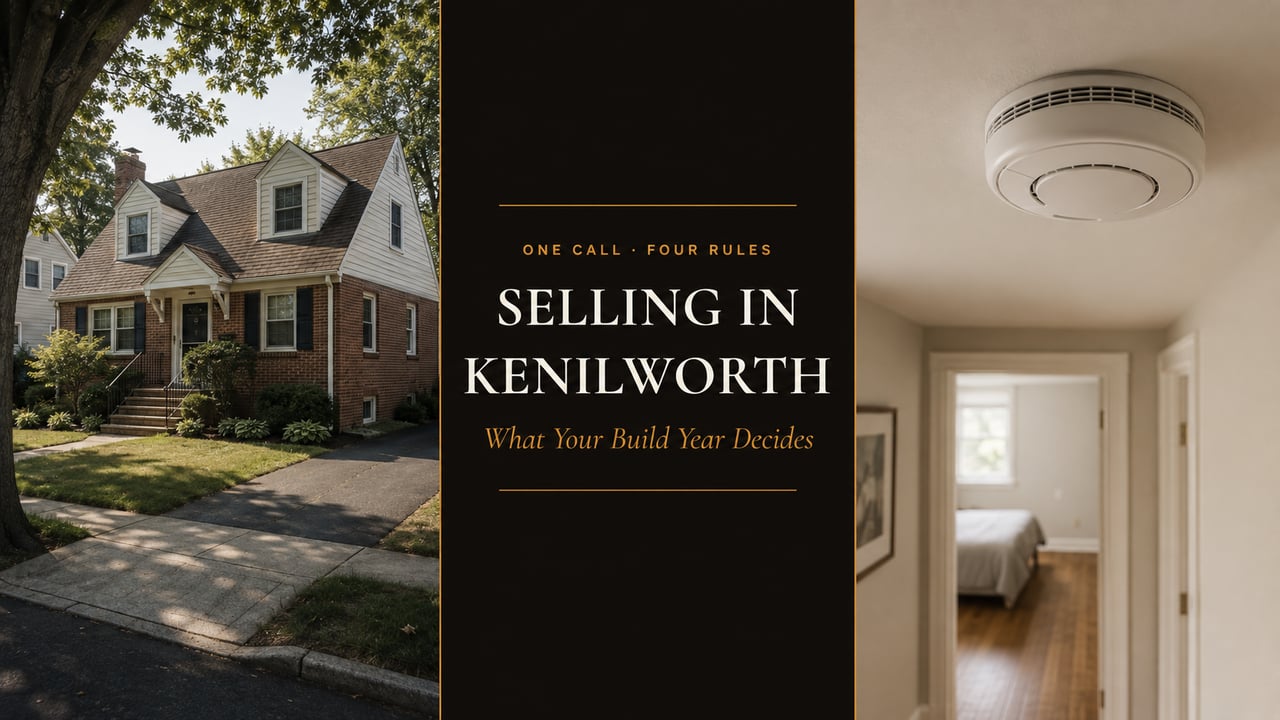
Kenilworth has no resale certificate-of-occupancy chapter — which is why sellers keep concluding there is nothing to do. The requirement is real and it is filed somewhere else entirely: an inspection for the sale of any building, sitting inside the Borough's fire prevention ordinance. Four more obligations apply on top of it, and three changed within the last two years.
Kenilworth has no resale certificate-of-occupancy chapter — and it does require an inspection to sell. The requirement lives in Chapter 94, Fires and Fire Prevention, under which the local enforcing agency inspects annually, on change of occupancy of a non-owner-occupied rental, and for the sale of any building — with express authority to refer property maintenance, health, ICC and zoning violations observed. That is narrower than a Lavallette-style permit audit and broader than a bare smoke certificate. Four more obligations bind every Kenilworth sale: the statewide alarm certificate, now tiered by your year of construction; the federal lead disclosure, which reaches most of this borough's pre-1978 stock; the flood disclosure that can release your buyer from the contract; and the seller-paid transfer fee above $1 million.
Municipal requirements change and differ sharply between adjoining towns — Cranford, three miles away, requires a Continuing Certificate of Occupancy that Kenilworth may not. Nothing here is legal advice. Confirm with the Borough of Kenilworth and your attorney before relying on any of it.
Kenilworth does require an inspection for the sale of a building — and it is not filed where most people look for it. There is no separate resale certificate-of-occupancy chapter in the Borough Code. The requirement sits inside Chapter 94, Fires and Fire Prevention, which provides that the local enforcing agency shall inspect annually, upon each change in occupancy of a non-owner-occupied residential rental unit, and for the sale of any building.
Chapter 94 goes on to provide that the local enforcing agency may refer violations of the property maintenance code, health codes, ICC code and zoning violations observed during that inspection.
That is narrower than a full certificate-of-occupancy audit — the inspector is there for fire safety, not to reconcile your house against the Tax Assessor's file the way Lavallette and Seaside Heights do. But an inspector standing in your house who notices a zoning or property-maintenance issue has express authority to refer it. Unpermitted work is not the subject of the visit, and it is not invisible during it.
Two more operational details from the Code. Under Chapter 165, application for a smoke detector inspection is made in writing at the office of the Building Department, with the fee set in Chapter 91 (Fees and Licenses); the Borough retains half for administrative expenses and half goes to the licensed official performing the inspection. Penalties run to $500 for a first offense and up to $1,000 for a second and each subsequent one. And landlords are entitled to an expedited inspection within two full business days of a completed application on payment of an additional $50 — worth knowing if you are selling a tenant-occupied property against a deadline.
So Kenilworth sits between the two extremes. It is not a town where you can sell on the statewide smoke certificate alone with no municipal involvement — the Borough's own ordinance requires an inspection for the sale of any building. Nor is it a Lavallette-style regime conditioning your certificate on building permits and Assessor records. It is a fire-safety inspection with a referral power attached, applied at sale.
What does the Chapter 94 sale inspection actually cover, and who performs it? The ordinance names the local enforcing agency; ask what that means in practice for your address.
Which office issues the smoke and carbon monoxide certificate, and what is the fee? Some boroughs run it in-house; others use the county Fire Marshal.
How far out are you booking? Statewide, one to two weeks is typical and peak months run longer. This converts an assumption into a date.
How long is the certificate valid? Six months in many towns, as short as 90 days in some — and a delayed closing can outrun a certificate you already paid for.
Whatever the answer, apply at the conclusion of attorney review rather than when the closing date approaches. That is the consistent professional guidance statewide, and it costs nothing to follow. Standard certificate requests commonly run around $35; expedited requests can cost $100 or more — a fee you pay purely for having waited.
The smoke and carbon monoxide certificate is statewide and non-negotiable — it applies to every residential resale in New Jersey, in every town. What most sellers get wrong is assuming one specification covers every house. It does not.
Battery-operated detectors with ten-year sealed batteries, on every level. Most of Kenilworth's capes, split levels and Colonial Revivals fall here — this is the borough's dominant tier.
Hardwired, interconnected detectors with battery backup. Battery units are not an acceptable substitute — a failed hardwired alarm must be replaced with a hardwired one.
All of the above, plus a detector inside every bedroom — the strictest tier, which surprises owners of newer construction who assume a modern house passes automatically.
Carbon monoxide alarms belong within ten feet of every bedroom door regardless of vintage, and detectors that form part of a home security system do not satisfy the code — they must be augmented with standalone units. Check your year of construction before you buy a single alarm. Walking into a 1985 house with a bag of sealed-battery units is a wasted afternoon and a failed inspection, and the reinspection puts you back in the queue at the worst possible moment.
And one change that saves you money. Portable fire extinguishers ceased to be required for the resale inspection effective February 3, 2025, under an amendment to the Uniform Fire Safety Act. Many published municipal checklists still list them. If you have one, leave it in place — several fire departments ask that you do — but do not buy one because an outdated form told you to.
Under the federal Lead-Based Paint Disclosure Rule (Section 1018 of Title X), before a buyer signs a contract on most pre-1978 housing the seller and agent must disclose known lead-based paint and hazards, provide any available records, give the buyer the EPA's Protect Your Family From Lead In Your Home pamphlet, and allow a 10-day period for a lead inspection or risk assessment (adjustable by written agreement).
This reaches most of Kenilworth. The borough's capes, split levels and Colonial Revivals largely predate 1978. Exemptions cover post-1977 housing, zero-bedroom units, properties certified lead-free by a certified inspector, and foreclosure sales. Sellers, landlords and agents are all responsible, and penalties for missing or false disclosure are severe.
Do not confuse it with New Jersey's lead-safe certification law. P.L. 2021 c.182 requires periodic inspections and Lead-Safe Certificates for pre-1978 rental dwellings. Per the state Realtors' association, that law does not apply to home sales. If you rent the property both obligations are live; if you are selling, the federal disclosure is the binding one.
Since March 20, 2024, every New Jersey seller must disclose flood risk on the Property Condition Disclosure Statement before the purchaser becomes obligated under contract. The Flood Risk Notification Law (P.L. 2023 c.93) requires you to state whether the property sits in FEMA's Special or Moderate Flood Hazard Area and to disclose actual knowledge of flood risks and any flooding history.
Failure to comply releases the purchaser from their obligations under the contract until the seller complies, and the law supplements the Consumer Fraud Act. The NJDEP Flood Risk Notification Tool is searchable by address. Landlords must separately provide a Flood Risk Notice on new and renewed leases, as a rider in no less than 12-point type, individually signed.
New Jersey's former 1% buyer-paid "mansion tax" became a seller-paid graduated fee on residential sales over $1 million: 1% to $2M, 2% to $2.5M, 2.5% to $3M, 3% to $3.5M, 3.5% above. The rate applies to the entire consideration once triggered, and it sits on top of the standard Realty Transfer Fee, which the seller also pays.
Most Kenilworth sales fall below the threshold — but not all of them. A recent snapshot showed nine houses listed from $539,900 to $1,249,000. If yours is one of the ones above a million, the fee is real money and it is yours to pay. Exemptions are claimed on Form RTF-1EE; run the arithmetic with your attorney before you set an asking price.
The value estimates on this borough run more than $100,000 behind what houses actually sell for. Pricing off one costs you the gain.
Kenilworth's March 2026 median came in at $602,000 with an average sale of $631,594, while value-estimate figures still sit near $440,500. In a borough appreciating around 7% a year, that gap is money — and an automated valuation will not find it for you. We price from recent closed sales in the borough, handle the certificate scheduling, and get the lead and flood disclosures right before they become contract problems. Backed by the New York metro buyer pool we bring to every listing.
This is the part of selling in Kenilworth that costs sellers real money, and it has nothing to do with paperwork. Published figures for this borough span roughly $440,500 to $631,295 — and they split cleanly by type. The estimate-based figures sit at $440,500 and around $490,000. The transactional figures sit at $602,000 (March 2026 median), $624,000 (May list median at about $390 per square foot) and $631,295 (twelve-month average, up roughly 7%).
A figure near $565,000 is also widely quoted for Kenilworth, including in materials we have published ourselves. Against a March median of $602,000 and a rising twelve-month average, that number now appears to understate the market too. Comp from recent closed sales in the borough — not from any quoted median, including ours.
On timing, Kenilworth behaves differently from its neighbour and that is worth knowing. Homes here averaged 38 days listed before sale in March 2026, with a 26-day median on May listings. Cranford, three miles away, runs 13 to 18 days at 0.60 months of supply. You have more room here than a Cranford seller does — but you also have fewer buyers competing, which makes the opening price more consequential rather than less. The full comparison is in our Kenilworth and Cranford breakdown.
And know who your buyer is, because it shapes the marketing. Kenilworth's price advantage over Cranford, Westfield and Summit comes down largely to one thing — the borough has no train station, and the nearest Raritan Valley Line stops are a four-to-six-minute drive. That means your strongest buyers are driving commuters and hybrid workers, for whom Garden State Parkway Exit 138 inside the borough is worth more than a platform they would rarely use. Market to that. Borough context sits in our Kenilworth guide.
Find your house's year of construction before you do anything else on this list. It is on your tax record, it takes two minutes, and it determines three separate things at once: which alarm specification you need, whether the federal lead disclosure applies to your sale, and whether the buyer gets a ten-day inspection window written into the transaction. Most of Kenilworth is pre-1978, which means most Kenilworth sellers are in the lead-disclosure category and the battery-alarm tier — but "most" is not "all," and a 1985 split level and a 1962 cape have genuinely different obligations. One number on a tax bill answers all three questions.
"I went through Kenilworth's code looking for a resale CO requirement and couldn't find one — which probably means the borough is in the easier group with Toms River and Brick, but I'm not going to tell a seller 'probably' and leave it there. Call the Borough. One question, one call. What I can tell you for certain is the four things that apply no matter what they say, and three of them changed in the last two years. The one nobody knows about is lead. Most of Kenilworth was built before 1978 — capes, splits, colonials — and that means a federal disclosure and a ten-day inspection window for your buyer. And check your build year first. It decides your alarms, your lead obligation and your buyer's inspection rights all at once."
— Anthony Licciardello, Broker, The Prodigy Team
Knowing which requirements are municipal, which are state, and which are federal — and telling a seller which ones actually apply to their house — is the work: I'm Anthony Licciardello, Broker of The Prodigy Team, a former Director of Community Affairs in the Bloomberg Administration who spent years inside municipal government, now dual-licensed in New York and New Jersey and a leading broker for cross-border New York–New Jersey transactions.
Anthony Licciardello · Broker, The Prodigy Team · 718-873-7345
We make the call to the Borough, match the alarms to your build year, and price from closed sales rather than an estimate a hundred thousand behind the market.
Does Kenilworth require an inspection to sell a home?
Yes — though not through a certificate-of-occupancy chapter, which is why sellers miss it. Under Chapter 94, Fires and Fire Prevention, the Borough's local enforcing agency inspects annually, upon change of occupancy of a non-owner-occupied rental, and for the sale of any building. The ordinance also permits the agency to refer property maintenance, health, ICC and zoning violations observed during that inspection. Under Chapter 165, application is made in writing at the Building Department with a fee set in Chapter 91; penalties run to $500 for a first offense. Confirm current procedure and fees directly with the Borough.
What smoke detectors do I need to sell in Kenilworth?
It depends on your year of construction. Pre-1977: battery-operated detectors with ten-year sealed batteries on every level — the tier most Kenilworth housing falls into. 1977–1990: hardwired, interconnected detectors with battery backup; battery units are not a substitute. Post-1990: all of the above plus a detector inside every bedroom. Carbon monoxide alarms belong within ten feet of every bedroom door regardless of vintage. Portable fire extinguishers ceased to be required February 3, 2025.
Do I have to disclose lead paint when selling in Kenilworth?
If the house was built before 1978, yes — under federal law. Section 1018 of Title X requires sellers and agents to disclose known lead-based paint and hazards, provide available records, give the buyer the EPA's Protect Your Family From Lead In Your Home pamphlet, and allow a 10-day inspection window before the buyer is obligated. Most of Kenilworth's housing stock predates 1978. Note that New Jersey's separate lead-safe certification law, P.L. 2021 c.182, applies to rental dwellings and — per the state Realtors' association — does not apply to home sales.
What is my Kenilworth home actually worth?
More than the estimates suggest. Published figures split by type: estimate-based figures sit at $440,500 and around $490,000, while transactional figures sit at $602,000 (March 2026 median), $624,000 (May list median) and $631,295 (twelve-month average, up about 7%). A widely quoted ~$565,000 also appears to lag. Homes averaged 38 days on market. Comp from recent closed sales in the borough rather than any quoted median.
New Jersey's Seller Certificate Changed in 2025 — What Replaced the Fire Extinguisher
Moving to Kenilworth — The Value Play With No Train Station
Kenilworth vs. Cranford — Three Answers to One Question
Selling a Home in Cranford — What the Township's FAQ Doesn't Make Clear
The North Cranford Historic District — 948 Properties
Kenilworth Homes for Sale — Browse Current Listings
Requirements as described at the time of writing, from the sources noted. Kenilworth municipal position: per the Borough of Kenilworth Code as published on eCode360, Chapter 94 (Fires and Fire Prevention) provides that the local enforcing agency shall enforce the Uniform Fire Code and shall inspect "annually and, upon each change in the occupancy of a residential rental unit that is not owner-occupied or for the sale of any building," and further provides that the local enforcing agency may refer violations of the property maintenance code, health codes, ICC code and zoning violations observed. Chapter 165 (Smoke Detectors and Lock Boxes) provides that application for inspection shall be made in writing at the office of the Building Department accompanied by a fee as set forth in Chapter 91 (Fees and Licenses), with the Borough receiving half of the fee for administrative expenses and half paid to the licensed official making the inspection, and establishes penalties of up to $500 for a first offense and up to $1,000 for a second and each subsequent offense. Chapter 94 further provides that landlords shall be entitled to expedited inspection within two full business days from the date of a completed application upon paying an additional $50. Certificate-of-occupancy provisions appearing in Chapter 120 (Land Use) and Chapter 78 (Uniform Construction Codes) govern zoning approval, construction permits and demolition permits rather than resale; no separate resale certificate-of-occupancy chapter was located. Current fees, procedures and forms are not stated in full here and must be confirmed directly with the Borough. For comparison, some New Jersey municipalities including Brick and Wall Township require no resale certificate of occupancy, while others including Lavallette (Chapter 17), Bay Head (Chapter 101) and Seaside Heights (Chapter 55) do, and Cranford requires a Continuing Certificate of Occupancy through its Fire Prevention Bureau. Statewide smoke and carbon monoxide certificate: required for every residential resale in New Jersey and issued by the local fire official; standard requests commonly run around $35 with expedited requests costing significantly more; validity periods vary and are as short as 90 days in some municipalities; alarm requirements are tiered by year of construction, with pre-1977 homes requiring battery-operated detectors with ten-year sealed batteries on every level, homes built 1977–1990 requiring hardwired interconnected detectors with battery backup, and homes built after 1990 additionally requiring detectors inside every bedroom; carbon monoxide alarms are required within ten feet of all bedroom doors; and detectors forming part of a home security system do not meet code and must be augmented with standalone alarms. Portable fire extinguishers ceased to be required for resale inspections effective February 3, 2025 under an amendment to the Uniform Fire Safety Act (P.L. 2025 c.19); many published municipal checklists still reference them. Lead-Based Paint Disclosure Rule: Section 1018 of Title X (Residential Lead-Based Paint Hazard Reduction Act of 1992), requiring sellers, landlords and agents to disclose known lead-based paint and hazards, provide available records and reports, provide the EPA's Protect Your Family From Lead In Your Home pamphlet, and allow purchasers a 10-day period to conduct a lead inspection or risk assessment before becoming obligated, with exemptions for post-1977 housing, zero-bedroom units, leases of 100 days or less, housing for the elderly or persons with disabilities absent a child under six, housing certified lead-based paint free by a certified inspector or risk assessor, and foreclosure sales; per the EPA, sellers, landlords, property managers and real estate agents are all responsible for compliance and may be subject to penalties. New Jersey's separate Lead-Based Paint Inspection Law, P.L. 2021 c.182 (N.J.A.C. 5:28A), requires lead-based paint inspections and Lead-Safe Certificates for pre-1978 rental dwellings at tenant turnover or every three years with certificates valid two years; per New Jersey REALTORS®, that law does not apply to home sales. Flood Risk Notification Law: P.L. 2023 c.93, effective March 20, 2024, requiring disclosure on the Property Condition Disclosure Statement before the purchaser becomes obligated of whether the property is in a FEMA Special or Moderate Flood Hazard Area and any actual knowledge concerning flood risks, with failure releasing the purchaser from obligations under the contract until the seller complies and the law supplementing the Consumer Fraud Act. Graduated Percent Fee: P.L. 2025 c.69, applicable to contracts fully executed on or after July 10, 2025, a seller-paid fee of 1% (over $1,000,000 to $2,000,000), 2% (to $2,500,000), 2.5% (to $3,000,000), 3% (to $3,500,000) and 3.5% (above $3,500,000), applied to the entire consideration once triggered and in addition to the standard Realty Transfer Fee, with exemptions on Form RTF-1EE. Market figures: a median home price of $602,000 as of March 2026 with an average sale price of $631,594 and an average 38 days listed, across nine houses listed from $539,900 to $1,249,000, and a trailing-twelve-month average sale price of $631,295 up approximately 7% (Homes.com); a May 2026 median list price of $624,000 at approximately $390 per square foot with a median 26 days on market (Movoto); a median home value of $440,500 (BrightMLS-fed platform); and a median home price of approximately $490,000 per regional brokerage commentary. Municipal requirements change and differ sharply between adjoining municipalities; fees, forms, validity periods and procedures are subject to change without notice. Nothing in this article is legal advice, a determination regarding any property or municipality, or a substitute for confirming current requirements with the Borough of Kenilworth and with your own attorney.
Prodigy Real Estate is an innovative real estate company offering high-end video production, home valuation services, purchasing, and home sales. Serving New York and New Jersey.