
Anthony Licciardello | September 1, 2026
New Jersey
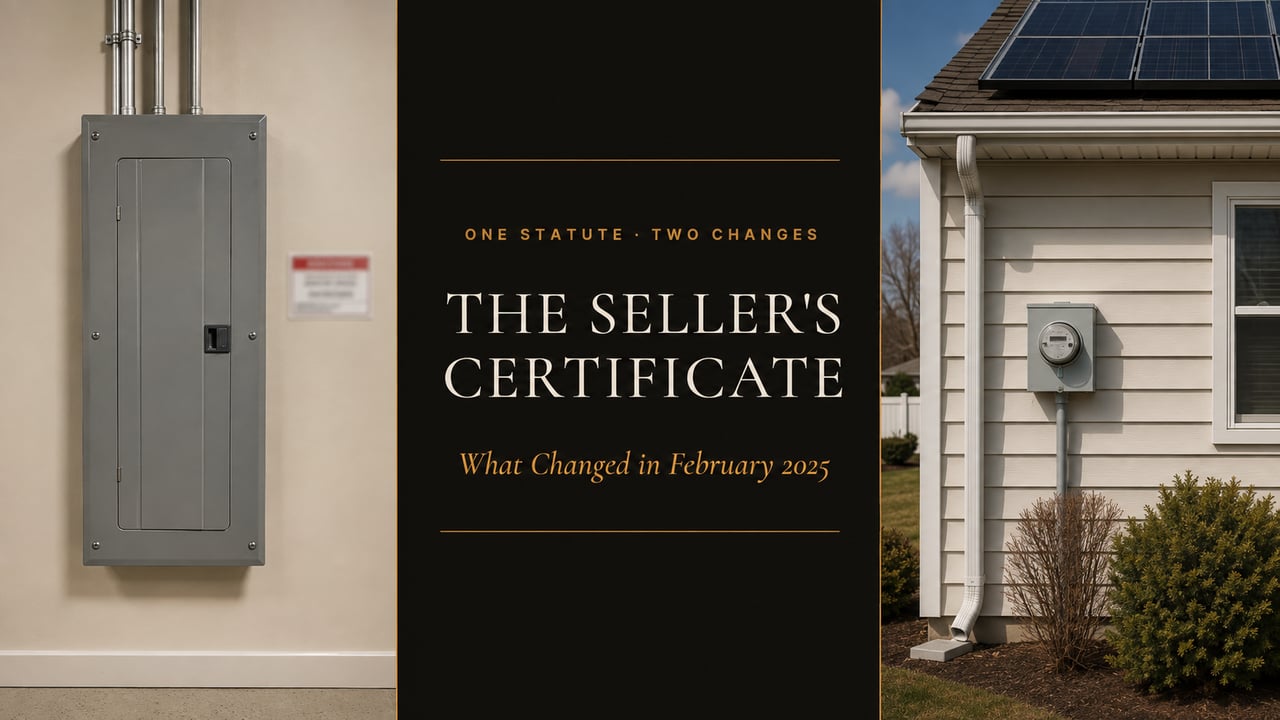
On one day in February 2025, New Jersey removed a requirement from the resale fire-safety certificate and added a new one. A great many municipal checklists still list the thing that was removed and say nothing about the thing that replaced it — which means sellers are buying equipment they no longer need and failing inspections over a label they have never heard of.
P.L. 2025 c.19, effective February 3, 2025, did two things at once. It repealed the portable fire extinguisher requirement for one- and two-family dwellings, and it added a secondary power source identification label requirement — a non-handwritten label reading essentially "CAUTION: MULTIPLE SOURCES OF POWER", installed within 18 inches of the main electrical panel and electrical meter, wherever a home has a generator, solar array or battery storage system. Both changes are enforced on change of occupancy — which means at your sale. Published municipal checklists have not universally caught up, and some still cite the extinguisher in their code references. Check the current requirement, not the form.
This is the statewide picture. What each municipality adds on top of it varies enormously, and our town-by-town guides cover that. Nothing here is legal advice. Requirements change — the ones below changed twice in eighteen months. Confirm current requirements with the enforcing agency having jurisdiction over your property and with your attorney.
Before you can sell a one- or two-family home in New Jersey, you need a certificate from the local enforcing agency confirming fire-safety compliance. That has been true for years, it applies in every municipality regardless of what else the town requires, and it is not optional. What changed in 2025 is what the certificate actually inspects for.
P.L. 2025 c.19 amended N.J.S.A. 52:27D-198.1 and took effect immediately. Out went the portable fire extinguisher, which had been a condition of the certificate for one- and two-family dwellings. In came the secondary power source identification label. Same statute, same date, opposite directions.
The certificate's own name is in transition. For years it was the certificate of smoke alarm, carbon monoxide alarm and portable fire extinguisher compliance — abbreviated CSACMAPFEC. Municipalities are now reissuing it under names referencing the secondary power source instead. Both names are in circulation simultaneously, and some municipal pages still quote the regulation text citing portable fire extinguisher compliance while separately noting the extinguisher is no longer required.
That is not incompetence — the statute moved faster than the regulation text and the printed forms. The practical consequence for a seller is simple: a checklist you download may be wrong in both directions at once, telling you to buy an extinguisher you no longer need and saying nothing about a label you now do. Ask the enforcing agency what they are currently inspecting for.
One practical note on the extinguisher. The requirement is gone, but several fire departments ask that you leave an existing extinguisher in place rather than removing it. It is still a sensible thing to own. Just do not go out and buy one because an outdated form told you to.
If your home has a generator, solar panels or a battery storage system, this now applies to you at sale. The Division of Fire Safety issued guidance in February 2025 to local enforcing agencies, the New Jersey Real Estate Commission and the state Realtors' association, and the specifications are precise.
Who it applies to: one- and two-family and attached single-family dwellings only.
When it is enforced: upon change of occupancy — your sale, lease or occupancy change.
Where the label goes: within 18 inches of the main electrical panel and the electrical meter. Both locations.
What counts as a secondary power source: permanently installed internal combustion generators, solar panels, battery storage systems, or any other supplemental source of electrical energy to the primary supply.
What it must say: wording similar to "CAUTION: MULTIPLE SOURCES OF POWER."
What it must not be: handwritten. A handwritten sign does not satisfy the requirement.
What satisfies it: a label compliant with ANSI Z535.4. Municipal specifications commonly add a minimum 3/8-inch letter height, white on red, reflective and permanently affixed.
The reasoning is worth understanding, because it explains why this will not be waived. A firefighter cutting power to a burning house needs to know the house can still be energised from a roof array or a battery in the garage. The Division notes these requirements already applied to new installations and were added to the Uniform Fire Safety Act to extend the same protection to existing ones. This is a life-safety rule for the people who come to your house in an emergency, not a paperwork formality.
And it is trivially cheap to comply with. The Division describes compliant labels as generally available at minimal cost. A conforming label costs a few dollars; a failed inspection costs a reinspection fee and a place at the back of the scheduling queue, usually at the exact moment your buyer's rate lock is running down. If you have solar, a generator or a battery, order the labels the week you decide to sell.
Ten-year sealed battery smoke alarms on each level, including the basement. Under the regulation, ten-year sealed battery-powered single-station alarms listed to ANSI/UL 217 are the standard for battery units.
Hardwired alternating-current alarms with battery backup. The Uniform Construction Code has required AC-hardwired alarms in homes built after January 1, 1977.
All of the above, plus a detector inside every bedroom — the strictest tier, and the one owners of newer homes least expect.
The single most common failure is a substitution that seems reasonable and is not allowed. If a hardwired interconnected alarm has aged out and needs replacing, it must be replaced with a hardwired alarm. A battery unit is not an acceptable substitute, and neither, in many municipalities, is a wireless battery-powered interconnected alarm. Detectors that form part of a home security system do not satisfy the code either — they must be augmented with standalone units.
The rest of the specification, briefly. A smoke alarm on each level including the basement and within ten feet of every sleeping area; alarms located and maintained per NFPA 72; carbon monoxide alarms within ten feet of every bedroom door wherever there is a fuel-burning appliance or an attached garage. Municipalities commonly hold battery-only and plug-in CO alarms to five years and combination smoke/CO units to ten. Anything past its manufacture date fails.
Many municipalities price this certificate by how much notice you give them. One published schedule charges $55 for a request more than 10 business days before closing and $100 for a request four to ten business days out, with a further step for anything later.
That is a tax on procrastination, and it is entirely avoidable. Apply at the conclusion of attorney review. And note the stakes: failure to obtain certification can carry a fine of up to $2,500 under the Uniform Fire Code, with some municipalities publishing minimums around $1,000. Certificates also expire — six months in many towns, as short as 90 days in some — so track the validity window against your actual closing date.
Every item on this page is knowable before your house goes on the market. None of it should surface during attorney review.
We confirm what your specific municipality currently requires rather than working from a downloaded form, walk the alarms against your year of construction, order the secondary power source labels if you have solar or a generator, and file at attorney review so scheduling never becomes your problem. Get a valuation and a pre-listing plan that handles the paperwork before it can delay a closing. Backed by the New York metro buyer pool we bring to every listing.
Since March 20, 2024, the Flood Risk Notification Law (P.L. 2023 c.93) requires every seller to disclose on the Property Condition Disclosure Statement — before the purchaser becomes obligated under contract — whether the property is in FEMA's Special or Moderate Flood Hazard Area, plus actual knowledge of flood risks and flooding history. Failure releases the purchaser from their obligations under the contract until the seller complies, and the law supplements the Consumer Fraud Act. The NJDEP Flood Risk Notification Tool is searchable by address.
Under Section 1018 of Title X, before a buyer signs a contract on most pre-1978 housing the seller and agent must disclose known lead-based paint and hazards, provide available records, give the buyer the EPA's Protect Your Family From Lead In Your Home pamphlet, and allow a 10-day period for a lead inspection or risk assessment. Sellers, landlords and agents are all responsible.
Do not confuse it with New Jersey's lead-safe certification law. P.L. 2021 c.182 requires periodic inspections and Lead-Safe Certificates for pre-1978 rental dwellings; per the state Realtors' association, that law does not apply to home sales.
The former 1% buyer-paid "mansion tax" became a seller-paid graduated fee on residential sales over $1 million: 1% to $2M, 2% to $2.5M, 2.5% to $3M, 3% to $3.5M, 3.5% above — applied to the entire consideration once triggered, and in addition to the standard Realty Transfer Fee.
The cliffs are brutal. A $2,000,000 sale costs the seller $20,000; a $2,000,001 sale costs $40,000. Exemptions are claimed on Form RTF-1EE. Run the arithmetic before you set an asking price.
And then there is what your own municipality adds, which is where the real variation lives. New Jersey sets no statewide resale certificate-of-occupancy requirement — that is left entirely to each town, and the spread we have documented is wide:
Nothing beyond the state certificate — Brick and Wall require no resale CO at all, and Toms River repealed its own in January 2024.
A fire-chapter sale inspection — Kenilworth requires inspection for the sale of any building under its fire prevention ordinance, with power to refer other violations observed.
A continuing CO through the fire bureau — Cranford says it requires no resale CO, then requires a Continuing Certificate of Occupancy in the next sentence.
A full permit-and-assessor audit — Lavallette and Seaside Heights condition the certificate on zoning, property maintenance, site plans, building permits and Tax Assessor records.
Two sequential inspections — South Toms River adds a County Fire Marshal certificate that must be filed before the Borough will schedule its own.
Which is why the first question is always the same: which municipality actually governs this parcel? On some stretches of New Jersey that is genuinely non-obvious — a place name can span a township line, and a mailing address does not establish a taxing municipality. Confirm it from the tax bill before you file anything anywhere.
Do not download a checklist. Call the enforcing agency and ask what they are inspecting for this month. The statute changed in February 2025, the regulation text and the printed forms have not universally caught up, and the certificate is being issued under two different names depending on the town. A form you find online may tell you to buy a fire extinguisher that is no longer required and say nothing about a label that now is. One phone call gives you the current answer, the current fee, and the current scheduling window — and it takes less time than reading the wrong form.
"One statute in February 2025 took the fire extinguisher out of the resale certificate and put a secondary power source label in. Same day, opposite directions. And I'm still seeing municipal forms that list the extinguisher and don't mention the label. So you get sellers buying equipment they don't need and then failing the inspection over a three-dollar sticker they've never heard of. If you've got solar or a generator or a battery — and on the shore a lot of people do — you need a printed label, not handwritten, within eighteen inches of your panel and your meter, saying multiple sources of power. Order it the week you decide to sell. It's the cheapest thing on the entire list and it's the one nobody knows about."
— Anthony Licciardello, Broker, The Prodigy Team
Keeping up with what changed this year — and knowing when a municipal form is out of date — is native ground for me: I'm Anthony Licciardello, Broker of The Prodigy Team, a former Director of Community Affairs in the Bloomberg Administration who spent years inside municipal government, now dual-licensed in New York and New Jersey and a leading broker for cross-border New York–New Jersey transactions.
Anthony Licciardello · Broker, The Prodigy Team · 718-873-7345
We confirm what your town requires this month — not what a downloaded form said last year.
Do I still need a fire extinguisher to sell a home in New Jersey?
No. Effective February 3, 2025, P.L. 2025 c.19 repealed the portable fire extinguisher requirement for one- and two-family dwellings as a condition of the resale fire-safety certificate. The same statute added a secondary power source identification label requirement. Many published municipal checklists still list the extinguisher and omit the label. If you already own an extinguisher, several fire departments ask that you leave it in place — but do not buy one because an outdated form told you to.
What is the secondary power source label requirement?
If a one- or two-family or attached single-family home has a permanently installed generator, solar panels, battery storage system or any other supplemental power source, a label must be installed within 18 inches of the main electrical panel and the electrical meter warning of the associated dangers. It must read essentially "CAUTION: MULTIPLE SOURCES OF POWER" and may not be handwritten; a label compliant with ANSI Z535.4 satisfies the requirement. Enforced on change of occupancy. Compliant labels are inexpensive and widely available.
What smoke alarms does New Jersey require to sell a home?
It depends on your year of construction. Pre-1977: ten-year sealed battery alarms on each level including the basement. 1977–1990: hardwired AC alarms with battery backup. Post-1990: all of the above plus a detector inside every bedroom. Alarms are required within ten feet of every sleeping area, with carbon monoxide alarms within ten feet of every bedroom door. A hardwired alarm that needs replacing must be replaced with a hardwired alarm — a battery unit is not an acceptable substitute, and security-system detectors do not satisfy the code on their own.
Does every New Jersey town require a certificate of occupancy to sell?
No — New Jersey sets no statewide resale certificate-of-occupancy requirement, and municipalities differ enormously. Brick and Wall require none; Toms River repealed its own in January 2024; Kenilworth requires an inspection for the sale of any building under its fire prevention chapter; Cranford requires a Continuing Certificate of Occupancy through its Fire Prevention Bureau; and Lavallette and Seaside Heights condition their certificates on zoning, property maintenance, site plans, building permits and Tax Assessor records. The statewide fire-safety certificate applies everywhere regardless.
Toms River — What to Clear Before Closing
The Barnegat Peninsula — Five Boroughs, Five Regimes
Cranford — What the Township's FAQ Doesn't Make Clear
Kenilworth — One Call, and Four Rules That Apply Regardless
Woodbridge — Certificate of Compliance & Transfer Fees
Point Pleasant Borough — No Resale CO, But Don't Skip These
Requirements as described at the time of writing, from the sources noted. P.L. 2025, c.19 amended Section 1 of P.L. 1991, c.92 (N.J.S.A. 52:27D-198.1), providing that a structure used or intended for use for residential purposes by not more than two households shall have a smoke-sensitive alarm device on each level and outside each separate sleeping area in the immediate vicinity of the bedrooms, and that each structure subject to the section that contains a secondary power source shall have a label installed within 18 inches of the main electrical panel and electrical meter warning of the danger associated with secondary power sources; the same enactment removed the portable fire extinguisher requirement for one- and two-family dwellings, effective February 3, 2025. Per a New Jersey Division of Fire Safety memorandum dated February 13, 2025 from the Chief of the Bureau of Fire Code Enforcement to all local enforcing agencies, the New Jersey Real Estate Commission and the New Jersey Association of Realtors: the requirements apply to one- or two-family and attached single family dwellings only and will be enforced upon a change of occupancy; a secondary power source may include permanently installed internal combustion generators, solar panels, battery storage systems, or any other supplemental source of electrical energy to the primary power supply; the label must be marked with wording similar to "CAUTION: MULTIPLE SOURCES OF POWER" and may not be handwritten; a label compliant with ANSI Z535.4 will meet the requirements and may be referenced in subsequent regulations; these requirements already applied to new installations and were added to the Uniform Fire Safety Act to extend the same protection to existing installations; and compliant labels are generally available at minimal cost. Individual municipal specifications observed add a minimum letter height of 3/8 inch, white on red background, reflective and permanently affixed. Per N.J.S.A. 52:27D-198.2 as amended, where a change of occupancy is subject to a municipal ordinance requiring a certificate of occupancy, certificate of inspection or other documentary certification, no such certificate shall issue until the responsible municipal officer or agency has determined that the building is equipped with the required alarm devices. Per a Department of Community Affairs advisory bulletin dated January 13, 2026, the statute and proposed regulations establish uniform statewide requirements governing fire inspections under the Uniform Fire Safety Act, and municipalities conducting these or municipal certificate of occupancy inspections pursuant to local ordinance are not exempt from fire inspector licensing requirements. Alarm requirements: per DCA Division of Fire Safety guidance, a smoke alarm regulation effective January 1, 2019 requires ten-year sealed battery smoke alarms in homes built before January 1, 1977, and the State Uniform Construction Code requires homes built after January 1, 1977 to have alternating current hardwired alarms; per N.J.A.C. 5:70-4.19, ten-year sealed battery-powered single station smoke alarms shall be installed and listed in accordance with ANSI/UL 217, alarms shall be located and maintained in accordance with NFPA 72, and interconnection is not required; municipal requirements observed additionally provide that hardwired alarms requiring replacement must be replaced with hardwired alarms rather than battery units, that battery-only and plug-in carbon monoxide alarms shall be under five years old and combination smoke/carbon monoxide alarms under ten years old, and that detectors forming part of a home security system do not satisfy the code. Certification is required upon resale or occupant change in all one- and two-family homes and some condominium units per N.J.A.C. 5:70-4.19 et seq., with failure to obtain certification carrying a fine of up to $2,500 per the Uniform Fire Code and some municipalities publishing minimum fines around $1,000. Municipal fee schedules observed charge $55 for certifications requested more than 10 business days prior to closing and $100 for those requested four to ten business days before, with further escalation for later requests; certificate validity periods vary, commonly six months and as short as 90 days. Other statewide obligations: the Flood Risk Notification Law, P.L. 2023 c.93, effective March 20, 2024; the federal Lead-Based Paint Disclosure Rule, Section 1018 of Title X, alongside New Jersey's separate P.L. 2021 c.182 lead-safe certification requirement which per New Jersey REALTORS® applies to rental dwellings and not to home sales; and the Graduated Percent Fee, P.L. 2025 c.69, applicable to contracts fully executed on or after July 10, 2025. Municipal requirements change and differ sharply between adjoining municipalities; fees, forms, validity periods and procedures are subject to change without notice, and the regulation text and printed forms in some jurisdictions have not yet been updated to reflect the 2025 statutory changes. Nothing in this article is legal advice, a determination regarding any property or municipality, or a substitute for confirming current requirements with the enforcing agency having jurisdiction and with your own attorney.
Prodigy Real Estate is an innovative real estate company offering high-end video production, home valuation services, purchasing, and home sales. Serving New York and New Jersey.