
Anthony Licciardello | August 30, 2026
Cranford, NJ
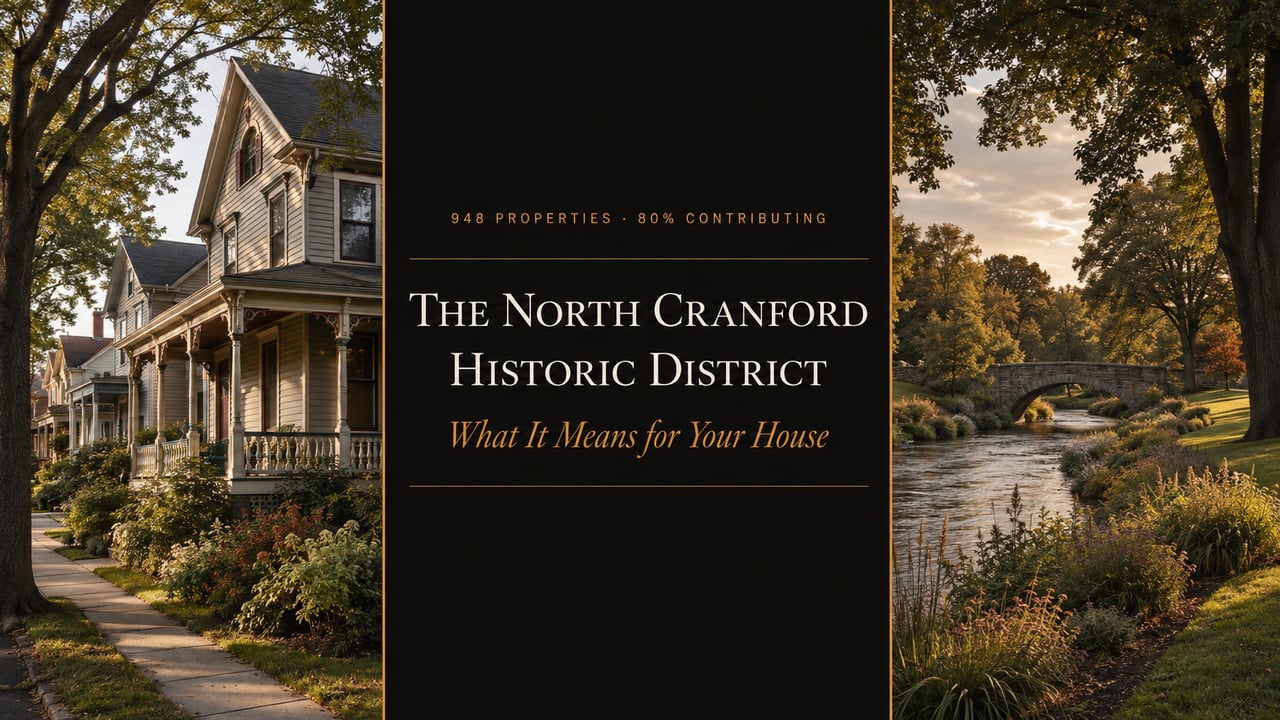
Nine hundred and forty-eight Cranford properties sit inside the North Cranford Historic District, and roughly four in five of them contribute to its historic significance. Most owners assume that means a board reviews what they do to the outside of their house. Based on the Township's own description of its Historic Preservation Advisory Board, it does not — and that assumption cuts both ways.
The North Cranford Historic District is a National Register district covering 948 properties, about 80% of them contributing. National Register listing is a federal and state honour. On its own it imposes no restriction on what a private owner does to their own building with private money. Cranford's Historic Preservation Advisory Board, created in 1993, states its mission as documentation, education and advice to the Township. Under the Code it surveys and inventories resources and prepares designation lists that are then referred to the Planning Board and the governing body — it proposes; others decide. We found no Certificate of Appropriateness requirement over an owner's exterior work. That is more freedom than most owners believe they have — and less protection from a neighbour's renovation.
This reflects our reading of the Township's published description of the Historic Preservation Advisory Board and the Board's provisions in the Code of the Township of Cranford. We did not exhaustively review every chapter of the municipal code, ordinances are amended, and nothing here is legal advice, a preservation determination, or a statement about any particular parcel. Confirm current requirements with the Township of Cranford and your own attorney before planning exterior work.
The North Cranford Historic District covers 948 properties, of which roughly 80% are classified as "contributing" to the district's historic significance under National Register criteria. That is an unusually high proportion — it means the district is not a preserved pocket inside a modernised town but a very largely intact nineteenth- and early-twentieth-century streetscape.
Two design pedigrees sit inside it that most Cranford owners do not know they live near. Franklin T. Lent, a late-nineteenth-century promoter of what was then called "cottage architecture," designed six homes within the district. And the Rahway River Parkway landscape was designed by the Olmsted Brothers — the successor firm to Frederick Law Olmsted, the designer of Central Park. A house in this district may sit on a street whose park landscape came off an Olmsted drawing board. That is a marketing fact almost nobody in Cranford is using.
National Register listing is a federal and state honour administered through the National Park Service and the State Historic Preservation Office. On its own it imposes no restriction whatsoever on what a private owner does to their own building using their own money.
Local historic district designation is a municipal ordinance. It creates a commission with approval authority, typically requires a certificate before exterior work, and binds owners to design standards. Many New Jersey municipalities have one. These are two different instruments, and conflating them is the single most common error buyers make about historic property.
The HPAB also runs a plaque programme covering 158 properties. A plaque is recognition — an acknowledgement that a house has documented historic significance. It is not a regulatory designation and should not be read as one, either by an owner worrying about restrictions or by a buyer hoping for protection.
The Township describes the Board's mission in its own words, and the three verbs are the whole answer. The Cranford Historic Preservation Advisory Board, created by the Township Committee in 1993, exists to aid preservation through documentation of significant structures, education of the public as to the value of preservation, and advice to the Township on laws and activities impacting preservation.
The Code's grant of powers follows the same shape. The Board is charged with identifying, recording and maintaining a system of survey and inventory of buildings, sites, places, landmarks and structures of historical or architectural significance — assessed against the Secretary of the Interior's Standards and Guidelines — and with aiding the public in understanding their worth and the methods of preservation. And it may prepare and adopt a public landmark and historic district designation list and official map — which is then referred to the Planning Board for consideration in the Master Plan and to the governing body for consideration in the Zoning Ordinance.
The Board prepares the list. The Planning Board and the Township Committee decide what to do with it. An entity that proposes designations for others to adopt is not an entity that approves your window replacement.
We found no Certificate of Appropriateness requirement, and no provision giving the Board approval authority over exterior alterations by private owners. Our review covered the Board's provisions and the Township's published materials rather than every chapter of the Code — so confirm with the Township for your specific property — but the structure is consistent and the Board's own name says it plainly.
The contrast with a genuinely regulatory board makes the difference concrete. Nearby Cranbury Township operates a Historic Preservation Commission whose ordinance requires a certificate of approval, sets Design Guidelines as the criteria for review, and obliges the Commission to approve or deny an application within 45 days of completeness. Cranbury's Commission gives advisory recommendations to its Planning and Zoning Boards — but the certificate itself is binding. That is what a regulatory preservation regime looks like, and Cranford's published structure does not match it.
One sign the Board is active rather than dormant: the Township Committee amended the HPAB's membership composition by ordinance in 2023. This is a functioning board doing survey and inventory work — it simply does not hold approval power over your house.
For a buyer, this removes an obstacle that was never there. We have watched buyers walk away from houses in historic districts because they assumed a commission would dictate their windows, their siding, their paint. In Cranford's district that assumption appears to be wrong — and it has cost people houses they could have renovated on ordinary terms. Zoning still governs, as it does everywhere. But a separate preservation approval layer does not appear to exist.
For an owner, the same fact reads as an absence of protection. If your neighbour replaces a slate roof with asphalt, wraps original trim in vinyl, or removes a porch, no preservation board can stop them. The district's remarkable intactness — four in five properties contributing — has been maintained by owner choice, market preference and ordinary zoning, not by regulation. That is worth knowing before you pay a premium for a streetscape.
Cranford's Historic Preservation Element, adopted in 2022, recommends that the Township "continue to use the local designation process to further identify significant buildings, sites, streetscapes, and districts." The Code sets out that designation process at § 6-54, and the Element contemplates proposing an historic river district among other actions.
So the machinery for local designation exists and the adopted policy points toward using it more. Nothing here should be read as a guarantee about the future. If you are buying a house you intend to alter significantly, ask the Township whether your specific property is locally designated today and whether any designation is under consideration — that is a different question from whether the district as a whole is on the National Register, and it is the one that binds you.
There is also an upside to the designation machinery that owners rarely hear about. The Township has pursued Certificate of Eligibility applications to the New Jersey State Historic Preservation Office for local resources — the Canoe Club, the Sperry Observatory and the First Baptist Church have been identified as candidates, following those already submitted and accepted for the Masonic Building, the Cranford Hotel and Sunny Acres. Recognised historic status can open doors on grants and programmes that unrecognised buildings cannot access. The HPAB is also charged with providing assistance to owners and organisations seeking to preserve and improve historic properties — which makes it a resource rather than an obstacle.
Some of your buyers are walking away because they think a board controls their renovation. Nobody is telling them otherwise.
A house inside a 948-property National Register district with an Olmsted-designed parkway landscape nearby has a story most Cranford listings never tell — and a renovation freedom most buyers assume it lacks. Both belong in the marketing. Get a valuation and a listing plan that uses the district as an asset rather than leaving it as an unanswered question. Backed by the New York metro buyer pool we bring to every listing.
Not "is it in the National Register district" — that is a different question with a different answer. The Code establishes a local designation process at § 6-54. Ask the Township whether your parcel is locally designated, and whether it appears on any adopted landmark or district designation list or official map.
The 2022 Historic Preservation Element recommends continued use of the local designation process. If you are buying to renovate significantly, a designation in progress matters as much as one already adopted.
Preservation is not the only constraint, and in Cranford it may not be the binding one. Setbacks, coverage, height and — near the river — the Floodplain Overlay District govern regardless of historic status. Our development guide covers how Cranford handles applications.
In a district shaped by the Rahway River, this belongs in the same conversation as the historic question. Pull the FEMA zone, ask for a current elevation certificate, request the NFIP claims history, and understand that repetitive-loss status follows the property rather than the owner.
And one thing to do regardless of what the answers are: if you are buying an older Cranford house, use an inspector who works on period property. A district with four in five properties contributing is a district full of original material — plaster, slate, wood windows, early systems. Those are assets when sound and expensive when not, and a general inspector is not the right instrument for assessing them.
Township context sits in our Cranford development guide, and the same National-Register-is-not-local-review finding, verified in two other New Jersey municipalities, sits in our Island Heights zoning guide and Bay Head guide.
Ask the Township one question, in writing, before you contract: "Is this specific parcel locally designated, and is any designation pending?" Written beats verbal, and the distinction between National Register listing and local designation is exactly the kind of thing that gets answered loosely in a phone call and precisely in an email. It costs nothing, takes one message, and it is the only version of this question that binds anybody. Everything else you will read about the district — including this article — describes the general position. Your parcel is the only one that matters to you.
"This is the third New Jersey town where I've gone looking for a preservation commission and found an advisory board instead. Island Heights, Bay Head, now Cranford. The pattern is always the same — a National Register district, everybody assumes there's a commission telling them what colour to paint the trim, and there isn't one. Nine hundred and forty-eight properties in North Cranford and four out of five of them contributing, and it stayed that way because owners wanted it to, not because anybody made them. That's more freedom than people think they have and less protection than they think they're buying. Both halves matter. Ask the Township about your specific parcel in writing — that's the only answer that counts."
— Anthony Licciardello, Broker, The Prodigy Team
Reading municipal ordinances line by line — and telling clients what they actually say rather than what everyone assumes — is native ground for me: I'm Anthony Licciardello, Broker of The Prodigy Team, a former Director of Community Affairs in the Bloomberg Administration who learned land use from inside government, now dual-licensed in New York and New Jersey and a leading broker for cross-border New York–New Jersey transactions.
Anthony Licciardello · Broker, The Prodigy Team · 718-873-7345
We ask the Township the parcel-specific question in writing — before you contract, not during attorney review.
Do I need approval to renovate a home in the North Cranford Historic District?
Based on the Township's published description of its Historic Preservation Advisory Board and the Board's provisions in the Code, we found no Certificate of Appropriateness requirement and no provision giving the Board approval authority over exterior work by private owners. The HPAB's stated mission is documentation, education and advice; it prepares designation lists that are referred to the Planning Board and governing body. National Register listing is a federal and state honour that imposes no restriction on private owners using private funds. Ordinary zoning still applies. Confirm your specific parcel's status with the Township of Cranford in writing.
How big is the North Cranford Historic District?
It covers 948 properties, of which approximately 80% are classified as contributing to the district's historic significance under National Register criteria — an unusually high proportion, indicating a very largely intact historic streetscape rather than a preserved pocket. Six homes within the district were designed by Franklin T. Lent, a late-nineteenth-century promoter of cottage architecture, and the Rahway River Parkway landscape was designed by the Olmsted Brothers. The HPAB separately operates a plaque programme covering 158 properties, which is recognition rather than regulation.
What does Cranford's Historic Preservation Advisory Board do?
The HPAB was created by the Township Committee in 1993, and the Township describes its mission as aiding preservation through documentation of significant structures, education of the public, and advice to the Township on laws and activities impacting preservation. Under the Code it identifies, records and maintains a survey and inventory of significant resources assessed against the Secretary of the Interior's Standards, and may prepare a landmark and historic district designation list and official map — which is then referred to the Planning Board and the governing body for consideration. The Board proposes; others adopt.
Could Cranford adopt local historic designation later?
The machinery exists. Cranford's Historic Preservation Ordinance establishes a process for designating historic properties and districts, set out at § 6-54, and the Township's 2022 Historic Preservation Element recommends continuing to use the local designation process to further identify significant buildings, sites, streetscapes and districts. Nothing in this article should be read as a guarantee about the future. If you intend significant alterations, ask the Township whether your parcel is locally designated today and whether any designation is under consideration.
Cranford Downtown Development — 2026 Progress Report
Union County Rental Market — Where the Concessions Are
Westfield New Construction & Teardowns
Cranford Homes for Sale — Browse Current Listings
Details as of publication, from the sources noted. The North Cranford Historic District is described as covering 948 properties, of which approximately 80% are "contributing" to historic significance per National Register criteria; the Historic Preservation Advisory Board operates a 158-property plaque programme; Franklin T. Lent, a late-nineteenth-century promoter of "cottage architecture," designed six homes within the district; and the Rahway River Parkway landscape was designed by the Olmsted Brothers. Historic Preservation Advisory Board: per the Township of Cranford's official website, the HPAB is a Township Committee created in 1993 whose mission is "to aid in the preservation of Cranford's architectural heritage through documentation of significant structures, education of the public as to the value of preservation, and advice to the Township on laws and activities impacting preservation," and which is "tasked with advising the Township on historic preservation, including development and maintenance of a comprehensive inventory of historic resources." Per the Code of the Township of Cranford as published on eCode360, the Board's powers include identifying, recording and maintaining a system for survey and inventory of all building sites, places and landmarks and structures of historical or architectural significance based on the Secretary of the Interior's Standards and Guidelines for Archaeology and Historic Preservation, aiding the public in understanding their worth and methods of preservation, and preparing and adopting pursuant to § 6-54 a public landmark and historic district designation list and official map "which shall then be referred to the Planning Board for consideration of inclusion in the Master Plan and to the governing body of the Township of Cranford for consideration of inclusion in the Zoning Ordinance." Township Ordinance No. 2023-12 amended Chapter 6, Section 43 to clarify the membership composition of the Historic Preservation Advisory Board. Per Cranford's Historic Preservation Element adopted April 6, 2022, the Code gives three responsibilities to the Advisory Board with regard to historic districts; Cranford's Historic Preservation Ordinance establishes the process of designating historic properties and districts and the Township "should continue to use the local designation process to further identify significant buildings, sites, streetscapes, and districts"; the Element contemplates proposing an historic river district; Certificate of Eligibility applications should be submitted to the NJ State Historic Preservation Office for local resources including the Canoe Club, the Sperry Observatory and the First Baptist Church, following those already submitted and accepted for the Masonic Building, the Cranford Hotel and Sunny Acres; and the HPAB should provide assistance necessary to preserve and improve historic properties to organizations or owners. Comparison: Cranbury Township's historic preservation chapter, as published on eCode360, establishes a Historic Preservation Commission requiring a certificate of approval, sets Design Guidelines as review criteria, and requires the Commission to approve or deny an application within 45 days of completeness, while providing that its recommendations to the Planning Board or Zoning Board of Adjustment on applications for development are advisory only. Our review covered the Township's published description of the Historic Preservation Advisory Board, the Board's provisions in the Code as published on eCode360, and the adopted Historic Preservation Element; it did not exhaustively review every chapter of the municipal code. The absence of a Certificate of Appropriateness requirement reflects that review. Ordinances are amended, the Code establishes a local designation process, and the adopted Element recommends continued use of it — so no representation is made about future designation or about any particular parcel. Nothing in this article is legal advice, a zoning or preservation determination, or an approval for any property or project. Confirm whether a specific parcel is locally designated, and whether any designation is under consideration, directly with the Township of Cranford in writing, and consult your own attorney and architect before designing, contracting or purchasing.
Prodigy Real Estate is an innovative real estate company offering high-end video production, home valuation services, purchasing, and home sales. Serving New York and New Jersey.