
Anthony Licciardello | April 15, 2026
Staten Island
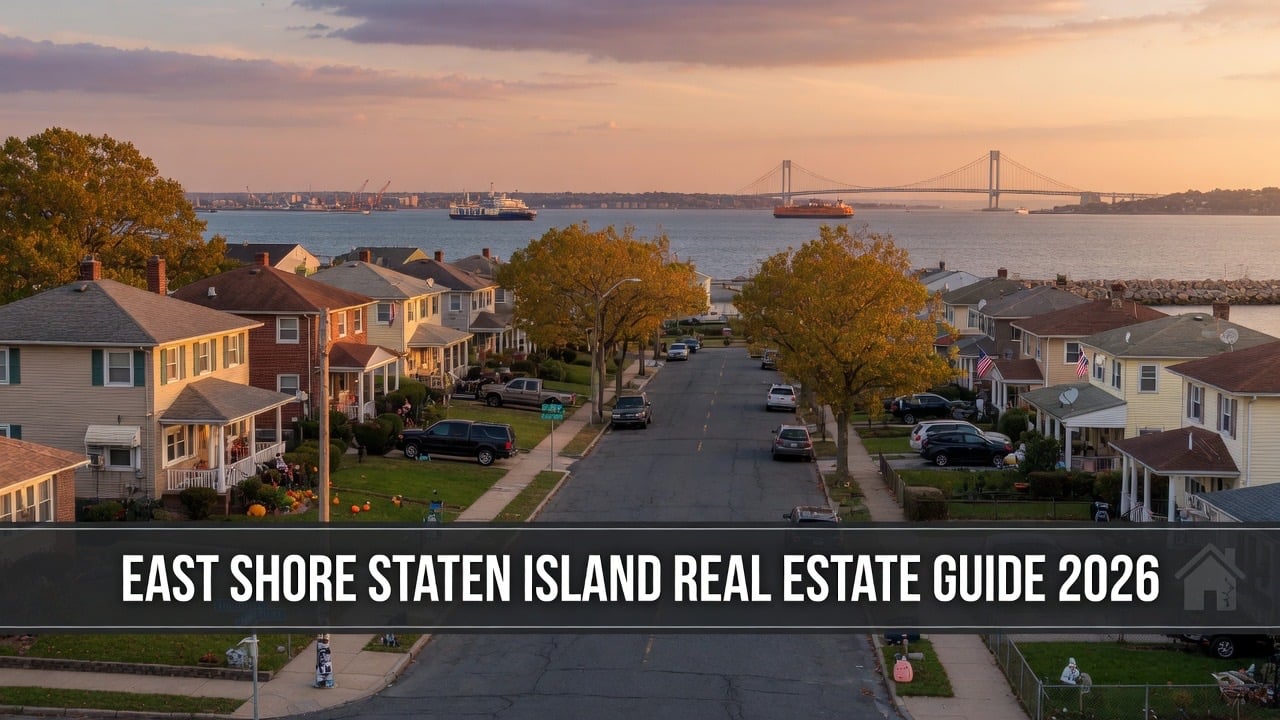
Staten Island's East Shore runs roughly from the base of the Verrazzano south through New Dorp to the edge of Great Kills Park, with the Staten Island Railway threading through its spine like a single connective tissue. Five distinct neighborhoods sit along that corridor — Dongan Hills, Grant City, New Dorp, Oakwood, and Midland Beach — and every serious buyer looking at one of them is quietly weighing the others. The commute times are nearly identical. The schools overlap. The same express buses run through all of them. What separates these markets is pricing, typology, flood exposure, and the specific lifestyle trade-off each neighborhood forces you to make.
That cross-shopping is not incidental. It's structural. A buyer priced out of New Dorp Heights at $979,000 instinctively looks at Dongan Hills above the boulevard. A buyer who wants the same SIR access at a fraction of the cost ends up in Grant City. A buyer chasing post-Sandy coastal upside ends up choosing between Midland Beach and Oakwood Beach depending on their risk tolerance and renovation appetite. Understanding how these five markets relate to each other is more useful than analyzing any one of them in isolation.
The borough-wide inventory picture shapes every transaction on the East Shore in 2026. Staten Island is running with roughly 921 active listings — about 26% below what a balanced market requires. With approximately 78% of homeowners locked into sub-5% mortgages and prevailing rates in the low-to-mid 6% range, the resale pipeline is structurally constrained. That means any appropriately priced, move-in-ready home across the entire corridor is competing in a seller's market regardless of which neighborhood it sits in. For a detailed breakdown of how those forces play out specifically in New Dorp, the New Dorp 2026 market report covers the ZIP code in full.
| Neighborhood | Median Ask | $/Sq Ft | Avg. DOM | Primary Buyer | Key Variable |
|---|---|---|---|---|---|
| Dongan Hills | ~$775K | $532 | 45–55 days | Move-up, prestige buyer | Above vs. below the boulevard |
| New Dorp | $699K–$979K | $499–$503 | 43–45 days | Families, transit commuters | Sub-market within ZIP code |
| Grant City | ~$388K | $395 | 50–60 days | First-time buyers, investors | Lowest barrier, same SIR access |
| Oakwood | $725K–$749K | $520–$568 | 45–55 days | Families, Great Kills proximity | NY Rising buyout premium |
| Midland Beach | ~$649K | $426 | ~98 days | Investors, new-build buyers | Highest flood risk / highest upside spread |
| * Active listing median asking prices, Q1 2026. New Dorp range reflects Heights ($979K) vs. Beach ($699K) sub-market spread. DOM estimates vary by property type and condition. | |||||
Dongan Hills
Bifurcated MarketNo neighborhood on the East Shore splits its own market more sharply than Dongan Hills. Richmond Road is the dividing line, and the two sides of it are effectively different submarkets priced as though they're in adjacent towns. Above the boulevard — locally known as the Colony — the terrain rises steeply into a network of winding private roads lined with custom-built estates. The elevation delivers panoramic views of the Verrazzano-Narrows Bridge and the harbor, and it provides the same topographical insulation from coastal flood risk that drives premiums in New Dorp Heights. This sector functions as a geographic and economic bridge to Todt Hill, where luxury homes routinely average between $1.2 million and $3.5 million and the island's most exclusive private clubs sit behind gates.
Below the boulevard, the character shifts entirely. The streets flatten, the lots normalize, and the housing stock transitions into charming mid-century bungalows and well-maintained colonials priced for the broader East Shore buyer pool. This tier has walkable access to commercial nodes along Hylan Boulevard and Richmond Road — including the long-standing neighborhood institution Lee's Tavern — and connects to the SIR. What it does not offer is the concentrated pedestrian retail density of New Dorp Lane. There is no equivalent Main Street experience. For buyers who want elevation prestige at a step below Todt Hill pricing, Dongan Hills above the boulevard is the move. For buyers who want a quieter version of the New Dorp residential corridor without the commercial activity, below the boulevard delivers that. The borough's highest price per square foot on the East Shore — $532 — reflects the blended average of both tiers. The full Dongan Hills neighborhood guide covers both sides of that divide in detail.
Grant City
Affordability AnchorGrant City sits immediately north of New Dorp and is the single most underappreciated value play on the East Shore for one simple reason: it has its own Staten Island Railway station. A buyer who purchases in Grant City gets essentially the same Manhattan commute infrastructure as a buyer in New Dorp Heights — the same SIR north to St. George, the same free ferry to Whitehall Street, the same express bus access via Hylan Boulevard — at a median asking price of roughly $388,000. That gap, measured against New Dorp's Heights tier at $979,000, represents one of the starkest location-adjusted value spreads in the borough.
Grant City's median asking price sits near $388,000. The SIR station is the same. The ferry is the same. The commute to the Financial District is the same. What changes is the structure — and for a specific buyer profile, that trade-off is precisely the point.
The trade-off is real. Grant City's housing stock is older, denser, and built on noticeably smaller lots than the detached ranch corridors of New Dorp Heights or Oakwood. The neighborhood carries a higher proportion of attached properties and a significant concentration of condominium units, particularly along Lincoln and Colfax Avenues. This is not a neighborhood for the buyer whose priority is a generous rear yard and architectural flexibility. It is a neighborhood for the buyer whose priority is location, transit access, and the lowest possible acquisition cost within that access zone. Closed sale medians in Grant City have historically settled closer to $505,000 — well above the asking median, reflecting the gap between aspirational listing prices and where transactions actually clear. For investors seeking value-add single-family product or first-time buyers who want a genuine foothold on the East Shore without stretching their budget, Grant City deserves serious underwriting before being dismissed as the budget option.
Oakwood
Post-Sandy PremiumOakwood is the East Shore market most transformed by public policy — and the one where that transformation has created the most counterintuitive pricing outcome. Situated southwest of New Dorp and sharing its coastal boundary with the Lower New York Bay, Oakwood Beach was one of the most severely damaged areas in the borough during Hurricane Sandy in 2012. Rather than simply rebuilding, New York State deployed the NY Rising Community Reconstruction Program — a federally funded Community Development Block Grant initiative — to purchase willing homeowners' properties at up to 100% of their pre-storm market value.
The most vulnerable homes were systematically acquired, demolished, and the land returned to natural coastal buffer zones with permanent deed restrictions against future residential development. What that program accomplished, from a real estate market perspective, was the removal of the lowest-quality, highest-risk inventory from the active pool. What remained was the resilient stock — homes that either survived Sandy with minimal damage or were subsequently rebuilt to far higher structural standards. The result is a market where the median asking price of $725,000 to $749,000 at $520 to $568 per square foot looks surprisingly strong for a flood-adjacent neighborhood, and is explained entirely by supply curation rather than organic appreciation. Buyers in Oakwood are not inheriting the pre-Sandy risk profile. They're buying into a fundamentally thinned and strengthened market. The Oakwood neighborhood guide covers the full community and housing profile.
Midland Beach
Investor / BifurcatedMidland Beach sits directly adjacent to New Dorp Beach along the southeastern shoreline and shares many of its flood zone characteristics — but with a notably different market outcome. Where New Dorp Beach has been partially reset by the $84 million Roma-Hett drainage project completed in May 2025, Midland Beach is still working through an earlier stage of the same recovery arc. The average days on market here — approximately 98 — is more than double New Dorp's 43 to 45. That extended absorption time reflects the psychological and financial weight of flood risk on a buyer pool that is split between speculative investors and the subset of owner-occupants willing to do careful underwriting.
Midland Beach averages 98 days on market — more than double the East Shore corridor average. The gap reflects flood risk psychology, insurance cost compression on older stock, and a buyer pool that skews heavily toward investors willing to underwrite the analysis. New elevated construction clears briskly at $800K+. On-grade unrenovated cottages sit.
The bifurcation between new and old construction is more stark here than anywhere else on the East Shore. Homes built post-2012 on raised foundations — designed to sit at or above current base flood elevations — are selling quickly at prices above $800,000 to buyers who want oceanfront proximity without the chronic insurance penalties that follow older structures. Those older cottages, many built directly on grade during the resort era, are sitting at steep discounts to the broader market. They will continue to do so until they're elevated, demolished, or replaced. For the risk-tolerant buyer with access to capital and a clear renovation thesis, Midland Beach has arguably the highest spread between current price and stabilized value of any neighborhood on the corridor — but only for buyers who go in with eyes open on the insurance math.
No comparison of the East Shore corridor is complete without acknowledging the two neighborhoods that define its upper boundary in both elevation and price. Todt Hill and Lighthouse Hill sit above the East Shore markets geographically — on the island's central ridge — and above them economically by a substantial margin. They are not cross-shopping destinations for the typical East Shore buyer. They are the aspirational benchmark that explains why New Dorp Heights and Dongan Hills above the boulevard command their premiums.
The trade-off both hills represent is the same one underlying every East Shore pricing decision: privacy and views versus walkability and transit. A buyer on Todt Hill has a magnificent home in an extraordinary setting and a car-dependent lifestyle with no meaningful pedestrian commercial life. A buyer on New Dorp Lane has a townhome within ten minutes of the SIR station and can walk to dinner, coffee, and the pharmacy without getting in a car. These are not inferior versions of the same lifestyle. They are genuinely different lifestyles, and the price differential between them — nearly $600,000 at the extremes — reflects the cost of each.
Every buyer on the East Shore is ultimately making a version of the same three-variable trade-off: price, structure, and access. No single neighborhood wins all three. Understanding which variable you're willing to optimize for — and which two you're willing to compromise on — is the decision framework that makes sense of the corridor.
The SIR is the thread that holds this whole corridor together. Every neighborhood on this list except Todt Hill and Lighthouse Hill has a station within reasonable distance — and that shared infrastructure compresses the commute variable that typically differentiates outer-borough markets from each other. What the East Shore offers, as a corridor, is the ability to choose your housing profile — density, lot size, flood exposure, architectural typology — without sacrificing the transit access that makes outer-borough ownership viable for a Manhattan-working household.
That combination is why the East Shore has consistently outperformed most of the broader Staten Island market in both price appreciation and sale velocity, and why inventory across the corridor remains structurally tight heading into 2026. Buyers who understand the internal geography of these five neighborhoods — not just their individual price points — will make better decisions than those shopping by ZIP code alone.
For a full community profile with listings, the New Dorp neighborhood guide, Dongan Hills guide, and the full ProdigyRE communities page cover every East Shore neighborhood with current listings and market context.
* Median listing and sale price data sourced from aggregated closed-sale and active inventory records, Q1 2026. Listing-side median prices reflect active asking prices, which typically skew above closed medians in low-inventory environments. Corridor price spread calculated as difference between New Dorp Heights median ask (~$979K) and Grant City median ask (~$388K). NY Rising program details per New York State HCR documentation. DOM estimates vary by property type and condition within each neighborhood.
Q
What is the most affordable neighborhood on Staten Island's East Shore?
Grant City has the lowest median asking price on the East Shore corridor at approximately $388,000 in Q1 2026, with closed sale medians historically settling closer to $505,000. It offers its own Staten Island Railway station — the same transit access as the much more expensive New Dorp market — at a significantly lower entry point. The trade-off is older, denser housing stock with smaller lots and a higher proportion of condominiums relative to detached single-family homes.
Q
How does Dongan Hills compare to New Dorp for real estate in 2026?
Dongan Hills carries a slightly higher price per square foot than New Dorp's aggregate average — $532 versus approximately $503 — but the two markets serve different buyer profiles. Dongan Hills above the boulevard appeals to move-up and prestige buyers seeking hilltop elevation and Todt Hill adjacency, without New Dorp's walkable Main Street experience. Dongan Hills below the boulevard competes more directly with New Dorp's central corridor at comparable price points. The key distinction is commercial density: New Dorp Lane offers a concentrated pedestrian retail environment that Dongan Hills, with its Hylan Boulevard and Richmond Road nodes, does not replicate.
Q
Is Midland Beach a good real estate investment in 2026?
It depends entirely on which segment of the Midland Beach market you're targeting. New construction built post-2012 on raised foundations exceeding base flood elevation is trading above $800,000 and represents a legitimate owner-occupant or long-term investment buy with manageable insurance exposure. Older, unrenovated, on-grade structures are trading at steep discounts but carry mandatory flood insurance costs that must be modeled carefully before any offer. The approximately 98-day average days-on-market — more than double the East Shore average — reflects the complexity of that due diligence process and a buyer pool that skews toward investors rather than traditional owner-occupants.
Q
Which East Shore neighborhoods have the best commute to Manhattan?
All five major East Shore neighborhoods — Dongan Hills, Grant City, New Dorp, Oakwood, and Midland Beach — offer access to the Staten Island Railway, which connects to the free Staten Island Ferry at St. George for a total door-to-Financial-District commute of roughly one to one and a quarter hours. For Midtown-bound commuters, the SIM11 and SIM7 express buses run through the Hylan Boulevard corridor and service the full East Shore. In practical terms, the commute differential between neighborhoods is measured in minutes rather than in any meaningful structural gap — transit access is the shared advantage the entire corridor holds over the deeper South Shore.
Prodigy Real Estate is an innovative real estate company offering high-end video production, home valuation services, purchasing, and home sales. Serving New York and New Jersey.