
April 19, 2026
New Providence, NJ
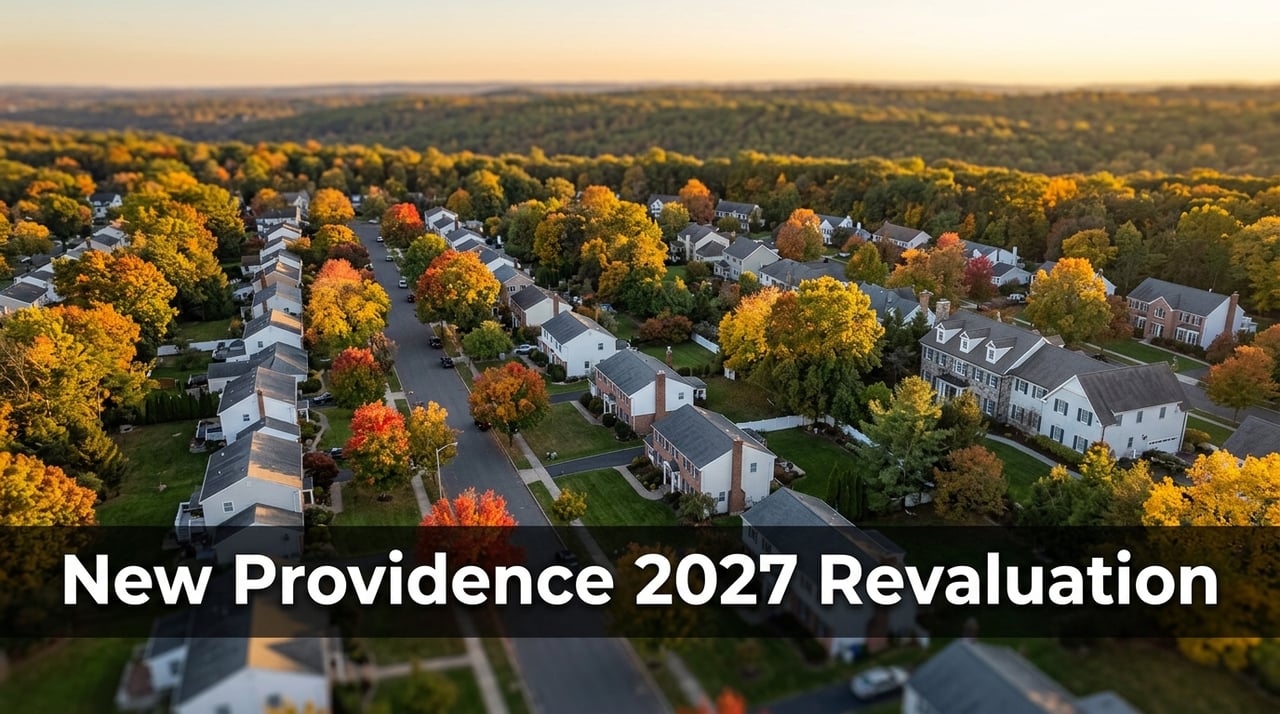
A New Providence NJ revaluation is underway for the first time in nearly three decades, and by the time it lands in 2027, the math on every home in the borough will have been rewritten. Professional Property Appraisers (PPA) began field inspections in September 2025 and expects to complete all valuation work by December 2026. New assessments take effect for the 2027 Tax Year.
This is not a routine update. The last revaluation was completed around 1999 — before the CR Bard campus began its long transition, before Lantern Hill opened, before the current generation of tear-down new construction reshaped entire streetscapes. The borough's housing stock, its sale prices, and its tax base all look nothing like they did the last time assessments were set.
Under New Jersey law, every taxable property must be assessed at 100% of fair market value. The Borough of New Providence Tax Assessor reports a 2026 equalization ratio of 34.32% — meaning the average assessment in town is running at about one-third of what homes actually sell for. A municipality's Director's Ratio is considered non-compliant with the state standard when it falls below 85%. New Providence sits at less than half of that threshold.
The Borough entered into an agreement with Professional Property Appraisers, a Delran-based firm that has run revaluations for New Jersey municipalities for more than 25 years. Field inspections run September 2025 through March 2026. PPA is expected to finish all valuation work by December 2026, and the new assessed values will apply to every parcel for the 2027 Tax Year — they show up on 2027 tax bills, not 2026 bills.
The mechanics of the reval are separate from what the borough collects. New Providence's 2025 general tax rate is 5.242%, with a 0.200% SID rate layered on top. After the reval, the tax rate drops — because the tax base, the total assessed value of all property in town, goes up sharply. The borough still collects the same total levy. That is the entire point of the exercise.
The revaluation is revenue-neutral at the municipal level. The Borough doesn't collect more tax money because of it. What changes is how the total levy is distributed across homeowners. Some will pay more, some will pay less, and the overall pot stays the same.
An equalization ratio is the average relationship, across an entire town, between what properties are assessed at and what they actually sell for. New Providence's current ratio of 34.32% is a straightforward statement: the typical assessment in the borough is running at about one-third of the typical market value. When that ratio was set near 100% in 1999, assessments reflected true value. Twenty-seven years of appreciation later, the assessments haven't moved but sale prices have — and the gap between the two is the reval's entire reason to exist.
Here's what the arithmetic looks like. A home currently carrying an assessment of $300,000 — not unusual for a mid-market New Providence property set in the late 1990s — has an implied market value of about $874,000 ($300,000 divided by 0.3432). That's not what the town thinks the home is worth. That's the math the state uses to equalize the tax burden across Union County municipalities when New Providence assessments drift this far from reality.
Two things follow. First, the Union County Board of Taxation doesn't wait for a revaluation to fix the distribution problem — it applies the equalization ratio every year to make sure New Providence pays its fair share of county taxes relative to Westfield, Cranford, Berkeley Heights, and the other 18 Union County municipalities. Second, individual homeowners inside New Providence have no such adjustment. Until the reval lands in 2027, owners whose homes have appreciated faster than the borough average are paying less than their fair share, and owners whose homes have lagged the average are paying more.
The general rule of thumb for a New Jersey revaluation, cited by municipalities and revaluation firms across the state, is that roughly one-third of properties see their share of the tax burden increase, one-third decrease, and one-third hold steady. The rule isn't a prediction specific to New Providence. It's a framework for understanding what happens when a 27-year assessment lag gets corrected in a single year.
Properties most likely to see their share increase in 2027 are older homes that have been extensively renovated or expanded since 1999 — where the current assessment reflects the original footprint and finishes, not the updated house. Tear-down new construction on lots that previously held smaller homes falls in the same category. So do parcels in neighborhoods that have outperformed the town average on price, and specialty properties — larger lots, premium locations, homes in the best catchments — where appreciation has rewarded them disproportionately.
Properties more likely to see their share decrease are homes that have seen little capital improvement since the last reval, commercial properties that haven't kept pace with residential appreciation, and neighborhoods where aging housing stock has appreciated below the borough average. Homes that have essentially tracked the town average since 1999 will sit somewhere in the middle — their share stays roughly flat.
The key thing to understand is that the total tax collected by New Providence doesn't change because of the reval. The borough's 2027 budget is set independently of assessments. What changes is the denominator used to calculate each homeowner's share of that budget. The tax rate drops — because the tax base goes up — and properties that were under-assessed relative to today's market pay more of the levy going forward.
Your 2027 tax bill depends on two things: your new assessed value AND the new (lower) tax rate. A higher assessment alone does not mean a higher tax bill. Both numbers matter, and both have to be set before the actual math is meaningful.
The field inspection is a two-stage process. PPA representatives first measure the exterior of every building on the property and note obvious improvements — decks, additions, finished areas, garages. They then request interior access to confirm living area, bedroom and bathroom count, basement finish, kitchen and bath condition, and overall condition grade. The entire visit typically takes 15 to 25 minutes for a standard single-family home.
The inspection captures gross living area and all finished square footage, bedroom and full/half bathroom counts, basement condition and degree of finish, garage type and size, building condition grade, and material improvements since the last assessment — kitchen and bath updates, additions, finished attics. What it does not capture: personal property, decorating choices, furniture, small sheds, above-ground pools, window air conditioners, lawn furniture. None of those items bear on assessed value, and seeing them on an inspector's clipboard would be unusual.
Every PPA inspector carries a photo identification badge and is registered with the New Providence Police Department. If no one is home during the initial visit, an exterior inspection is completed and a notice is left asking the owner to call and schedule interior access. Appointments can be scheduled evenings and Saturdays as needed.
Refusing access is legally permitted but carries real consequences. After three attempts to gain interior access, PPA will estimate the interior based on the property's exterior characteristics and neighborhood norms — and the estimate assumes the property is at the highest level for its property type. That typically produces a higher assessment than an actual inspection would. More importantly, the Union County Board of Taxation has been explicit that homeowners who refuse interior access lose their right to appeal the new assessment — because the basis for an appeal is a challenge to the data underlying the valuation, and refusing access prevents that data from being collected in the first place.
Residential properties in New Providence are being analyzed using the Sales Comparison Approach, supported by a cost approach for properties where comparable sales data is thin. Commercial properties — small office, retail, multi-family — may be analyzed using an income capitalization method that evaluates the property's income-generating potential rather than direct residential comparables.
The sales pool is public. Professional Property Appraisers posts its qualifying sales sets for each revaluation municipality at ppareval.com/news during and after the study period. In neighboring Glen Ridge, which PPA revalued for the 2026 tax year, the firm used sales between October 1, 2024 and October 31, 2025 as the primary comparison data. New Providence's window will be posted by PPA when the firm's analysis is complete.
Under New Jersey statute, every assessment is based on a property's market value as of October 1 of the pre-tax year. For 2027 assessments, that means conditions as of October 1, 2026. Any sale of a New Providence property between late 2025 and October 2026 is potentially a comparable in someone else's valuation — which is why the window matters and why buyers closing in this period should understand that their purchase price may become a data point in the reval pool.
Context on what the sales pool actually looks like: median sale prices across New Providence have run in the $900,000 to $1.1 million range throughout 2025, with the trailing-twelve-month median reported near $920,000.* Inventory has been tight — typical monthly closings ran from the low teens to mid-30s — and median days on market have stayed under 20 days, consistent with a sellers market. Most of the comparable sales PPA uses will reflect that environment rather than any cooler period.
For a deeper read on current conditions underlying these comps, see our recent New Providence market report covering pricing, inventory, and demand across the borough.
After PPA completes its field work and runs its analysis, every New Providence property owner will receive a letter stating the proposed new assessed value. The letter typically includes an estimated 2027 tax amount, calculated by applying an estimated new (lower) tax rate to the new assessment. That estimate uses current-year budget figures — the 2027 municipal, school, and county budgets are set independently and aren't finalized until later in the year. The estimate also does not account for the Veteran's Deduction, the ANCHOR rebate, the Senior Freeze, or any other property tax relief a homeowner may qualify for.
Before formal appeals open, property owners are given the opportunity to discuss the new value directly with a PPA representative. This is the informal review. It's the single most efficient point in the process to fix a valuation issue — and it's handled directly with PPA, not with the Union County Board of Taxation.
The informal review is where most problems get resolved. The most common issues caught at this stage are square footage discrepancies between the property record card and the actual home, bedroom or bathroom counts that don't match reality, missing or inaccurate notes about condition (deferred maintenance, unfinished basements, outdated systems), incorrect assumptions about additions or renovations, and comp selection that doesn't reflect the specific neighborhood or property type.
The process is straightforward. A property owner calls PPA at the phone number provided in the letter, schedules a review, and presents any data — photographs, contractor estimates, records of actual square footage, alternative comparable sales — that supports a different valuation. If the data is compelling, PPA adjusts the assessment before it's finalized.
If the informal review with PPA doesn't resolve the valuation concern, the next step is a formal appeal filed with the Union County Board of Taxation. The deadline for 2027 formal appeals in New Providence is May 1, 2027, or 45 days from the bulk mailing of the Notice of Assessment, whichever is later. That's one month longer than Union County's standard April 1 appeal deadline — a specific accommodation for revaluation years that gives homeowners time to review the new values.
The original petition is filed with the Union County Board of Taxation, with copies served on the New Providence municipal assessor and the municipal clerk. Filing fees apply and scale with the assessment amount. Hearings are typically scheduled within three months of the filing deadline. Decisions are mailed to the homeowner rather than rendered at the hearing itself. For properties with an assessed value greater than $1 million, the homeowner has the option of filing directly with the New Jersey Tax Court rather than going through the County Board first. If the County Board decision is unfavorable, the homeowner has 45 days to escalate to the Tax Court.
The strongest appeals are built on three to five recent comparable sales of similar properties in the same or adjacent neighborhoods, closed within the prior 12 months, along with photographs of the subject property and of each comparable. The property record card from PPA — requested in advance from the assessor to verify accuracy — is essential. For complex cases or high-value properties, a written appraisal from a licensed appraiser carries substantial weight. Contractor estimates for deferred maintenance, structural issues, or functional obsolescence can also move the number.
The burden of proof is on the homeowner. Under New Jersey law, the assessment is presumed correct, and the homeowner must demonstrate it's unreasonable, excessive, or discriminatory relative to market evidence. Comparing a home's assessment or tax amount to a neighbor's property is not acceptable evidence on its own — the County Board evaluates market value against the October 1 valuation date, not relative fairness between neighbors.
For a deeper primer on how NJ property tax bills actually work — tax rates, budgets, and the relationship between assessment and tax liability — see our breakdown of Westfield property taxes, which covers the same mechanics in a nearby Union County market.
If you're closing on a New Providence home in 2026 or early 2027, the seller's disclosure reflects the OLD assessment and the OLD tax bill. Your first post-reval tax bill may look materially different. Factor this into financing, escrow, and — if you're buying — your purchase-price calculus. For more on what buyers and sellers are actually paying at the closing table, see our 2026 NJ closing costs breakdown.
Not automatically. The revaluation is revenue-neutral at the municipal level — the Borough collects the same total tax levy before and after. What changes is how that levy is distributed. Homes that appreciated faster than the town average since 1999 will likely carry a larger share going forward; homes that appreciated more slowly will carry less. Your 2027 tax bill also depends on the 2027 municipal, school, and county budgets, which are set independently of the reval and determine the tax rate applied to your new assessment.
Legally, no. But if you refuse, Professional Property Appraisers will make up to three attempts and then estimate your interior at the highest level for your property type — typically producing a higher assessment than an actual inspection would. You also lose your right to appeal, because the basis for a formal appeal is disputing the data used in the valuation, and refusing access prevents that data from being collected in the first place. The practical recommendation is to allow the walkthrough.
The 2027 Tax Year. Field inspections run September 2025 through March 2026. Professional Property Appraisers is expected to complete all valuation work by December 2026. Letters with proposed assessments typically arrive in late 2026 or early 2027. New assessed values appear on 2027 tax bills, with first- and second-quarter 2027 bills typically estimated from prior-year figures and the third- and fourth-quarter bills reflecting the full new assessment.
The Borough Tax Assessor reports a 2026 equalization ratio of 34.32%. That means the average assessment is running at roughly 34% of true market value. A Director's Ratio below 85% denotes non-compliance with the state's requirement that all property be assessed at 100% of fair market value, which is why the Borough contracted for the revaluation. The ratio is also how the Union County Board of Taxation fairly distributes the county tax burden across municipalities until updated assessments are in place.
*Closed-sale data and home value index data referenced throughout are drawn from independent multiple listing service (MLS) closed sales and publicly available home value index data. Monthly figures vary by source and sample size; the trailing-twelve-month median is presented as the most stable data point. Equalization ratio and tax rate figures are reported by the Borough of New Providence Tax Assessor. Revaluation timeline and procedural detail are sourced from the Borough of New Providence, Professional Property Appraisers, and the Union County Board of Taxation.
Prodigy Real Estate is an innovative real estate company offering high-end video production, home valuation services, purchasing, and home sales. Serving New York and New Jersey.