
Anthony Licciardello | May 1, 2026
Westfield, NJ
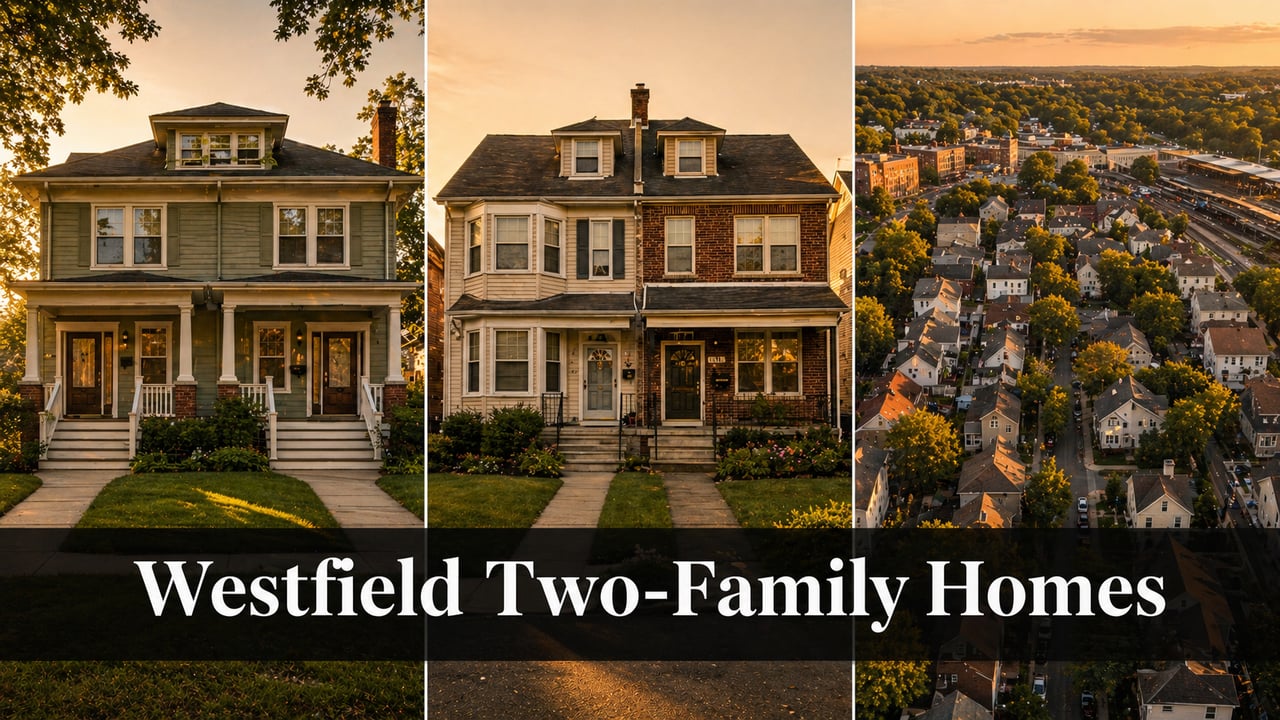

A Westfield investor walks through a charming 1920s side-by-side near the train station. The exterior reads two-family — separate front entrances, two electric meters, two mailboxes, two heating systems. The listing agent confirms it has been a two-family for sixty years. The investor runs the rental numbers and the deal pencils. Then, three days into attorney review, the buyer's lawyer pulls the SDL Portal record and the certificate of occupancy. The property is on a 5,400-square-foot lot. The current zoning requires 8,000 square feet for two-family use. The existing two-family is a pre-existing nonconforming use — perfectly legal to continue, but it cannot be expanded, and a major renovation could trigger conformity requirements. The deal closes anyway, but the price gets renegotiated. This scenario plays out somewhere in Westfield every few months.
Two-family homes in Westfield are a small, defined inventory pool with very specific rules. Most of the town does not permit them at all. Where they are permitted, the lot size requirements often exceed what the actual lots in those zones provide, which is why so many of the existing two-families are pre-existing nonconforming. For investors and owner-occupants looking to buy a two-family in Westfield in 2026, the question is not whether two-families exist — it is which streets allow them, what the lot has to be, and what the property's legal status actually is. This is the working guide.
For a broader picture of how Westfield's downtown has shaped the demand pressure on its rental and small multi-family inventory, our Above the Streets Westfield episode lays out the geography and history.
The Rule 01
Westfield's Land Use Ordinance permits two-family residential use as a principal use in exactly four zone districts: RM-12, RM-8, RM-6, and RM-6D. The RA-3 multi-family zone also permits two-family dwellings as one of several housing types. That is the entire list. Every other residential zone in Westfield — every RS district from RS-40 down to RS-6 — allows only single-family detached homes as principal uses. No two-families. No duplexes. No conversions.*
The seven RS districts cover the bulk of the town's residential land — the established neighborhoods buyers usually picture when they think of Westfield. None of them are two-family zones. The RM districts cluster on the older grid streets closer to the central business district and the train station, which is also where most of the town's existing two-family inventory was built in the early twentieth century. The geography is not a coincidence. Two-family housing in Westfield was historically concentrated where workers needed to walk to the train, and the zoning followed the existing pattern when the ordinance was first adopted.
The Math 02
The minimum two-family lot size is the single most important number in any Westfield investor's analysis. The standards are not the same across the four RM districts, and the gap between what the ordinance requires and what the actual lots provide is where most deals get complicated.
| Zone | Min. Two-Family Lot | Min. Lot Width | Key Requirement |
|---|---|---|---|
| RM-12 | 12,000 sf | 75 ft (103 ft corner) | Detached 2-car garage; same minimum lot for both single- and two-family |
| RM-8 | 8,000 sf | — | Two-family must look like a one-family with single main entrance; detached 1-car garage; mandatory front porch ≥50% of facade width |
| RM-6 | 8,000 sf | — | Single-family lot only requires 6,000 sf; two-family requires 2,000 sf more; minimum 1-car garage |
| RM-6D | 8,000 sf (or duplex on 4,000 sf each) | — | Permits attached single-family duplexes — two units sharing a common vertical wall on two separate lots of 4,000 sf each |
RM-6 deserves a closer look because it is the most common two-family zone in Westfield and the one where lot-size friction shows up most often. The single-family minimum in RM-6 is 6,000 square feet. The two-family minimum is 8,000 square feet. The 2,000-square-foot delta sounds small, but it eliminates a meaningful portion of the existing housing stock from being legally redeveloped as a two-family. Many of the original RM-6 lots were platted at 5,000 to 7,000 square feet — large enough for the single-family standard, too small for the two-family standard. Those parcels can still hold an existing two-family that predates the current ordinance, but they cannot be redeveloped into a new two-family without variance approval.
RM-6D Specifically 03
RM-6D is the most distinctive of the RM districts, and it is regularly confused with the others because the ordinance treats it as both an RM-6 variant and a separate product type. The "D" stands for duplex. The zone permits standard single-family detached dwellings on 6,000-square-foot lots, standard two-family dwellings on 8,000-square-foot lots, and a third option that no other Westfield zone permits: attached single-family duplexes on two separate 4,000-square-foot lots, with the two homes sharing a common vertical wall.
From the street, an RM-6D duplex looks like a townhouse pair. Architecturally, it functions like one. Legally, it is two separate single-family detached homes on two separate lots of record, each owned independently with its own deed, its own taxes, and its own mortgage if financed. The two units share a common wall, but the lots beneath them are treated as completely independent parcels. This is why duplex pairs in RM-6D zones often trade as separate single-family transactions rather than as a single two-family deal.
For investors, RM-6D is interesting because it allows the smallest single-family lots permitted in any Westfield residential zone — 4,000 square feet. For owner-occupants, the value proposition is owning a single-family home with downtown proximity at a smaller lot footprint than RS-6 would permit. The trade-off is the shared wall and the shorter side yard between you and your neighbor. RM-6D parcels are uncommon and concentrated in specific pockets, primarily in the older grid sections south and southwest of the central business district.
Pre-Existing 04
A meaningful share of Westfield's existing two-family inventory predates the current zoning ordinance. These are properties that were lawfully two-family at the time they were built, but no longer meet current bulk standards — usually because the lot is below the 8,000-square-foot minimum, or because the lot width or some other dimensional standard falls short. Under New Jersey land use law, these properties enjoy "pre-existing nonconforming" status, which means they can continue to be used as a two-family indefinitely.
The catch is what they cannot do. A pre-existing nonconforming two-family generally cannot be expanded in a way that intensifies the nonconformity. It often cannot be rebuilt at the same scale if it is destroyed (state law and the ordinance have specific provisions on this). Major renovations may trigger requirements to bring the property closer to current standards. And the lot itself, if it falls below the minimum, cannot be used to build a new two-family — only to maintain the existing one.
The 2025 Westfield Zoning Board of Adjustment dockets contain regular examples of this pattern. One application sought relief on a property where the minimum lot area for two-family residential use was 8,000 square feet but the existing and proposed lot was 1,973 square feet. Another addressed a substandard 50-foot lot frontage in a zone that requires 60 feet for two-family. These cases illustrate the reality: substantially nonconforming two-families exist throughout the older grid, they can keep functioning as two-families, but every renovation, expansion, or redevelopment plan runs through a Zoning Board of Adjustment with mixed and case-specific outcomes.
RA-3 Track 05
RA-3 is the only multi-family district in Westfield that permits two-family dwellings as a principal use alongside garden apartments and single-family detached homes. The two-family minimum lot in RA-3 is 8,000 square feet — the same standard as RM-6 and RM-8. The single-family minimum is 6,000 square feet, also matching RM-6. The garden apartment minimum is 15,000 square feet. RA-3 parcels are scattered along specific corridors and are not interchangeable with the RM districts even though the two-family standards line up.
For investors, the RA-3 distinction matters mostly because RA-3 lots tend to be priced relative to their multi-family upside, not just their two-family yield. A 15,000-square-foot RA-3 lot can support a small garden apartment building under the appropriate site plan approval, which is a different investment than the same lot held for a two-family conversion. Buyers should understand which use is being underwritten before pricing the deal.
Due Diligence 06
A two-family transaction in Westfield carries diligence requirements that a standard single-family deal does not. Five steps cover almost every situation and should be completed before the inspection contingency expires.
Step 1 — Confirm the zone district. Pull the current zoning designation for the property from the Westfield Zoning Map maintained by the Engineering Department. Two-family use is only permitted as-of-right in RM-12, RM-8, RM-6, RM-6D, and RA-3. If the property sits in any other zone, the existing two-family is by definition pre-existing nonconforming, and that status drives every subsequent question.
Step 2 — Verify the certificate of occupancy. A two-family is only legally a two-family if the certificate of occupancy on file with the town reflects two-family use. Some Westfield properties have been operated as informal two-families for decades without ever receiving a CO for that use. The SDL Portal at sdl.town/westfield is the first place to look. The Building Department at 959 North Avenue West can confirm what the official record shows.
Step 3 — Run the lot-size math. Compare the actual lot square footage against the minimum two-family standard for the zone. RM-12 requires 12,000 square feet; RM-8, RM-6, RM-6D, and RA-3 require 8,000 square feet. If the lot meets the minimum, the property is conforming on lot area. If it falls short, the property is nonconforming and any expansion plans require variance review.
Step 4 — Verify lot width and frontage. Lot width is measured at the front yard setback line; lot frontage is the width along the street. Both have minimums by zone. RM-12 requires 75 feet of width and frontage (103 feet on corners). RM-6 and RM-8 typically require 50 feet for single-family and 60 feet for two-family. Lots below these standards on either dimension are nonconforming even if the area math works.
Step 5 — Pull the SDL Portal record and check for unpermitted improvements. Westfield's December 11, 2025 zoning permit rule means buyers' attorneys are now routinely auditing the construction permit record on every property. Two-families often have decades of incremental work — kitchen splits, bathroom additions, basement finishes, separate utility metering, fence installations — and any of it that lacks permits becomes a closing-table issue. We covered the full mechanics of this in our breakdown of Westfield's zoning permit requirement.
Investor Math 07
Two-family pricing in Westfield is set by three forces working in different directions. First, the inventory is small and capped by zoning — only four RM districts plus RA-3 produce eligible two-family parcels, and most of those neighborhoods were built out decades ago. Second, the rental demand is strong and structurally underserved given Westfield's downtown amenity density, school district reputation, and rail access to Penn Station. Third, the underlying single-family market is one of the most expensive in Union County, with the median sale price hovering near $1.4 million heading into spring 2026 — which means the dirt under any two-family is being priced against single-family teardown alternatives.
The result is a two-family market where rental yields look thin on paper relative to outer Union County or Middlesex County alternatives, but where the dirt appreciation and downtown convenience premium have historically delivered strong total returns. Investors comparing Westfield two-families to higher-yield rental markets in Sayreville, Old Bridge, or Brick Township are comparing different products — Westfield is a low-yield, high-appreciation play; the outer markets are higher-yield, lower-appreciation plays. Both can work; they are not the same trade.
For owner-occupants buying a two-family to live in one unit and rent the other, the math is different again. The Westfield property tax bill — averaging over $18,000 annually for a typical home — is significant, but rental income from the second unit can offset a meaningful share of carry. We broke down the property tax structure in detail in Westfield property taxes explained, and the full closing-cost picture for sellers in what it really costs to sell a home in Westfield. The owner-occupant path remains one of the most underrated entry strategies for buyers who want a Westfield address but cannot underwrite the full $1.4 million single-family median on their income alone.
Looking Forward 08
The five affordable housing overlay sites adopted in Westfield's 2025 Master Plan Amendment do not change the two-family framework directly. They sit on commercial parcels along Elm Street, North Avenue East, and South Avenue, not on the residential RM districts. They will produce multi-family rental supply rather than two-family for-sale stock. But they will compete with the existing two-family rental market once they deliver, particularly for the renter cohort attracted to walkable, transit-adjacent housing.
The honest read for two-family investors is that the new rental supply will tighten cap rates on existing two-families near the train station modestly, but the broader population growth and downtown activation should support occupancy and gradual rent increases over the same horizon. We covered the full structure of the overlay program and the 380-unit obligation in Westfield's affordable housing overlay zones, and the broader zoning framework that ties all of this together in the Westfield zoning map explained. Investors actively shopping the two-family inventory can browse current listings and neighborhood detail on our Westfield, NJ community page.
Two-family Westfield is a small, defensible inventory pool with specific rules. Buyers who understand which streets allow them, which lots actually conform, and which existing properties are pre-existing nonconforming will find good entries. Buyers who skip the diligence usually find out at attorney review.
*Sources: Town of Westfield Land Use Ordinance, Chapter LUL, including Article 11 §§ 11.10 (RM-12), 11.11 (RM-8), 11.12 (RM-6), 11.13 (RM-6D), and 11.16 (RA-3); Article 2 (Definitions); Article 12 (General Zoning Regulations); Article 14 (Home Occupations); Town of Westfield Schedule of Zoning Standards / Schedule of Requirements; Westfield Zoning Board of Adjustment agendas, May 12, 2025 and October 15, 2025; Westfield Planning and Zoning Department Zoning Permits guidance (effective December 11, 2025); Town of Westfield SDL Portal at sdl.town/westfield. Bulk standards including minimum lot area, minimum lot width, lot frontage, and garage requirements are taken directly from Article 11 zone-by-zone regulations and verified against the Schedule of Zoning Standards. Median sale price reference for context is sourced from closed-sale data tracked across major listing platforms.
Frequently Asked
Can I convert my Westfield single-family home into a two-family?
Only if the property sits in an RM-6, RM-8, RM-12, RM-6D, or RA-3 zone, and only if the lot meets the minimum two-family standard for that zone — generally 8,000 square feet (12,000 in RM-12). Single-family RS zones do not permit two-family conversions under any circumstance, and variance applications for two-family use in RS zones are rarely approved.
What does pre-existing nonconforming mean for my Westfield two-family?
A pre-existing nonconforming two-family was lawful at the time it was built but no longer meets current bulk standards — usually a sub-8,000-square-foot lot. The use can continue indefinitely, but expansion that intensifies the nonconformity, or significant rebuild after destruction, may require variance approval. The status does not transfer or terminate at sale; it remains attached to the property.
How do I confirm a property is legally a two-family in Westfield?
Three checks: pull the certificate of occupancy from the Building Department at 959 North Avenue West; review the SDL Portal at sdl.town/westfield for the property's permit and inspection history; and confirm the zone district allows two-family use. If the certificate of occupancy reflects two-family use, the zoning permits it, and the lot meets the minimum standards, the property is conforming. Anything short of all three is a nonconforming or unverified situation.
What's the difference between a two-family and a duplex in Westfield?
A two-family is a single building containing two dwelling units on a single lot — both units are owned together. A duplex in Westfield's RM-6D zone is a pair of attached single-family homes sharing a common vertical wall, but each unit sits on its own separate lot of 4,000 square feet, with independent ownership. The two products look similar from the street but have very different ownership, financing, and resale profiles.
Prodigy Real Estate is an innovative real estate company offering high-end video production, home valuation services, purchasing, and home sales. Serving New York and New Jersey.