
Anthony Licciardello | May 22, 2026
Staten Island
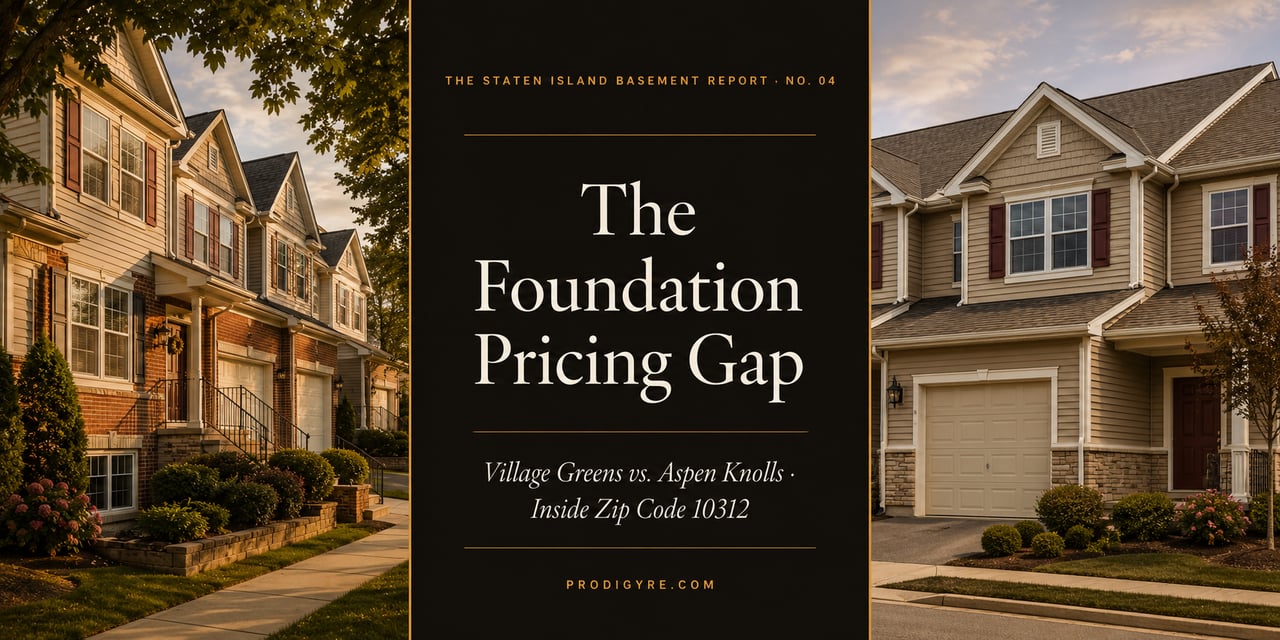
The Staten Island Basement Report · No. 04
Inside a single Staten Island zip code, two townhouse complexes — Village Greens and Aspen Knolls — price $125,000 apart. The line between them is drawn at grade level.
The Argument in Brief
Two Staten Island townhouse complexes — Village Greens in Arden Heights and Aspen Knolls a few blocks away — share a zip code, a school district, and a school bus route. They do not share a price band. Village Greens units, built over full finished basements, trade for $565,000 to $750,000. Aspen Knolls units, many of which sit on slab foundations, trade for $450,000 to $630,000.
The pricing gap between the highest Village Greens comp and the lowest Aspen Knolls comp inside a single zip code can run over $125,000. The variable doing most of the work is not square footage. It is not interior finish. It is foundation type — and ANSI Z765-2021 explains why that variable matters more in 2026 than it has at any point in the prior twenty years.
For buyers comparing complexes, this is the most important comp distinction on the South Shore. For sellers in either complex, the question is not "what is my townhouse worth?" but rather: "is my townhouse being compared to the right comp set?"
A Definition for the Reader
ANSI Z765-2021
The American National Standards Institute standard for measuring single-family residential square footage. Adopted by Fannie Mae on April 1, 2022 and by Freddie Mac in November 2023, the standard now governs how every residential appraiser in the United States reports the size of a home.
Its central rule is binary: if even one fraction of a level sits below the exterior grade of the earth, the entire level is reported as basement area — not as Gross Living Area (GLA). Walk-out access, full-size windows, and high-end finishes do not change the classification. The standard applies to detached single-family homes and to attached townhouses and rowhouses. Apartment-style condominiums are the exception and continue to follow the long-established interior perimeter measurement method.
Why it matters here: ANSI is the reason a Village Greens townhouse with a 2,000 above-grade and 800 below-grade configuration reports as 2,000 GLA plus 800 basement — not 2,800 total. The basement carries a separate dollar-amount adjustment, and that mechanical separation is the engine behind the foundation pricing gap.
There is a stretch of Arden Heights where a buyer can stand on one sidewalk and see two townhouse complexes within walking distance of each other. From the curb, they look comparable: similar build era, similar pitched-roof vinyl-and-brick architecture, similar landscaping, similar mailbox clusters. Same school district. Same SIRR train access. Same shopping. The complexes were even marketed to similar buyers when first developed.
A buyer who tours both will find broadly comparable interior square footage, broadly comparable kitchen and bathroom layouts, and broadly comparable HOA fee structures. What they will not find is comparable pricing. One complex's median sale price runs roughly $200,000 above the other's. The architecture inside is similar. The architecture below is not.
That is the foundation pricing gap. It is the single largest comp-set distortion in Staten Island townhouse valuation in 2026, and it produces both the largest opportunity and the largest pricing mistakes on the South Shore.
Chapter
The Two Complexes
Two complexes. One zip code. Different foundations. Different price bands.
Before the pricing math, the two complexes need to be understood as physical products. The architecture and foundation specifications are the variables driving the comp distortion. Everything else — schools, services, transit — is held constant.
Village Greens
Full finished basements throughout
Architecture: Multi-level townhouses, pitched roofs, vinyl and brick exteriors, attached two-car or one-car garages depending on building.
Foundation: Full poured-concrete foundation. Finished or finishable basement level standard across the complex. Most units list with finished basements at time of resale.
Typical SF (above + below): 1,600–2,200 above-grade + 700–900 finished below-grade.
Median sold band, 2025–2026: $565,000 to $750,000
Aspen Knolls
Mixed foundations: slab and basement
Architecture: Duplexes and condominium-style units. Several distinct floor plans across the complex. Similar pitched-roof aesthetic from the curb.
Foundation: Mixed. Some units sit on slab foundations with no below-grade space. Other units include full basement foundations, some finished, some unfinished.
Typical SF (above + below): Slab units: 1,400–1,700 above-grade only. Basement units: 1,600–2,000 above + 600–900 below.
Median sold band, 2025–2026: $450,000 to $630,000
Two complexes. One zip code. The Village Greens median sits roughly $150,000–$200,000 above the Aspen Knolls median, and the price gap between the highest Village Greens comp and the lowest Aspen Knolls slab comp can exceed $300,000. That delta is almost entirely a foundation story.
Chapter
The Regulatory Layer
A regulatory distinction that quietly redefined what a townhouse buyer is buying.
With the ANSI definition established above, the practical question for Staten Island townhouses becomes: how does the standard land differently on Village Greens versus Aspen Knolls? The answer is in the architectural distinction the standard explicitly makes — and explicitly does not make.
ANSI applies to attached single-family townhouses and rowhouses with the same below-grade rule as detached single-family homes. It does not apply to apartment-style condominiums, which continue to follow interior perimeter measurement. This distinction matters here because Aspen Knolls includes condominium-style units that read on appraisal reports differently than the townhouse-style units inside the same complex. The complex is mixed in foundation type and mixed in legal product type.
The practical result for a Village Greens townhouse: a 2,000 above-grade and 800 below-grade configuration reports as 2,000 GLA plus 800 basement. The home contains 2,800 finished square feet. It does not report 2,800. The basement carries a dollar-amount line-item adjustment instead. And that mechanical change is what produces the cross-complex pricing gap below.
The Distinction That Matters
Townhouses follow ANSI. Apartment-style condos do not.
In a mixed-product complex like Aspen Knolls, this means a townhouse-style unit and a condominium-style unit of identical physical size can produce different appraisal GLA figures. Both are valid under their respective standards. Neither is "wrong." But the comp set has to be carefully matched to product type — and unsophisticated comp pulls routinely mix the two, producing artificial price-per-square-foot distortions that mislead both buyers and sellers.
Chapter
The Comp Math
Where the foundation gap shows up at the closing table.
The clearest way to see the foundation pricing gap is in the scorecard below. The rows compare typical-condition units sold during 2025 and Q1 2026, grouped by complex and foundation type. The Premium column on the right tells the story: same neighborhood, same zip code, similar walk-up appearance — but the cross-foundation pricing gap inside 10312 can exceed $125,000 on directly comparable square footage.
| Complex & Type | Foundation | Typical Sold Band | Cross-Complex Spread |
|---|---|---|---|
|
Village Greens 2-BR · finished basement |
Full basement | $565K – $620K | baseline |
|
Village Greens 3–4 BR · finished basement |
Full basement | $650K – $750K | top of band |
|
Aspen Knolls 4-BR · finished basement |
Full basement | $595K – $630K | comparable |
|
Aspen Knolls 2-BR · slab foundation |
Slab | $450K – $505K | −$125K+ |
Source: SIBOR closed sales 2025–Q1 2026; The Prodigy Team market adjustments file. Bands reflect typical-condition units; turnkey renovated and original-condition units sit at the high and low ends of each band, respectively. Cross-Complex Spread column compares each row to the Village Greens 2-BR finished-basement baseline.
The pattern is clean. Inside Village Greens, a 4-BR finished-basement unit at 52 Aspen Knolls Way sold for $630,000 in March 2026 — a meaningful price, comfortably within the Village Greens 3–4 BR range despite being inside Aspen Knolls. The unit had a full finished basement. The foundation, not the address, set the price.
Conversely, a 2-BR slab-foundation Aspen Knolls unit a few buildings away listed in the same period at $485,000 — a fair price for the product, but $80,000 below the lowest Village Greens 2-BR comp during the same window. Same complex as the $630,000 comp. No basement. $145,000 separates them.
Inside a single zip code, the foundation pricing gap can run over $125,000 on architecturally comparable units. It is the largest single-variable comp distortion on the South Shore townhouse market in 2026, and it routinely catches both buyers and sellers off guard.
“
A slab-foundation Aspen Knolls unit is not a discounted Village Greens unit. It is a different product. The buyers who shop one rarely shop the other — and the listing strategy has to start from that recognition.
Anthony Licciardello · Broker · The Prodigy Team
Chapter
The Buyer Pools
Why the pricing gap is durable, not arbitrary.
The pricing gap holds year after year because the underlying buyer pools for the two foundation types are different. Each pool has its own preferences, financial circumstances, and life-stage logic. Understanding both is essential to either buying or selling a Staten Island townhouse correctly in 2026.
Buyer Pool One
The full-basement buyer
Families with children, working-from-home professionals, multi-generational households, and buyers planning to grow into the space. The finished basement is treated as a fourth bedroom, a playroom, a home office, or a den. The buyer is willing to pay the $100,000+ premium because the alternative — buying a slab unit and renting or buying additional space elsewhere — is more expensive over the holding period. This pool largely shops Village Greens and the basement-equipped Aspen Knolls units.
Buyer Pool Two
The slab-foundation buyer
First-time buyers, downsizers from larger Mid-Island homes, single professionals, and buyers prioritizing affordability over future expansion. The slab unit is fit-for-purpose: lower price point, lower utility costs, smaller maintenance envelope, and no moisture-risk worry. The buyer is not foregoing the basement reluctantly; they are actively choosing the slab product. This pool shops the slab-foundation Aspen Knolls units and rarely crosses over to Village Greens, which they perceive as overpriced for their needs.
Because the two buyer pools are functionally separate, the pricing gap is durable. A market correction does not collapse Village Greens prices toward Aspen Knolls slab prices, and an inventory shortage does not lift slab prices to basement parity. Both products move together with the broader market, but at their respective bands.
Chapter
Listing Strategy
How to price a Staten Island townhouse without falling into the cross-foundation comp trap.
Selling either a Village Greens unit or an Aspen Knolls unit correctly in 2026 requires four specific listing decisions. They look small individually. They are not.
01
Comp set must be foundation-matched, not address-matched.
A slab-foundation Aspen Knolls listing comped against finished-basement Aspen Knolls comps overprices the home and stalls. A finished-basement Aspen Knolls listing comped only against slab Aspen Knolls comps underprices the home by $80,000–$150,000. Pull comps by foundation type first, complex second.
02
Finished basements need cinematic listing video.
Because ANSI removes basement square footage from the GLA column on the appraisal, the buyer's emotional and financial connection to the lower level has to be established during the listing experience. Cinematic 4K video tours — the format The Prodigy Team produces in-house for every listing — communicate the finished basement as a primary living space before the appraisal report ever lands.
03
Slab-foundation units lean into the affordability narrative.
A slab Aspen Knolls listing should not apologize for the foundation. The product serves a specific buyer pool — first-time buyers and downsizers — who actively choose lower price points, lower utility costs, and lower maintenance envelopes. Listing copy emphasizing those advantages reaches the right buyer pool directly.
04
Disclose foundation type explicitly in MLS copy.
The single most common MLS error in South Shore townhouse listings is omitting foundation type or burying it in remarks. A buyer's agent screening 30 listings on a Saturday morning will not click through to discover whether a unit has a basement. Foundation type belongs in the headline, the first sentence of remarks, and the photo set.
A Private Consultation
Before listing a Staten Island townhouse, the comp set should be foundation-matched, ANSI-compliant, and aligned to the buyer pool actually shopping for the product. A 20-minute pre-listing conversation usually identifies the right band within $20,000.
Anthony Licciardello · The Prodigy Team · Conversations are confidential.
Appendix
Reader Questions
Questions Staten Island townhouse buyers and sellers ask most.
Question One
Why does Village Greens sell for so much more than Aspen Knolls?
The dominant variable is foundation type. Village Greens units are built over full poured-concrete foundations with finished or finishable basement levels standard throughout the complex. Aspen Knolls is mixed: some units sit on slab foundations with no below-grade space, while others have full basements. The cross-complex pricing gap inside zip code 10312 reflects this foundation difference, not differences in school district, neighborhood services, or interior finish quality.
Question Two
Do ANSI Z765 rules apply to my Staten Island townhouse?
Yes — if you own a townhouse-style attached unit. ANSI Z765-2021 explicitly covers attached single-family townhouses and rowhouses, applying the same below-grade rule as detached single-family homes: any level with even a fraction of its floor area below the exterior grade is reported as basement area rather than Gross Living Area. Apartment-style condominium units are the exception and continue to follow the interior perimeter measurement method, which is unchanged. The product type matters more than the address.
Question Three
Is a slab-foundation townhouse a bad investment?
No. A slab-foundation townhouse is a different product, not an inferior one. It serves a specific buyer pool — first-time buyers, downsizers, single professionals — who actively prioritize lower entry price, lower utility costs, smaller maintenance envelope, and no moisture-risk worry. These units appreciate at roughly the same rate as basement-equipped units within their respective price band. The pricing gap is structural and durable, but slab-foundation appreciation tracks the broader Staten Island market consistently.
Question Four
Can I add a basement to a slab-foundation townhouse?
Practically, no. Excavating beneath an existing slab-foundation townhouse is structurally impractical and economically infeasible — the cost of jacking the structure, excavating, pouring a new foundation, and re-supporting the unit would exceed the basement premium by a wide margin. Slab-foundation buyers should treat the foundation as a fixed condition of the product and price accordingly. Owners considering an addition should focus on above-grade expansions where HOA rules and footprint allow.
Question Five
How do I know whether a townhouse is a townhouse or a condo under ANSI?
The distinction comes from the legal product type, not the architectural appearance. A "townhouse" under ANSI is a fee-simple attached single-family unit where the owner holds title to the land beneath the unit. An apartment-style condominium is a unit within a multi-unit building where the owner holds title to the interior airspace and a share of the common elements. Many Staten Island townhouse complexes have units that look architecturally similar from the street but are legally structured differently. Your title documents, your HOA bylaws, and your purchase agreement will identify which product type your unit is. When in doubt, ask your attorney before pulling comps.
Sources & Methodology
SIBOR closed sales 2025–Q1 2026; The Prodigy Team market adjustments file; ANSI Z765-2021 regulatory framework per Fannie Mae Single Family Standardized Property Measuring Guidelines (effective April 1, 2022); Freddie Mac ANSI Z765 adoption (November 2023). Complex-level pricing bands reflect typical-condition units; turnkey renovated and original-condition units sit at the high and low ends, respectively. Individual unit results vary based on configuration, condition, HOA fee structure, and market timing. Nothing in this article constitutes legal advice; consult a New York City real estate attorney for any specific question about Certificate of Occupancy classification, condominium versus townhouse status, or HOA governance.
Prodigy Real Estate is an innovative real estate company offering high-end video production, home valuation services, purchasing, and home sales. Serving New York and New Jersey.