
Anthony Licciardello | April 16, 2026
Staten Island Luxury Home Market
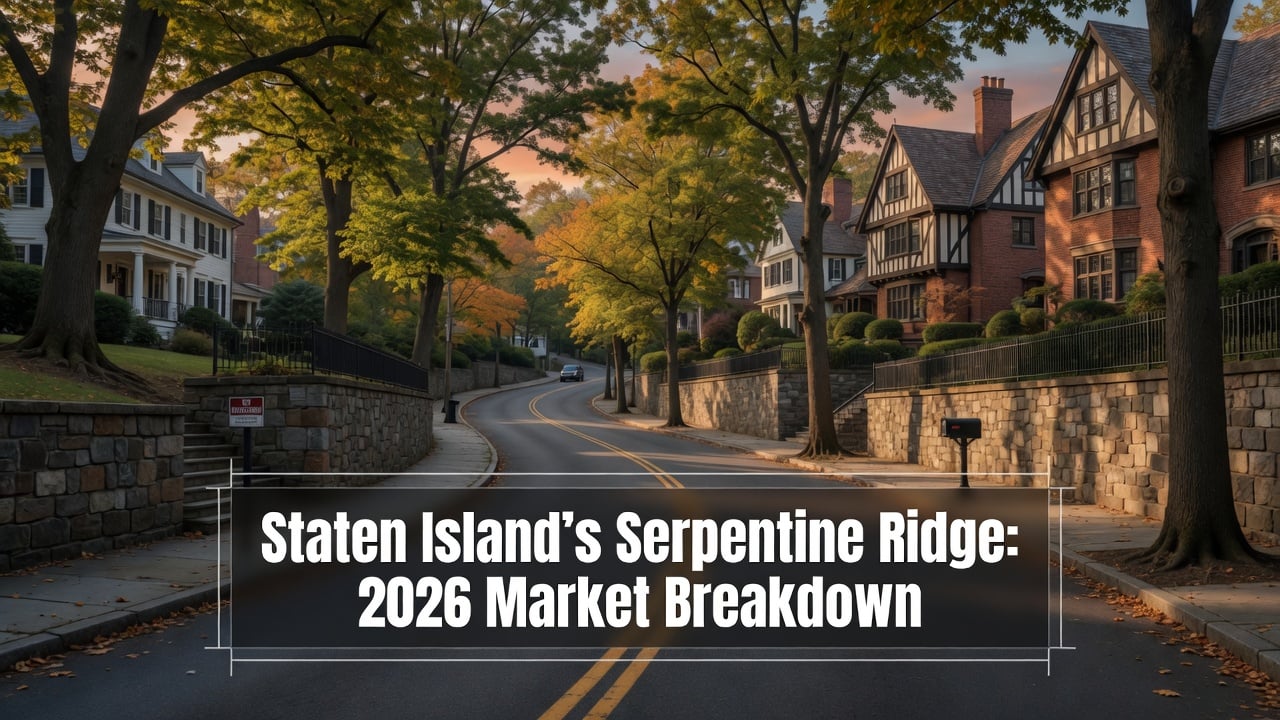
The Serpentine Ridge is ancient ocean floor — serpentinite bedrock that physically resists excavation, governed by two overlapping zoning districts that legally prevent density, and peaks at 409.8 feet above sea level at Todt Hill, the highest natural point on the Eastern Seaboard south of Maine. No developer can blast through it. No variance can waive around it. The supply of homes on this ridge is structurally fixed in a way that no other neighborhood in New York City can claim — and every pricing figure in this post flows directly from that fact.
Todt Hill, Emerson Hill, Grymes Hill, and Ward Hill each occupy a distinct position on that fixed foundation. Different elevation, different view corridor, different buyer profile, different price tier. Here is what the numbers look like in each one right now.
At 409.8 feet above sea level, Todt Hill is not just the highest point on Staten Island. It is the highest natural point on the Eastern Seaboard south of Maine. That distinction is not trivia. It is the foundation of a pricing tier that runs 2.6 to 2.7 times above the borough median — and has sustained that premium through every market cycle the city has seen.
In early 2026, the median sale price in Todt Hill sits between $1.88 million and $2.05 million, representing a 28% to 36% year-over-year increase while the broader borough median holds near $762,000. The median list price runs higher at $2.3 million, with top-tier estates regularly trading above $5 million. Price per square foot ranges from $491 to $529 on typical transactions, though individual estate sales skew these figures significantly in either direction.*
This is not a high-volume market. Todt Hill typically records four to seven closed sales per month, with active listings rarely exceeding 17 to 25 properties at any given time. Homes spend an average of 120 to 143 days on market — a duration that is entirely normal in the ultra-luxury segment, where the buyer pool is limited to high-net-worth individuals who purchase on their own timeline. The median household income stands at $140,700.
The housing stock is dominated by custom mid-century architecture, sprawling ranches, Mediterranean-style villas, and brick colonials on lots ranging from half an acre to full acres — a genuine rarity anywhere in the five boroughs. Most properties are accessed via winding private lanes or gated driveways, and many back directly onto the 2,800-acre Staten Island Greenbelt. The Richmond County Country Club, organized in 1888 as the borough's only private country club, anchors the neighborhood's social infrastructure with an 18-hole championship golf course, eight Har-Tru tennis courts, an aquatic facility, and fine dining. The Staten Island Academy, a college-preparatory independent school founded in 1884, is the oldest independent school in the borough and sits on Todt Hill Road.
Special Natural Area District zoning governs every parcel on the hill. Supply cannot grow. For a deeper look at how SNAD affects transactions and pricing in this specific market, see our dedicated Todt Hill market report.
Just northeast of Todt Hill and tucked directly beneath the Staten Island Expressway, Emerson Hill is the second-richest neighborhood in the borough. It offers a slightly more accessible entry point into the luxury hill market without sacrificing history, architectural quality, or the SNAD protections that define the central ridge.
The median sale price in Emerson Hill sits at approximately $1.1 million in early 2026, representing a 13.9% year-over-year increase. The median list price is significantly higher at $1.76 million, with only 14 active listings in recent tracking — a reflection of how tightly held these properties are. Price per square foot shows wide variance: older, unrenovated homes register around $285, while updated custom residences with clear Verrazzano Bridge views command $550 to $731 per square foot.* Unlike Todt Hill, this is a liquid market. Properties move in an average of 52 to 53 days. The median household income is $125,000.
The neighborhood carries genuine historical pedigree. It was named for Judge William Emerson — brother of Ralph Waldo Emerson, who visited his brother's estate here, affectionately called "The Snuggery," before it was destroyed by fire in 1855. The area was methodically developed in the 1920s and 1930s by Cornelius G. Kolff, a prominent real estate developer who preserved the neighborhood's literary street names. Today the housing stock runs from grand mock Tudor homes and mid-century modern designs to expansive custom-built residences oriented specifically to capture eastern views of the Narrows.
Emerson Hill also carries a piece of American cinema. The Tudor Revival property at 110 Longfellow Avenue — a 6,248-square-foot home built in 1930 — and the adjacent house at 120 Longfellow Avenue together formed the Corleone family compound on a dead-end cul-de-sac in Francis Ford Coppola's 1972 masterpiece The Godfather. The production crew constructed a fake stone wall and entrance gate at the end of the street to give the appearance of a walled private estate — the wall itself was styrofoam. The grounds of 110 Longfellow served as the location for the opening wedding scene and Vito Corleone's death in the garden. All interior mansion scenes — including Don Vito's famous study — were built and filmed at Filmways Studios in East Harlem. The street at the end of Longfellow Avenue looks remarkably similar today to how it looked in 1971 when the production shot there.
At 374 feet above sea level — the second-highest natural point on Staten Island — Grymes Hill is the most diverse of the four ridge neighborhoods in terms of architectural stock, price distribution, and resident demographics. That range is a deliberate feature of the market, not a weakness. It means Grymes Hill offers a wider set of entry points into ridge-level real estate than its southern counterparts.
The median listing price ranges from $888,499 to $1.08 million, with an average price per square foot of approximately $520.* The price distribution tells the full story: roughly 35% of listings fall between $500,000 and $750,000, 40% between $750,000 and $1 million, and 25% above $1 million. That bottom tier captures buyers who want the ridge's structural advantages — flood immunity, SHPD canopy protection, harbor views — at a more accessible price point than Emerson Hill or Todt Hill offer. The median household income is $108,000.
The hill was named for Suzette Grymes, whose family settled the area in 1836. The elevation attracted significant wealth immediately: shipping magnate Sir Edward Cunard built a lavish estate here in the mid-19th century, and the winding roads — Howard Avenue, Prospect Avenue, Ralph Place — still bear the imprint of that era. The architectural mix is genuinely varied: stately Italianate mansions, rare Spanish Colonial Revival homes, robust mid-century modern houses, and postwar apartment condominiums on Arlo Road and Narrows Road North, all governed by SHPD's slope protection framework.
What distinguishes Grymes Hill from the other hills is institutional density. The campuses of Wagner College and St. John's University Staten Island sit atop the hill's plateau, giving the neighborhood the feel of a Northeastern college town transplanted into a luxury residential enclave. The Casa Belvedere — a landmarked former silk importer's mansion converted into an Italian cultural center — adds programming in culinary arts, literature, and the performing arts that no other hill neighborhood offers. For buyers who want ridge-level real estate with intellectual and cultural energy built in, Grymes Hill is the logical choice.
Ward Hill occupies the northernmost elevation of the ridge and carries a specific identity built around two things: a direct, unobstructed sightline to the Manhattan skyline, and a commute to the Financial District that most Brooklyn neighborhoods cannot match. These two factors make Ward Hill the ridge's most city-connected enclave — and its most accessible entry point for buyers crossing the Verrazzano who are not prepared to give up visual proximity to Manhattan entirely.
Pricing in Ward Hill shows the widest variance of any neighborhood on the ridge. Homes requiring renovation or without premium views can be acquired in the $819,000 to $895,000 range. Properties with clear Manhattan skyline views command significantly more — $1.1 million to $1.35 million for well-positioned mid-market homes, and elite estates on St. Pauls Avenue reaching $3.3 million.* The variance reflects the neighborhood's mix of sprawling historic Victorians, solid 1930s brick colonials, and modern townhouses built in the late 20th century on streets like Clark Lane and Austin Place.
The neighborhood takes its name from Caleb Tompkins Ward, a 19th-century landowner and businessman whose uncle was Governor Daniel D. Tompkins of New York. Ward constructed a Greek Revival-style mansion at 141 Nixon Avenue around 1835 — now a New York City landmark and listed on the National Register of Historic Places since 1982. The steep, winding streets leading up to and around it — Nixon Avenue, Ward Avenue, St. Pauls Avenue — are lined with grand Victorian homes featuring brick exteriors, turrets, and bay windows. Schools serving the neighborhood include PS 14, PS 16, Curtis High School, and Notre Dame Academy.
Ward Hill's structural advantage is the St. George Ferry Terminal. The Staten Island Ferry runs free, 24 hours a day, delivering residents to the Financial District in 25 minutes without a highway. For professionals who need Manhattan proximity, this route bypasses the Verrazzano entirely. That commute is the same regardless of whether mortgage rates are 3% or 7% — and it places a durable pricing floor under the Ward Hill market that no rate environment can erode.
| Neighborhood | Median Household Income | Median Sale / List Price | Price Per Sq. Ft.* | Avg. Days on Market |
|---|---|---|---|---|
| Todt Hill | $140,700 | $1.88M – $2.35M | $491 – $529 | 120 – 143 |
| Emerson Hill | $125,000 | $1.1M – $1.76M | $285 – $731 | 52 – 53 |
| Grymes Hill | $108,000 | $888K – $1.08M | ~$520 avg. | — |
| Ward Hill | — | $819K – $3.3M+ | Highly variable | — |
| Staten Island Average | $95,500 | $754K – $762K | $398 – $471 | — |
The supply side of the Serpentine Ridge market is structurally constrained — that much is fixed by geology and zoning. What has changed in 2026 is the demand side, and it is pressing harder against that fixed supply than it has in years.
The primary brake on inventory is the mortgage rate lock-in effect. An estimated 78% of Staten Island homeowners secured 30-year fixed mortgages at rates below 5% between 2020 and 2022, with many in the luxury tier locking in below 3%. With prevailing rates stabilizing between 6.18% and 7.5% through 2025 and into early 2026, the financial penalty for selling is severe. A Todt Hill or Emerson Hill homeowner holding a $1.5 million mortgage who moves from a 2.75% rate to a 6.5% rate absorbs more than $3,300 in additional monthly payments — over $40,000 in additional annual debt service on the same principal. Discretionary sellers are staying put. Active inventory across the borough runs roughly 26% to 30% below historical norms, with only a 2.5 to 2.6 month supply of homes at the current pace of sales.
Against that locked-down supply, demand is accelerating. With median home prices in prime Brooklyn neighborhoods like Park Slope and Bay Ridge exceeding $900,000, dual-income households earning $150,000 to $200,000 are discovering that their purchasing power extends significantly further on the ridge. A buyer priced out of a constrained Brooklyn townhouse can acquire a historic estate with harbor views and mature landscaping in Ward Hill or Grymes Hill for a comparable or lower price — and gain substantially more space in the process. Pending sales on Staten Island rose 2.1% year-over-year in early 2026, breaking a streak of declining contract activity. The median price per square foot across the borough climbed 3.9% year-over-year. Properties priced under $700,000 — which captures the entry-level range of Grymes Hill and Ward Hill — saw approximately 35% receive multiple offers.
New single-family construction permits across the Serpentine Ridge remain well below pre-pandemic levels. The combination of serpentine bedrock, SNAD, and SHPD makes meaningful new supply practically impossible. The borough cannot build its way out of the current inventory shortage on the hills. That is not a temporary condition tied to interest rates or builder confidence. It is a permanent structural feature of these four markets.
For buyers, the practical implication is that waiting for more inventory will not produce results on the ridge. When a well-priced property comes to market in Emerson Hill or Todt Hill, it is competing only against the handful of other listings that exist — not against a future wave of alternatives. Patience in the search process makes sense. Assuming more supply will eventually appear does not.
For sellers, the structural scarcity is pricing leverage. A correctly priced listing on the Serpentine Ridge in 2026 faces a buyer pool that has already exhausted comparable options in Brooklyn and is operating in a market where replacement inventory is functionally unavailable. The broader Staten Island luxury market context reinforces what the ridge's own numbers show: Ward Hill, Grymes Hill, Emerson Hill, and Todt Hill are not simply expensive neighborhoods. They are physically and legally constrained assets in a market with no mechanism to build its way to equilibrium.
* Pricing data sourced from closed-sale records and listing-side trackers for the period ending early Q1 2026. Todt Hill figures reflect low monthly transaction volume and are subject to material variance from individual estate sales. Ward Hill income data not reported due to high variance across property categories. All figures represent market approximations and should not be treated as appraisals or formal valuations.
Q
What is the most expensive neighborhood on Staten Island?
Todt Hill is definitively the most expensive neighborhood on Staten Island and consistently ranks among the wealthiest zip codes in New York City. Median sale prices in early 2026 range from $1.88 million to over $2 million, with top-tier estates trading above $5 million. Its combination of SNAD zoning protections, estate-sized lots, Greenbelt adjacency, and 409.8-foot elevation has sustained a premium running 2.6 to 2.7 times the borough median across market cycles.
Q
How does Emerson Hill compare to Todt Hill for real estate?
Emerson Hill offers a more liquid, faster-moving market at a lower median price point — typically $1.1 million at median sale versus $1.88 million or more at Todt Hill. Homes sell in 52 to 53 days on average in Emerson Hill compared to 120-plus days in Todt Hill. Both neighborhoods fall under SNAD zoning, preventing new construction. Emerson Hill's primary view corridor faces east toward the Verrazzano Bridge and the Narrows; Todt Hill looks south over the Greenbelt to open water. Buyers who want faster liquidity and a lower entry point typically favor Emerson Hill. Buyers purchasing for privacy, estate scale, and permanence go to Todt Hill.
Q
Is Grymes Hill a good place to buy in 2026?
Grymes Hill offers the widest range of entry points on the Serpentine Ridge, with listings spanning from $500,000 to well above $1 million. The neighborhood benefits from the same Special Hillsides Preservation District protections that prevent new construction, keeping supply constrained. Demand from Brooklyn buyers crossing the Verrazzano has been particularly active in the sub-$1 million tier, where multiple-offer situations are occurring at elevated rates. For buyers who want ridge-level scarcity and harbor views at a more accessible price point than Todt Hill or Emerson Hill, Grymes Hill is the logical entry point in the current market.
Q
How long do homes stay on the market in Todt Hill?
Homes in Todt Hill typically spend 120 to 143 days on market, with some estate transactions extending beyond 200 days. This is not a sign of weak demand — it reflects the ultra-luxury segment's deliberately patient transaction pace. The buyer pool at Todt Hill pricing is limited to high-net-worth individuals who purchase on their own schedule, not under financial pressure. Correctly priced properties do sell. The timeline simply reflects a market where there are very few buyers in the world capable of transacting at this price point in this specific location.
Prodigy Real Estate is an innovative real estate company offering high-end video production, home valuation services, purchasing, and home sales. Serving New York and New Jersey.