
Anthony Licciardello | April 23, 2026
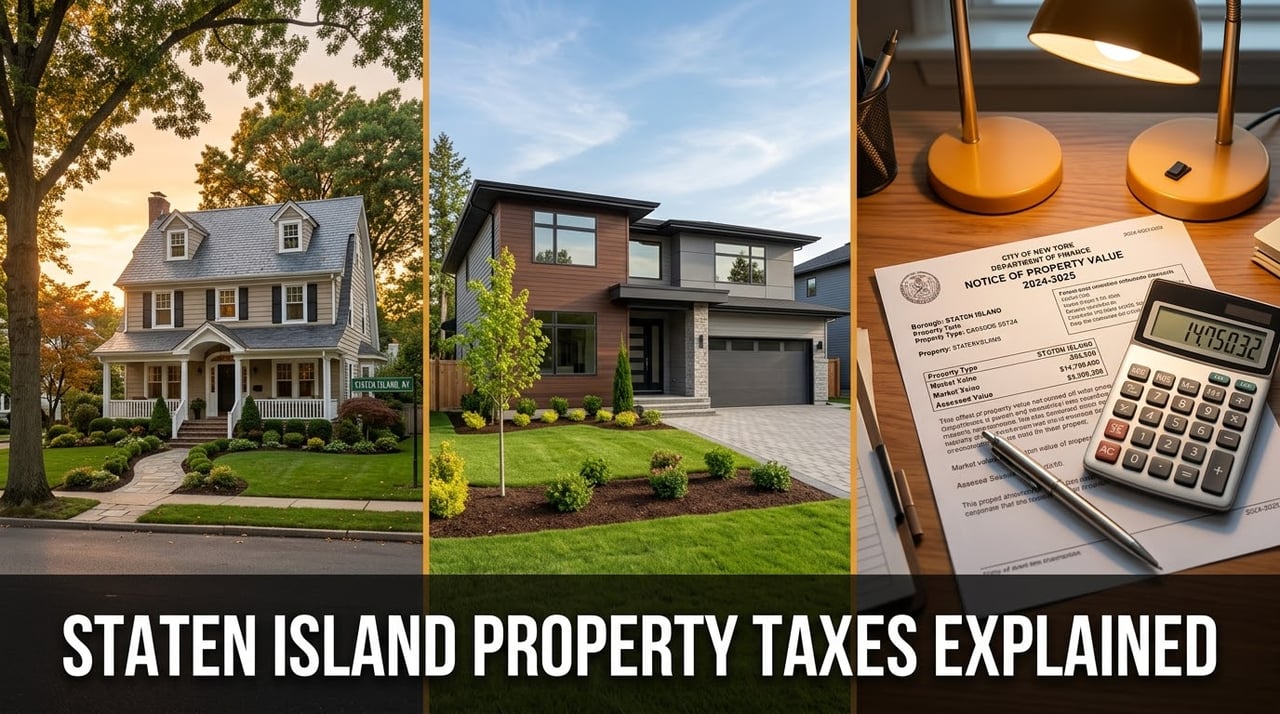

If you own a home on Staten Island, your property tax bill is being shaped by a 1981 state law most people have never heard of. The law caps how fast the city can raise your assessed value. Older homes have ridden those caps for decades. New construction hasn’t.
That’s the whole story in one sentence. The age of the house you buy matters more to your tax bill than what the house is actually worth.
A 1,800-square-foot colonial built in 1920 and a 1,800-square-foot new build finished in 2024 can sit on the same Westerleigh block, sell for the same price, and carry property tax bills thousands of dollars apart. Not because anyone did anything wrong. Because Section 1805 of the New York Real Property Tax Law locked older homes into artificially low assessments and left new construction exposed to the full weight of the tax code.
This is the plain-English guide to how it works, why Staten Island pays more than Park Slope, and where condos fit — because they play by an entirely different set of rules.
Start here, because this is where people get confused fastest.
New York City doesn’t tax you on what your house is worth. It taxes you on a fraction of what your house is worth. For a Class 1 property — a one-, two-, or three-family home — the target fraction is 6%.
So if the Department of Finance says your Staten Island house is worth $800,000, the most the city is legally allowed to assess it at is $48,000. That $48,000 is the “assessed value,” and it’s what actually gets multiplied by the tax rate.
The tax rate itself is where the confusion deepens. The Class 1 rate for the 2025/2026 tax year is 19.843%. That number sounds punishing until you realize it’s being applied to 6% of your home’s value, not the whole thing.
Run the math on that $800,000 house: $48,000 assessed value × 19.843% = $9,525 annual tax bill. That’s a 1.19% effective tax rate on true market value. Real money, but nowhere near the 20% headline rate.
Other property classes use different ratios. Condos, co-ops, and large rentals (Class 2) get assessed at 45% of value, not 6%. Commercial property (Class 4) also runs at 45%. That’s why a Manhattan office tower and a Staten Island colonial aren’t running through the same formula.
Now for the part that actually matters: almost nobody pays the full 6% target. The state cap makes sure of that.
Picture a Staten Island home bought in 1995 for $250,000. The assessed value that year was around $15,000 — 6% of market.
Fast forward to 2026. That same home is now worth $850,000. If the 6% target applied straight to current market value, the assessed value should be $51,000.
It isn’t. State law doesn’t allow it.
Section 1805(1) of the Real Property Tax Law limits how fast the Department of Finance can raise assessed value on a Class 1 home: no more than 6% in any single year, and no more than 20% over any five-year stretch. Those caps apply no matter how fast the market moves.
Even if the neighborhood doubles in five years, the city can only raise your assessment by 20% over that window. The cap compounds year after year. The longer you own and the faster the area appreciates, the bigger the gap grows between what your home is actually worth and what you’re being taxed on.
Citywide, the average Class 1 assessment ratio has drifted down to around 3.9% — meaning most homeowners are being taxed on less than 4% of their home’s true market value, not the 6% the law allows.
The catch-up effect. Because the cap compounds on last year’s capped number, your assessed value can keep rising even when your home’s market value drops. If your assessment is sitting well below the 6% ceiling, the city can legally raise it 6% a year until it catches up — even in a down market. Class 1 billable assessed values across NYC rose in years when market values fell. The caps work in both directions.
Here’s the piece that catches Staten Island buyers off guard when they’re weighing a teardown-and-rebuild against buying what’s already standing.
The 6/20 caps only apply to increases driven by the market — general appreciation, inflation, comps creeping up. They do not apply to increases caused by physical changes to the property.
Physical changes include additions, major permitted renovations, and — the big one — demolition and new construction.
When a developer buys a 1950s ranch, knocks it down, and builds a new single-family home, the Department of Finance treats it as a fresh parcel. The old assessment history, with decades of cap protection baked in, is gone. The new structure gets assessed at the full 6% target of current market value, unshielded.
That’s why an $800,000 new-construction home gets hit with roughly a $48,000 assessed value immediately, while the $800,000 older colonial across the street — with decades of cap drift protecting it — might be sitting at an assessed value in the mid-$30,000s. Same market value, same square footage, same block. Completely different tax bill.
This also applies to major renovations that add square footage or meaningfully change the structure. The DOF can reassess the improvement at full value, bypassing the cap on that portion.
People moving to Staten Island from California often assume NYC works like Prop 13. It doesn’t.
In California, when a house sells, the assessed value resets to the sale price. The new owner inherits none of the previous owner’s tax protection.
New York does the opposite. Nothing in Section 1805 resets assessment on sale. The cap history is attached to the parcel and the structure, not to whoever holds the deed.
When you buy a 1920 Westerleigh colonial that’s been in the same family for forty years, you inherit forty years of capped assessments. You walk into closing with a tax bill that reflects decades of protection you did nothing to earn.
That’s not a loophole. That’s exactly how the law is written — and it’s the single biggest reason older Staten Island homes are cheaper to carry than new ones.
Practical consequence: in Staten Island’s resale market, older housing stock carries a quiet tax advantage new construction can’t replicate — and smart buyers factor it into the offer. A $780,000 older home with a $6,400 tax bill carries a fundamentally different monthly cost than an $800,000 new build with a $9,500 tax bill. Similar price range, different house, roughly $250 per month in carrying-cost difference before anyone talks about the mortgage.
This is the part of the story that makes Staten Islanders angry once they see the numbers.
The typical Staten Island homeowner pays a higher effective property tax rate than the typical Park Slope homeowner — even though Park Slope homes are often worth three to four times as much.
Recent data puts Staten Island’s median effective tax rate in the 0.85%–0.91% range. Brooklyn’s overall median ETR is around 0.73%. Some Brownstone Brooklyn community districts have been documented as low as 0.26%. The NYC Comptroller has stated plainly that homeowners in Staten Island, Southeast Queens, Eastern Brooklyn, and the Northeast Bronx sometimes pay up to three times the effective tax rate of homeowners in Manhattan and Brownstone Brooklyn.*
The cause traces back to the cap.
Neighborhoods that appreciate fast — Park Slope, Williamsburg, Cobble Hill — blow past the 6% annual cap year after year. Market values sprint. Assessed values crawl. The gap between what the home is worth and what it’s being taxed on expands relentlessly, and the effective tax rate drifts lower.
Staten Island’s appreciation pattern is different. Steady. Suburban. Rarely explosive enough to permanently detach assessed value from market value. So Staten Island assessments stay much closer to the 6% target, and the borough ends up paying closer to full freight while faster-appreciating neighborhoods quietly escape the bill.
The math doesn’t know it’s unfair. The law rewards speed of appreciation, and Staten Island doesn’t appreciate the way the most protected neighborhoods do.
Numbers tell the story faster than words.
Consider two illustrative properties on the same Westerleigh block. Both 1,800 square feet. Both three-bedroom colonials. Both worth roughly $780,000 in the current market. One was built in 1920 and has passed through three families. The other was completed in 2024 after a teardown.
| Metric | 1920 Colonial | 2024 New Build |
|---|---|---|
| Market Value | $780,000 | $780,000 |
| Assessed Value | ~$36,000 | ~$46,800 |
| Assessment-to-Market Ratio | ~4.6% | 6.0% (full target) |
| Annual Property Tax | ~$7,143 | ~$9,287 |
| Effective Tax Rate | 0.92% | 1.19% |
Annual difference: roughly $2,144.
Over a 30-year hold, that gap adds up to about $64,000 in raw tax dollars, before accounting for rate increases. If the older-home buyer invested the annual savings into a broad-market index fund at a conservative 7% average return, the wealth gap over 30 years approaches $200,000.
Two nearly identical houses. Same block. Same school district. Same commute. A six-figure generational wealth decision, made entirely by the year the foundation was poured.
Everything above applies to Class 1 — one-, two-, and three-family homes. If you’re buying a condo on Staten Island, forget most of it. Different class. Different math. Different relief programs.
Condos and co-ops are Class 2 property. They’re assessed at 45% of value, not 6%. The tax rate is lower — 12.439% for the 2025/2026 tax year, compared to 19.843% on single-family homes. Small Class 2 buildings (ten units or fewer) have an 8% annual / 30% five-year assessment cap, more generous than Class 1. Larger buildings (eleven or more units) have no absolute cap but phase in changes over five years through what’s called transitional assessment.
Here’s the part of state law that drives reform advocates crazy. When the Department of Finance values a condo or co-op, it isn’t allowed to use comparable sales. State law requires DOF to estimate what the building would generate in rental income if it were a rental, then derive value from that hypothetical income stream.
For most Staten Island condos, this produces reasonable numbers. For Manhattan luxury condos selling for $20 million, it produces comically low assessments — because comparable rentals in Manhattan don’t generate income reflecting $20 million sale prices. This is one of the biggest structural distortions in the NYC tax code and the core grievance behind the TENNY (Tax Equity Now NY) lawsuit.
Primary-residence condo and co-op owners get a relief program Class 1 homeowners don’t: the Cooperative and Condominium Property Tax Abatement under RPTL Section 467-a. Depending on the average assessed value of units in the building, qualifying owners see 17.5% to 28.1% shaved off their property tax bill.
Two things to know as a buyer:
Before closing on a Staten Island condo, ask the managing agent directly whether the building receives the abatement and whether anything pending could pull it.
When you tour a brand new North Shore waterfront condo listing and the taxes look shockingly low — this is why.
Many new condo developments receive 421-a tax abatements (or, under the successor program, 485-x) that reduce property tax bills for 10 to 25 years before phasing out. A condo with a $2,000 annual tax bill in year one may carry a $7,500 annual tax bill by year fifteen as the abatement steps down.
Buyer due-diligence list. Listing sheets rarely spell out the phase-out schedule. Before you commit, ask your agent to pull the tax abatement certificate and walk you through the year-by-year phase-out. The monthly carrying cost you qualify for on day one is not the monthly carrying cost you’ll have in ten years.
Every January the Department of Finance mails out the Notice of Property Value — the NOPV. It isn’t a tax bill. It’s the city’s determination of what your property is worth and how it’s being assessed, reflecting the property’s condition as of January 5th.
On the NOPV you’ll see three key numbers: estimated market value, actual assessed value, and target assessed value without caps. The gap between the second and third is your cap protection, expressed in dollars.
Two kinds of appeals, two different agencies:
For condo owners, the building’s managing agent typically files valuation appeals on behalf of the development — you don’t file individually. For single-family owners on Staten Island, you’re on your own, though many use specialized tax certiorari attorneys who work on contingency.
Billing cadence depends on assessed value. Homes assessed at $250,000 or less are billed quarterly (July 1, October 1, January 1, April 1). Higher-assessed properties are billed semi-annually (July 1, January 1).
The NYC property tax system isn’t designed to be fair. It was designed in 1981 to protect the homeowners already in place, and those protections have compounded across decades. New construction absorbs the difference. So does Staten Island, whose steady appreciation keeps most homes closer to full freight while the fastest-appreciating Brooklyn and Manhattan neighborhoods quietly escape the bill.
For buyers, the age of the house you buy matters enormously for long-term cost. For sellers, cap history is a quiet asset that belongs to the next owner whether anyone in the transaction acknowledges it. For condo buyers, single-family tax intuition will actively mislead you — different class, different math, different relief programs.
Real structural reform would take state legislation. Until then, the mechanics above are the mechanics, and the only move available is knowing the system well enough to work inside it.
Why do older homes on Staten Island pay less in property tax than new ones?
Because New York State law caps how fast the Department of Finance can raise assessed values on single-family homes — 6% a year, or 20% over any five-year stretch. Older homes have accumulated decades of this cap protection, and that protection stays with the parcel when it sells. New construction resets to the full 6% target ratio with no cap history, so it pays the unshielded number from day one.
Does my property tax reset when I buy a Staten Island house?
No. Unlike California’s Proposition 13, New York does not reset assessments on sale. Whatever cap protection the previous owners built up over the years stays attached to the parcel. When you buy an older Staten Island home, you inherit decades of artificially suppressed assessed values and the lower tax bill that comes with them. The buyer inherits the discount; the seller cannot take it with them.
Why is my tax bill going up even though my home’s value dropped?
Because the cap compounds on last year’s capped number, not on current market value. If your assessment is sitting well below the 6% target, the city can legally raise it 6% every year until it catches up — even in a falling market. Assessors call this the “catch-up” effect, and it’s why Class 1 billable assessed values can climb in years when market values decline.
How are condo property taxes different from single-family on Staten Island?
Condos are Class 2 property, not Class 1. They’re assessed at 45% of value rather than 6%, taxed at a lower rate (12.439% vs. 19.843% for FY26), and valued using a hypothetical rental-income method instead of sale comparisons. Primary-residence condo owners can also qualify for the Co-op/Condo Tax Abatement, which reduces taxes by 17.5% to 28.1% when the building’s board files on their behalf.
*Effective tax rate data referenced from NYC Comptroller and Independent Budget Office reports; Class 1 rates and assessment mechanics from the NYC Department of Finance and New York Real Property Tax Law §1805. Numbers in the Westerleigh example are illustrative and derived from the FY26 Class 1 tax rate and state-mandated assessment caps; they do not represent any specific address. Condo abatement percentages per RPTL §467-a. This article is educational and not tax or legal advice. Consult a licensed tax certiorari attorney or the NYC Department of Finance for guidance on your specific property.
Anthony Licciardello
NYS/NJ Licensed Broker · The Prodigy Team
16+ years and 5,000+ deals closed, including the $4.4M Nicolosi estate sale and the $2.4M Far Hills property. Anthony leads Prodigy Real Estate and a 25,000-member NY–NJ–FL relocation community. Direct: (718) 873-7345.
Prodigy Real Estate is an innovative real estate company offering high-end video production, home valuation services, purchasing, and home sales. Serving New York and New Jersey.