
Anthony Licciardello | May 11, 2026
Shrewsbury, NJ
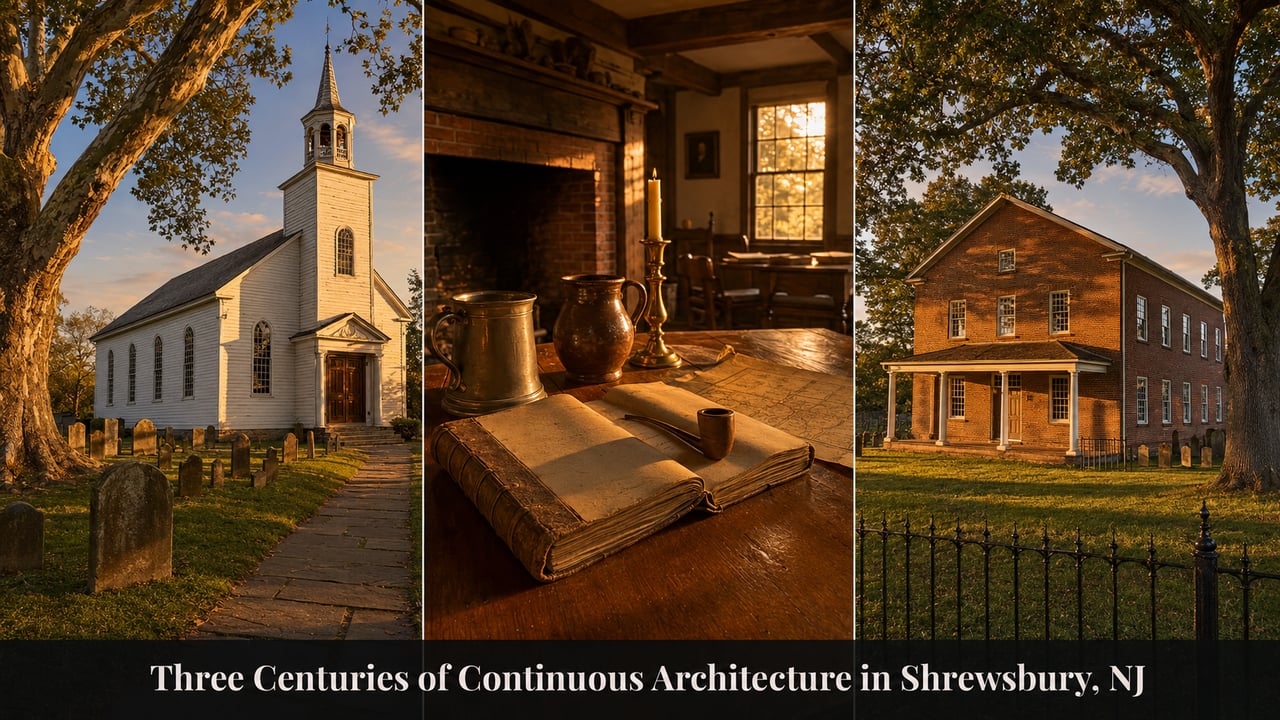
Shrewsbury, New Jersey is one of the most architecturally distinctive small boroughs in Monmouth County, and the reason has nothing to do with what's on the market this week. It has to do with what has stood at the corner of Broad Street and Sycamore Avenue since the 1670s, and what has been built around it in the three and a half centuries since. The borough covers just 2.2 square miles along Route 35 in the heart of Monmouth County's coastal corridor.1 The 2020 U.S. Census recorded a population of 4,184 — the highest decennial count ever, and a 9.8 percent increase from 3,809 in 2010. The borough's name comes from Shrewsbury, England, and the township was settled in 1665 as part of the original Navesink Patent or Monmouth Tract granted soon after the creation of East Jersey — making Shrewsbury the second-oldest town in Monmouth County after Middletown.2
What sets the borough apart from almost any other 2.2-square-mile community in New Jersey is the architectural continuum that survives within its borders. Most New Jersey suburbs were essentially built once — either in the late-19th-century railroad-suburb era, the early-20th-century streetcar era, or the postwar mid-century tract-development era. Shrewsbury is one of the rare places in the state where buildings from before the Declaration of Independence still stand, in active use, alongside buildings from every subsequent era. The Quaker Meeting House has occupied its present site since 1672. Christ Church Episcopal has held services in its 1769 building, designed by master architect Robert Smith, for more than 250 years. The Allen House at 400 Sycamore Avenue dates to circa 1710. And the surrounding residential housing stock spans from late-18th-century colonials to 19th-century farmhouses to mid-century ranches to modern construction — all coexisting within a borough that buyers can walk across in less than an hour.
This piece is the foundational architectural-heritage guide to Shrewsbury, NJ — the Historic Four Corners that anchors the borough's identity, the school district that shapes its family-buyer demand, the lifestyle infrastructure that has grown around the historic district, and the relationship to the surrounding towns of Red Bank, Little Silver, Tinton Falls, and Eatontown. For prospective buyers actively in the Shrewsbury market or evaluating current property values, refer to Prodigy's Shrewsbury homes for sale page for current listings and address-specific market data. This piece is the brand-and-context companion to that conversion-focused resource. Subsequent Prodigy pieces will extend the analysis into each adjacent municipality, building a complete picture of the central Monmouth County corridor.
The defining feature of Shrewsbury is the Historic Four Corners — the intersection of Broad Street and Sycamore Avenue. The Shrewsbury Historic District was added to the National Register of Historic Places in 1978, and is also designated as a State Historic District. Four buildings stand at the intersection, each with its own continuous history dating back to the colonial era. Together they represent one of the most concentrated pockets of surviving pre-Revolutionary American architecture and continuous religious community anywhere in New Jersey.4
The Shrewsbury Friends Meeting House is the oldest of the Four Corners institutions. Quaker meetings were held in members' homes before founder George Fox visited Shrewsbury in 1672 and noted in his journal that a meeting house was being constructed. The current building, the second on the present site, was built in 1816. The Shrewsbury Friends played a documented and significant early role in the abolition of slavery in the United States, a history covered in detail in Rick Geffken and Don Burden's The Story of Shrewsbury Revisited, 1965-2015.
Christ Church Episcopal at 380 Sycamore Avenue was organized in 1702 by Anglican missionary Reverend George Keith and received a royal charter from King George II in 1738 that remains on display in the church. The current building, designed by master architect Robert Smith, was constructed in 1769 and added to the National Register of Historic Places on October 25, 1995. The church was used as a barracks during the Revolutionary War (a bullet hole remains in the steeple gilt ball, and a musket ball is embedded in the original pulpit). The bell tower, called Eli, was added in the mid-18th century and still chimes the hour for local residents. The church library holds a 1716 "Vinegar" Bible and a communion service donated by Queen Anne. Many Monmouth County founders are buried in the surrounding graveyard, with the earliest legible grave marker dated 1719.
The Presbyterian Church traces its history to 1685, when Scottish Presbyterians who settled the area worshipped in members' homes. The congregation was formally organized in 1705 when John Boyd was licensed to preach in Shrewsbury — the first minister ordained by the first presbytery in the United States. The first church was erected in 1735. The Reverend Charles McKnight, a staunch patriot, lent church funds to the Continental government during the Revolutionary War; the original church burned in 1800, and the current building was completed in 1822 with the bell tower added in 1840.
The Allen House at 400 Sycamore Avenue was built around 1710 as a second residence for the Stillwell family of New York — Richard, a wealthy merchant, his wife Mercy, and their eight children. After the Stillwells died, their heirs sold the property to Josiah Halstead in 1754, who transformed the house into the Blue Ball Tavern, "the most noted tavern in Shrewsbury." The Vestry of Christ Church held meetings there, as did the Shrewsbury Library Company and the Monmouth County Circuit Court. In June 1779 a Loyalist raiding party led by Joseph Price and Richard Lippincott attacked the tavern where 12 Continental soldiers from Colonel Benjamin Ford's Virginia Regiment were quartered — killing three and capturing nine, in what would become known as the Allen House Massacre. The house operated as a pharmacy, medical practice, teahouse, dry goods store, and antique shop in the 19th and 20th centuries before being acquired by the Monmouth County Historical Association in 1968.5
Each December, the four institutions jointly host the Holiday Lantern Tours of the Historic Four Corners — a Monmouth County Historical Association-organized event with first-person reenactment storytelling, period music, and refreshments. The tours leave from Christ Church and rotate through all four buildings. For visitors and prospective residents, the Lantern Tours are the most accessible introduction to the depth of Shrewsbury's continuous occupied history.
When buyers tell me they are looking for a Monmouth County town with genuine character, I usually start by asking if they have ever stood at the corner of Broad Street and Sycamore Avenue. Three hundred fifty years of continuous community life sits at one intersection. Most New Jersey suburbs cannot make that claim. Shrewsbury can.
Shrewsbury operates a notably simple K-12 school structure. The Shrewsbury Borough School District is a single-school district serving pre-kindergarten through 8th grade. All Shrewsbury Borough School students attend the Shrewsbury Borough School at 20 Obre Place. As of the 2024-25 school year, the school enrolled 443 students with 52.0 classroom teachers (FTE basis), for a student-teacher ratio of 8.5:1 — one of the lowest in Monmouth County. Per Niche, 73 percent of Shrewsbury Borough School students achieve math proficiency (vs. New Jersey state average of 38 percent) and 74 percent achieve reading proficiency (vs. NJ state average of 49 percent). Per Public School Review, the district's per-pupil spending of $22,124 sits below the New Jersey state median of $25,837. The district has been classified by the New Jersey Department of Education in District Factor Group "I", the second-highest of eight socioeconomic groupings statewide.6
Two recent developments matter for prospective family buyers. First, in August 2025, the Shrewsbury Borough School completed a $22.5 million capacity expansion funded by a 2022 voter-approved referendum. The expansion added a dedicated pre-K wing, an all-purpose room, upgraded security features, and new playground facilities, with capacity for up to 100 additional students. The expansion was driven in part by anticipated enrollment surges from regional commercial development, including activity tied to the Netflix Studios project at the Fort Monmouth redevelopment site in nearby Oceanport (covered in detail in Prodigy's Oceanport Netflix Effect piece). Second, in April 2025, the Shrewsbury Board of Education appointed Rick Cohen as the next Superintendent-Principal, with Cohen assuming leadership on July 1, 2025.
For grades 9-12, Shrewsbury Borough students attend Red Bank Regional High School at 101 Ridge Road in Little Silver, a regional school operated by the Red Bank Regional High School District. RBR was formed in 1969 by voters in Little Silver, Red Bank, and Shrewsbury, and the current 53.4-acre Little Silver campus opened in 1975. The school currently enrolls approximately 1,261 students with a 10.1:1 student-teacher ratio (NCES 2024-25). RBR carries strong recognition: it has been named one of Newsweek's "America's Top High Schools" three times since 2008, was approved as an International Baccalaureate (IB) school in 2009, was designated a New Jersey Model School for the Arts the same year, and was recognized as a High Performing District by the New Jersey Department of Education in 2011. The school's specialized programs include the acclaimed Academy of Visual and Performing Arts, the Academy of Information Technology, the Academy of Finance, Engineering, and Graphic Communications, and the Early Childhood Education Academy.7
Shrewsbury holds two seats on the nine-member RBR Board of Education, with five seats allocated to Red Bank and two to Little Silver. The seats are population-weighted. For private school options, Christian Brothers Academy and Red Bank Catholic High School both serve as regional alternatives within commutable distance.
Outside the Four Corners institutional core, Shrewsbury's residential housing stock is unusually varied for such a small footprint. The architectural range reflects the borough's three centuries of continuous occupation rather than a single era of suburban tract development. Walking south from the Broad Street and Sycamore Avenue intersection, a buyer encounters mid-19th-century vernacular farmhouses, late-Victorian and Queen Anne homes from the 1880s and 1890s, early-20th-century Craftsman bungalows and Colonial Revivals, mid-century ranches and capes from the postwar decades, and modern infill construction completed within the past 20 years. The 1978 National Register-designated Shrewsbury Historic District covers the heart of this corridor, with mid-19th-century buildings most prevalent inside the district boundary.
For prospective buyers, the practical implication is that Shrewsbury inventory does not behave like a single-product market. Listings span 2-to-3-bedroom ranches, winterized bungalows, mid-19th-century farmhouses, restored Victorians, classic Colonial Revivals, and 10+ room modern colonials priced well above $1 million. The Shrewsbury Historic District’s 1978 National Register designation has helped protect the historic core from large-scale teardown-and-replace activity, while areas outside the district boundary have absorbed both renovation and new construction at a more typical Monmouth County pace.
Two structural facts shape any Shrewsbury home search. First, the 2.2-square-mile borough has a small total housing inventory — typically just a handful of homes for sale at any given moment, sometimes only one or two single-family listings active simultaneously. Tight inventory means well-priced listings clear quickly, and offer construction in Shrewsbury typically requires the same multi-bid discipline used in higher-volume markets like Red Bank or Long Branch. Second, the buyer pool is overwhelmingly professional and credentialed: 65.47 percent of Shrewsbury adults hold a four-year college or graduate degree (vs. 21.84 percent nationally), and 94.79 percent of the workforce is employed in white-collar jobs — a demographic concentration that supports premium pricing across the architectural spectrum, from mid-century ranches to modern colonials.
For current Shrewsbury home listings, recent comparable sales, address-specific valuation data, and active market metrics including median sale price, average sale price, days on market, and year-over-year price change, refer to Prodigy's dedicated Shrewsbury, NJ homes for sale page. This piece is the architectural-heritage companion to that real-time market resource.
Shrewsbury's lifestyle infrastructure punches well above what buyers expect from a 2.2-square-mile borough. Two major shopping destinations sit off Broad Street: The Grove at Shrewsbury, an upscale outdoor mall featuring Banana Republic, Sephora, Anthropologie, and similar mid-to-luxury retail; and Shrewsbury Plaza, anchored by Marshalls and other practical retail. The combination is unusual — few small Monmouth County boroughs have both a destination shopping center and a working everyday plaza within their borders.
Sycamore Avenue, lined with award-winning sycamore trees that the borough has consciously preserved, runs east-west through town and forms the backbone of the residential and historic district. Manson Park serves as the primary recreational hub for the borough, with facilities for baseball, basketball, tennis, and a community garden. Since summer 2024, Manson Park has also hosted the borough's summer concert series featuring local bands — an initiative championed by current Mayor Kimberly Eulner, a Shrewsbury Borough School and Red Bank Regional High School alumna who took office in January 2024 after serving in the New Jersey General Assembly representing the 11th Legislative District. The 9/11 Memorial sits across the street from the Municipal Center.
For dining, the Americana Diner has been a Shrewsbury anchor for breakfast and lunch traffic, and Albariño Tapas & Wine Bar serves a more contemporary dinner crowd. Route 35 along the borough's eastern edge provides additional dining and retail options that residents access regularly. The borough's small footprint means most daily errands can be handled by walking or short drive within Shrewsbury, with broader Monmouth County options easily accessible via Route 35, Route 18, or the Garden State Parkway.
For NYC commuters, Shrewsbury residents typically access NJ Transit's North Jersey Coast Line via the nearby Little Silver station (about 1.5 miles east) or the Red Bank station (about 2 miles north), both with direct service to Newark Penn and connections to NY Penn Station. Total commute time runs roughly 75 to 90 minutes depending on time of day. Seastreak ferry service from Atlantic Highlands is also accessible by car, providing a direct commute option to the Wall Street and Midtown ferry terminals.
Shrewsbury sits at the geographic and lifestyle center of a cluster of distinct Monmouth County towns. Each adjacent municipality offers a different value proposition, and most buyers run an explicit comparison across at least two or three of them before committing. Understanding the relationship between Shrewsbury and its neighbors is fundamental to making an informed decision.
Red Bank (north): Approximately 2 miles north of Shrewsbury, Red Bank is the commercial and cultural center of the cluster. The Red Bank market is significantly larger and more transit-oriented, with the Red Bank NJ Transit station, the Count Basie Theatre, the Two River Theater, and a substantial restaurant and retail downtown. The 25-acre Red Bank Train Station Redevelopment District — with planned 350 to 400 apartments and mixed-use buildings — will reshape the downtown over the coming years. Pricing in Red Bank runs lower than Shrewsbury at the median, but with much wider variation by submarket. Detail in Prodigy's Red Bank market piece.
Little Silver (east): Approximately 1.5 miles east of Shrewsbury, Little Silver is the home of Red Bank Regional High School at 101 Ridge Road and the Little Silver NJ Transit station. The borough is a popular family-buyer destination with a similar demographic profile to Shrewsbury, but with NJ Transit train station walkability that Shrewsbury lacks. Little Silver pricing typically runs comparable to or slightly above Shrewsbury at the median, with a similar architectural mix.
Tinton Falls (west): Tinton Falls is meaningfully larger than Shrewsbury (over 17,000 residents vs. Shrewsbury's 4,184) and has a more suburban, less walkable character. Pricing typically runs below Shrewsbury at the median, with more inventory and a wider range of housing types including townhomes and newer-construction subdivisions. Tinton Falls residents attend Monmouth Regional High School rather than RBR.
Eatontown (south): Eatontown is the major retail and commercial hub of the southern cluster, anchored by Monmouth Mall (which is being substantially redeveloped over the coming years) and significant Route 35 commercial frontage. The borough is also part of the broader Fort Monmouth redevelopment footprint — the Netflix Studios project sits primarily in Eatontown and Oceanport. Pricing runs significantly below Shrewsbury, and the buyer profile is more mixed.
For buyers weighing the broader Monmouth County coastal market, Prodigy's Long Branch market piece, Middletown market piece, and Rumson luxury deep-dive document the surrounding markets in detail. Forthcoming Prodigy pieces will extend this analysis with dedicated Tinton Falls, Eatontown, and Little Silver foundational guides — building a complete picture of the central Monmouth County corridor.
The buyers who succeed in Shrewsbury understand they are buying into a small, tight, historically distinctive borough with limited inventory — not a high-volume suburban market with predictable selection. The compensation for the smaller inventory is the borough's combination of small-school education quality, historic-district character, and central-corridor commute access that almost no other 2.2-square-mile market in New Jersey can match.
1. Borough land area (2.17 sq mi land + 0.03 sq mi water = 2.2 sq mi total), 2020 U.S. Census population (4,184), 2024 estimate (~4,052), borough incorporation March 22, 1926 from portions of Shrewsbury Township via referendum May 11, 1926: U.S. Census Bureau; Wikipedia, Shrewsbury, New Jersey (en.wikipedia.org/wiki/Shrewsbury,_New_Jersey).
2. 1665 Navesink Patent / Monmouth Tract settlement, second-oldest town in Monmouth County, name derived from Shrewsbury, England: Wikipedia; Rick Geffken and Don Burden, The Story of Shrewsbury Revisited, 1965-2015; Two River Times.
3. Shrewsbury demographic profile (65.47% college-educated vs. 21.84% national average, 94.79% white-collar workforce): NeighborhoodScout (neighborhoodscout.com/nj/shrewsbury); World Population Review 2026 (worldpopulationreview.com/us-cities/new-jersey/shrewsbury). For active Shrewsbury market data including median sale price, average sale price, list price, days on market, and year-over-year change, refer to Prodigy's dedicated Shrewsbury homes-for-sale page.
4. Shrewsbury Historic District added to National Register of Historic Places in 1978, also designated as State Historic District; four institutions at intersection of Broad Street and Sycamore Avenue: Quaker Meeting House (first 1672, current building 1816), Christ Church Episcopal (organized 1702 by Rev. George Keith, royal charter from King George II 1738, current building 1769 designed by master architect Robert Smith, individually added to NRHP October 25, 1995, reference #95001184), Presbyterian Church (organized 1705 with John Boyd as first US-ordained presbytery minister, first church 1735, current building 1822 with bell tower 1840), Allen House / Blue Ball Tavern (built ~1710, NRHP): Living Places (livingplaces.com/NJ/Monmouth_County/Shrewsbury_Borough/Shrewsbury_Historic_District); Wikipedia, Christ Church (Episcopal) Shrewsbury (en.wikipedia.org/wiki/Christ_Church_(Episcopal),_Shrewsbury); The Journal Magazines.
5. Allen House / Blue Ball Tavern: built ~1710 by Stillwell family of New York; Josiah Halstead acquired 1754 and operated as Blue Ball Tavern; June 1779 Loyalist raid led by Joseph Price and Richard Lippincott against 12 Continental soldiers from Col. Benjamin Ford's Virginia Regiment, killing three and capturing nine; acquired by Monmouth County Historical Association 1968; located at 400 Sycamore Avenue: Wikipedia, Allen House Shrewsbury (en.wikipedia.org/wiki/Allen_House_(Shrewsbury,_New_Jersey)); Revolutionary War New Jersey (revolutionarywarnewjersey.com); Monmouth Timeline (monmouthtimeline.org/timeline/allen-house-massacre).
6. Shrewsbury Borough School District metrics (single-school district, PreK-8, 20 Obre Place, 443 students 2024-25, 52.0 FTE teachers, 8.5:1 student-teacher ratio, District Factor Group "I" second-highest of eight; per Niche math 73% / reading 74% proficiency vs. NJ state averages 38% / 49%; per Public School Review per-pupil spending $22,124 vs. NJ state median $25,837); $22.5M August 2025 expansion (PreK wing, all-purpose room, security upgrades, playgrounds, capacity for up to 100 additional students, funded via 2022 voter-approved referendum); Superintendent-Principal Rick Cohen appointed April 15, 2025, started July 1, 2025: Wikipedia, Shrewsbury Borough School District (en.wikipedia.org/wiki/Shrewsbury_Borough_School_District); Shrewsbury Borough School (sbs.k12.nj.us); Niche; Public School Review.
7. Red Bank Regional High School District: 1969 formation, 53.4-acre Little Silver campus opened 1975, current address 101 Ridge Road Little Silver, 1,261 students 2024-25, 10.1:1 student-teacher ratio, accredited by Middle States Association since 1928, IB program since 2009, NJ Model School for the Arts 2009, NJ DOE High Performing District 2011, three-time Newsweek "America's Top High Schools" since 2008; Academies of Visual and Performing Arts, Information Technology, Finance, Engineering, Graphic Communications, Early Childhood Education; constituent sending districts Little Silver, Red Bank, Shrewsbury; 9-member Board of Education with seats allocated 5 Red Bank / 2 Little Silver / 2 Shrewsbury: Wikipedia, Red Bank Regional High School (en.wikipedia.org/wiki/Red_Bank_Regional_High_School); RBR official site (rbrhs.org); NCES Public School Search.
This piece is the architectural-heritage and brand-context guide to Shrewsbury, NJ. For active market data including current home listings, recent comparable sales, median and average sale prices, days on market, and year-over-year change, refer to Prodigy's dedicated Shrewsbury homes-for-sale page. Prospective buyers should consult a licensed New Jersey broker for property-specific valuation analysis.

Prodigy Real Estate is an innovative real estate company offering high-end video production, home valuation services, purchasing, and home sales. Serving New York and New Jersey.