
Anthony Licciardello | April 24, 2026
Oceanport, NJ
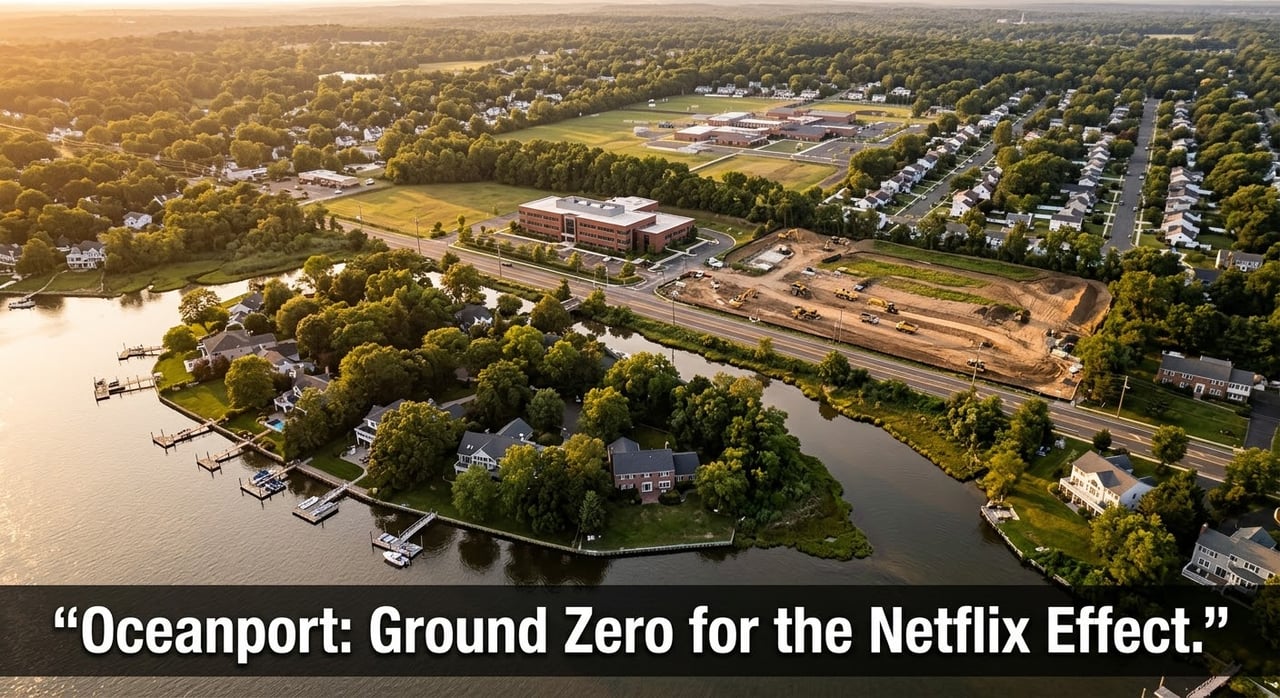
Oceanport is not a big town. It's a tiny peninsula of roughly 6,150 residents at the 2020 Census — about 6,540 by the Census Bureau's 2025 estimate — sitting on the Shrewsbury River, with water on three sides and one of the stronger K–8 districts in the county. It is also the host town for Phase 1A of Netflix's Fort Monmouth studio. The Netflix effect here is real. The headline numbers circulating online are not.
Oceanport hosts Phase 1A of Netflix's Fort Monmouth studio — four soundstages on the roughly 29-acre McAfee parcel, topped off on June 23, 2026 and on track for summer 2027, with Phase 1B in Eatontown targeted for fall 2028 and total investment now described as roughly $1 billion. A 30-year PILOT agreement brings the borough roughly $66 million, plus a separate $3 million Community Benefit payment — an easing of future tax pressure, not a tax cut. The market is strong but small: typical home values sit in a $760K–$840K band (corroborated) and closed-sale medians in a $950K–$1.15M band (indicative), at roughly two months of supply. Single-month headlines of 17.8% or 23% gains are noise in a town where four to ten homes close a month. Netflix didn't create Oceanport's demand — it added a new buyer group on top of it, and flood exposure, buildout traffic and asks that already assume the premium are the risks to price in.
You've probably seen headlines claiming Oceanport median prices are up 17.8% year-over-year, or 23%, or even higher. Be careful. Oceanport has about 2,470 housing units total (2020 Census), and in a typical month only four to ten homes actually close. One waterfront Port-Au-Peck estate selling at $1.6 million can swing the monthly median by $200,000 or more. Two ranch homes on Driftwood Circle closing at $600K each can pull it right back down. So this report publishes the market as graded bands, not a single number — and starts with the studio itself.
Phase 1A lands on the roughly 29-acre McAfee parcel, which sits almost entirely in Oceanport, with about three acres shifted over from Eatontown under the Fort Monmouth reuse plan. The program: four soundstages, a mill building, two support and office buildings, and a warehouse, all inside a perimeter wall. The Oceanport Planning Board approved the Phase 1A site plan unanimously in late November 2024.
Why Oceanport first, rather than Eatontown? Because the McAfee Center was already standing. The red brick research building, nearly three decades old and roughly 90,000 square feet, is being renovated into the campus operations and production-office hub rather than demolished, which saves Netflix real schedule time. It is a fitting reuse for a post whose Signal Corps labs ran Project Diana's 1946 moon radar experiment.
Four soundstages, a mill building and the McAfee Center production offices. Topped off June 23, 2026; on track per Netflix.
Eight more soundstages.
Roughly 79 acres along Parkers Creek, zoned for studio use under Amendment 20 — backlots, basecamps and support space, alongside protected open space.
Construction is well underway. Netflix held a topping-off ceremony on June 23, 2026, setting the final structural beam on Stages 3 and 4, and the company says Phase 1A remains on track for summer 2027, with Phase 1B in Eatontown targeted for fall 2028. Total investment is now described as roughly $1 billion.
And the relationship doesn't end at four stages. Phase 2 sits in Oceanport too, on roughly 79 acres in the Gooseneck / 400 Area along Parkers Creek, zoned for studio use under Amendment 20 to the Fort Monmouth Reuse and Redevelopment Plan.
Approximate acreage. Source: Fort Monmouth Reuse and Redevelopment Plan, including Amendment 20; Oceanport Planning Board Phase 1A approval.
Oceanport and the Netflix Effect.
On December 4, 2025, the Oceanport Borough Council voted to approve a 30-year Payment in Lieu of Taxes agreement with Netflix. The next day, Netflix closed on its purchase of the Fort Monmouth Mega Parcel.
Under the agreement, Netflix will pay Oceanport approximately $64.8 million over 30 years. Adding the required administrative fee brings the total to roughly $66 million, with the county receiving its statutory 5% share. Separately, Netflix is contributing a $3 million Community Benefit payment. The first PILOT payment lands in 2027, timed to Phase 1A's operational opening.
Source: Oceanport Borough Council approval of the 30-year PILOT agreement, December 4, 2025. The county receives its statutory 5% share.
The mayor's rationale is straightforward: a fixed payment schedule insulates the borough from volatile streaming economics. The payments continue for the full term even if Netflix were to sell the campus. For a borough of about 6,500 residents with a limited tax base and high fixed costs, that predictability matters.
Don't expect a tax cut. Waterfront estates already carry six-figure annual property tax bills, and the PILOT won't erase that. What it does is ease pressure on future residential tax increases by funding operations and capital projects from a non-residential source. Over time, slower tax growth is one more support for resale values.
Headlines claiming 17.8% or 23% year-over-year gains describe single months in a very thin market. With about 2,470 housing units (2020 Census) and only four to ten closings in a typical month, one $1.6 million Port-Au-Peck waterfront sale can move the monthly median by $200,000 or more. So instead of a single number, here is the market as a set of bands, each graded by how well independent sources agree.
US Census ACS 2020–24; Zillow Home Value Index; ATTOM.
Homes.com; Berkshire Hathaway HomeServices market data.
Homes.com; active-listing review.
Homes.com; Berkshire Hathaway HomeServices; listing history since late 2024.
The gap between the value band and the closed-sale band isn't a contradiction. Value indexes estimate the whole housing stock, including modest inland homes that rarely trade; closed-sale medians reflect what actually sold, and in Oceanport that mix leans toward larger and waterfront homes. Either way, the picture is a strong, tight seller's market at roughly two months of supply, not a runaway one.
Market figures in this post are published as bands, not single-point estimates, because portal data for a town this small moves sharply with only a handful of closings. Each band is built from at least two independent sources and graded on a five-step scale:
Tied to closed MLS or public-record transactions and confirmed by an independent source.
Two or more independent sources agree within the band.
Sources point the same direction but differ in method, timing or sample size.
A single source or thin sample; useful for trend, not price.
Not enough data to publish a band.
Sources: US Census Bureau QuickFacts (ACS 2020–2024 median owner-occupied value), Zillow Home Value Index (April 2026 reading), ATTOM property data, Homes.com and Berkshire Hathaway HomeServices market pages (reviewed October 2026). Bands are estimates, not appraisals; a specific home's value depends on its location, condition and comparable sales.
Monthly medians are noise. The things that actually drive value here haven't changed:
Only 3.17 square miles of land, with water on three sides. There is very little room for new construction.
The Oceanport School District — Wolf Hill pre-K–4, Maple Place 5–8, then Shore Regional for high school — consistently rates in the top tier of New Jersey districts.
NJ Transit's North Jersey Coast Line stops nearby in Little Silver and Long Branch, putting New York Penn Station roughly 80–95 minutes away, with seasonal service at Monmouth Park.
Netflix didn't create Oceanport's demand. It added a new buyer group on top of demand that was already there.
Oceanport's pockets price very differently — from Blackberry Bay Lagoon estates with 400-foot bulkheads to ranch homes near Monmouth Park Racetrack.
Covers roughly half of Oceanport's land area and holds most of its waterfront inventory, north of the NJ Transit tracks. It's the town's signature address, and listings there have started to mention proximity to the Netflix campus.
The northeast waterfront enclave. The 400 Area next door was once slated for a 236-home residential development under the old Oceanport village-center plan; that was shelved when the parcel was folded into Netflix's Mega Parcel for Phase 2. Pulte's Parkers Creek townhomes have sold out, with end units closing in the low-to-mid seven figures.
A tightly held waterfront pocket with very few turnovers. Prices run from roughly $525,000 for inland homes to $3 million-plus for Blackberry Bay Lagoon waterfront estates with 400-foot bulkheads.
Oceanport's most accessible entry points, near Monmouth Park Racetrack. Ranch homes in the $600K–$850K range, a short drive from the campus.
The 400 Area was once slated for a 236-home residential development. Folding it into Netflix's Mega Parcel for Phase 2 shelved that plan — in a town with only 3.17 square miles of land and very little room for new construction.
Four to ten closings a month, and one waterfront sale can move the median by $200,000. A single "Oceanport median" is not a price for your home.
Well-priced homes move quickly in Oceanport; ambitious asks sit, collect days on market and usually end in a price cut — and some asks in Port-Au-Peck and interior Oceanport already assume a Netflix premium. We'll price your home to real comparables, not headlines, and put it in front of the buyers who are actually moving here. Dual-licensed in New York and New Jersey.
Netflix-linked demand is still small, because Phase 1A doesn't open until summer 2027. Netflix posted its first operational job listings for the campus in late February 2026, including a Director of Studio Operations ($420,000–$790,000) and a Manager of Studio Site and Services (up to roughly $320,000). The hires made this year, and the handful that follow, are the first wave of what Oceanport will see.
Port-Au-Peck waterfront, Gooseneck, Blackberry Bay.
Interior Port-Au-Peck, Driftwood, upper Main Street.
Elkwood Park, Main Street corridor, Oceanport rentals.
Anywhere in-district, prioritizing schools and yard. Still the bulk of today's buyers.
That last group matters most. Commuter and family demand was carrying this market before Netflix arrived, and it still makes up the bulk of today's buyers.
Roughly 55% of properties in Oceanport carry a major 30-year flood risk per First Street Foundation modeling. That shows up in insurance premiums, lender requirements and, eventually, in price. Check every address's flood zone and elevation certificate before you fall in love.
Traffic and infrastructure during buildout. Oceanport Avenue and the roads around the McAfee parcel face years of construction and production traffic, with Phase 1A finishing in summer 2027 and Phase 1B in Eatontown targeted for fall 2028. A roughly $1 billion construction project wrapping up inside and beside the borough's borders is not a quiet neighbor.
The Netflix premium may already be priced in. Some sellers in Port-Au-Peck and interior Oceanport are asking prices that assume the premium. If the ramp-up runs slower than the 2027/2028 targets, or the streaming industry contracts, those asks are the first to get cut.
If you're buying, start with the fundamentals: which school boundary you're in, where the home sits in its neighborhood, proximity to water, flood zone classification, lot size and condition. Those will still matter in 2032, when the initial Netflix excitement has become the town's normal baseline. Netflix is a tailwind, not a thesis.
If you're selling, pricing right matters more than a splashy listing day. Well-priced homes move quickly in Oceanport; ambitious asks sit, collect days on market and usually end in a price cut. The sellers who win this year will price to recent sales of genuinely comparable homes, not to last quarter's headline.
Not to last quarter's headline, and not to an ask that already assumes the Netflix premium. Ambitious asks sit and usually end in a price cut.
School boundary, position in the neighborhood, proximity to water, flood zone, lot size and condition — the things that will still matter in 2032.
Roughly 55% of Oceanport properties carry a major 30-year flood risk, and it shows up in premiums, lender requirements and price.
Roughly $66 million over 30 years eases pressure on future residential increases; it does not erase six-figure waterfront tax bills.
$760K–$840K typical value (corroborated) and $950K–$1.15M closed-sale median (indicative) — not a single month's 17.8% or 23%.
For the broader Monmouth County picture, read our pillar analysis of the Netflix effect across the county, along with companion pieces on Red Bank's rapid market shift and Long Branch's luxury rental pipeline. For current listings and town data, see our Oceanport neighborhood guide.
Never price an Oceanport home off a monthly median. In a typical month only four to ten homes close, and one waterfront Port-Au-Peck estate selling at $1.6 million can swing that median by $200,000 or more — while two ranch homes on Driftwood Circle closing at $600K each can pull it right back down. That is how 17.8% and 23% headlines get written. Price to recent sales of genuinely comparable homes — same pocket, same relationship to the water, same flood zone, similar lot and condition — and use the graded bands only as a check on the whole market, never as a price for one house.
"The Netflix effect here is real. The headline numbers circulating online are not. Netflix didn't create Oceanport's demand — it added a new buyer group on top of demand that was already there, and commuter and family buyers still make up the bulk of it. Some asks already assume the premium, and if the ramp-up runs slower than the targets, those are the first to get cut. Netflix is a tailwind, not a thesis. The sellers who win this year will price to genuinely comparable homes, not to last quarter's headline."
— Anthony Licciardello, Broker, The Prodigy Team

Reading a municipal resolution and knowing what it means for the house across the street is what years inside local government teach you: I'm Anthony Licciardello, Broker of The Prodigy Team, dual-licensed in New York and New Jersey, a member of the Staten Island Growth Management Task Force, and a former Director of Community Affairs in the Bloomberg Administration.
We pair hyperlocal reporting like this with a digital reach built for the New York–to–New Jersey move: a YouTube channel with 400K+ views over the trailing year, a 26,500+ member relocation community on Facebook, and 17M+ Pinterest impressions. Our in-house drone series, Above the Streets, shows New Jersey towns from the air — the way relocating buyers first get to know them.
Anthony Licciardello · Broker, The Prodigy Team · 718-873-7345
We'll price your home to real comparables, not headlines, and put it in front of the buyers who are actually moving here.
Is Oceanport actually getting Netflix soundstages, or is it all in Eatontown?
Oceanport hosts Phase 1A: four soundstages, a mill building and the McAfee Center production offices, targeted to open in summer 2027. Eatontown gets Phase 1B, which adds eight more soundstages with a fall 2028 target. A later Phase 2 on Oceanport's Gooseneck / 400 Area adds backlots, basecamps and support space, alongside protected open space. Both towns are hosts; Oceanport is simply first.
How much are home prices really up in Oceanport because of Netflix?
It's hard to isolate. Oceanport was already a tight seller's market with limited inventory. Monthly median price swings of 15%–25% are common here because so few homes sell each month. Taken together, independent sources put typical home values in a $760K–$840K band and recent closed-sale medians in a $950K–$1.15M band. Prices are high, but the year-over-year change is smaller than single-month headlines imply.
Will the Netflix PILOT lower my property taxes in Oceanport?
Not directly. The agreement brings in $64.8 million in payments over 30 years plus administrative fees, with the total reaching roughly $66 million. That money supports borough operations and capital projects, which eases pressure to raise residential taxes. Don't expect a cut; expect taxes that may grow more slowly than they otherwise would.
Which part of Oceanport is closest to the Netflix campus?
The McAfee parcel sits in the central-western part of town. Port-Au-Peck homes east of the railroad tracks are a short drive or bike ride away, and the Pulte Parkers Creek townhomes sit directly next to the campus. Elkwood Park and the Main Street corridor are the most accessible price points that are still a quick trip to the studio.
The Netflix Effect on Monmouth County
Red Bank Real Estate Is Moving Fast
Long Branch Real Estate Market Report 2026
Oceanport Neighborhood Guide
Details as of October 17, 2026, from the sources noted, and subject to change. Studio schedules, municipal agreements and market conditions change; confirm current status directly with the Borough of Oceanport and the relevant agencies before relying on any of it. Nothing here is legal, planning, tax or investment advice. Population and housing per the 2020 Census (roughly 6,150 residents; about 2,470 housing units) and the Census Bureau's 2025 population estimate (about 6,540); land area of 3.17 square miles. Studio facts — the roughly 29-acre McAfee parcel, about three acres shifted from Eatontown under the Fort Monmouth reuse plan, the Phase 1A program of four soundstages, a mill building, two support and office buildings and a warehouse, the Oceanport Planning Board's unanimous Phase 1A site-plan approval in late November 2024, the June 23, 2026 topping-off of Stages 3 and 4, Netflix's statement that Phase 1A remains on track for summer 2027 with Phase 1B in Eatontown targeted for fall 2028, total investment described as roughly $1 billion, and Phase 2 on roughly 79 acres in the Gooseneck / 400 Area zoned for studio use under Amendment 20 to the Fort Monmouth Reuse and Redevelopment Plan — per Netflix and the Fort Monmouth reuse documents. PILOT terms per the Oceanport Borough Council's December 4, 2025 approval: approximately $64.8 million over 30 years, roughly $66 million with the required administrative fee, the county's statutory 5% share, a separate $3 million Community Benefit payment and a first payment in 2027; Netflix closed on the Fort Monmouth Mega Parcel the following day. Job postings per Netflix's late-February 2026 operational listings for the campus. Market bands per US Census Bureau QuickFacts (ACS 2020–2024 median owner-occupied value), the Zillow Home Value Index (April 2026 reading), ATTOM property data, and Homes.com and Berkshire Hathaway HomeServices market pages reviewed October 2026, graded under the Vortex Modeling Disclosure above; bands are estimates, not appraisals. Flood risk per First Street Foundation modeling. Schools are described only by program structure and published ratings. Household income, crime statistics and demographic composition data have been deliberately excluded, as we exclude such material for every community we cover. No prediction is made about the timing or scope of any studio phase, the PILOT's effect on any tax bill, or any effect on any property's value.
Prodigy Real Estate is an innovative real estate company offering high-end video production, home valuation services, purchasing, and home sales. Serving New York and New Jersey.