
Anthony Licciardello | July 21, 2026
Short Hills, NJ
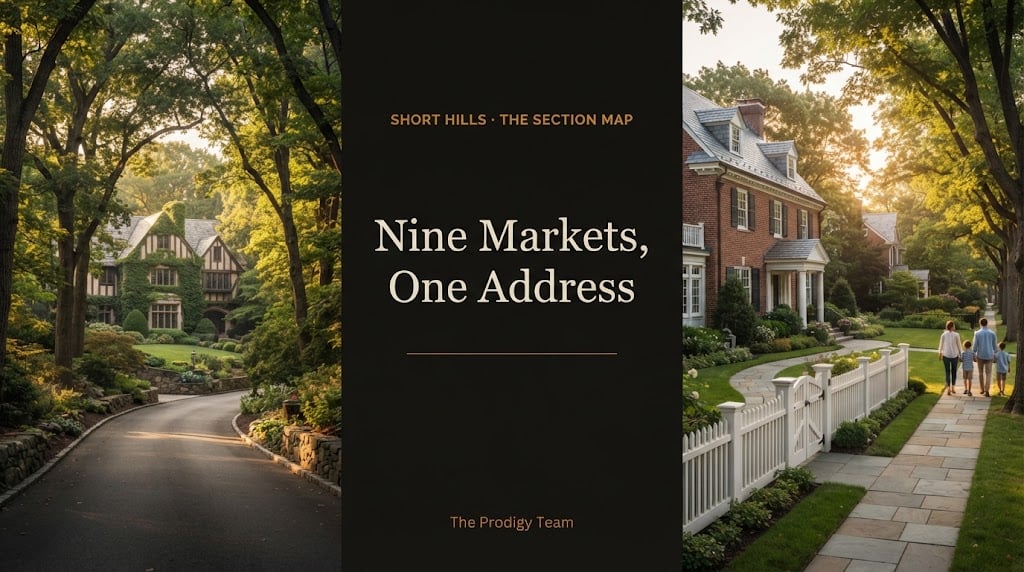
Millburn Township officially recognizes nine sections of Short Hills — and the market speaks an even richer dialect, with Poet’s Section, Fairfield Estates, and Woodfield in the listing language. A “Short Hills search” is really nine searches wearing one prestigious ZIP code: different lot logic, different walk radii, different architecture, different buyers. This is the map, section by section, and the framework for finding yours.
The township’s official map names nine Short Hills sections — Knollwood, Glenwood, Brookhaven, Country Club, Merrywood, Deerfield-Crossroads, Mountaintop, White Oak Ridge, and Old Short Hills Estates — and the working market adds its own vocabulary on top: Country Club doubles as the Poet’s Section, listing sheets invoke Fairfield Estates and Woodfield, and “Historic Old Short Hills” means the Hartshorn-era core around the National Register district. The sections sort into three broad bands: the station belt (Glenwood, Knollwood, and the historic park streets), the estate interior (Country Club through Old Short Hills Estates — the curving-road, wooded-lot, architect-designed heart), and the larger-lot edges (White Oak Ridge, Deerfield-Crossroads, Mountaintop).
The numbers confirm what the map implies: NeighborhoodScout places the Deerfield/Fairfield pocket’s median around $2.40 million with 100% detached single-family stock and 0.8% vacancy — a market with essentially no slack — while lots across the sections typically run 0.4 to 1 acre against Millburn-side streets where some parcels are 36 feet wide. Same township, same schools, same tax rate; profoundly different products. This guide walks the bands in order, then hands you the choosing framework.
Hartshorn’s 1874 plan guaranteed this outcome: a community designed pocket by pocket around glacial terrain was never going to become uniform, and a century and a half of development finished the differentiation. Today the sections trade like a stack of related-but-distinct micro-markets under one address — which is why this chapter of our complete Short Hills guide exists: to make sure the section you buy matches the life you’re buying it for.
Start with the official taxonomy — the township’s own materials name the nine sections above — then learn the dialect, because listings and locals use both: Poet’s Section for the Country Club area’s literary street names, Fairfield Estates and Woodfield for prized estate pockets, Historic Old Short Hills for the founder’s core. None of these are marketing inventions; they are the market’s finer-grained honesty about a place the official map paints in broader strokes.
The practical sort is by relationship to the two assets everything here prices against: the train and the land. The station belt trades walkability; the estate interior trades Hartshorn’s landscape; the edges trade acreage and separation. Same 2.019% tax rate across all of it — but what a dollar buys, and who is bidding against you, changes band by band.
Glenwood is where many Short Hills searches begin: the section oriented toward the station and downtown Millburn, with the township’s widest range of housing types and its most accessible entry points — the commuter’s section, where the walk to the platform is the headline amenity and the buyer pool skews toward households counting train seats. Knollwood rises from the same orbit into the Hartshorn-era fabric, adjoining the Short Hills Park Historic District — Hobart Avenue, Knollwood Road, The Crescent, Lake Road — where the National Register recognizes the founder’s romantic plan intact: houses on knolls, roads bent around terrain, the 1879 depot as the neighborhood’s front door.
The belt’s value logic is the township’s most straightforward: with parking gated to residency and capped even then, the five-to-twelve-minute walk radius is among the most reliably priced variables in the market, and the belt owns it. The trade-offs are the honest ones — smaller lots than the interior, more pedestrian and school-hour activity, and competition from every commuter-first buyer entering the market.
This is the Short Hills of the imagination — and of the township’s own 2026 planning literature, which describes the Woodfield/Old Short Hills Estates fabric as curving roads, wooded lots, and architect-designed homes in Tudor, Georgian, and Colonial Revival styles. Country Club — the Poet’s Section — Merrywood, Brookhaven, Mountaintop, and Old Short Hills Estates form the interior band: the brick center-hall colonials, the stone Tudors, and increasingly the high-spec rebuilds that arrive wherever empty lots don’t exist — here, builders buy the smallest house on the street, and the new construction inherits Hartshorn’s trees.
The interior’s market signature is scarcity wearing white gloves: in the Deerfield/Fairfield pocket NeighborhoodScout measures a median around $2.40 million, a stock that is 100% detached single-family, and 0.8% vacancy — a market with functionally nothing sitting idle. Buyers here are purchasing the landscape itself as much as any house on it, which is why interior listings trade on siting, canopy, and provenance in a way square-footage spreadsheets never capture — and why touring with someone who knows which streets carry which pedigree is worth real money.
White Oak Ridge and Deerfield-Crossroads are the larger-lot edges — the township describes them as siblings in zoning and topography, Deerfield-Crossroads with the steeper hills and wide streets, its older sections dating to the early 1940s — where the purchase is space and separation rather than platform proximity, and the 36-acre Gero Park complex (community pool, par-3 golf) anchors daily life. Two honest alternatives complete the picture: the condo and townhome layer — West Mill Garden, the Enclave at Short Hills, Short Hills Terrace — the address’s rare lower-maintenance doors; and the Millburn side itself, where the historic Wyoming district and South Mountain offer Victorians and Tudors on conventional streets — some lots just 36 feet wide — at entry points the Short Hills sections can’t match, with the identical schools and services.
The framework, then, is three questions asked in order. How many train seats a year? Daily commuters belong in the station belt; the seat-count math does the rest. Land or walk? The interior and edges sell Hartshorn’s landscape; the belt sells minutes — almost no address sells both cheaply. Entry point or endgame? Glenwood, the condo layer, and the Millburn side are the doors in; the interior is where the market’s equity concentrates. Same ZIP, same district, same tax mechanics — nine different answers. The right one is a biography question, not a real estate question, and it deserves a tour built around your actual life — beginning with the current Short Hills homes for sale read section by section.
“Out-of-town buyers ask me for “a house in Short Hills.” Short Hills buyers ask me for Knollwood, or the Poet’s Section, or ten minutes flat to the platform — because they’ve learned what the map already knows: this is nine markets in a trench coat. My first job isn’t finding you a house. It’s finding you your section.”
— Anthony Licciardello, Broker, The Prodigy Team
Every guide on this site is part of a system: town-by-town content clusters, dedicated neighborhood pages, and cross-state marketing engineered for one outcome — putting your listing in front of the motivated New York families already searching for it. I’m Anthony Licciardello, Broker of The Prodigy Team — a former Director of Community Affairs in the Bloomberg Administration and a member of the Staten Island Growth Management Task Force — and this pipeline is what 22 years and 5,000 closings taught me to build.
Our Above the Streets cinematic drone series extends that reach — aerial storytelling that markets entire towns, not just listings, with audience performance exceeding industry benchmarks for real estate media.
Anthony Licciardello · Broker, The Prodigy Team · 718-873-7345
Tell us your commute pattern, your land-versus-walk instinct, and your number — we’ll narrow nine sections to your two or three, and build the tour around them.
What are the neighborhoods of Short Hills, NJ?
Millburn Township officially recognizes nine Short Hills sections: Knollwood, Glenwood, Brookhaven, Country Club, Merrywood, Deerfield-Crossroads, Mountaintop, White Oak Ridge, and Old Short Hills Estates. The market adds its own vocabulary — the Country Club area is widely called the Poet’s Section, and names like Fairfield Estates and Woodfield appear in listing language for prized estate pockets.
Which Short Hills section is best for NYC commuters?
The station belt: Glenwood offers the strongest commuter orientation and the township’s widest range of housing types near downtown Millburn, while Knollwood and the Short Hills Park Historic District streets (Hobart Avenue, Knollwood Road, The Crescent, Lake Road) put the Hartshorn-era fabric within walking distance of the 1879 depot. With township parking gated to residents and capped, the walk radius is among the most reliably priced variables in the market.
What are the estate sections of Short Hills like?
The interior band — Country Club/Poet’s Section, Merrywood, Brookhaven, Mountaintop, and Old Short Hills Estates — matches the township’s own description: curving roads, wooded lots, and architect-designed homes in Tudor, Georgian, and Colonial Revival styles, increasingly joined by high-spec rebuilds. NeighborhoodScout places the Deerfield/Fairfield pocket’s median around $2.40 million with 100% detached single-family stock and 0.8% vacancy.
What are the most accessible ways into the Short Hills market?
Three doors: Glenwood’s wider housing range near the station; the condo and townhome layer (West Mill Garden, the Enclave at Short Hills, Short Hills Terrace); and the Millburn side of the township — the historic Wyoming district and South Mountain — where Victorians and Tudors on conventional lots offer lower entry points with the identical school district and township services.
Moving to Short Hills, NJ: The Complete Guide
The Short Hills Commute: Two Stations, One Seat
Short Hills, NJ Property Taxes: The 2017 Time Capsule
Westfield vs. Short Hills: The Million-Dollar Question
Official section names and Millburn-side composition per Millburn Township’s About the Township materials; estate-fabric description (curving roads, wooded lots, Tudor/Georgian/Colonial Revival) per the township’s 2026 Woodfield/Short Hills Estates planning literature; Deerfield-Crossroads character (zoning/topography kinship with White Oak Ridge, steeper hills, wide streets, early-1940s sections) per township descriptions as reported in local market guides. Deerfield/Fairfield pocket statistics (median ~$2.40M; 100% detached; 0.8% vacancy) per NeighborhoodScout. Short Hills Park Historic District streets per its National Register documentation. Market vocabulary (Poet’s Section, Fairfield Estates, Woodfield), housing-stock character, condo/townhome communities, typical 0.4–1 acre lots, and Millburn-side 36-foot lots per local realty and community guides. Gero Park facilities per township recreation materials. Section boundaries are customary rather than legal; verify any specific property’s context directly. This post is general information.
Prodigy Real Estate is an innovative real estate company offering high-end video production, home valuation services, purchasing, and home sales. Serving New York and New Jersey.