
Anthony Licciardello | July 20, 2026
Short Hills, NJ
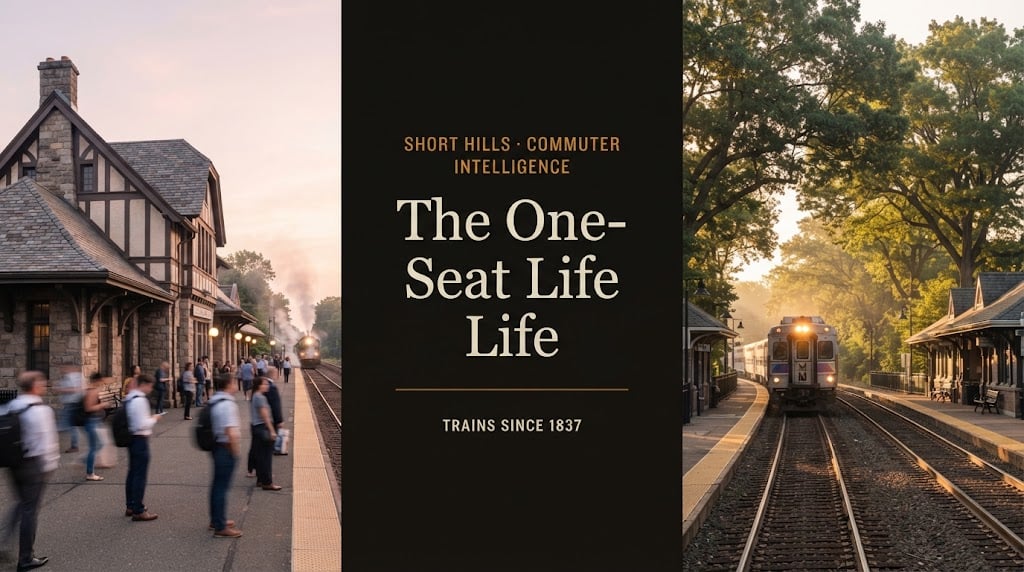
Stewart Hartshorn built the station before he sold the first lot — and a century and a half later, the commute is still the most valuable thing a Short Hills deed conveys. Two stations, one-seat Midtown Direct trains, fare zone 7, expresses to Penn in the low-to-mid 30s — and a parking regime so resident-protective the township literally offers non-residents nothing. The complete brief, from the 1837 rails to the door-to-door math.
The infrastructure: Millburn station (35 Essex Street) has hosted trains since the Morris & Essex’s first runs in September 1837; Short Hills station (225 Chatham Road) is Hartshorn’s own 1879 creation, rebuilt 1906–07, electrified in 1930, with the Millburn-Short Hills Historical Society’s museum inside it today. Both sit in NJ Transit fare zone 7 — recently about $10 one-way to Penn and near $300 monthly — with Midtown Direct one-seat service, peak trains roughly every 20 minutes per local guides, typical peak expresses in the 30–40 minute range, and Hoboken trains connecting to PATH for downtown.
The constraint: parking is resident territory, full stop. Commuter permits — issued through the Tax Office at Town Hall, resident-priority, recently published around $510 annually, with the most convenient lots reported to run waitlists — are the system; the township offers no non-resident day parking at the train lots at all, overnight parking is banned township-wide from 2 to 6 AM, and the one flexibility valve is a $10-a-day resident-sticker pay station at the Short Hills train lot. Which is why, here more than anywhere on the corridor, the walk to the platform is the product — and the pre-offer parking check is mandatory diligence.
The Short Hills commute is the rare amenity that predates the town it serves: the rails came in 1837, Hartshorn chose his 1,552 acres because of them, and he built the depot at his own expense two years before the post office he lobbied into it opened in 1880. This is the commute chapter of our complete Short Hills guide — the founding asset, read the way a relocating buyer actually needs it: service, fares, the parking rules the township enforces, and the honest door-to-door arithmetic.
Millburn station is the elder: trains have called at Essex Street since the Morris & Essex Railroad’s inaugural September 1837 service — among the first commuter runs in American history — though today’s building dates to a 1986–88 reconstruction after the original depot generations were lost. Short Hills station is the founder’s artifact: Hartshorn built it in July 1879 as the front door to his planned community, the handsome current depot rose in the 1906–07 rebuild, electrification arrived in December 1930 — and the building now houses the Millburn-Short Hills Historical Society’s museum, which is exactly the fate a station this central to a town’s identity deserves.
The scale is part of the luxury: roughly 988 average weekday riders at Short Hills and 1,164 at Millburn (2024) — village-station volumes, not terminal crowds. One honest accessibility note for buyers who need it: Short Hills’ two side platforms are not handicap-accessible; Millburn and neighboring stations are the answer for step-free boarding, and touring buyers with mobility needs should verify current station configurations with NJ Transit directly.
The service pattern is the corridor’s benchmark: Midtown Direct one-seat trains to New York Penn from both stations on the Morris & Essex Lines, with local guides putting peak-hour departures at roughly every 20 minutes (morning peak outbound, evening peak returning) and hourly service through the off-peak — verify the current timetable for your actual window, as NJ Transit updates schedules monthly. Typical peak expresses run in the 30–40 minute range to Penn; Hoboken-bound trains connect to PATH for Financial District commuters; and the two-station redundancy means most of the township has a genuine choice of platform.
The money: both stations sit in fare zone 7, with recent published fares around $10 one-way to Penn and monthly passes near $300 — confirm against NJ Transit’s current tables, and note most employers’ pre-tax commuter benefits apply. For corridor context: that zone-7 pricing and one-seat pattern is precisely the asset our Westfield-versus-Short Hills analysis prices against the Raritan Valley Line’s transfer — the commute is not a feature of the Short Hills premium; it is the largest single component of it. Millburn’s ticket office keeps weekday-morning-into-afternoon hours (6:00 AM–1:30 PM); machines handle the rest.
Schedules, headways, and fares change — NJ Transit revises timetables monthly and fare tables periodically, and not every train is an express. Before committing to a house on the strength of a specific commute, pull the current timetable for your actual departure window, confirm which runs are one-seat, and ride it once at your real hour. The twenty minutes you spend verifying is the cheapest diligence in a seven-figure decision.
Millburn’s parking regime is the most resident-protective on the corridor, and the township is refreshingly explicit about it. Commuter permits — issued through the Tax Office at Town Hall, linked to your license plate — are the backbone, with resident priority, published pricing recently around $510 annually (about $375 semi-annual), caps on permit counts, and waitlists reported for the most convenient lots. The township’s own FAQ states it plainly: there is no non-resident day parking at the train lots — outsiders are pointed to Summit or Maplewood. The flexibility valve for residents: a pay station at Lot 3, the Short Hills train lot, offering $10-per-day parking to holders of a resident sticker (card and app only), plus a 155-space commuter level on the parking deck by Millburn station.
Two rules to internalize before closing: overnight parking is prohibited township-wide — every street, every lot — from 2:00 to 6:00 AM, with a call to the police desk required even for a stranded-in-the-city commuter’s car; and permits transfer with plates, not families, so new residents should apply the week they establish residency. The strategic read is the same one we give in every permit-constrained town, amplified: either buy inside the walk radius and exit the parking economy entirely, or verify the current permit and waitlist status with the Tax Office before you write the offer — because here the township has designed the system so that residency is the only door in.
Do not model your commute on a permit you do not yet hold. Permit counts are capped, convenient lots have reported waitlists, and there is no non-resident fallback in town — a buyer who assumes a parking spot is assuming a fact not in evidence. One call to the Tax Office (and one to 973-275-5555 for station-lot specifics) before the offer prices the house correctly; discovering the answer after closing prices it painfully.
Price the commute the way you’ll live it. The honest all-in for a well-located household: a 5-to-12-minute walk or drive to the platform, a few minutes’ buffer, the 30-to-40-minute ride, and the Penn-to-desk walk — typically 45 to 65 minutes door-to-door, tightening toward 40–50 for the station-adjacent catching an express. That range is the corridor’s best, and it is also the honest denominator for the premium: as our Westfield comparison frames it, a daily commuter buys this asset roughly 480 times a year; a hybrid household, 100–150. The more seats you actually occupy, the more of the Short Hills premium is consumption rather than cost.
And the walk radius is where the market does its own pricing: with parking gated to residency and capped even then, proximity to the two platforms is among the most reliably priced variables in the township — a structural feature of the supply-constrained side of New Jersey’s split market, and one more reason the full carrying-cost math should be run street by street, not town by town. Hartshorn built the station first because he understood the order of operations. A century and a half later, the smart buyer’s diligence runs the same way: train, walk, parking — then the house, starting with the current Short Hills homes for sale mapped against the two platforms.
“In most towns I tell buyers the train adds value to the house. In Short Hills it’s the reverse — the house is your ticket to the train, and the township has quietly built the rules to keep it that way: resident permits, no outsider day parking, a walk radius the market prices to the block. Verify your parking before you bid. Here, that one phone call is worth more than the inspection.”
— Anthony Licciardello, Broker, The Prodigy Team
Every guide on this site is part of a system: town-by-town content clusters, dedicated neighborhood pages, and cross-state marketing engineered for one outcome — putting your listing in front of the motivated New York families already searching for it. I’m Anthony Licciardello, Broker of The Prodigy Team — a former Director of Community Affairs in the Bloomberg Administration and a member of the Staten Island Growth Management Task Force — and this pipeline is what 22 years and 5,000 closings taught me to build.
Our Above the Streets cinematic drone series extends that reach — aerial storytelling that markets entire towns, not just listings, with audience performance exceeding industry benchmarks for real estate media.
Anthony Licciardello · Broker, The Prodigy Team · 718-873-7345
Send us the listing — we’ll map the true walk to both platforms, check the current permit picture with the township, pull the timetable for your actual hours, and price what that address really buys you.
How long is the train from Short Hills to NYC?
Typical peak expresses reach New York Penn Station in roughly 30–40 minutes on one-seat Midtown Direct service from both the Short Hills and Millburn stations, with peak trains about every 20 minutes per local guides and hourly off-peak service. Realistic door-to-door — walk, buffer, ride, and the Penn-to-desk leg — runs about 45–65 minutes.
How much does the Short Hills commute cost?
Both stations sit in NJ Transit fare zone 7, with recent published fares around $10 one-way to Penn and monthly passes near $300 — confirm current numbers on NJ Transit’s fare tables. Drivers add the township commuter permit, recently published around $510 annually, or the $10-per-day resident pay-station option at the Short Hills train lot.
Can I park at the Short Hills or Millburn train stations?
Only realistically as a Millburn Township resident: commuter permits are issued through the Tax Office with resident priority, capped counts, and reported waitlists for convenient lots — and the township offers no non-resident day parking at its train lots. Overnight parking is prohibited township-wide from 2 to 6 AM. Verify the current permit and waitlist status before making an offer, or target a home within walking distance of either platform.
Why does Short Hills have such good train service?
Because the town was built around it: the Morris & Essex rails reached Millburn with the line’s first service in September 1837, and Stewart Hartshorn built Short Hills station at his own expense in 1879 as the front door to his planned community — the depot, rebuilt 1906–07 and electrified in 1930, now houses the local historical society’s museum. The one-seat Midtown Direct service is the modern inheritance of that founding decision.
Moving to Short Hills, NJ: The Complete Guide
Short Hills, NJ Property Taxes: The 2017 Time Capsule & the 2029 Question
Westfield vs. Short Hills: The Million-Dollar Question
How the New Jersey Housing Market Is Splitting in Two
Station facts per NJ Transit and documented station histories: Millburn (opened with September 1837 Morris & Essex service; rebuilt 1986–88; fare zone 7; 1,164 average weekday riders, 2024; ticket office 6:00 AM–1:30 PM weekdays) and Short Hills (opened July 1879 by Stewart Hartshorn; rebuilt 1906–07; electrified December 18, 1930; fare zone 7; 988 average weekday riders, 2024; side platforms not handicap-accessible; Historical Society museum on site). Parking rules per Millburn Township’s official parking pages and FAQ (permits via the Tax Office; Lot 3 resident $10/day pay station, card/app only; 155-space deck commuter level; no non-resident train-lot day parking; township-wide 2–6 AM overnight prohibition) and Explore Millburn-Short Hills; permit pricing (~$510 annual / ~$375 semi-annual) and ~20-minute peak headways per local guides — both change; verify with the township and NJ Transit. Fares per recent zone-7 published tables (~$10 one-way, ~$300 monthly); confirm current. Door-to-door estimates per local commuter guides. This post is general information; confirm all schedules, fares, and parking rules before relying on them.
Prodigy Real Estate is an innovative real estate company offering high-end video production, home valuation services, purchasing, and home sales. Serving New York and New Jersey.