
Anthony Licciardello | June 10, 2026
Scotch Plains, NJ
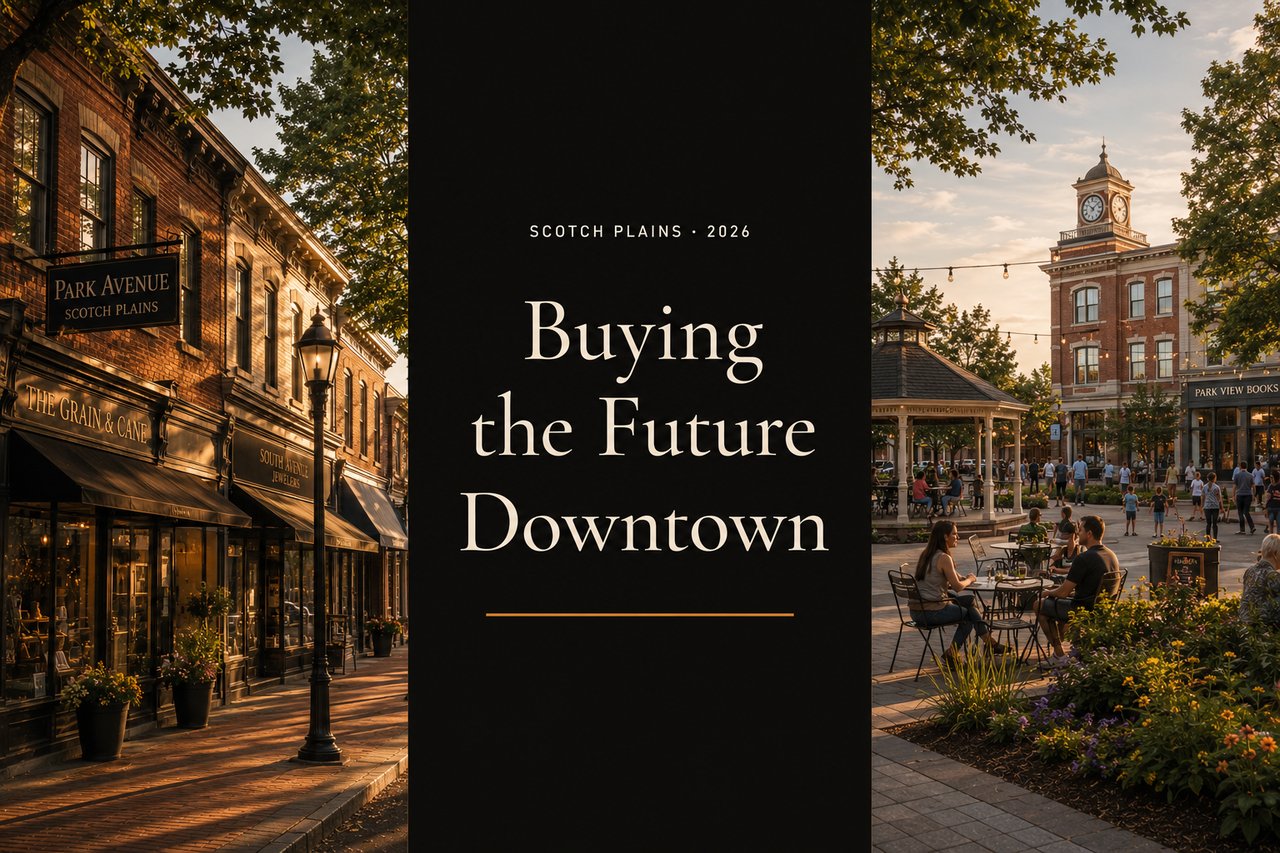
For the first time in decades, Scotch Plains has a concrete, publicly presented plan to rebuild the heart of its downtown. That changes the calculation for anyone buying within walking distance of Park Avenue. You are no longer just buying a house in a quiet Union County township — you are placing a bet on what that township looks like in 2030. This guide walks through what is actually being built, when, and how a careful buyer should price the difference between the downtown that exists today and the one on the drawing board.
The Argument in Brief
The redevelopment is real and detailed, but it is a seven-to-ten-year build-out, not a switch that flips on closing day. Buyers within a half-mile of Park Avenue are pricing against today’s downtown while living into tomorrow’s — which means a slightly longer hold horizon and explicit modeling of the 2027 revaluation are the two moves that protect your purchase. Done right, proximity to the new town square is a genuine long-term value driver. Done carelessly, you overpay today for walkability that is still years out.
At the May 18, 2026 public information session, Scotch Plains Township and its designated redeveloper, Woodmont Properties, presented the detailed plan for roughly nine acres of township-owned property along Park Avenue. The centerpiece is a new town square paired with the existing Alan M. Augustine Village Green, surrounded by ground-floor retail with residential units above, public plazas, and a consolidated municipal building intended to replace the current library, town hall, and fire facilities. The architecture is designed to fit downtown’s scale — brick detailing, varied rooflines, stoops, and porches — and the township has described programming the square for farmers’ markets, live music, movie nights, and community events.
The Plan at a Glance
9
Acres of township land
3
Redevelopment districts
~10K
Sq ft ground-floor retail
7–10
Year build-out
Source: Township of Scotch Plains, Downtown Redevelopment Department; May 18, 2026 public session.
It helps to know the runway behind this. The township adopted the downtown redevelopment plan in November 2021, ran a competitive process in 2022 that drew eleven developer submissions, and formally designated Woodmont — a Fairfield firm with roughly sixty years of regional experience and prior downtown work in Morristown, Cranford, Red Bank, and Metuchen — as conditional redeveloper in June 2023. The May 2026 session was the moment the vision became a specific, rendered proposal. For the full property-value analysis of what that means for the surrounding blocks, see The Park Avenue Rebuild.
The single most important thing for a buyer to internalize is the timeline. A seven-to-ten-year, multi-phase build-out means a home purchased in 2026 will spend its first few years next to construction, staging, and a downtown that still looks much like today’s. The payoff — a walkable town square, new retail, restaurants, civic space — arrives gradually and lands fully toward the back half of the decade. That reframes the buyer’s question from “is this neighborhood walkable?” to “how walkable will this neighborhood be in three to five years, and am I planning to be here to enjoy it?”
Practically, that argues for a slightly longer intended hold than you might apply to a stable, finished submarket. If you expect to move again within two or three years, you may pay a proximity premium now and sell before the amenity fully materializes. If you plan to stay through the build-out, you are positioned to capture the upside as each phase delivers. Two nearby projects already give a sense of momentum: a 40-unit mixed-use development with a Lidl at 1776 East Second Street broke ground in 2024, and a separate Front Street project followed — visible signals that the broader corridor is moving even before the main Woodmont scheme begins.
Here is the line item most buyers miss. Scotch Plains is conducting a municipal-wide revaluation in 2026, with new assessed values locking in for the 2027 tax year. The township currently assesses property at only about 17% of true market value, which is why its nominal tax rate looks alarmingly high while its effective rate lands near 2.1%. When the revaluation resets assessments toward full market value, the nominal rate will fall sharply — but individual bills will shift, and recently renovated or higher-end homes in desirable pockets can move higher. If you are underwriting a purchase near the redevelopment, model your monthly payment against a realistic post-revaluation scenario, not just the seller’s current bill.
Scotch Plains Market Snapshot — Early 2026
~$865K
Median sale price (07076)
~+5%
Year-over-year price change
3–4 wks
Typical time on market
Source: public MLS-based listing data, early 2026. Approximate and shifts month to month.
The full mechanics — the rate, the budget pressure, and exactly how the reset works — are broken down in the Scotch Plains property tax and 2027 revaluation guide. If you are also weighing neighboring towns, the Union County town-by-town tax comparison and the Westfield property tax breakdown show how different the true burden looks once you correct for assessment ratios.
Not every Scotch Plains address benefits equally. The redevelopment’s value gradient radiates outward from Park Avenue: homes within comfortable walking distance of the future town square stand to gain the most from the walkability story, while properties on the far edges of the township are priced more on conventional fundamentals — lot, schools, condition — than on the downtown plan. When you tour, ask honestly how a given home actually connects to the redevelopment footprint on foot, not just by car. A half-mile walkshed around the new square is where the “buy the future downtown” thesis is strongest.
Before You Make an Offer Near the Redevelopment
1. Map the walkshed. Confirm the actual walking distance and route from the home to the Park Avenue footprint, not just the drive time.
2. Underwrite the 2027 number. Run your monthly payment against a realistic post-revaluation tax estimate, not the current bill.
3. Match hold to horizon. If you may move within two to three years, weigh whether you’ll capture the amenity before you sell.
4. Plan around the build. Expect construction-phase disruption near the core, and ask which phase touches your block first.

The New York → New Jersey Pipeline
Anthony Licciardello
Broker, The Prodigy Team
The Prodigy Team moves a steady stream of New York buyers — many from Staten Island and across the five boroughs — actively relocating into New Jersey. For sellers, that cross-state reach means your home reaches motivated, pre-qualified out-of-state buyers most local brokerages never touch.
Call 718-873-7345
Is it a good idea to buy near the Scotch Plains redevelopment now?
It can be, if you plan to hold through the build-out. The walkability payoff arrives gradually over seven to ten years, so buyers staying long-term are best positioned to capture it; short-term buyers may pay a premium before the amenity fully exists.
Will the 2027 revaluation raise my taxes?
The revaluation resets assessments to full market value and lowers the nominal rate, but individual bills shift in both directions. Renovated or higher-end homes in desirable pockets can move up, so model a realistic post-reval figure before you buy.
When will the new downtown be finished?
The plan is a multi-phase, roughly seven-to-ten-year build-out, so the full town square and surrounding retail will land in stages toward the latter part of the decade rather than all at once.
Thinking about buying near the new downtown?
We can map the walkshed, model a realistic post-revaluation tax number, and help you weigh proximity against price. Let’s talk it through.
Email Our TeamOr call 718-873-7345
Broker, The Prodigy Team
Prodigy Real Estate is an innovative real estate company offering high-end video production, home valuation services, purchasing, and home sales. Serving New York and New Jersey.