
Anthony Licciardello | May 18, 2026
Manasquan, NJ
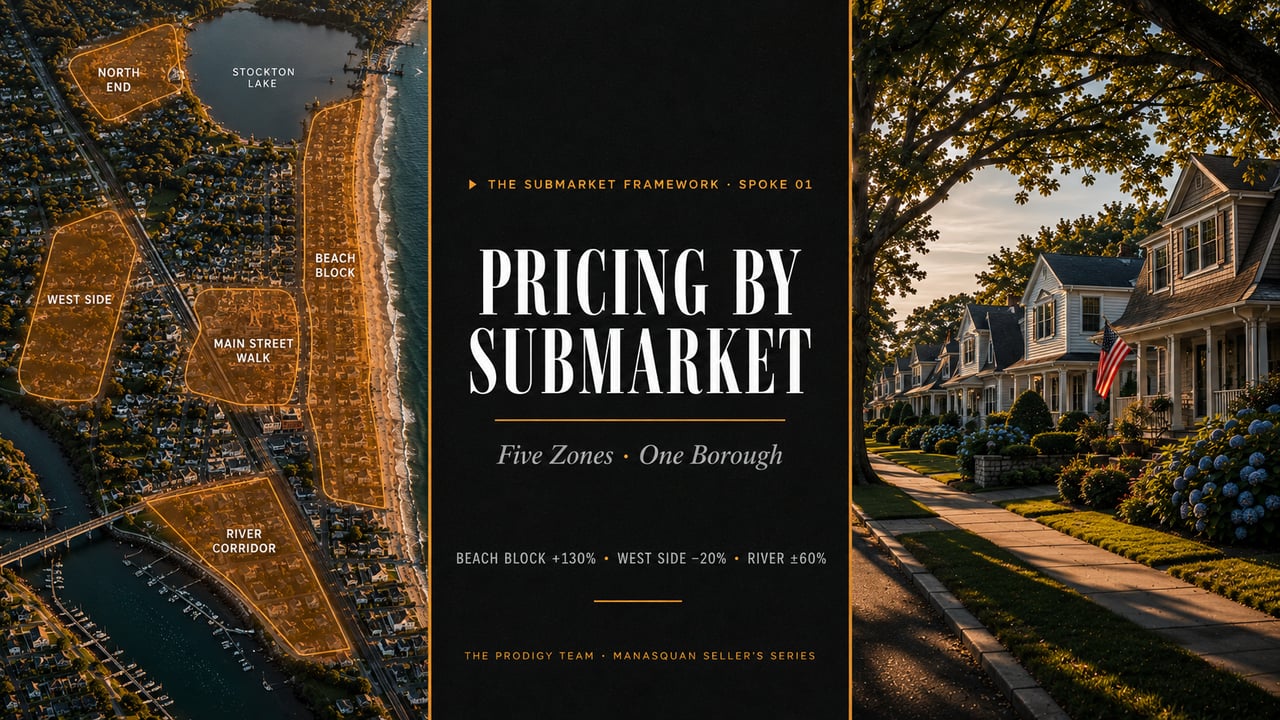
The borough-wide Manasquan average sale price of $1.72 million is a useful headline. It is not a useful pricing tool. A 2,800-square-foot Cape Cod on Beachfront Avenue and a 2,800-square-foot Cape Cod on the west side of the train tracks are not the same product, do not attract the same buyer pool, and do not trade in the same range. Treating them as comparable on borough averages is the most common pricing mistake we see Manasquan sellers make. This post breaks the borough into five functional submarkets, explains what drives each one, and lays out the framework a seller should use to price against the right comp set rather than the wrong one. For the broader four-year context, see our 2023–2026 Manasquan Seller’s Data Guide.
▸ Mornings on the Shore · Manasquan, NJ
▸ Methodology Note
The zone framework below is built from MOMLS borough data combined with on-the-ground broker observation of how Manasquan submarkets actually trade. Premium and discount ranges are directional, anchored to the borough average. A property-specific pricing audit using current comparable closings within your zone is the only way to translate this framework into a defensible asking price.
Manasquan covers 2.53 square miles. Half of that is water. The land area is roughly 1.38 square miles, which sounds tight enough to behave as a single market. It does not.
The borough divides naturally along three physical features and one transportation feature. The Atlantic Ocean creates the eastern beach corridor. Stockton Lake and the Glimmer Glass break the north end from the rest of town. The Manasquan River anchors the south and southwest. And the NJ Transit North Jersey Coast Line splits the borough roughly in half from north to south, with a recognized pricing delta between “east of the train” and “west of the train.”
A buyer touring a Beach Block home is not the same buyer touring a West Side colonial. The Beach Block buyer is comparing your home to Spring Lake oceanfront, Sea Girt second-row, and Bay Head — a high-six-to-low-seven-figure conversation where Atlantic proximity is the entire thesis. The West Side buyer is comparing your home to Brielle, Sea Girt inland, and Wall Township — a comp set where land size, school district, and downtown walkability matter more than ocean access. Pricing the same against the borough average ignores the buyer profile.
▸ Seller Takeaway
Your pricing strategy starts with identifying which submarket your home sits in — not where it sits on a map. Submarket determines comp set. Comp set determines pricing range. Borough averages obscure both.
| Zone | Boundary | vs Borough Avg |
|---|---|---|
| Beach Block | East of Ocean Ave to the Atlantic | +60% to +130% |
| North End | North of Stockton Lake / Glimmer Glass | +15% to +40% |
| Main Street Walk | Downtown core, east of train | Baseline (±10%) |
| West Side | West of the NJ Transit line | −20% to −5% |
| River | Manasquan River corridor, south | −10% to +60% |
Read the ranges as directional, not deterministic. A 1,400-square-foot Beach Block cottage on a 40x100 lot doesn’t hit the top of the +130% band; a 4,500-square-foot oceanfront new build with a pool does. The framework tells you which range to start in. Lot, finish level, condition, and view determine where in that range your home actually sits.
Boundary: Properties east of Ocean Avenue, running from Brielle Road north to the Sea Girt border, plus the Beachfront Avenue and First Avenue corridor.
What it is: Manasquan’s scarcest and most valuable inventory. True oceanfront homes on Beachfront Avenue command the highest prices in the borough — a tier that competes directly with Spring Lake and Sea Girt second-row at the mid-to-upper seven-figure level. One block back, ocean-block and two-block homes still carry meaningful Atlantic premium, with condition and view corridors driving the spread.
Buyer profile: NYC and North Jersey weekend-and-summer households, second-home buyers, and a smaller cohort of full-time residents drawn by Manasquan’s relative value compared to Spring Lake. These buyers underwrite carrying costs at high price points and are comparing your home to peer shore towns — not to inland Manasquan.
Pricing range: +60% to +130% above borough average. Two-block-back homes anchor the lower end. Direct oceanfront with view, new construction, or major renovation sits at the top. Direct oceanfront new builds have traded into the mid-seven-figures.
▸ Seller Takeaway — Beach Block
Price against Spring Lake and Sea Girt comps, not Manasquan ones. Your buyer pool sees those towns as alternatives. The borough average is irrelevant to this conversation.

▸ Broker’s Note
“A Beach Block seller who anchors to the Manasquan borough average is leaving six figures on the table. The buyer in front of you is shopping Spring Lake. Price like it.”
— Anthony Licciardello, Broker, The Prodigy Team
Boundary: Properties north of Stockton Lake and the Glimmer Glass, including the streets around the North End Beach and the Stockton Lake corridor itself.
What it is: A quieter, less-trafficked section of the borough that commands its own premium for three specific reasons: direct walking access to the North End Beach (less crowded than the main Manasquan Beach), Stockton Lake water-view inventory, and proximity to the Sea Girt border, which extends the comp set upward. The architecture leans more toward classic shingle-style and updated capes than the new-build product appearing elsewhere.
Buyer profile: Full-time residents trading up within the borough, second-home buyers seeking quieter beach access, and a meaningful cohort of buyers spilling over from Sea Girt at a 10–20% discount to that town’s pricing.
Pricing range: +15% to +40% above borough average. Stockton Lake water-view homes anchor the upper end. Standard inland North End homes sit in the +15% to +25% band, with a meaningful premium for the proximity to North End Beach access.
▸ Seller Takeaway — North End
Lead the listing copy with North End Beach walking distance and Sea Girt-border proximity. Both are searchable buyer queries that warrant a premium and signal to the right comp set.
Boundary: Downtown core, east of the train tracks — roughly the streets between South Street and Atlantic Avenue, bounded by Ocean Avenue to the east and Main Street to the west.
What it is: The borough’s baseline submarket. Walkability to Main Street boutiques, restaurants, the train station, and the Manasquan Beach Path. The most uniform housing stock in town — predominantly capes, colonials, and older bungalows on 50x100 to 75x100 lots. This is the zone that produces most of the borough’s 36-to-73 annual closings.
Buyer profile: Full-time families relocating from North Jersey and NYC outer-borough markets, downsizers from Wall Township or Brielle who want walkability, and a growing cohort of remote workers using the NJ Transit line to commute occasionally.
Pricing range: Baseline (within ±10% of borough average). This is the zone where the borough average is most directly applicable. Lot size, condition, and proximity to Main Street drive most of the variance.
▸ Seller Takeaway — Main Street Walk
This zone is where the 32-day average DOM is most reliable. Price precisely to comp. Listings here that sit past 45 days are almost always pricing problems, not product problems.
▸ The Core Zone
“Main Street Walk is the most disciplined submarket in town. Buyers know the comp set cold. The seller who tries to push above it is the seller who sits at 90 days.”
— Anthony Licciardello, Broker, The Prodigy Team
Boundary: Everything west of the NJ Transit North Jersey Coast Line tracks, extending to the Wall Township and Brielle borders.
What it is: The borough’s value tier — not because the housing stock is inferior, but because buyers underwrite an inconvenience cost. The walk to Main Street is meaningfully longer. Train track noise affects properties within roughly a block of the line. The compensation: larger lots, more space, and pricing that trades at a discount to the borough average without sacrificing Manasquan school district access or the 25% CRS flood discount.
Buyer profile: Full-time families prioritizing land and school district over walkability, buyers priced out of the east-of-tracks core, and a steady migration from Brielle and Wall Township buyers who want the Manasquan address without the east-side premium.
Pricing range: −20% to −5% below borough average. Properties immediately adjacent to the tracks anchor the low end. Larger-lot homes farther west, away from the rail line, compress the discount.
▸ Seller Takeaway — West Side
Your competition is Brielle and Wall, not east-of-tracks Manasquan. Lead with lot size, school district, and flood discount — the things that beat your real comp set, not the things that lose to it.
Boundary: The Manasquan River corridor — properties along River Road, Perrine Boulevard, and the riverfront streets extending toward the Brielle bridge.
What it is: The borough’s widest pricing band — and the most carefully comp-sensitive. Direct-river homes with deep-water dockage, bulkheading, and Atlantic access through the Manasquan Inlet command meaningful premiums and attract a boater-focused buyer pool. Set-back river-adjacent homes without water access trade closer to or below the borough average. Flood zone designation, base flood elevation, and the new NJDEP REAL rule compliance question loom larger here than in any other zone.
Buyer profile: Boaters and fishing-lifestyle buyers willing to pay for dockage, multi-generational families using the river for recreation, and value buyers picking up non-waterfront river-adjacent homes at a discount. The buyer comp set is split — direct-river competes with Brielle waterfront and Point Pleasant; set-back river competes with inland Manasquan.
Pricing range: −10% to +60% above borough average. The widest range of any zone. Direct-waterfront with dockage anchors the top, set-back river-adjacent without water access sits below the borough average, and flood zone profile drives meaningful variance throughout. The 2026 NJDEP REAL rule changes add a substantial new construction cost layer that buyers are now actively pricing into offers on tear-down candidates.
▸ Seller Takeaway — River
Direct-waterfront sellers should foreground dock specs, depth at low tide, and bulkhead condition. Non-waterfront river-adjacent sellers should foreground the flood zone profile, current elevation, and any compliance work already done. The two comp sets do not overlap.
▸ Broker’s Note
“The River is the only zone where the seller has to pick a comp set before pricing. Direct-water and set-back river trade in different worlds. Pick the wrong one and you either underprice by 30 percent or price into a market that doesn’t exist.”
— Anthony Licciardello, Broker, The Prodigy Team
For any Manasquan seller working from this framework, the practical sequence:
▸ The Bottom Line
Manasquan is five submarkets, not one. The right asking price starts with the right zone identification, runs through zone-specific comparable sales, and finishes with property-level adjustments plus a deliberate negotiation window. Sellers who skip the first step end up either underpricing scarce inventory or sitting past 90 days on overpriced inventory. The framework above is the structure. The audit fills in the numbers.
Directionally, 60% to 130% above borough average. Two-block-back anchors the lower end. Direct oceanfront on Beachfront Avenue, with view and contemporary construction, anchors the top. The variance is driven by view corridor, lot size, and finish level.
Yes. Buyers comparison-shop on walkability, train noise, and proximity to downtown — not on borough lines. West Side properties carry the same school district and CRS flood discount, but trade at a 5% to 20% discount because the buyer comp set extends into Brielle and Wall Township, not east-of-tracks Manasquan.
For pricing purposes, default to the lower-priced zone’s comp set. Buyers will, and pricing optimistically into a higher zone is the most common cause of stale listings. The exception is when a specific property feature — a view, a deep-water dock, immediate beach access — clearly pulls the property into the higher zone’s buyer pool.
Because two completely different products sit inside it. Direct-waterfront homes with dockage compete with Brielle and Point Pleasant waterfront, drawing a boater buyer and pricing 30% to 60% above borough average. Set-back river-adjacent homes without water access compete with inland Manasquan and trade slightly below borough average. Flood zone designation and REAL rule construction costs further widen the band.
No. The aggregator estimates pull from public records and broad regional comps without zone segmentation. In Manasquan specifically, they conflate Beach Block, Main Street Walk, and West Side properties into a single average that doesn’t reflect how the market actually trades. The result is consistent underpricing of premium-zone inventory and overpricing of West Side and set-back River inventory.
▸ Zone-Specific Pricing Audit
The framework in this post tells you which zone you sit in. A property-specific audit pulls the eight-to-ten zone-matched closed comps that translate the framework into your actual asking price.
Request Your AuditOr call direct: (718) 873-7345
▸ The Manasquan Seller’s Series
Pillar · The 2023–2026 Seller’s Data Guide · Spoke 1 · Pricing Your Manasquan Home by Submarket · Spoke 2 · When to List: Seasonality and the Spring Premium · Spoke 3 · Manasquan vs. Spring Lake vs. Sea Girt · Spoke 4 · Selling a Tear-Down to the Builder Buyer Market · Spoke 5 · Flood, Taxes, Insurance: What Buyers Will Negotiate Against in 2026
Prodigy Real Estate is an innovative real estate company offering high-end video production, home valuation services, purchasing, and home sales. Serving New York and New Jersey.