
Anthony Licciardello | August 2, 2026
North Plainfield, NJ
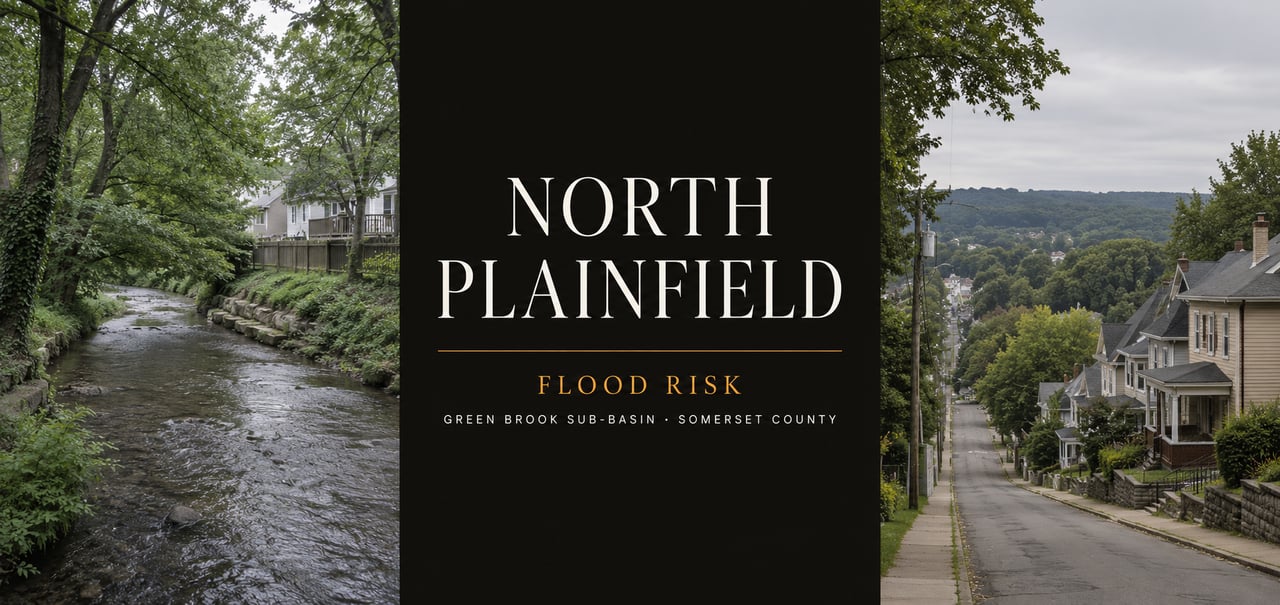
Two brooks define this borough — one forms its southern boundary, the other runs straight through its historic core. A federal flood control project started in 1973 is still being built around them, and since March 2024 New Jersey has had one of the strictest flood disclosure laws in the country. Here's what all of that means for a house here.
North Plainfield sits inside the Green Brook sub-basin, a 65-square-mile watershed that has flooded destructively enough, often enough, that Congress authorized a federal flood control project here in 1973 — and it is still under construction more than half a century later. The borough is one of thirteen municipalities across three counties in the project area, and it is named specifically among the communities the levee-and-floodwall system is built to protect. After Hurricane Ida, the project received $496 million in disaster supplemental funding in January 2022, on top of $261 million previously allocated, to finish the work — including mitigating Stony Brook through North Plainfield and the Green Brook that forms the borough's boundary. Meanwhile, since March 20, 2024, New Jersey requires sellers and landlords to disclose flood zone status and flood history in writing before a contract is signed, with real teeth: a seller's failure releases the buyer from the contract, and a landlord's failure lets a tenant walk and recover prepaid rent. None of this makes North Plainfield unbuyable. It makes flood risk a line item you price rather than a topic you avoid — and it is the single most under-asked question in this market.
Buyers ask me about taxes and schools in this borough constantly. They ask about flooding almost never — which is strange, because the Borough maintains a standing Green Brook Flood Control Commission, has done since well before most current owners bought in, and a Somerset County commissioner who lives here has described himself publicly as living in the floodplain. The information is not hidden. It just isn't part of the conversation, and it should be. For the wider town picture, start with our guide to moving to North Plainfield.
The Green Brook is the borough's southern edge — it separates North Plainfield from Green Brook Township and, further along, from the City of Plainfield in Union County. It is, quite literally, the line that makes North Plainfield a different municipality in a different county, which is the subject of our guide to North Plainfield versus Plainfield. It is also the watercourse that gives the whole federal project its name.
The Stony Brook is the one more people underestimate, because it runs through the borough rather than along its edge — and it forms one of the natural boundaries of the Washington Park Historic District. That matters enormously. The borough's most architecturally significant housing stock, much of it built between 1868 and 1917, sits near a watercourse that the Army Corps has specifically identified for mitigation. Century-old masonry foundations and water are a poor combination, and a Victorian basement tells you a great deal about a property's history if you know to look.
Add the topography from our pillar — the borough climbs toward the Watchung ridge in the north and falls toward the brooks in the south — and you get a market where elevation varies meaningfully within 2.9 square miles. Two houses a few blocks apart, similar age, similar price, can carry entirely different flood profiles and entirely different insurance costs. In most towns "where is it" is about schools and commute. Here it is also about how many feet above the brook you are.
The Green Brook Flood Risk Management Project is co-sponsored by the U.S. Army Corps of Engineers' New York District, the New Jersey Department of Environmental Protection, and Middlesex, Somerset, and Union counties. It covers the 65-square-mile Green Brook sub-basin of the Raritan River basin, plus reaches of the Raritan itself and its Middle Brook tributary. Thirteen municipalities sit in the project area — in Somerset County, that means Bound Brook, North Plainfield, Watchung, Green Brook Township, and Bridgewater.
The engineering is a system rather than a single structure: levees, floodwalls, pump stations, and road closure gates. The Corps describes it as protecting the boroughs of Bound Brook, Middlesex, Dunellen, and North Plainfield along with Green Brook Township. Construction proceeds in segments, and each segment requires surveys, design, contamination screening, soil borings to confirm the ground can carry heavy levees, wetland delineation, environmental permits, and real estate acquisition by NJDEP. As the Corps puts it plainly, that process can take years.
Why it took fifty years. The project was initiated in 1973 following deadly flooding and then languished for decades on insufficient federal appropriations — it is funded annually, with the Corps responsible for 75% of construction, engineering, and planning costs. Hurricane Floyd in 1999 caused severe damage and loss of life in the basin, particularly in Bound Brook, and revived momentum. Hurricane Ida in 2021 did it again. In January 2022, $496 million in disaster supplemental funding was announced to complete the project, on top of $261 million previously allocated.
What that funding buys North Plainfield specifically. The announced scope includes mitigating future flooding of Stony Brook through North Plainfield, and of the Green Brook along the borough's boundary. That is a direct, named benefit to this town — but it is future-tense, segment-by-segment, and subject to the same permitting and acquisition timeline as everything before it. Do not underwrite a purchase on the assumption that protection is already in place where you're buying. Ask the Borough's Green Brook Flood Control Commission, which exists precisely to coordinate with the Corps, what the status is on your segment.
Funding figures per the January 19, 2022 announcement of disaster supplemental funding for the Green Brook Sub Basin Flood Control Project. The Army Corps of Engineers is responsible for 75% of construction, engineering, and planning costs, with the project subject to annual federal appropriation. Allocation is not the same as completed construction — confirm the status of work in any specific area before relying on it.
New Jersey's Flood Risk Notification Law was signed on July 3, 2023 and took effect March 20, 2024. Practitioners have described it as among the strictest flood disclosure regimes in the country, and the remedies are the reason.
If you're selling, you must disclose flood risk in writing through the property condition disclosure statement before the buyer becomes obligated under contract. The required questions cover whether any part of the property sits in FEMA's Special Flood Hazard Area (the 100-year floodplain) or Moderate Risk Flood Hazard Area (the 500-year floodplain); whether the property has experienced flood damage or pooled water from heavy rainfall or another natural flood event; whether you or any prior owner you know of received FEMA, Small Business Administration, or other federal disaster flood assistance; whether you have ever filed a flood claim with any insurer including the NFIP, and if approved, the amount received; whether a FEMA elevation certificate exists, which must be shared with the buyer if it does; and whether federal law requires flood insurance on the property.
The consequence of getting it wrong is not a fine. A seller's failure to make the required disclosures releases the buyer from obligations under the sale contract unless and until the seller complies. For agents and brokers, compliance stopped being best practice and became a legal requirement with rescission and liability exposure attached.
If you're renting out a property, the exposure is sharper still — and this is essential reading alongside our multi-family investor's guide. Landlords must give written flood notice before executing any new lease or renewal dated on or after March 20, 2024, covering zone status and actual knowledge of flooding at the premises or its parking areas, plus notice that NFIP renter coverage exists. Fail, and a tenant who later learns the property sits in a Special or Moderate Risk area may end the lease immediately without penalty and, within thirty days of surrendering possession, is entitled to a refund of all rent and other amounts paid in advance. The landlord may also face liability for damage to the tenant's personal property, reduced habitability, or denied access due to flooding.
The State maintains a flood disclosure lookup tool searchable by mailing address through the NJDEP, which identifies whether a property sits in a flood hazard area. The model Seller's Property Condition Disclosure Statement and the model rental flood risk notice are published by the State for use in transactions. FEMA's Flood Map Service Center is the underlying national source for the flood insurance rate maps themselves. Check all three before you list, before you offer, and before you sign a lease — and remember that maps get revised, so a decade-old answer is not a current one.
If you're buying. Pull the flood zone determination on the specific address before you tour, not after you're under contract. If the property sits in a Special Flood Hazard Area and you're financing through a federally regulated or insured lender, flood insurance is mandatory, not optional — that premium belongs in your carrying-cost model from day one. Ask whether a FEMA elevation certificate exists; if it does, the seller must share it, and it drives your premium more than almost anything else. And read the disclosure statement carefully rather than skimming it: prior claims and prior federal disaster assistance are both disclosable, and both tell you something a basement inspection on a dry week will not.
If you're selling. Complete the disclosure fully and honestly, and do it early. The instinct to under-answer is understandable and it is the wrong instinct — an incomplete disclosure gives your buyer an exit, which means you lose the deal after you have already taken the house off the market. If you have an elevation certificate, produce it. If you've done mitigation work — regrading, a French drain, a sump system, foundation waterproofing — document it with invoices and put it in the listing. Buyers in this borough are increasingly asking, and a seller with paperwork wins against a seller with reassurances.
If you're a landlord. Build the flood notice into your lease packet permanently — new leases and renewals both, executed before signing. Given that a violation lets a tenant terminate and recover prepaid rent, and given North Plainfield's rent stabilization ordinance already imposes its own annual notice obligations, the sensible move is one consolidated compliance calendar rather than remembering each requirement separately.
Use the NJDEP lookup tool and FEMA's Flood Map Service Center. Elevation varies sharply across 2.9 square miles here — a neighbor's answer is not your answer.
Sellers must share it when one exists. It drives the premium more than any other single document. If there isn't one, getting one may still be worth the cost.
Flood coverage is separate from homeowners and mandatory with most federally backed loans in a Special Flood Hazard Area. Quote it in week one, while you still have an out.
Disclosable under the 2024 law: prior NFIP or private claims with amounts received, and FEMA or SBA disaster assistance to this or any prior owner.
Funded is not built. Ask the Borough's Green Brook Flood Control Commission what stage the work is at near the property, and what the expected timeline looks like.
Staining lines, efflorescence, replaced mechanicals mounted high, a newer sump. On an 1890s masonry foundation these read clearly to someone who knows the vocabulary.
General information, not legal, insurance, or engineering advice. Confirm flood zone status, disclosure obligations, and insurance requirements with the NJDEP, FEMA, a licensed New Jersey insurance producer, and a licensed New Jersey real estate attorney.
Walk the property during or right after heavy rain if you possibly can. Every basement in this borough looks fine in August. What you want to see is where water actually goes on the lot — whether the grade carries it away from the foundation or toward it, whether the downspouts discharge two feet from the wall, whether there's standing water at the low corner an hour after the rain stops. A flood map tells you about the brook. It tells you nothing about the roof runoff and the neighbor's regrading, and in a borough of small lots on sloping ground, that's where a lot of the actual water damage originates.
"I'd rather have this conversation with a buyer in week one than have it with a seller after a deal collapses in week five. Flood risk here is knowable — the maps exist, the disclosure form asks the right questions, the Borough has a commission that tracks the federal work. What gets people hurt isn't the water. It's finding out late. Sellers who document what they've done and buyers who ask early both end up fine. It's the people hoping nobody brings it up who get the bad outcome."
— Anthony Licciardello, Broker, The Prodigy Team
Flood risk is a pricing question, not a taboo — and handling it early is what keeps deals together. I'm Anthony Licciardello, Broker of The Prodigy Team, dual-licensed in New York and New Jersey, a member of the Staten Island Growth Management Task Force, and a former Director of Community Affairs in the Bloomberg Administration. We get the zone determination, the elevation certificate, and a real insurance quote in front of buyers during due diligence — while there's still leverage.
Our Above the Streets cinematic drone series extends that reach — aerial storytelling that shows a town's real geography, not just its listings.
Anthony Licciardello · Broker, The Prodigy Team · 718-873-7345
Mitigation work you've paid for is worth money — but only if it's documented and in front of the buyer early. We build the paperwork into the listing so flood risk gets priced at the start instead of renegotiated in week five.
Does North Plainfield, NJ flood?
Parts of it carry real flood risk. The borough sits within the 65-square-mile Green Brook sub-basin and is one of thirteen municipalities in the federal Green Brook Flood Risk Management Project area — the Army Corps names North Plainfield among the communities its levee, floodwall, and pump station system is built to protect. Two watercourses matter locally: the Green Brook along the borough's southern boundary and the Stony Brook running through it. Risk varies sharply by address, since elevation changes considerably across the borough's 2.9 square miles.
What is the Green Brook Flood Control Project?
A federal flood risk management project covering the 65-square-mile Green Brook sub-basin, co-sponsored by the U.S. Army Corps of Engineers, NJDEP, and Middlesex, Somerset, and Union counties. Initiated in 1973 after deadly flooding, it uses levees, floodwalls, pump stations, and road closure gates. It languished for decades on insufficient federal funding; after Hurricane Ida, $496 million in disaster supplemental funding was announced in January 2022 on top of $261 million previously allocated, including work to mitigate Stony Brook through North Plainfield.
What must a New Jersey seller disclose about flooding?
Since March 20, 2024, sellers must disclose in writing, before the buyer is obligated under contract, whether the property lies in FEMA's Special Flood Hazard Area or Moderate Risk Flood Hazard Area; whether it has experienced flood damage or pooled water; whether the seller or a known prior owner received FEMA, SBA, or other federal disaster flood assistance; whether any flood claim was filed and what was received; whether a FEMA elevation certificate exists, which must be shared; and whether federal law requires flood insurance. Failure to disclose releases the buyer from the contract until the seller complies.
What happens if a landlord skips the flood notice?
The consequences are significant. A tenant who later discovers the premises sit in a Special or Moderate Risk Flood Hazard Area may end the lease immediately without penalty, and within thirty days of surrendering possession is entitled to a refund of all rent and other amounts paid in advance. The landlord may also face liability for damage to the tenant's personal property, diminished habitability, or limited or denied access caused by flooding. The notice is required before executing any new lease or renewal dated on or after March 20, 2024.
Do I have to buy flood insurance in North Plainfield?
It depends on the address and the loan. Properties in a Special Flood Hazard Area carrying mortgages from federally regulated or insured lenders are required to obtain and maintain flood insurance. Outside those areas it is optional but often still sensible, since flood damage is excluded from standard homeowners policies. Get a real quote during due diligence rather than an estimate — an elevation certificate, where one exists, is the largest single factor in the premium.
Moving to North Plainfield — The Complete Relocation Guide
North Plainfield Borough Homes for Sale
The Washington Park Historic District — North Plainfield's Victorian Core
The Multi-Family Investor's Guide to North Plainfield
Green Brook Township Homes for Sale
Green Brook Flood Risk Management Project details per the U.S. Army Corps of Engineers New York District and the project's Floodplain Management Plan: co-sponsored by USACE, the New Jersey Department of Environmental Protection, and Middlesex, Somerset, and Union counties; encompassing the 65-square-mile Green Brook sub-basin of the Raritan River basin plus reaches of the Raritan and its Middle Brook tributary; thirteen municipalities across three counties, including the Boroughs of Bound Brook, North Plainfield, and Watchung and the Townships of Green Brook and Bridgewater in Somerset County; system of levees, floodwalls, pump stations, and road closure gates; USACE responsible for 75% of construction, engineering, and planning costs, subject to annual federal appropriation. Project initiated in 1973 following deadly flooding. Funding figures per the January 19, 2022 announcement of $496 million in disaster supplemental funding, in addition to $261 million previously allocated, with announced scope including mitigation of Stony Brook through North Plainfield and the Green Brook. North Plainfield's Green Brook Flood Control Commission is established under N.P.R.G.O. 2-25.8 and coordinates with the Army Corps on flooding, flood prevention, and brook maintenance. New Jersey Flood Risk Notification Law: P.L. 2023, c.93, signed July 3, 2023, effective March 20, 2024, amending the Truth-in-Renting Act; disclosure requirements and remedies as summarized. Model disclosure forms are published by the State of New Jersey; the NJDEP maintains an address-searchable flood hazard lookup tool, and FEMA's Flood Map Service Center publishes the underlying flood insurance rate maps. Federal allocation is not the same as completed construction, and flood maps are periodically revised. Flood risk varies by individual address and this guide makes no representation about any specific property. This is general information, not legal, insurance, engineering, or financial advice — confirm zone status, disclosure obligations, project status, and insurance requirements with the NJDEP, FEMA, the Borough of North Plainfield, a licensed New Jersey insurance producer, and a licensed New Jersey real estate attorney.
Prodigy Real Estate is an innovative real estate company offering high-end video production, home valuation services, purchasing, and home sales. Serving New York and New Jersey.