
Anthony Licciardello | August 1, 2026
North Plainfield, NJ
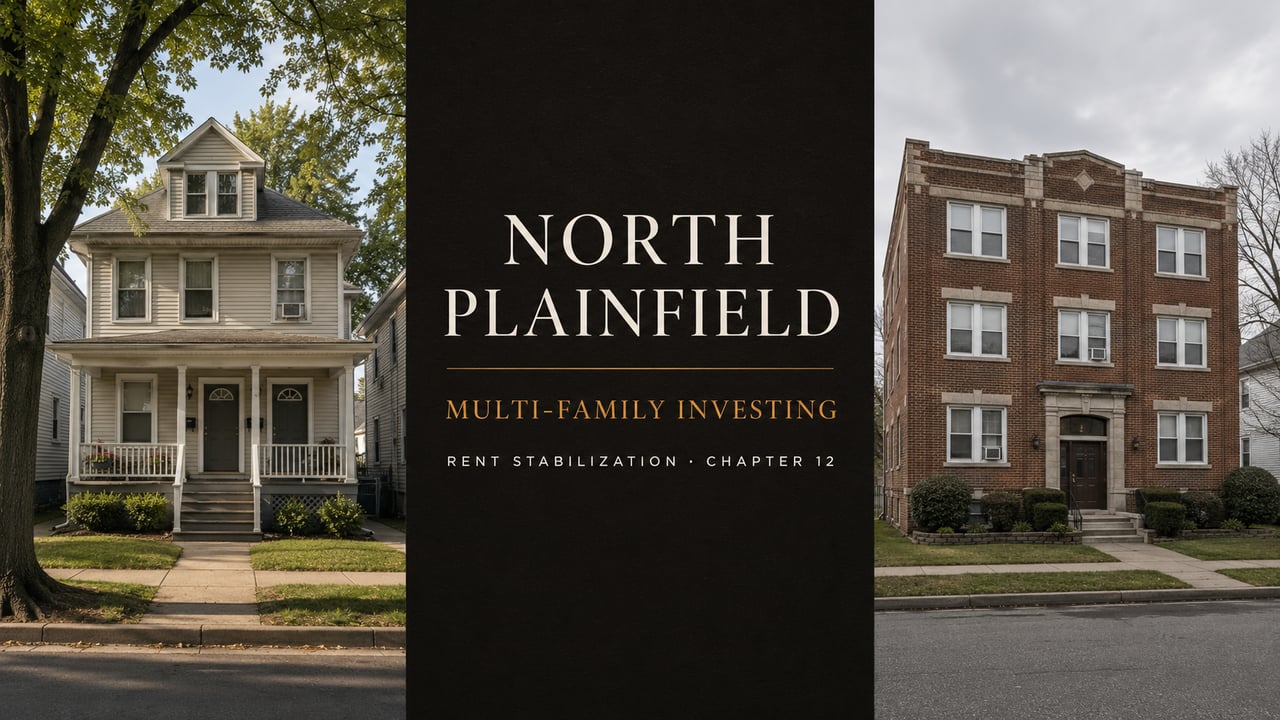
North Plainfield has a rent stabilization ordinance, an active Rent Stabilization Board, and just-cause eviction protection. Most investors shopping the borough don't know that. But buried in the same chapter is a clause that changes the math on small buildings entirely — and almost nobody talks about it.
Chapter 12 of the Borough Code caps annual base rent increases at 4% where the landlord doesn't supply heat and 5% where they do, requires just cause to refuse to relet or terminate a tenancy, and gives an appointed Rent Stabilization Board authority over increases, hardship applications, and capital improvement surcharges. On its face that reads like a hard market for a landlord. But §12-4 contains the clause that actually governs the small-building math: in a dwelling of fewer than eleven units, once a unit becomes vacant through the tenant's voluntary act or a just-cause dispossession, that unit is permanently exempt from the chapter. Not reset — exempt. Which means the two-to-four-unit stock that makes up most of what an investor actually buys here decontrols one unit at a time as tenants turn over naturally. You underwrite the building you're inheriting, with its existing rents and its just-cause obligations intact, and you hold a decontrol option that vests on ordinary turnover. That is a materially different asset than "a rent-controlled building in a rent-controlled town," and the difference is worth understanding precisely.
The certified 2025 county records show why this market exists at all: North Plainfield carries 34 apartment-class parcels assessed at $159.6 million, about 10.5% of the borough's entire ratable base, inside 2.9 square miles. Add the two-to-four-unit houses scattered through the residential grid and you have a genuine small multi-family market in a town where the average home is worth under $400,000. What follows is the regulatory reality of operating in it. This is a summary of a dense ordinance, not legal advice — pull the current text of Chapter 12 yourself and retain a New Jersey real estate attorney before you write an offer. For the wider town picture, start with moving to North Plainfield.
The ordinance applies, per §12-3, to all housing space and dwellings within the Borough unless specifically exempted. Hotels, motels, and transient rentals are out. Everything else starts inside.
The rate ceiling. Under §12-9, at the termination of a lease term or periodic tenancy, no landlord may request or receive an increase in the Base Rent Component greater than 4% where the landlord does not supply heat, or 5% where they do. Under §12-5, no increase may come more often than once in any twelve-month period. Under §12-13, any increase beyond what the chapter authorizes is voidable — meaning a mistake here doesn't just get corrected going forward, it can be unwound.
Just cause. Section 12-2 is short and consequential: a landlord shall not refuse to rent, relet, or rerent housing space, or terminate a landlord-tenant relationship, except for just cause. The definition in §12-1 runs to thirteen enumerated grounds — nonpayment, disorderly conduct after written notice, willful damage, substantial lease breach after notice, the owner seeking to personally occupy the unit, conversion, permanent retirement of the building from the rental market, and others. It is a real list with real paths, but it is a list, and "I'd rather have a different tenant" is not on it.
An outstanding violation freezes your increase. Also in §12-9: no increase is effective for any period during which there is a valid outstanding notice — past its correction period — from local or State authorities for property maintenance, health, or fire violations substantially affecting the use and enjoyment of that unit. Deferred maintenance in this borough doesn't just cost you a repair. It costs you the increase.
Here is the provision that separates a two-family house from an apartment building in this borough, and it sits in a section most people skim because of its title.
Section 12-4 provides that where housing space in a dwelling of fewer than eleven units becomes vacant through the voluntary act of the tenant, or a dispossession with just cause, that housing space is thereafter exempt from the provisions of the chapter. Read that carefully: not exempt for the purpose of setting the next rent, but exempt going forward. The unit leaves the system.
Larger buildings work differently. Where a dwelling has more than ten units, a voluntary vacancy or just-cause dispossession exempts the unit only for the purpose of establishing the initial rent of the new tenant. After that, the increase limitations apply again — and the ordinance says explicitly that the new initial rent may not provide for subsequent increases beyond what the chapter permits. So an eighteen-unit building resets and re-enters control with each turnover. A four-family exits permanently, one door at a time.
What that means practically: when you buy a small building here you are buying its current rent roll and its current obligations, and a decontrol option that vests as tenants leave of their own accord over the years. It does not mean you can accelerate the process — the just-cause requirement and the anti-reprisal provisions of §12-28 exist precisely to prevent that, and pushing a tenant out to decontrol a unit is the fastest way to turn an investment into litigation. Underwrite on the rents you're actually inheriting, treat decontrol as upside rather than plan, and get a lawyer to read the ordinance against the specific building before you're bound.
Source: Borough of North Plainfield Municipal Code, Chapter 12, Rent Stabilization. The 4% and 5% ceilings apply to the Base Rent Component only — tax, sewer, and trash components are separate pass-throughs calculated per room. Ordinances are amended; confirm the current text before relying on any figure here.
Section 12-8 divides total rent into six components: Base Rent, Tax, Sewer Charge, Major Capital Improvement Surcharge, Hardship Increase, and Trash Removal. Only the Base Rent Component is subject to the 4%/5% ceiling. The others move with the underlying costs.
The allocation method is the part that catches new owners. Costs are divided by rooms, not by units. The monthly Tax Component is one-twelfth of the annual property tax for the dwelling, divided by the total number of rooms in the dwelling, multiplied by the number of rooms in that particular unit. Sewer and trash use the same formula. That's why §12-25 requires owners of dwellings of more than five units to certify room counts in writing to the Borough Clerk, and to file an amended certification within thirty days of any change.
The notice obligation is annual and it is unconditional. Under §12-7, a landlord seeking any increase must notify the tenant in writing — personal service or certified mail — of the calculations involved. And annually, the landlord must notify tenants in writing of the calculations for the Tax, Sewer, Trash, Capital Improvement, and Hardship components whether or not an increase is being sought. That is a compliance task with a calendar, not a transaction.
One provision that will surprise anyone planning a tax appeal. Under §12-12, a landlord filing a tax appeal must notify all tenants in writing within fifteen days of filing. And if the appeal succeeds, the landlord must — after deducting reasonable expenses of prosecuting it — pay 50% of the balance to the tenants, apportioned per room. Given that North Plainfield carries the second-highest effective tax rate in Somerset County, appeals are attractive here. Half the win is not yours.
The ordinance is not a dead end. Two mechanisms let a landlord go above the annual ceiling, and both run through the Board.
Hardship increases (§12-19) are available where a dwelling isn't returning the fair rate of return — defined, unusually and specifically, as the average interest rate on passbook accounts at banks and savings institutions located in North Plainfield, plus three percent, set by Council resolution no later than March each year. To apply, a landlord must allege efficient operation, a safe and sanitary property with no overdue code violations, compliance with tenants'-rights law, and arm's-length transactions throughout. Management fees are capped at 3% of gross rental income in the computation. A granted increase runs up to four years, with an interim report due within thirty days of the two-year anniversary or the back half is nullified. Application fee is $50 or $10 per unit, whichever is greater, capped at $2,500.
Capital improvement surcharges (§12-20) cover a major capital improvement — defined as one with an anticipated useful life of at least five years and a cost of at least $1,000. The surcharge is prorated over the improvement's useful life, must be approved as reasonable by the Board, and may not exceed 15% of the tenant's rent. Critically, it is not treated as rent for purposes of calculating future increases, so it doesn't compound into your base.
Two procedural details worth pricing into your timeline. The Board will not entertain any landlord application until it confirms you provided tenants — at least thirty days prior — with the Truth in Renting Statement, the Board's Fact Sheet, and a copy of Chapter 12 itself. And under §12-14, if the Board doesn't reach a decision within 120 days of filing, the application is deemed denied unless you consented in writing to an extension. Either side may appeal a determination to the Borough Council within thirty days, on the record.
Required from the Borough before any tenant takes occupancy. Add a $120 per unit lead inspection administration fee — so budget roughly $220 per unit per turnover.
Required under New Jersey State law. In a borough where most stock predates 1978, assume this applies and price remediation risk before you're bound.
$100 for a single family plus $100 for each additional unit in a multi-family. An inspector checks compliance with Borough ordinances. Plan for it on your exit, not at the closing table.
You are buying these rents, not market rents. Ask which units have turned over voluntarily since the ordinance applied — those may already be exempt.
Room counts drive every pass-through. Missing annual §12-7 notices are a compliance defect you inherit, and they can bar you from Board relief later.
An outstanding notice past its correction period suspends your ability to raise rent and blocks Board relief. Clear these before closing or price them.
Fees and requirements per the Borough of North Plainfield property maintenance and zoning office. Fees change — confirm current amounts with the Borough before budgeting. This is general information, not legal advice.
Ask the seller for the last three years of §12-7 annual notices. Almost no small landlord in this borough sends them reliably, and the gap tells you two useful things at once: how professionally the building has been run, and whether you're about to inherit a compliance problem that could bar you from Board relief when you need it. It's a single document request that costs nothing and reprices deals. I've had sellers go quiet on that question, and quiet is an answer.
"Most investors hear 'rent control' and walk. The ones who read the actual ordinance find the under-eleven-unit clause and understand what they're really looking at. But I want to be careful here, because there's a wrong way to use this information. Decontrol comes when a tenant chooses to leave. It is not a plan you execute on someone. Buy the building on the rents it has, run it well enough that people stay, and let the upside arrive on its own schedule. That's both the ethical version and, honestly, the profitable one."
— Anthony Licciardello, Broker, The Prodigy Team
Small multi-family in a stabilized borough is a specialist transaction — the rent roll, the notice history, and the ordinance matter more than the cap rate on the flyer. I'm Anthony Licciardello, Broker of The Prodigy Team, dual-licensed in New York and New Jersey, a member of the Staten Island Growth Management Task Force, and a former Director of Community Affairs in the Bloomberg Administration. We read the municipal code before we write the offer.
Our Above the Streets cinematic drone series extends that reach — aerial storytelling that markets entire towns rather than single listings.
Anthony Licciardello · Broker, The Prodigy Team · 718-873-7345
Buildings here get listed as square footage and unit counts, which leaves money behind. A clean rent roll, documented notice history, and units already exempt under §12-4 are worth real premium — to a buyer who understands why. We make sure they do.
Does North Plainfield have rent control?
Yes. Chapter 12 of the Borough Code establishes rent stabilization, administered by an appointed Rent Stabilization Board. It applies to all housing space and dwellings in the borough unless specifically exempted, with hotels, motels, and transient rentals excluded. Annual increases to the Base Rent Component are capped at 4% where the landlord does not supply heat and 5% where they do.
Are two-to-four unit properties rent controlled in North Plainfield?
They start inside the ordinance, but §12-4 provides that in a dwelling of fewer than eleven units, once housing space becomes vacant through the tenant's voluntary act or a dispossession with just cause, that unit is thereafter exempt from the chapter. So small buildings decontrol permanently, unit by unit, as tenants leave on their own. Buildings of more than ten units work differently — a vacancy allows the initial rent to be reset, but increase limits apply again afterward. Confirm the current ordinance text and a specific property's history with a New Jersey attorney.
Can I decline to renew a tenant in North Plainfield?
Only for just cause. Section 12-2 prohibits refusing to rent, relet, or rerent, or terminating a tenancy, except on the grounds enumerated in §12-1 — which include nonpayment, disorderly conduct after written notice, willful damage, substantial lease breach after notice, an owner seeking to personally occupy the unit, and permanent retirement of the building from the rental market, among others. Chapter 12 also prohibits reprisals against tenants for enforcing their rights or complaining to authorities.
What does it cost to put a tenant in a North Plainfield rental?
A Rental Certificate of Occupancy is required before any tenant takes occupancy, at $100 per unit, plus a $120 per unit lead inspection administration fee — roughly $220 per unit per turnover. Interior lead inspections are required on one and two family rental properties under New Jersey State law. Separately, selling a residential property requires a Municipal Certificate of Compliance at $100 for a single family plus $100 per additional unit. Confirm current fees with the Borough.
If I win a tax appeal on a rental property, do I keep the refund?
Not all of it. Under §12-12, a landlord filing a tax appeal must notify all tenants in writing within fifteen days of filing, and if the appeal succeeds must pay 50% of the balance due — after deducting reasonable expenses of prosecuting the appeal — to tenants, apportioned on a per-room basis. Worth factoring in, since North Plainfield carries the second-highest effective tax rate in Somerset County and appeals are otherwise attractive here.
Moving to North Plainfield — The Complete Relocation Guide
North Plainfield Borough Homes for Sale
North Plainfield vs Plainfield — Two Towns, Two Counties, One Name
The Washington Park Historic District — North Plainfield's Victorian Core
Rent stabilization provisions summarized from the Borough of North Plainfield Municipal Code, Chapter 12, Rent Stabilization (Ord. #741 and subsequent amendments), including §12-2 (refusal to rent or relet — just cause), §12-3 (applicability), §12-4 (first time rentals and the fewer-than-eleven-unit vacancy exemption), §12-5 (increase frequency), §12-7 (notification of calculations, including annual notice), §12-8 (six rent components and per-room allocation), §12-9 (4% and 5% base rent increase ceilings; suspension during outstanding violations), §12-12 (tax appeals and the 50% tenant share), §12-13 (unauthorized increases voidable), §12-14 (Board powers; 120-day deemed denial), §12-16 (Truth in Renting Statement precondition), §12-17 (appeal to Council within 30 days), §12-19 (hardship increases; fair rate of return defined as average local passbook rate plus 3%; 3% management fee cap; four-year term; 20% interim collection cap; application fee $50 or $10 per unit to a $2,500 maximum), §12-20 (major capital improvement defined as five-year useful life and $1,000 minimum cost; 15% surcharge ceiling), §12-25 (room certification for dwellings of more than five units), and §12-28 (reprisals). Rental Certificate of Occupancy, lead inspection administration fee, and Municipal Certificate of Compliance amounts per the Borough of North Plainfield property maintenance and zoning office. Ratable base figures from the certified 2025 Abstract of Ratables for Somerset County (certified September 9, 2025): Class 4C apartment property assessed at $159,615,208 across 34 line items against a net taxable value of $1,515,036,558. Ordinances, fees, and Board composition change, and this summary is necessarily partial — a municipal rent ordinance is a dense document and the interaction between its sections matters. Pull the current full text of Chapter 12 directly and retain a licensed New Jersey real estate attorney before acquiring, operating, or raising rent on any regulated property. Nothing here is legal, tax, or investment advice.
Prodigy Real Estate is an innovative real estate company offering high-end video production, home valuation services, purchasing, and home sales. Serving New York and New Jersey.