
Anthony Licciardello | July 31, 2026
North Plainfield, NJ
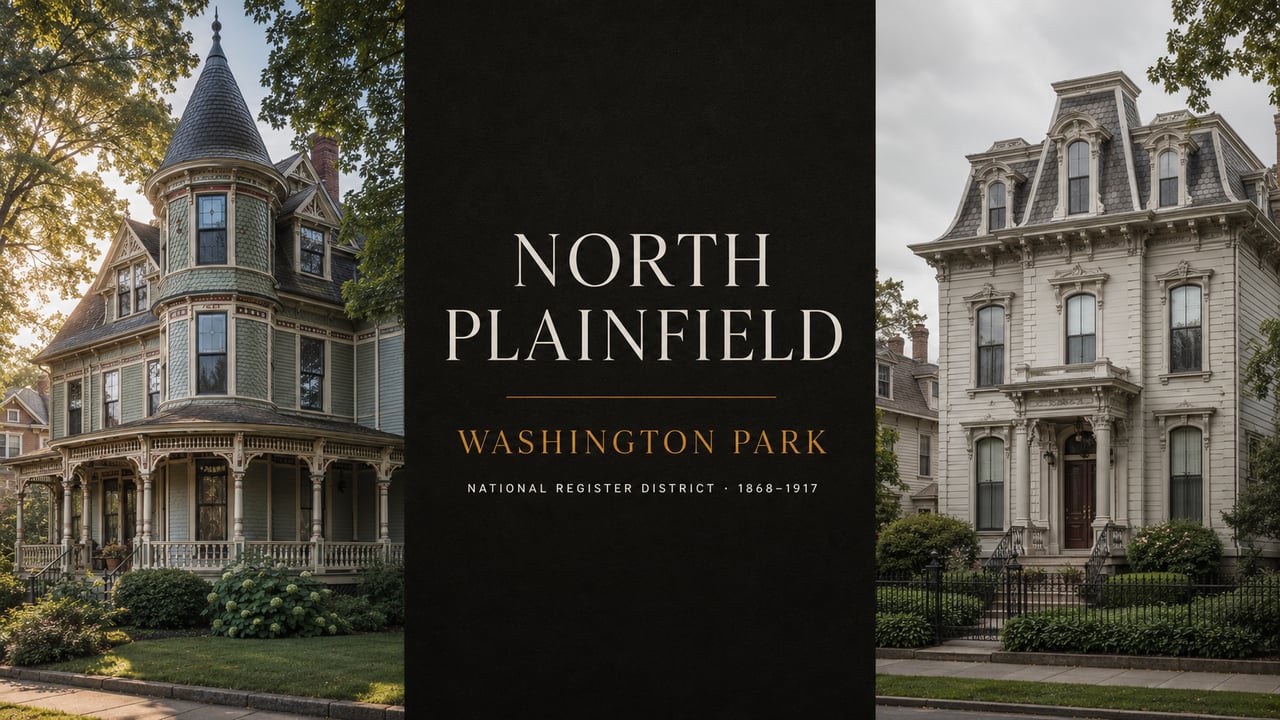
One hundred acres, 145 contributing buildings, and a build period running from 1868 to 1917 — listed on the National Register since 1987. It is the most architecturally significant thing in North Plainfield and the least understood. Here's what you're actually buying, including the one legal distinction most buyers get wrong.
Washington Park is the reason to look at North Plainfield rather than any of the cheaper towns around it. A hundred acres of intact late-Victorian architecture — Second Empire, Queen Anne, Shingle Style, much of it attributed to the architect Charles H. Smith — sitting in a market where the average borough home is worth under $400,000. There is nothing else like that combination in this corridor. But two things need saying before anyone falls in love. First, National Register listing and local historic-district regulation are not the same thing, and buyers routinely conflate them in both directions — some assume they can't change a doorknob, others assume nobody's watching. Neither is safe to assume; you confirm it with the borough. Second, these are large, complicated, 110-to-160-year-old houses. Slate, plaster, original millwork, and systems that have been patched by six generations of owners. The purchase price is the smaller number. The buyers who do well here treat that as the starting assumption rather than the unpleasant surprise.
I've walked buyers down Rockview Avenue who stopped talking halfway along the block. That reaction is the whole thesis of this neighborhood — people who have spent months looking at colonials and split-levels come around a corner and see a turreted Queen Anne with original scrollwork, and then they see the asking price, and they need a minute. What follows is the part that comes after the minute: what the district actually is, what the rules actually are, and what these houses actually cost to own. For the wider town picture, start with our guide to moving to North Plainfield.
The Washington Park Historic District was added to the National Register of Historic Places on April 9, 1987, having been designated on the New Jersey Register a month earlier. It covers roughly 100 acres and contains 145 contributing buildings. The listing cites significance in three areas — architecture, landscape architecture, and community planning — and that third one is worth pausing on, because it tells you this was a designed neighborhood rather than an accumulation of nice houses.
The district sits roughly bounded by Green Brook Road, Grove Avenue, East Front Street, and Geraud Avenue, with the Stony Brook and the Green Brook forming natural edges. Houses date from 1868 through 1917, spanning the full late-Victorian sequence: Second Empire mansards from the earliest phase, Queen Anne with its turrets and patterned shingles through the 1880s and 1890s, and Shingle Style toward the end.
Much of the district's architecture is attributed to Charles H. Smith, who worked both sides of the Green Brook — he also designed the Orville T. Waring House of 1881 in Plainfield's Van Wyck Brooks district, across the municipal line in Union County. Individual houses carry their own stories: 11 Rockview Avenue was built in the 1860s as a Downingesque "Swiss" cottage, a picturesque style that predates most of the district around it. 12 and 16 Rockview followed between 1882 and 1894 in the Late Victorian manner. The district also has an active neighborhood association organized specifically around preservation and restoration, which is a meaningful asset when you need to find someone who has already solved the problem you're facing.
This is the single most misunderstood thing about buying in any historic district, and it costs people money in both directions. Some buyers walk away assuming they'd need federal approval to paint a porch. Others buy assuming nobody can tell them anything, then discover a design review process at permit time. Both are guessing.
National Register listing is primarily honorific. It recognizes significance, it creates a documented record, and it can open access to certain preservation grant and tax-credit programs. What it generally does not do is restrict what a private owner may do with their own property using their own money. Federal review is triggered by federal funding, licensing, or permitting — not by your kitchen renovation.
Local historic-district ordinances are the layer that actually governs your project. A municipality can adopt its own historic preservation ordinance, appoint a commission, and require design review for exterior changes, additions, window replacement, or demolition — and those rules have real teeth regardless of what the National Register says. Whether North Plainfield has such an ordinance in force, what it covers, and whether its boundary matches the National Register boundary are questions to put directly to the Borough's construction and zoning offices before you write an offer. Do not take a listing agent's word for it, and do not take mine — get it in writing from the municipality. If you are planning significant exterior work, that answer changes your budget and your timeline more than any inspection finding will.
Ask the Borough three specific questions and get the answers in writing: (1) Does North Plainfield have a local historic preservation ordinance, and is this property inside its regulated boundary? (2) If so, which categories of work require review — exterior only, or interior as well? (3) What is the typical review timeline, and does it run before or alongside the standard construction permit? Those three answers determine whether a Washington Park renovation is a six-month project or an eighteen-month one.
A Washington Park house is not a colonial with older trim. It is a fundamentally different building, and the differences drive everything about cost and livability.
The envelope. Slate or tile roofs where original, which last a very long time and cost a great deal when they don't. Wood windows — often original, often single-glazed, frequently with storm sashes added later. Elaborate porches, brackets, and trim that are the reason you want the house and also the maintenance cycle you're signing up for. Masonry foundations that predate modern damp-proofing.
The guts. Assume the electrical, plumbing, and heating have each been through at least two full generations of replacement, done to the standards and budgets of their day. Knob-and-tube remnants are common in houses of this vintage even when the panel is modern. Plaster over wood lath rather than drywall, which is better acoustically and worse to open up. Insulation that ranges from retrofitted to essentially absent.
The layout. These houses were designed for a different way of living — formal front rooms, back stairs, small kitchens, bedrooms without closets. Some have been opened up sympathetically; some have been chopped into apartments and returned; some are untouched. The untouched ones are the prize and the project simultaneously. What you should be pricing is not the house you're standing in but the house you'll have in five years, and the distance between those two things.
Calculated from the certified 2025 general tax rate of $4.543 per $100 of assessed value, Somerset County Abstract of Ratables. Implied market values derived from the borough's 57.23% equalization ratio. These are illustrative scenarios, not appraisals — pull the actual assessment for any specific property from the Borough Assessor and run the same arithmetic. Rates change annually.
The most important decision you make on a Washington Park house happens before the inspection contingency: who you hire to look at it. A competent general home inspector will produce a competent general report, and on a 140-year-old house that report will be largely beside the point. You want someone who has worked on buildings of this age and can tell you the difference between settlement that happened in 1910 and settlement that is happening now.
Budget for separate specialist opinions on the roof and the chimneys, on the electrical service, and — if there is any sign of water in the basement — on the foundation and drainage. Ask the seller for permit history, which tells you what was done legally and, by omission, what wasn't. Unpermitted work in a house this old is common, and it surfaces at title or at your own permit application.
Two more that people skip. Insurance. Call a carrier before you're under contract, not after — replacement cost on a house with irreplaceable millwork is its own conversation, and some carriers simply won't write it. Financing. If the house needs significant work, a conventional purchase mortgage may not be the right instrument; renovation loan products exist precisely for this and take longer to arrange than you'd expect. Both are easier to solve in week one than in week five.
Whether a local historic preservation ordinance regulates this specific property, what work it covers, and the review timeline. From the Borough, not from a listing sheet.
An inspector experienced with pre-1920 construction, plus separate specialist opinions on roof, chimneys, electrical service, and foundation.
What was done legally, and what the gaps suggest. Unpermitted work surfaces at title review or when you apply for your own permit.
Replacement cost on irreplaceable millwork is a specialized conversation, and carrier appetite varies. Find out in week one.
Assessment ÷ 100 × $4.543 = your annual bill. Buying does not reset the assessment; budget from the roll, not from your purchase price.
Price the house you'll have in five years, not the one you're standing in. Get contractor numbers during due diligence, not after closing.
General information, not legal, tax, financial, or engineering advice. Confirm all regulatory questions directly with the Borough of North Plainfield and retain a licensed New Jersey real estate attorney and qualified inspectors.
Talk to the neighbors before you talk to the bank. Washington Park has an active preservation association, and the people in it have already solved the exact problem you're about to encounter — which slate contractor is worth the money, who does sash restoration properly, which mason understands lime mortar. In a district of 145 buildings, that knowledge is concentrated and freely given, and it is worth more than any inspection report. Knock on a door on a Saturday and say you're thinking about buying on the street. In my experience people in historic districts are almost never annoyed by that question; they've usually been waiting for someone to ask.
"People fall in love with these houses in about four minutes, and my job at that point is to slow things down without spoiling it. A Washington Park Victorian is a wonderful thing to own if you go in knowing what it asks of you. It's a hard thing to own if you found out afterward. So I ask buyers to price the five-year version of the house, get the ordinance answer in writing, and hire an inspector who's actually worked on a house this old. Do those three things and I'd buy here myself."
— Anthony Licciardello, Broker, The Prodigy Team
Period houses need brokers who understand them — and buyers who will pay for them. I'm Anthony Licciardello, Broker of The Prodigy Team, dual-licensed in New York and New Jersey, a member of the Staten Island Growth Management Task Force, and a former Director of Community Affairs in the Bloomberg Administration. We market architecture to the New York buyers who came looking for exactly this and didn't know it existed twenty-three miles out.
Our Above the Streets cinematic drone series extends that reach — aerial storytelling that markets entire neighborhoods rather than single listings.
Anthony Licciardello · Broker, The Prodigy Team · 718-873-7345
A period house sold as "3 bed, 2 bath, needs updating" leaves real money on the table. These houses need photography, copy, and a buyer pool that understands what a Charles H. Smith Queen Anne actually is — and that buyer is often coming from New York.
Where is the Washington Park Historic District in North Plainfield?
It covers roughly 100 acres in North Plainfield, Somerset County, bounded approximately by Green Brook Road, Grove Avenue, East Front Street, and Geraud Avenue, with the Stony Brook and Green Brook forming natural edges. It was listed on the National Register of Historic Places on April 9, 1987 under reference number 87000603.
Can I renovate a house in a National Register historic district?
National Register listing is largely honorific and generally does not restrict what a private owner does with private money — federal review is triggered by federal funding, licensing, or permitting. What can restrict you is a separate local historic preservation ordinance, which a municipality may adopt with its own commission and design review requirements. Confirm directly with the Borough of North Plainfield whether such an ordinance applies to a specific property, what work it covers, and the review timeline. Get the answer in writing before you make an offer.
What architectural styles are in Washington Park?
Primarily Second Empire, Queen Anne, and Shingle Style, spanning a build period from 1868 to 1917. Much of the district is attributed to the architect Charles H. Smith. Individual houses vary — 11 Rockview Avenue was built in the 1860s as a Downingesque "Swiss" cottage, while 12 and 16 Rockview date from 1882 to 1894 in the Late Victorian manner.
What are property taxes on a Washington Park house?
The same North Plainfield rate applies across the borough: $4.543 per $100 of assessed value for 2025. Assessment ÷ 100 × 4.543 gives the annual bill — so a house assessed at $250,000 pays roughly $11,358. Because the borough's equalization ratio is 57.23%, assessments generally sit well below market value, and buying a property does not reset its assessment.
Do I need a special home inspector for a Victorian?
You want one experienced with pre-1920 construction. A general inspector will produce a general report, and on a house of this age much of what matters — distinguishing century-old settlement from active movement, assessing slate, reading masonry — sits outside a standard scope. Budget for separate specialist opinions on roof, chimneys, electrical service, and foundation, and pull the full municipal permit history while you're at it.
Moving to North Plainfield — The Complete Relocation Guide
North Plainfield Borough Homes for Sale
North Plainfield vs Plainfield — Two Towns, Two Counties, One Name
Green Brook Township Homes for Sale
District facts per the National Register of Historic Places listing for the Washington Park Historic District, North Plainfield, Somerset County, New Jersey — NRHP reference number 87000603, added April 9, 1987; New Jersey Register of Historic Places number 2574, designated March 4, 1987. Listed for significance in architecture, landscape architecture, and community planning; approximately 100 acres containing 145 contributing buildings; period of construction 1868–1917; architect Charles H. Smith; styles Second Empire, Queen Anne, and Shingle Style; boundary roughly Green Brook Road, Grove Avenue, East Front Street, and Geraud Avenue. Tax figures from the certified 2025 Abstract of Ratables for Somerset County (certified September 9, 2025), filed with the New Jersey Division of Taxation: general tax rate $4.543 per $100 of assessed value, equalization ratio 57.23%. Tax scenarios in this guide are illustrative calculations from those certified inputs, not appraisals or assessments of any specific property. The distinction drawn between National Register listing and local historic preservation ordinances reflects the general structure of federal and municipal historic designation; it is not a determination about any particular property, and the existence, scope, and boundary of any local ordinance in North Plainfield must be confirmed directly with the Borough. Rates, ordinances, and district boundaries change. This is general information, not legal, tax, financial, or engineering advice. Confirm with the Borough of North Plainfield construction and zoning offices, the Borough Assessor (263 Somerset Street, North Plainfield, NJ 07060), qualified inspectors, and a licensed New Jersey real estate attorney before relying on any of it.
Prodigy Real Estate is an innovative real estate company offering high-end video production, home valuation services, purchasing, and home sales. Serving New York and New Jersey.