
Anthony Licciardello | April 15, 2026
New Jersey Property Taxes
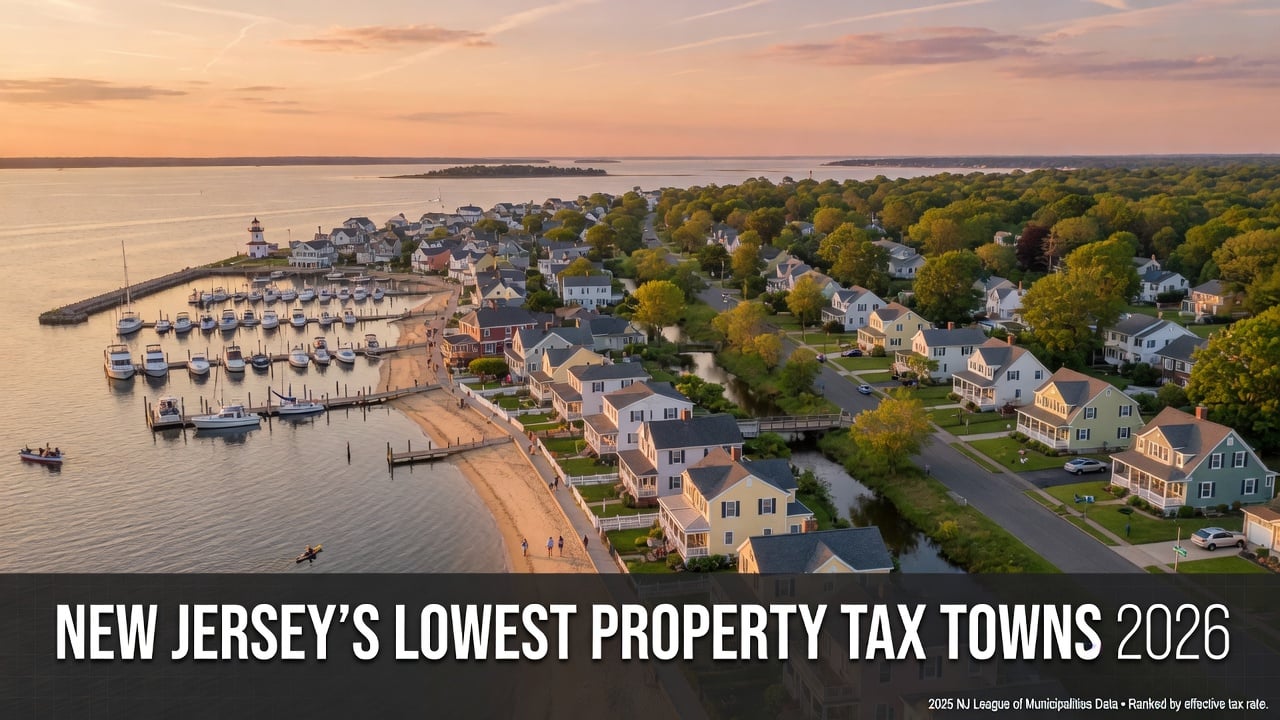
New Jersey's statewide average residential property tax bill landed at $10,095 in 2024, according to NJ Department of Community Affairs MOD-IV data. That figure gets repeated constantly, and it shapes how a lot of buyers think about the state. What gets said less often is how much the distribution around that average actually moves—and how much a well-chosen municipality can shift the math in a buyer's favor.
In Millburn, Essex County, the average bill reached $25,407. In Avalon, Cape May County, the effective tax rate sits at 0.376%—among the lowest in the country for any well-functioning suburb. In Burlington County, the county-portion of the average residential bill was $1,172, well below the statewide county average. These aren't outliers in a system that punishes everyone equally. They're structural positions that reward buyers who understand the levers.
The same logic applies within counties. In Union County, the gap between the highest and lowest-taxing municipalities runs several thousand dollars annually on comparable homes. In Monmouth County, a buyer choosing between two towns five miles apart could be looking at a $3,000 to $5,000 difference in recurring annual cost. Buyers comparing markets across specific Union County townships consistently find that the municipality moves the budget more than the interest rate does.
This guide breaks down what those structural advantages look like—and which specific towns are worth targeting depending on what a buyer actually needs.
02
Two different metrics define property tax burden in New Jersey, and they frequently point in opposite directions. Understanding which one to use for which decision prevents a lot of costly confusion.
The average tax bill is the absolute dollar amount paid by a typical homeowner in a municipality—the number that hits your bank account four times a year. A low average bill can signal a genuinely efficient municipality, or it can simply reflect depressed underlying property values.
The effective tax rate normalizes for those differences. It divides total property taxes paid by aggregate residential market value, producing a percentage that shows how hard a municipality taxes each dollar of real estate—regardless of what that dollar figure is. This is the better tool for comparing cost across markets with different price levels.
In New Jersey, the two metrics diverge sharply. Shore communities in Cape May and Monmouth counties report some of the lowest effective rates in the state—often below 1%—while posting average bills that exceed many inland suburbs, simply because home values are so much higher. Urban municipalities in Cumberland or Salem counties may show low average bills but punishing effective rates. A buyer using only one of these numbers will consistently misread the market.
For buyers making relocation decisions, effective rate matters most when deploying significant equity. Average bill matters most when working within a monthly payment budget. The sections below use both.
03
The municipalities with the lowest average residential tax bills in New Jersey in 2024 all share one trait: the reason their bills are low isn't something that scales to a typical residential buyer. Understanding why is instructive.
| Municipality | County | Avg. Annual Bill (2024)* | What's Driving It |
|---|---|---|---|
| Walpack Township | Sussex | ~$1,156 | Federal/state land (Delaware Water Gap); near-zero population |
| Teterboro Borough | Bergen | ~$1,937 | Teterboro Airport commercial ratables; fewer than 100 residents |
| Camden City | Camden | ~$2,072 | Heavy state transitional aid; very low median assessed values |
| Lower Alloways Creek | Salem | ~$2,330 | Hope Creek and Salem nuclear stations carry the municipal budget |
| Commercial Township | Cumberland | ~$2,840 | Depressed regional assessments; minimal service demand |
| Trenton City | Mercer | ~$3,690 | State aid dependency; low baseline residential values |
| Bridgeton City | Cumberland | ~$3,803 | Average assessed value ~$72k; effective rate is actually high |
The pattern is consistent. Nuclear plants, airports, federal land, and state fiscal intervention suppress bills in ways that have nothing to do with the quality of local governance or the strength of the residential market. In most of these municipalities, the same forces that lower the tax bill also limit resale liquidity, school quality, or basic community infrastructure.
Bridgeton is a useful illustration of the divergence problem: an average bill of $3,803 sounds appealing until you learn the average assessed value is roughly $72,000 and the effective rate is quite high. Low bill, punishing rate. Not the same thing as a low-tax municipality.
The towns worth targeting look different from this list—and they're covered in the sections below.
04
Cape May County's barrier island communities and the Monmouth County shoreline produce the lowest effective property tax rates in New Jersey—not through fiscal restraint alone, but through structural math. Modest year-round school budgets and limited municipal services are distributed across billions of dollars of premium oceanfront real estate. The levy is thin because the base is enormous.
| Municipality | County | Effective Tax Rate (2024)* |
|---|---|---|
| Avalon Borough | Cape May | 0.376% |
| Stone Harbor Borough | Cape May | 0.440% |
| Cape May Point Borough | Cape May | 0.449% |
| Sea Isle City | Cape May | 0.480% |
| Spring Lake | Monmouth | 0.517% |
| Deal | Monmouth | 0.576% |
| Sea Girt | Monmouth | 0.625% |
| Cape May City | Cape May | 0.655% |
| Ocean City | Cape May | 0.665% |
| Longport Borough | Atlantic | 0.698% |
| Mantoloking | Ocean | 0.700% |
A $1,000,000 home in Avalon generates an approximate annual tax bill of $3,760 at a 0.376% effective rate. That same $1,000,000 in certain Essex County municipalities can produce a tax liability exceeding $30,000. The acquisition cost at the shore is real and high—median values in Avalon and Stone Harbor routinely clear $2 million. But for buyers transferring substantial equity from high-tax inland counties, the effective rate math at the shore rewards serious analysis alongside sticker price.
"The shore isn't just a lifestyle move for buyers coming from Essex or Union County—it's often a structural tax reset that changes the long-term cost of holding real estate entirely."
05
For buyers who don't need oceanfront and don't want rural isolation, county selection is the most underused lever in New Jersey property tax planning. The county portion of a tax bill—covering county government, open space, and related services—varies significantly across the state and operates independently of what municipalities and school districts do.
Burlington County has reported the lowest average county-portion property tax in New Jersey for at least five consecutive years through 2024, according to NJ DCA data. In 2024 the county levy on the average Burlington County residential property was approximately $1,172, against a statewide county average of roughly $1,809. That $637 annual differential isn't huge in isolation, but it compounds with typically lower municipal and school levies to make Burlington County municipalities consistently competitive on overall burden compared to northern and central NJ counterparts.
Specific Burlington County municipalities worth examining: Evesham Township, Cinnaminson, Moorestown, Medford, and Mount Laurel all offer established suburban infrastructure, regional transit access, and meaningfully lower aggregate bills than comparable communities in Monmouth, Union, or Morris counties.
Middlesex County offers a different variant of this advantage. Cranbury Township posts the lowest effective tax rate in the county at approximately 1.91%, with strong schools and a tight housing market reflecting that premium. Monroe Township offers large adult community infrastructure, competitive rates for the region, and a well-established senior services network—making it a consistently cited destination for retirees optimizing both tax burden and community amenity.
06
Most buyers don't have the flexibility to reorganize their search around tax optimization alone—they have job locations, school district preferences, and family proximity to account for. Within any given county, though, the spread between the highest and lowest-taxing municipalities is wide enough that it's worth knowing which towns are structurally positioned below their county average.
Union County is one of the higher-tax counties in New Jersey, but the range within it is meaningful. Clark Township consistently reports among the lowest tax rates in the county—a function of a solid commercial ratable base on Route 22 and disciplined municipal budgeting. Fanwood and Scotch Plains both trend below the county's most expensive municipalities, and both offer strong commuter rail access to New York. Springfield runs competitive rates relative to its school district quality. Buyers comparing options across Union County will find that the difference between the highest-taxing and lowest-taxing towns in comparable price ranges can exceed $3,000 annually.
Monmouth County's average bill has climbed above $10,000 following recent reassessment cycles—the county saw average assessed values rise approximately 11.4% in a single year. But variation within the county remains significant. Manalapan Township and Keyport, Matawan, and Aberdeen consistently track below the county average on effective rate, while offering suburban infrastructure and reasonable Raritan Valley or Jersey Shore commute patterns. The shore towns covered above represent the extreme low end of effective rates within Monmouth, but mid-county options offer a more accessible entry point with rates that still beat the inland suburban norm.
Ocean County is structurally positioned below Monmouth and Union on average bills, and it offers some of the most tax-competitive suburban and semi-rural communities in the region. Toms River, Brick Township, and Manchester Township all benefit from large commercial and retail ratable bases along Route 9 and the Parkway corridor, which reduces the residential share of the levy. Manchester Township in particular—home to several large adult communities including Holiday City—has built a well-documented senior services infrastructure alongside some of the more competitive effective rates in the area. For buyers with flexibility on commute who are prioritizing tax burden, Ocean County municipalities represent a value position that rarely gets discussed as clearly as it should be.
Not every shore address requires a $2 million buy-in to access low effective rates. Point Pleasant Beach, Seaside Heights, Lavallette, and Ortley Beach are Monmouth and Ocean County shore communities with significantly lower acquisition costs than Avalon or Stone Harbor, and their effective rates, while higher than the Cape May barrier islands, still sit meaningfully below the inland suburban average. Buyers who want shore proximity with a more accessible price range will find the effective rate advantage present here too, even if smaller in magnitude.
07
There is no single "best" municipality for property taxes in New Jersey—there are better and worse matches depending on what a buyer is optimizing for. Here's how the logic maps across the four most common buyer profiles we work with.
The equity-heavy retiree seeking the lowest long-term rate on capital: Cape May County shore communities are the structural answer. Avalon, Stone Harbor, Sea Isle City, and Cape May Point offer effective rates the rest of the state can't match. Pair that with New Jersey's Senior Freeze, ANCHOR, and Stay NJ programs and the net cost of ownership over a 20-year retirement can be dramatically lower than continuing to hold a paid-off home in Bergen or Essex County at 2%+ effective rates.
The suburban family buying their first or second home: Burlington County municipalities—Evesham, Cinnaminson, Moorestown—or Ocean County communities like Toms River and Brick Township offer the strongest balance of suburban quality of life and below-average tax burden. These are not compromise markets; they're well-functioning suburbs that happen to sit in counties with structurally lower levy pressure.
The NYC-area buyer relocating to Union or Monmouth County: Within these higher-tax counties, Clark, Fanwood, and Scotch Plains in Union County, and Manalapan, Keyport, and Matawan in Monmouth County, consistently represent the lower end of their county's effective rate distribution. Choosing within the county rather than across it limits the disruption to commute and school preferences while still capturing meaningful tax savings. Where buyers from each NYC borough are actually landing shifts this calculus in specific ways worth understanding before narrowing a search.
The veteran with a 100% service-connected permanent and total disability: Location is largely a quality-of-life decision. New Jersey's full property tax exemption eliminates the bill entirely regardless of municipality, making the tax variable moot. Any municipality that fits other criteria is valid—there's no tax-based reason to avoid a higher-rate town.
In every case, verifying the actual current-year tax liability on a specific property—not the listing estimate, not a county average—is the right move before writing an offer. NJ closing costs and ongoing annual tax burden both belong in that calculation from the start.
FAQ
Q
What New Jersey towns have the lowest property taxes for regular buyers?
For buyers prioritizing the lowest effective rate on a premium property, Avalon Borough (Cape May County, ~0.376%) leads the state. For accessible suburban markets with below-average overall bills, Burlington County municipalities like Evesham, Cinnaminson, and Moorestown consistently outperform northern NJ counterparts. Within Union County, Clark Township tracks among the lowest-rate towns in the county. In Monmouth County, Manalapan, Keyport, and Matawan tend to run below the county average on effective rate.
Q
Why do New Jersey shore towns have such low effective property tax rates?
Shore municipalities distribute modest year-round school and municipal budgets across an enormous base of premium oceanfront real estate. Because total assessed value is very high and year-round enrollment is small, the effective rate—taxes as a percentage of value—drops well below 1% in communities like Avalon, Stone Harbor, and Spring Lake. The absolute dollar bill on a $2 million shore property may still exceed what a $400,000 inland home pays, but the rate on capital deployed is structurally lower.
Q
Is Burlington County the most affordable New Jersey county for property taxes?
By the county-levy measure, yes—Burlington County has reported the lowest average county-portion property tax in New Jersey for at least five consecutive years through 2024, per NJ DCA data. In 2024 the county levy on an average Burlington County home was approximately $1,172, versus a statewide county average near $1,809. That structural advantage compounds with lower municipal and school rates to make Burlington County consistently competitive overall.
Q
How do I compare property taxes accurately between two New Jersey towns?
The NJ Department of Community Affairs publishes MOD-IV property tax data annually, including average residential bills and general tax rates by municipality. For cross-market comparisons, effective tax rate—total taxes divided by true market value—is the most useful tool because it normalizes for assessment differences. For a specific property, your county assessor's database shows current assessed value and applicable rate. Always verify the current-year actual bill rather than the estimate on a listing, which may predate a reassessment cycle.
* Average residential tax bill and effective rate data: New Jersey Department of Community Affairs MOD-IV Property Tax Tables, 2024. Effective tax rates are based on aggregate residential class data and may differ from individual property calculations. ** County levy figures: NJ DCA 2024 County Tax Levy data, residential class. *** Statewide average bill: NJ Spotlight News, March 2025, citing NJ DCA. **** Monmouth County assessment increase: NJ DCA county assessment data. All figures are point-in-time snapshots; annual reassessment cycles can move these numbers materially from one year to the next.
Prodigy Real Estate is an innovative real estate company offering high-end video production, home valuation services, purchasing, and home sales. Serving New York and New Jersey.