
Anthony Licciardello | April 1, 2026
New Jersey Shore
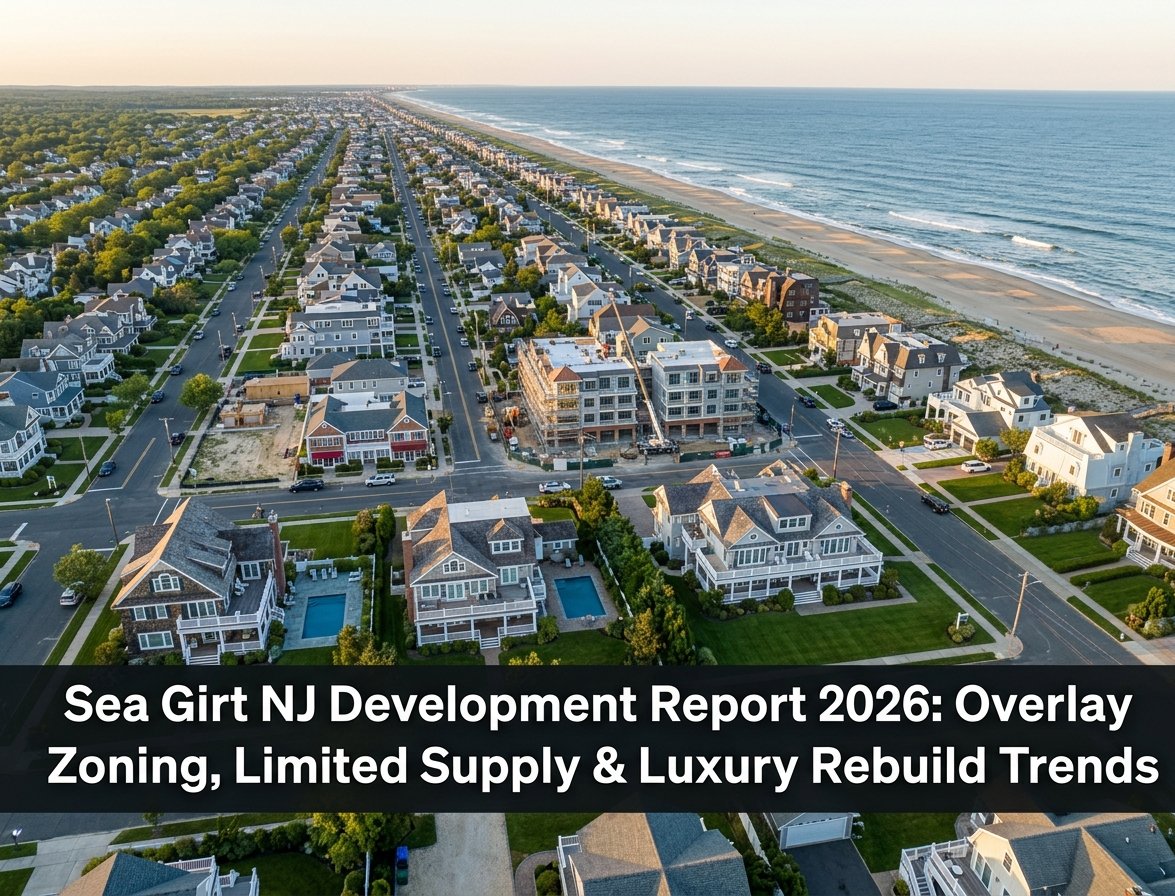
How zoning, scarcity, and teardown economics are quietly shaping one of the Shore's most exclusive markets
Sea Girt doesn't grow. It evolves. A fully built-out borough with formally zero vacant land, it is one of the few markets on the New Jersey Shore where real estate movement is driven entirely by scarcity, regulatory overlays, and high-end redevelopment — not expansion. What makes Sea Girt's story unusual in 2026 is that its development arc is being shaped just as much by affordable housing compliance and state-mandated zoning as it is by luxury teardown activity. Understanding both forces is essential to understanding the market.
This report breaks down where the borough stands today: market conditions, active development categories, zoning mechanics, and what it all means for buyers, sellers, and developers entering Sea Girt in 2026.
Note: Sea Girt's averages fluctuate significantly due to low transaction volume. A single sale above $6M can shift borough-wide statistics materially.
"Sea Girt's inventory sits below two months — a structural constraint, not a cyclical one. This borough was built out by design, and the data reflects it."
Sea Girt is not a pipeline-driven market. There are no condo towers, no multi-phase subdivisions, no ribbon-cutting ceremonies. Activity falls into three distinct categories — each operating under its own economic and regulatory logic.
This is the dominant form of development in Sea Girt — and it tells you everything about how the market is structured. Older coastal homes, many built between the 1940s and 1980s, are being acquired primarily for their land value — typically in the $2M to $3.5M range — then demolished and replaced with new construction ranging from 4,000 to 6,000-plus square feet.
New builds follow a recognizable playbook: FEMA-compliant elevation, reverse living layouts that maximize ocean views, and outdoor living packages with pools and cabanas. End values come in between $4M and $7M-plus depending on proximity to the water. The closer to the ocean, the further the ceiling rises.
```Land Acquisition
$2M – $3.5M
Lot value, older structure
New Build End Value
$4M – $7M+
FEMA-compliant, ocean proximity
In Sea Girt, the structure is often secondary. The lot is the asset.
```Near 5th Ave and Washington Blvd sits one of the most legally significant parcels in the borough. The AH-1 zone — a direct product of a builder's remedy settlement — is one of the only areas in Sea Girt where meaningful density is permitted at all.
The zone allows approximately 19 total units across its parcels, with mixed-use configurations that include a retail component and mandatory affordable housing inclusion. Height allowances reach up to three stories and 45 feet, with building coverage ratios that exceed the borough's typical residential standards.
For developers, this is the rare path to actual density in Sea Girt — but it comes pre-loaded with set-aside obligations and the legacy complexity that builder's remedy projects carry.
Sea Girt's most consequential recent zoning move has been the introduction of overlay districts along the Washington Blvd corridor and Route 71 at 7th Ave. These overlays represent the borough's primary mechanism for absorbing future development pressure while maintaining residential character everywhere else.
Within the overlay zones, three-story mixed-use buildings are permitted — residential above commercial — with a 20% affordable housing set-aside baked in. Building coverage is capped at roughly 40%, with improved lot coverage up to 85%. Outside these corridors, the rest of the borough remains low-density residential with no path to upzoning.
```Max Height
3 stories / 45 ft
Bldg Coverage
~40%
Affordable Set-Aside
20%
Sea Girt's land-use framework is the most important factor in understanding its real estate market — arguably more important than any individual sale price or inventory number. The borough has formally concluded that no meaningful vacant land remains within its borders. Its Realistic Development Potential, as documented in fourth-round affordable housing planning, stands at zero units.
That single fact is the foundation of everything: all growth must come from redevelopment. There is no other path.
Despite its physical constraints, Sea Girt carries a fourth-round obligation of 73 affordable units under New Jersey's Mount Laurel doctrine. The borough's response — overlay zoning, small-scale infill, and compliance-driven redevelopment — is pragmatic given the land reality, but the pressure remains active. It's one of the primary reasons the overlay corridors exist.
Any developer considering a project with five or more units in Sea Girt needs to underwrite these into the pro forma from day one:
For-Sale Projects
20%
Affordable unit set-aside requirement
Rental Projects
15%
Affordable unit set-aside requirement
Sea Girt has been updating rental certificate requirements and raising compliance standards — a signal that the borough is increasing scrutiny around short-term rental usage. For investors, this means higher operational friction and a closer look at how any income strategy is structured. This is not the kind of municipality that allows vacation rental arbitrage to go unmonitored.
"Zero Realistic Development Potential. That's the official number. It's not a complaint — it's a feature. Constrained supply is exactly why Sea Girt values hold."
Sea Girt doesn't announce projects with press releases. Its development activity is quiet and parcel-level. But it's constant. Current signals in the market include a steady flow of variance applications — lot coverage requests, height adjustment petitions, and expansion approvals for existing homes pushing against setback limits. These applications are the borough's real development volume.
Washington Blvd corridor parcels are drawing continued interest from prospective developers, though activation of the overlay zones has been gradual. The affordable housing obligation creates an underlying push — anyone who triggers a qualifying development must include the set-asides, which shapes deal sizing and unit mix from the start.
For buyers watching the market, this parcel-level activity is also the reason why newer homes — with full FEMA compliance, updated construction, and modern floor plans — command the significant premium they do over pre-existing structures. The cost of getting there has never been higher, and the end values reflect it. For more on how Shore market conditions are evolving across Monmouth County, see our Monmouth County market analysis.
No large-scale expansion. No subdivision pipeline. No major rezoning waves coming. The borough has structurally opted out of conventional growth — and that decision functions as a price floor. Every constraint on supply is, by extension, a form of value protection. Compare this to Spring Lake, which operates under a similar built-out dynamic along the northern Shore stretch.
Whatever density Sea Girt absorbs will flow through two channels only: the AH-1 zone and the overlay corridors. Everywhere else remains low-density residential with strong zoning protection. This bifurcation is intentional — it allows the borough to satisfy state housing obligations without altering the residential fabric that defines its character and drives its values.
Between land costs starting at $2M-plus, construction running $400 to $650 per square foot, and layered zoning restrictions, only two types of market participants can realistically operate in Sea Girt: high-net-worth buyers and experienced developers with the capital and patience to navigate entitlement risk. That compression at the entry point is itself a market signal — it tells you who's competing for Sea Girt assets and why prices hold even in soft cycles.
Sea Girt is transitioning into what the data shows is a controlled, compliance-driven luxury market: development allowed, but only in very specific formats. Zoning used as a filter, not a facilitator. Supply permanently constrained by design. That combination is one of the strongest long-term appreciation setups on the Jersey Shore.
Developers
Target overlay zones. Outside of them, entitlement risk is high and variance approvals are not guaranteed.
Investors
Underwrite regulatory friction from the start — rental compliance requirements and set-aside obligations are structural, not negotiable.
Buyers
Expect continued upward pressure. Zero-expansion markets do not produce buyer's markets without a macro catalyst — and Sea Girt's fundamentals are insulated from most of them.
Navigating the Sea Girt Market
Prodigy works with buyers, sellers, and developers across the Monmouth County Shore market — including Sea Girt, Spring Lake, and Red Bank. If you're evaluating a move, a teardown acquisition, or a development opportunity, let's talk strategy.
Connect With THE Prodigy TeamProdigy Real Estate is an innovative real estate company offering high-end video production, home valuation services, purchasing, and home sales. Serving New York and New Jersey.