
May 8, 2026
Middlesex County
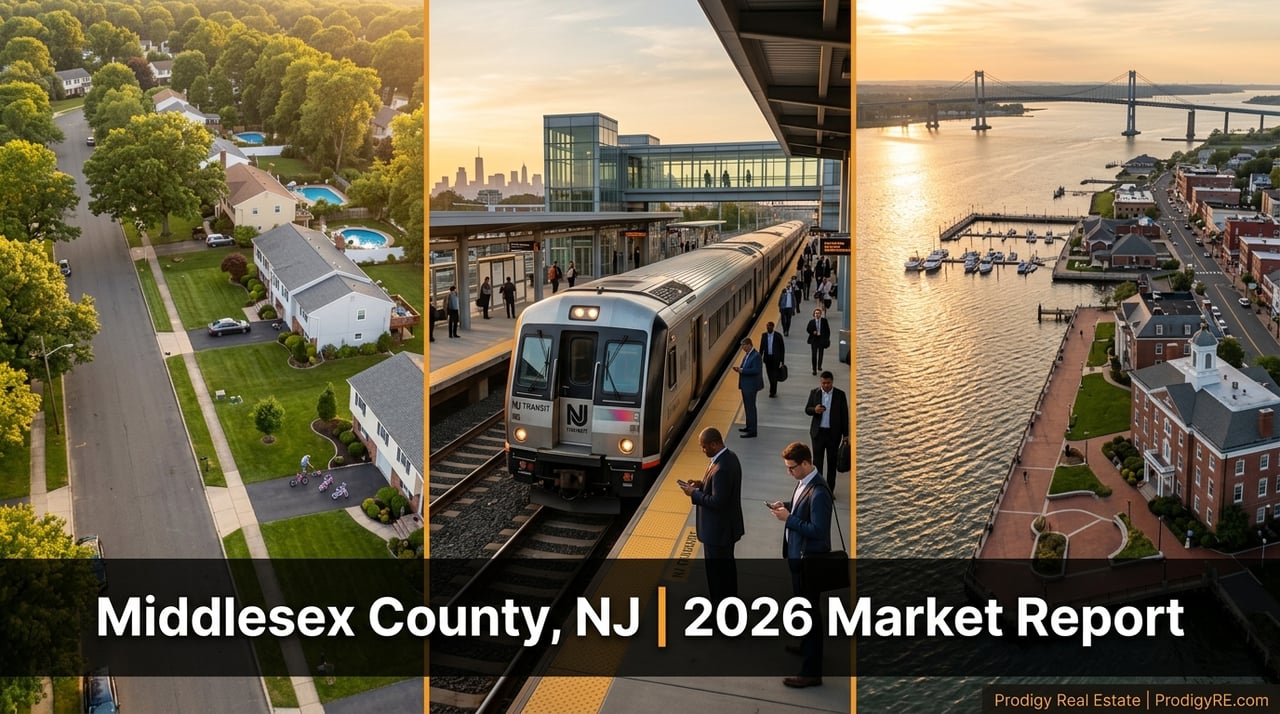
The Middlesex County NJ real estate market entered 2026 in a position that will feel familiar to anyone who has been watching Central Jersey over the past several years: not enough homes, too many buyers, and sellers who have finally accepted the rate environment and started listing again. That combination has kept conditions firmly in seller's territory despite a meaningful inventory recovery underway across the county.
Single-family home prices are tracking near $575,000 for closed sales in early 2026, up roughly 4% year-over-year. That number shifts significantly depending on the municipality — Princeton and Cranbury are running well above $900,000, while South Amboy and Perth Amboy remain accessible entry points under $400,000. But the county-wide trajectory is consistent: prices are rising, and the underlying demand holding them up is structural, not cyclical.
What has changed from the pandemic era is the pace and the temperament. New listings surged substantially year-over-year as sellers who had been locked into sub-3% mortgages began accepting the rate reality and returning to market. More supply is arriving. The absorption rate, however, has not given buyers much relief. Total active inventory sits near 1.4 months of supply — the same figure that defined an extreme seller's market during the frenzy years. A balanced market requires six months of inventory on hand. Middlesex County has not been close to that in years, and it is not close now.
Homes that are priced correctly and presented well are still generating multiple offers in Edison, Woodbridge, East Brunswick, and Metuchen. Competitive listings in those markets are regularly closing at or above list price. Days on market have crept higher than pandemic-era lows, and the spread between aggressive sellers and patient ones has widened. A well-priced, turnkey home in a strong school district moves in a matter of weeks. An overpriced listing in the same town can sit for two months. That gap is the defining behavioral shift in this market: buyers are disciplined now. They have data, they have more options than two years ago, and they are not panicking. But when the right home appears at the right price, competition is immediate and the window is short.
For renters, the picture is tighter than the for-sale numbers suggest. Vacancy rates for newly upgraded single-family rentals and luxury multi-family units remain extremely low across the county. New construction rental product — particularly in New Brunswick and Woodbridge — is leasing up quickly, keeping upward pressure on rents even as more units come online. The two are connected: when would-be buyers stay on the sidelines waiting for the right home, they compete for the same rental supply, keeping that market just as constrained.
The inventory shortage and price appreciation in Middlesex County are not accidents of the market cycle. They reflect something more durable: a fundamental shift in where New Jersey's highest-earning workers want — and need — to live. Over the past several years, a significant wave of biotechnology, pharmaceutical, and life sciences companies has been relocating or expanding from higher-cost coastal hubs into Central New Jersey. This is not pandemic-era remote work. It is employment-driven migration anchored to physical workplaces in places like New Brunswick, Piscataway, and North Brunswick.
The institutional infrastructure enabling this shift is real and deeply established. Rutgers University, Johnson & Johnson's global headquarters presence, and Robert Wood Johnson University Hospital give this corridor a research and life sciences ecosystem that most counties in the country cannot replicate. Companies moving into the region are not making speculative bets — they are locating next to the talent pipelines and research institutions they need. And the workers following those companies are high-income professionals seeking housing in sophisticated suburban settings with transit access and quality amenities.
The ripple effect is measurable. Communities within roughly 15 miles of the New Brunswick innovation corridor — including Edison, North Brunswick, Metuchen, and Piscataway — have all seen sustained buyer and renter demand that tracks closely with the institutional expansion underway in the urban core. As more phases of the Health + Life Science Exchange (HELIX) campus come online and Nokia Bell Labs settles into its new New Brunswick headquarters, that demand will only intensify. The innovation migration is not a trend. It is the new structural baseline for this county's housing market, and buyers who understand that are positioning themselves accordingly.
The most consequential real estate development in Middlesex County is not a residential tower. It is the Health + Life Science Exchange — the HELIX — a three-building, 1.5-million-square-foot innovation campus being assembled on four acres in the heart of downtown New Brunswick, directly across from the NJ Transit train station. Developed by the New Brunswick Development Corporation (DEVCO), the campus is the physical anchor of the county's innovation economy and the single most significant driver of residential demand in the city.
The first phase — a 574,000-square-foot tower housing Rutgers Robert Wood Johnson Medical School, a Rutgers translational research facility, and the New Jersey Innovation Hub — is substantially complete. The second phase, a 370,000-square-foot home for Nokia Bell Labs, broke ground in 2024 as part of a joint venture between DEVCO and SJP Properties, representing Nokia's relocation from its longtime Murray Hill campus. The third and final phase, known as H-3, was approved in March 2026: a 39-story, 563,000-square-foot tower featuring 265 residential units, Rutgers School of Medicine student housing, advanced research space, and Middlesex County government offices, supported by $359 million in NJEDA Aspire tax credits. Total investment across all three phases is projected to exceed $2 billion, with full campus completion targeted for 2028. For residential buyers and renters in New Brunswick, this is the engine behind everything happening in the city right now.
Directly complementing the HELIX's professional and academic draw is The Liv, a 24-story, 407-unit luxury residential tower being developed by Weiss Properties at 40 Livingston Avenue. The project involves the demolition of a nearly century-old building that has housed the local Elks Lodge — both the Elks and the George Street Co-op will have ground-floor homes in the new building — and replaces it with the most ambitious purely residential project in New Brunswick's modern history.
The Liv caters directly to the professional demographic arriving with the HELIX. The tower includes 355 covered parking spaces, a resort-style rooftop pool, a fitness center with Equinox-caliber equipment, a golf simulator, coworking spaces, and a panoramic penthouse-level amenity floor. There are no affordable units in the building. It is a market-rate signal about where New Brunswick's residential ceiling is heading.
The Liv will set a new pricing benchmark when it delivers, but the existing rental market is already running well above national norms. Per closed-sale and listing-side rental data compiled by RentCafe and Yardi Matrix as of early 2026, New Brunswick renters are paying an average of approximately $2,400–$2,600 per month across all unit types — roughly 30 to 35% above the national average. The breakdown by unit size reflects the city's heavily professional renter base.
| Unit Type | Avg. Size | Avg. Monthly Rent (2026) |
|---|---|---|
| Studio | ~513 sq ft | ~$1,832 |
| 1 Bedroom | ~768 sq ft | ~$2,432 |
| 2 Bedroom | ~1,060 sq ft | ~$2,805 |
| 3 Bedroom | ~1,265 sq ft | ~$3,212 |
| *Rental data: RentCafe/Yardi Matrix market analysis, February 2026. Reflects buildings of 50+ units. | ||
To live comfortably under the standard 30% rent-to-income guideline at New Brunswick's current one-bedroom average, a renter needs to be earning roughly $97,000 per year. That number tells you everything about who this market is increasingly being built for. As The Liv and the HELIX H-3 residential component deliver new luxury supply over the next two years, the upper end of the market will push higher. The entry-level rental stock will remain competitive because demand at that tier consistently outpaces supply.
Roughly 12 miles from New Brunswick along the Raritan River, the most ambitious private development in New Jersey history is going vertical. Riverton is a $2.5 billion, 418-acre mixed-use community being built on the former National Lead industrial site in Sayreville — a brownfield that sat contaminated and dormant for decades before developers North American Properties and PGIM Real Estate transformed it into what will eventually become a full-scale waterfront destination.
The scale is hard to fully picture. At build-out, Riverton will include approximately 1,300 residential units (20% affordable, per the terms of the project's $400 million NJEDA Aspire tax approval), over a million square feet of retail and commercial space, multiple hotels, a 200-slip marina, and two miles of waterfront boardwalk along the Raritan River. Access is provided through full interchanges off the Garden State Parkway, Route 9, and Route 35, placing the site at one of the most trafficked highway intersections in the state.
For buyers and renters watching Sayreville's trajectory, the near-term signal to watch is the anchor tenant: Bass Pro Shops, at approximately 200,000 square feet the largest single-level Bass Pro in the United States, is expected to open in summer 2026. Construction has been visible from the Driscoll Bridge since early 2025. When Bass Pro opens, it will mark the first completed Phase 1 retail component and begin Riverton's transformation from a development story into a functioning destination. The residential component will follow in phases over what the developers themselves describe as a 10-plus year buildout. This is a long-cycle play — but the foundation is now being poured.
Sharing the Arthur Kill waterway with Carteret and facing Staten Island across the water, Perth Amboy is executing its own dramatic waterfront reinvention. In January 2026, the Perth Amboy Planning Board approved Sea Gate — a $200 million waterfront neighborhood plan developed by Kushner Companies on a 15.75-acre former brownfield site that the city had been unable to develop for years.
The plan calls for 602 market-rate rental units across five buildings, constructed over approximately three years. Every unit is market-rate — Kushner is contributing $1 million separately toward affordable housing elsewhere in the city as part of the deal structure. Public amenities funded by the developer include a tree-lined esplanade running nearly a half-mile along the Arthur Kill waterfront, a playground, landscaped plazas, and a dog park accessible to all Perth Amboy residents, not just Sea Gate tenants. The site includes 909 parking spaces and at least 5,000 square feet of ground-floor retail and restaurant space with waterfront views.
The financial mechanics are worth noting for anyone tracking Perth Amboy's growth trajectory. The city is executing a 35-year PILOT agreement under which Kushner pays roughly $1.2 million annually — compared to the $113,000 in net annual revenue the same properties were generating before the deal. That is more than a tenfold increase in fiscal return from a parcel that was sitting unused. The city purchased the properties back from Kushner for $4.6 million as part of the transaction, and the developer purchased them back under the redevelopment agreement. Architect Minno & Wasko — the same firm behind The Liv in New Brunswick — is handling design. Construction is expected to begin in 2026.
Not every major development story in Middlesex County involves a waterfront brownfield or a nine-figure institutional campus. Two of the county's most compelling housing markets in 2026 are inland boroughs that have been systematically investing in their downtowns for years — and are now reaping the demand that follows.
Woodbridge Township operates one of the most aggressive redevelopment pipelines in New Jersey, with 36 active pre-construction and construction projects currently being managed by the municipal Redevelopment Agency — nine focused on residential housing and two on major commercial uses. A mild 2025–2026 winter allowed foundational and framing work in the downtown corridor to advance ahead of schedule.
The residential anchor of the Woodbridge revival is Vermella Woodbridge, a luxury multi-family community that represents the new pricing floor for professionally managed rentals in the township. Base market rents at Vermella run from approximately $1,565 for studios to $3,500 for two-bedroom units, with availability across both immediate move-in and mid-2026 delivery dates. To support the density of new residential arrivals, the municipality is engineering two large centralized parking decks and funding comprehensive streetscape improvements through the Downtown Special Improvement District, including façade rehabilitation grants for legacy storefronts and public plaza upgrades at Parker Press Park.
Metuchen's transformation from a pass-through commuter stop into a genuine destination borough has been one of the more underreported real estate stories in Central New Jersey. The success of Woodmont Metro at Metuchen Station delivered critical residential mass to the downtown, and what followed was a full revival of local retail and dining that permanently altered the borough's economic identity.
In early 2026, the Borough Council and Planning Board finalized a sweeping update to the municipal Master Plan — the first comprehensive ground-up revision since 1983. The updated Land Use Plan Element reflects a decisive shift away from legacy industrial zoning toward mixed-use densification and residential quality improvement. That shift is backed by a $4.5 million infrastructure bond and a 50-year high in local police staffing to ensure public safety keeps pace with a denser environment.
For buyers and renters, the Metuchen story is most relevant as a pricing signal. As investment follows the master plan update — particularly through adaptive reuse of existing commercial spaces along the downtown core — property values in the borough will continue to rise. Metuchen has also successfully resolved its affordable housing compliance obligations with the state, which removes the risk of court-mandated builder's remedy lawsuits forcing unwanted high-density development. That is a meaningful long-term stability signal for anyone buying in the borough. For a broader look at how New Jersey closing costs factor into your total purchase budget in markets like these, see our full 2026 buyer guide.
The southern tier of Middlesex County — less dense, more land-rich, and deeply connected to the Shore via the Garden State Parkway — has emerged as the undisputed epicenter of 55+ active adult community development in New Jersey. Monroe Township and Old Bridge are both hosting large-scale new construction aimed at the aging baby boomer cohort: a demographic that wants to remain in New Jersey, shed the burdens of property maintenance, and gain access to resort-caliber amenities without relocating to Florida.
The product being built here is meaningfully different from prior generations of active adult housing. These are not retirement facilities. They are master-planned communities with pools, fitness centers, pickleball courts, clubhouses, and professionally managed social programming — designed to attract active 55-and-older buyers who are downsizing from larger single-family homes but are not ready to reduce their quality of life in the process. National builders with scale and deep experience in the segment are active across both townships, and new phases are consistently absorbing quickly in the current environment.
The pricing dynamic in this segment offers one of the more interesting entry points in the county right now. Adult community median prices have seen softer year-over-year appreciation compared to the conventional single-family market, and days on market have been slightly elevated in some sub-segments. For a buyer in the right life stage, that relative softness — in an otherwise tight county-wide market — represents a real opportunity. For context on how Middlesex County's active adult growth fits into the broader Central Jersey demand picture, our NJ communities hub covers the key municipalities in detail.
Q
What is the median home price in Middlesex County in 2026?
Single-family home prices in Middlesex County are tracking near $575,000 for closed sales in early 2026, up roughly 4% year-over-year. Prices vary significantly by municipality — from under $400,000 in South Amboy and Perth Amboy to well over $900,000 in Princeton and Cranbury. Townhouses and condos run lower on average, making them an important entry point for first-time buyers in the county.
Q
Is Middlesex County a buyer's or seller's market right now?
It is firmly a seller's market. Active inventory sits at approximately 1.4 months of supply — far below the six months that defines a balanced market. Well-priced homes in desirable towns like Edison, Woodbridge, and Metuchen are still generating multiple offers. Buyers have more options than during the pandemic peak, but the fundamental supply shortfall has not resolved. Strategic pricing and strong presentation remain essential for sellers, and buyers should be pre-approved and prepared to move quickly on the right home.
Q
Which Middlesex County towns are seeing the most new housing development?
New Brunswick leads the county with the HELIX campus and The Liv tower driving both residential supply and rental demand. Sayreville is seeing its first major vertical construction in decades through Riverton. Perth Amboy's Sea Gate project is adding 602 waterfront rentals. Woodbridge has 36 active redevelopment projects in its pipeline. Monroe Township and Old Bridge are the dominant markets for 55+ active adult new construction in the state.
Q
Are rents rising in Middlesex County in 2026?
Yes, and the increases are most pronounced in New Brunswick, where the innovation economy is driving demand from high-income professionals. Average rents in New Brunswick are running 30 to 35% above the national average, with one-bedroom apartments averaging approximately $2,400 per month and two-bedrooms approaching $2,800. Woodbridge luxury rentals are tracking in a similar range for new construction product. Vacancy rates for newly upgraded units across the county remain extremely low, and that imbalance is not expected to resolve until more supply comes online in 2027 and 2028.
Middlesex County's housing market is not showing signs of softening in any meaningful way. The inventory shortfall is real, the demand drivers are structural, and billions in new development — from waterfront brownfields in Sayreville and Perth Amboy to innovation towers in New Brunswick — are reshaping what this county looks like and who it is attracting. That is not a temporary condition. It is a decade-long realignment.
For buyers, the most important strategic decision is understanding the difference between markets that are moving fast and markets that are worth moving fast for. Edison, Woodbridge, and Metuchen are competitive because they offer proven school districts, transit access, and community infrastructure that holds value through cycles. New waterfront communities like Sea Gate and Riverton offer a different calculus: they are being built from scratch in locations that have been undervalued for decades, and early positioning in those markets comes with both upside and a longer patience horizon.
For renters, the New Brunswick and Woodbridge markets are increasingly being set by new luxury construction, and that pricing is spreading outward. If you are budgeting for a move to Middlesex County, the realistic floor for new construction one-bedroom product in desirable locations is $2,400 per month and rising. Stretching your search to Metuchen, North Brunswick, or South Brunswick can still offer meaningful value relative to the New Brunswick core.
For anyone thinking about what drives all of this — the institutional capital, the PILOT structures, the life sciences investment strategy, and what it means for investors and developers — the commercial and institutional development pipeline tells the full story. If you are tracking the broader Central Jersey market, our Middletown NJ market report covers the Monmouth County side of the same demand corridor, and our Jersey City 2026 market report provides useful context on the metro region dynamics pushing buyers into Central New Jersey in the first place. The Prodigy team covers both sides of the Hudson — reach out when you are ready to move.
Prodigy Real Estate is an innovative real estate company offering high-end video production, home valuation services, purchasing, and home sales. Serving New York and New Jersey.