
Anthony Licciardello | July 21, 2026
Short Hills, NJ
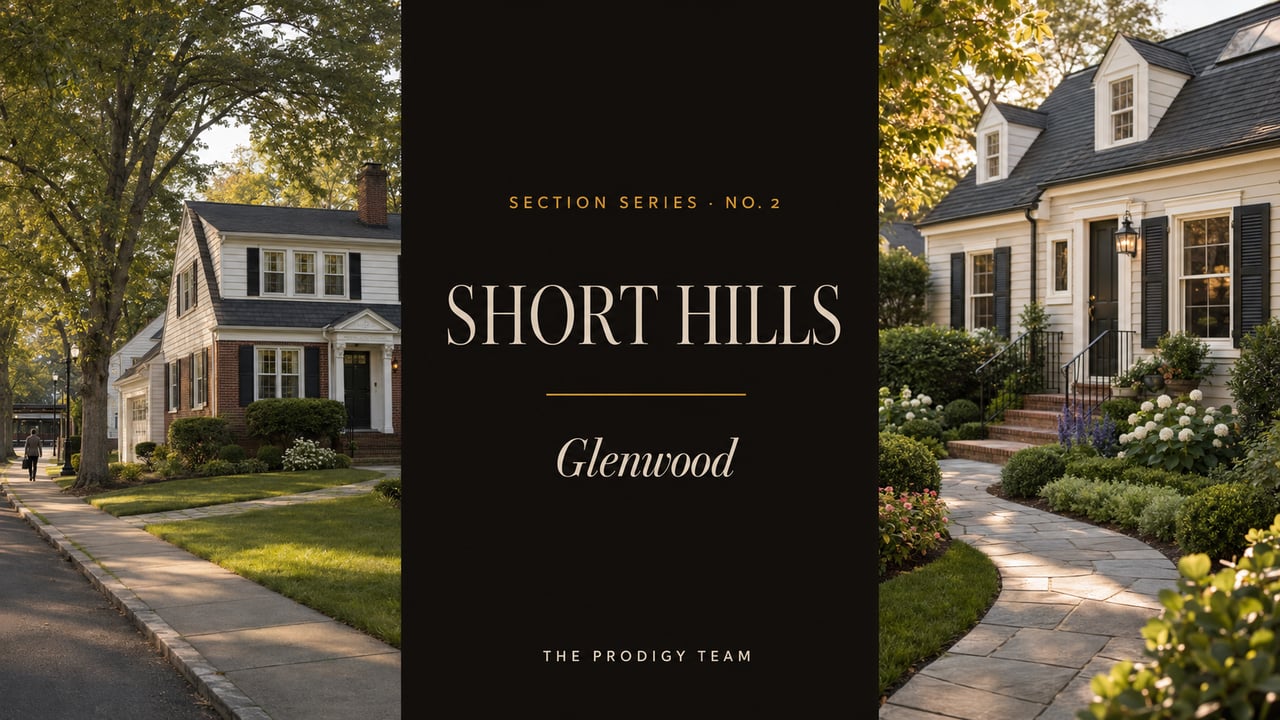
Every prestige town has a door, and Glenwood is Short Hills’: the compact mid-century section by the station and the schools where the address’s full bundle — the one-seat train, the banner district, the ZIP code — is bought at its minimum ticket. The verified September 2025 entry print was $1,490,000 for a 1952 three-bedroom. This is the complete brief on what that ticket buys, what the street data actually shows, and who wins here.
Glenwood is the station belt’s working door: detached single-family stock — predominantly colonials and capes of three to six bedrooms from the 1940s and 1950s — on the township’s most compact lots, with two independent street datasets agreeing on the profile: Lupine Way’s 31 properties average 0.23 acres, a 1944 build year, a $1.24 million assessment, and $23,039 in annual taxes, while Inwood Road’s 10 properties average 0.17 acres and $17.6K. The anchors are the section’s namesake Glenwood Elementary and the Short Hills station — parts of the section sit a genuine quarter-mile from the platform.
The verified market: 11 Inwood Road — a 1952 three-bedroom of 2,494 square feet — closed at $1,490,000 ($597 per square foot) on September 19, 2025, the section’s cleanest recent entry-tier print, double-confirmed across MLS-fed platforms. Model estimates on Lupine Way cluster between roughly $1.67 and $1.85 million, against 1991–2001 purchase prices of $305,000–$716,000 — a long-tenured equity base that keeps supply thin and makes every well-priced Glenwood listing a competition. In a town whose trailing median just printed $2.4 million, this is where the first-time Short Hills buyer actually gets in.
Every family that eventually buys the estate interior tends to tour Glenwood first — and a meaningful share, having done the math, simply stays. This is Post No. 2 of our Section Series, the door-side companion to our Knollwood brief: where Knollwood sells the founder’s provenance at a $3.6 million ceiling, Glenwood sells the identical district, the identical train, and the identical ZIP at the township’s most attainable numbers. The map of all nine sections lives in our neighborhoods guide; this is the deep read on the one most buyers meet first.
Glenwood’s role in the township’s architecture is structural: it is the section where Short Hills’ two priced assets — the one-seat train and the banner district — are bundled at the smallest possible package. Recent sold listings in the section advertise the geography plainly: two-tenths of a mile to the station, seven-tenths to Glenwood Elementary, with downtown Millburn’s shops and the Paper Mill a stroll beyond. In a township where commuter parking is gated to residents and waitlisted even then, that walkability is not lifestyle garnish — it is the section’s core economic product.
The buyer pool follows the product: first-time Short Hills purchasers converting from Hoboken, Maplewood, and the brownstone belt; train-first households counting seats; and right-sizers who want the district and the walk without estate-scale grounds. Which means Glenwood’s competition profile is the township’s broadest — more qualified bidders per listing than any other section — and its well-priced homes clear accordingly.
The fabric is postwar America at its most orderly: detached colonials and capes, mostly three to six bedrooms, built in the 1940s and 1950s (Lupine Way averages 1944; the verified Inwood print is a 1952 build) on rectangular lots of roughly a sixth to a quarter acre — the township’s most compact band, a fraction of the ~0.7-acre knoll parcels one section over. Streets are neat rather than winding, sidewalks connect, and the scale is neighborly: this is the corner of Hartshorn’s town that developed after Hartshorn, on conventional planning logic, for the commuting middle class the trains kept delivering.
The upgrade wave is the modern story: the section’s stock is steadily being renovated, expanded, and in cases fully rebuilt — nearby comparables tout 2024 expansions with open plans, quartzite kitchens, and en-suite additions — because Glenwood’s land-to-location math rewards improvement: the lot may be compact, but it sits on the township’s most valuable convenience radius. For buyers, that means the section offers the township’s widest condition spectrum, from original-condition capes to like-new product, and pricing tracks that spectrum tightly.
The cleanest recent recorded sale: 11 Inwood Road, $1,490,000 on September 19, 2025 (GSMLS #3978124) — three bedrooms, four baths, 2,494 square feet, built 1952, $597 per square foot, confirmed independently across two MLS-fed platforms with Glenwood Elementary as its assigned school. That is the section’s honest entry arithmetic in one line: seven figures, well under the town’s $2.4 million trailing median, for the full Short Hills bundle in original-era packaging.
Above the entry prints sits the model band:
Source: Redfin automated value estimates, spring 2026, on three long-tenured Lupine Way properties — models, not appraisals or sales, shown as one consistent measure. Their prior recorded purchase prices (1991–2001) illustrate the section’s equity base; the ~$1.86M average of comparable recent sales cited by the same platform corroborates the band’s top.
Now the detail that makes Glenwood the perfect classroom for our tax analysis: Lupine Way’s average assessment is $1,241,293 — while model values on the same street run $1.67–1.85 million. That gap is Essex County’s 2017 revaluation time capsule made visible on a single block, and it carries both messages every Glenwood buyer needs: today’s ~$23,000 average Lupine tax bill (Inwood averages $17.6K) is computed on yesterday’s values, and the expected ~2029 revaluation will re-measure exactly this spread. Model the bill at your purchase price; treat the current figure as the introductory rate it functionally is. And note the tenure math underneath everything: owners who bought at $305K–$716K are sitting on twenty-plus years of equity, sell only when life requires it — and that is why Glenwood inventory is scarce even at the township’s highest turnover-demand section.
Glenwood fits three buyers precisely. The first-time Short Hills household buying the district and the train at the minimum ticket, with the option to expand the house as equity builds — the section’s renovation wave is exactly this cohort, one cycle ahead. The train-maximalist, for whom the quarter-mile walk beats any acreage — the same seat-count logic our commute brief prices. And the right-sizer trading estate-interior grounds for walkable everything without leaving the township. If instead your priorities run to provenance and land, the Knollwood analysis is your next read — same series, opposite trade.
Winning here is a preparation game played against the township’s deepest bidder pool: underwritten financing before the first tour, the condition spectrum priced honestly (original-condition capes and 2024 rebuilds are different purchases sharing a street), the tax bill modeled at your price against the 2017 rolls, and speed — because the section’s scarce, well-priced listings are exactly what the town’s 33-day average clears fastest. Track the pipeline with the current Short Hills homes for sale, watched weekly — in Glenwood, the buyers who win are simply the ones who were ready the week it mattered.
“Glenwood is where I take every family who thinks they can’t afford Short Hills — and half of them leave with a plan. A 1952 colonial at a quarter-mile from the platform isn’t the consolation prize; it’s the same district, the same train, and the same ZIP as the $4 million knoll, bought at the door price. The estate can come later. The address starts here.”
— Anthony Licciardello, Broker, The Prodigy Team
Every guide on this site is part of a system: town-by-town content clusters, dedicated neighborhood pages, and cross-state marketing engineered for one outcome — putting your listing in front of the motivated New York families already searching for it. I’m Anthony Licciardello, Broker of The Prodigy Team — a former Director of Community Affairs in the Bloomberg Administration and a member of the Staten Island Growth Management Task Force — and this pipeline is what 22 years and 5,000 closings taught me to build.
Our Above the Streets cinematic drone series extends that reach — aerial storytelling that markets entire towns, not just listings, with audience performance exceeding industry benchmarks for real estate media.
Anthony Licciardello · Broker, The Prodigy Team · 718-873-7345
Tell us your number and your timeline — we’ll watch Glenwood’s thin pipeline, price the condition spectrum honestly, and have you prepared the week the right one lists.
How much do homes in Glenwood, Short Hills cost?
The verified recent entry print is $1,490,000 — 11 Inwood Road, a 1952 three-bedroom of 2,494 square feet ($597/sq ft), recorded September 19, 2025 — while model estimates on long-held Lupine Way homes cluster between roughly $1.67 and $1.85 million. That positions Glenwood well under Short Hills’ $2.4 million trailing town-wide median: it is the township’s value door.
What are homes in the Glenwood section like?
Detached mid-century colonials and capes of three to six bedrooms — core build years in the 1940s and 1950s — on the township’s most compact lots (street averages of 0.17–0.23 acres), along neat sidewalked streets near Glenwood Elementary and the Short Hills station. The stock spans the township’s widest condition spectrum, from original-era capes to fully expanded 2024 rebuilds.
How close is Glenwood to the Short Hills train station?
Genuinely close — recent sold listings in the section advertise distances of about two-tenths of a mile to the station and seven-tenths to Glenwood Elementary. In a township where commuter parking is resident-gated and waitlisted, that walk is the section’s defining economic asset.
What are property taxes like in Glenwood?
Street averages run about $23,039 on Lupine Way and $17.6K on Inwood Road — computed on 2017-era assessments (Lupine’s average assessment is $1.24 million versus model values of $1.67–1.85 million). Buyers should model the bill at their purchase price and understand the expected ~2029 Essex revaluation, which our Short Hills tax analysis covers in full.
Knollwood, Short Hills: The Founder’s Quarter (Series No. 1)
Short Hills Neighborhoods: Nine Sections, Three Bands
Moving to Short Hills, NJ: The Complete Guide
Short Hills Property Taxes: The 2017 Time Capsule
Recorded sale: 11 Inwood Road ($1,490,000, September 19, 2025, GSMLS MLS #3978124; 3BR/4BA, 2,494 sq ft, built 1952, ~$597/sq ft) confirmed across two independent MLS-fed platforms (Redfin and Homes.com), with Glenwood Elementary school attribution. Street-level data: Lupine Way (31 properties; average assessment $1,241,293; average tax $23,039; average lot 0.23 acre; average build 1944) per Ownerly public-records aggregation; Inwood Road (10 properties; average lot ~0.17 acre; average tax $17.6K) per Redfin street records — two independent datasets. Model estimates on 295, 300, and 328 Lupine Way (with 1991–2001 recorded purchase prices) per Redfin automated valuations, spring 2026 — models, not appraisals. Section composition (detached single-family; Colonial-style 3–6BR; historical entry descriptions) per MLS-fed local market pages; station and school distances per recent sold-listing records. Town-wide context (trailing median $2,404,375, +11%; 154 sales; 33-day average) per Homes.com, 2026. Verify all figures independently before transacting. This post is general information, not an appraisal.
Prodigy Real Estate is an innovative real estate company offering high-end video production, home valuation services, purchasing, and home sales. Serving New York and New Jersey.