
Anthony Licciardello | April 18, 2026
Freehold, NJ
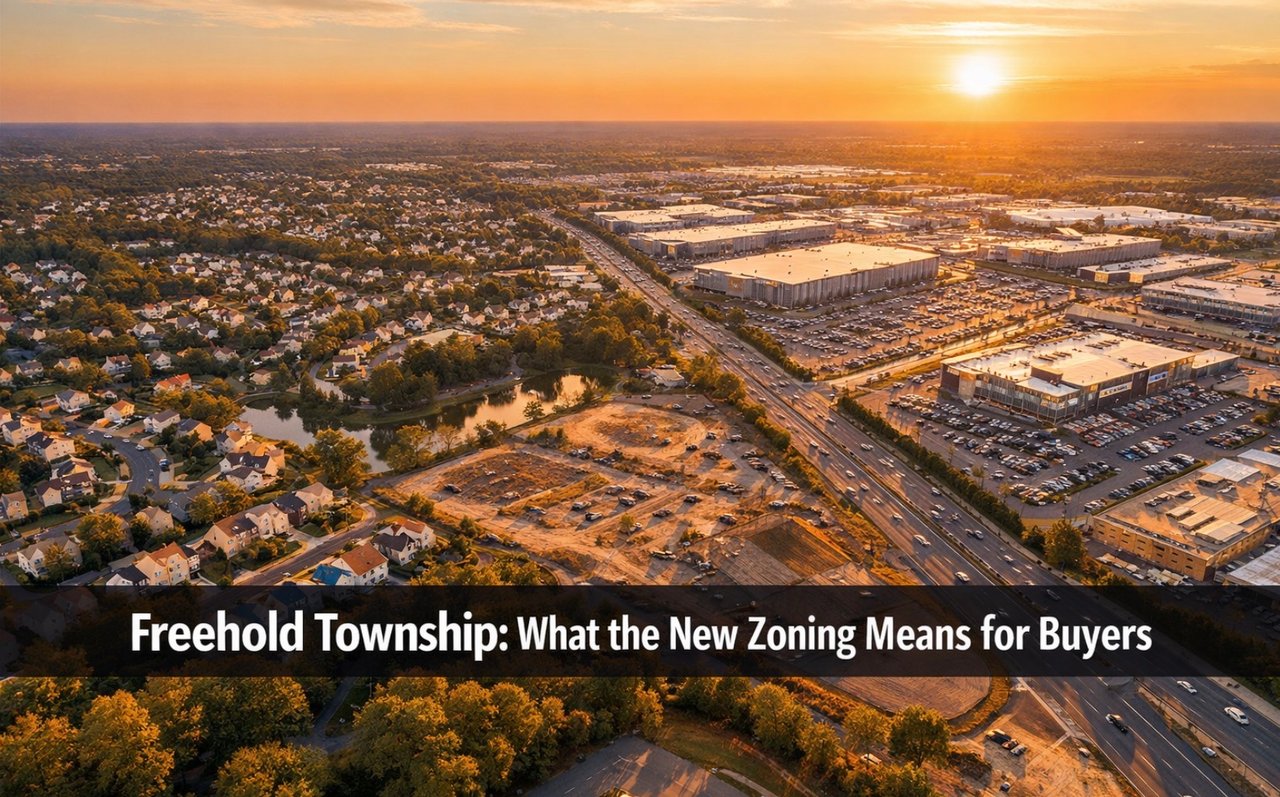
POLICY & MARKET CONTEXT
Most buyers searching Freehold Township in 2026 are focused on the right things — price, schools, lot size, commute. What almost none of them are tracking is the legal framework that is actively reshaping the township's zoning map right now and will determine what gets built within a mile of their future home over the next decade.
That framework is the Mount Laurel doctrine. In New Jersey, every municipality has a constitutional obligation to provide realistic opportunities for the development of low- and moderate-income housing within its borders. This isn't a voluntary commitment or a federal grant program. It's a state Supreme Court mandate, first established in 1975 and enforced through a cyclical judicial process that has required every NJ municipality to recalculate and resubmit its housing obligation multiple times since. Freehold Township is currently in the Fourth Round of that process — the most recent and most consequential cycle.
Why does Freehold Township's obligation matter more now than it did five years ago? Because the township got significantly wealthier. As covered in our Freehold NJ market report for 2026, the township's total ratable base expanded from $6.5 billion in 2019 to a preliminary $10.64 billion for the 2026 tax year — nearly 60% growth in seven years. That wealth accumulation, driven by sustained residential appreciation, directly increases the municipality's calculated Mount Laurel obligation. The richer the tax base, the larger the housing mandate the courts expect the municipality to accommodate.
■ THE ENFORCEMENT MECHANISM
Builder's remedy is the legal tool most NJ buyers have never heard of — and the one township officials think about constantly. Here is how it works.
When a municipality fails to secure judicial approval of a Mount Laurel compliance plan — or fails to meet a court-imposed deadline — it loses what is called builder's remedy immunity. Without that immunity, any private developer can file suit against the municipality and propose a residential development project that completely bypasses local zoning. The developer doesn't need a variance. They don't need the planning board's blessing. As long as a designated percentage of the proposed units are priced as affordable housing, the developer can argue in court for the right to build at a density the municipality would never voluntarily approve — think five-story multifamily complexes in corridors currently zoned for single-family homes on one-acre lots.
Township administrators have been explicit about this dynamic. The motivation driving these lawsuits is financial, not philanthropic. A builder's remedy action is a profitable strategy: propose a high-density project, include the required affordable percentage, and use the state's mandate to override every local objection. The municipality that loses builder's remedy immunity has almost no recourse once a developer files. It is forced to litigate a project it didn't want, often in front of a court that views the municipality's prior planning failures as evidence it doesn't deserve to win.
This is why the March 15, 2026 deadline was treated by the Township Committee as an absolute hard stop. The cost of missing it — measured in lost zoning control, legal exposure, and forced density — was far higher than the political friction of adopting new overlay zones and a spending plan on an aggressive timeline.
■ WHAT THE TOWNSHIP DID
To retain sovereign control over its zoning map, Freehold Township took a proactive, defensive planning posture in early 2026. Rather than waiting for a developer to file a builder's remedy suit, the township moved first — amending its zoning code to create the "realistic opportunities" the court requires, on the municipality's own terms and in locations the municipality chose.
In February 2026, the Township Committee formally adopted a comprehensive Fourth Round Affordable Housing Spending Plan, fulfilling the court's financial compliance requirements. Concurrent with that action, the township introduced sweeping zoning revisions creating two new overlay zones designed to absorb the required unit count without disrupting established residential neighborhoods.
Assisted Living Overlay Zone. Targets parcels suitable for age-restricted or assisted living residential development. Allows higher density in a format that generates affordable unit credit without producing the intense traffic or infrastructure load of general multifamily construction.
Moderate and Low Income Housing Zone. A targeted zoning classification applied to specific parcels identified as appropriate for income-restricted residential development. Designed to concentrate affordable units in areas with existing infrastructure capacity rather than dispersing them into low-density residential fabric.
The township also revised its existing mixed-use overlay zoning to accommodate additional residential density in appropriate commercial corridors. Together, these amendments represent a deliberate attempt to satisfy the court's numerical requirements while steering new density toward zones that can absorb it — away from the established single-family neighborhoods that define the township's residential character.
The township was not always successful in excluding specific parcels from the plan. In mediation, the court declined to remove certain properties — including a parcel on Weaverville Road earmarked for a planned residential development — even at the township's request. The density proposed there, 8 to 10 units per acre, was considered low density by court standards relative to what might be modeled for larger industrial sites. That outcome is a useful reminder that immunity doesn't mean total control — it means the municipality gets to be at the table and make the case. That's a meaningfully better position than the alternative.
■ THE DENSITY NUMBERS
In Freehold Township's Fourth Round negotiations, the judiciary repeatedly referenced 8 to 10 residential units per acre as an acceptable density threshold for sites included in the compliance plan. Understanding that number in physical terms helps buyers contextualize what is actually being built — and what isn't.
At 8 to 10 units per acre, you are in the range of townhome-scale development or modest garden apartment complexes — not the 5-story high-density towers that builder's remedy worst-case scenarios produce. A one-acre parcel at this density yields 8 to 10 units. A 5-acre site produces 40 to 50. This is meaningful residential development, but it is not the kind of density that fundamentally alters the character of a suburban neighborhood when placed in the appropriate location.
IMPORTANT
The court described 8–10 units per acre as "low density" relative to what it might approve for larger industrial or commercial conversion sites. Buyers near sites like the former Nestle manufacturing facility should understand that industrial-to-residential conversions can involve higher unit counts than what the court considers the baseline for residential parcels. Location, site size, and infrastructure capacity all factor into what density a court will accept at a specific address.
The township has demonstrated that community participation in Planning Board hearings produces real results when immunity is intact. A proposed development on Jackson Mills Road was originally conceived by the developer as a dense, 100% affordable complex exceeding 60 units. Organized resident participation during public hearings allowed the township to advocate for structural changes to the site plan that meaningfully altered the final product. That outcome is not available to a municipality that has lost its immunity — at that point, the developer negotiates with a judge, not with the township's planning board.
■ WHAT THIS MEANS FOR BUYERS
New higher-density development is coming to Freehold Township. That is not speculation — it is the direct output of zoning amendments that are already on the record. The question for buyers isn't whether this development will happen, but where, at what scale, and with what relationship to the specific property they are considering purchasing.
The township's strategy has been deliberate about location. New overlay zones are being applied to targeted corridors — areas with existing commercial or industrial character, infrastructure capacity, and proximity to services. The goal is to concentrate affordable unit absorption in places that can handle density without disrupting the single-family residential fabric that defines the township's value proposition for most buyers. A buyer purchasing a home on a cul-de-sac in an established subdivision is in a different risk environment than a buyer purchasing a home adjacent to a former industrial corridor or a commercially zoned parcel that now carries an ML-6 overlay.
On the property value question — the instinctive reaction many buyers have is that affordable housing nearby means declining values. The research doesn't support that as a blanket conclusion. What the evidence consistently shows is that planned, well-designed affordable and mixed-income development integrated into commercial or transit-oriented corridors does not meaningfully suppress surrounding residential values. The market distinction is between planned overlay development — which is what Freehold Township is producing under its immunity — and builder's remedy chaos, which is what happens when immunity is lost and a developer forces density anywhere it chooses. The second scenario is genuinely damaging to surrounding property values. The first is manageable and in some cases creates value by adding residents and spending power to underutilized corridors.
For buyers, the practical due diligence steps are specific. Before going under contract on any Freehold Township property, ask your agent to pull the current zoning designation for all adjacent parcels. Request the township's current zoning map, which now reflects the early 2026 overlay amendments. Review Planning Board meeting minutes from the past six months — these are public records available via OPRA request or on the township website. If a parcel within line of sight of your target property carries an ALH or ML-6 overlay designation, you need to understand what is permitted there and what is in the application pipeline before you remove your inspection contingency.
■ THE BIGGER PICTURE
The affordable housing mandate is not operating in isolation from the township's larger commercial redevelopment story. The two largest vacant sites in Freehold — the former Nestle manufacturing facility on Jerseyville Avenue and the closed Freehold Raceway on Park Avenue — are not being evaluated as purely commercial plays. When the township's planning board develops redevelopment plans for sites of this scale, affordable unit absorption is structurally embedded in the planning framework.
This is actually the smartest version of Mount Laurel compliance available to a municipality. By concentrating affordable unit obligations inside large mixed-use redevelopment projects on brownfield or obsolete industrial land, the township accomplishes two things simultaneously: it satisfies its court obligation with units that are contextually appropriate for their location, and it avoids the pressure to rezone established residential neighborhoods to absorb the same unit count. For buyers, this means the affordable housing footprint is most likely to land inside the redevelopment perimeter of these major sites — not on the residential street they're buying into.
The broader implication is that buyers near the Nestle site and the former Raceway property are buying adjacent to significant planned development activity. That cuts both ways: the upside is new amenity, new ratables, and increased economic activity in corridors that are currently underperforming. The density component is part of the deal. Buyers who understand this going in are better positioned than buyers who discover it after closing.
■ WHAT TO DO WITH THIS
The point of this post is not to discourage buyers from Freehold Township. The township is a strong market with a growing ratable base, excellent highway access, a functioning luxury tier, and school options that are among the better choices in Central Monmouth County. The point is that informed buyers make better decisions — and in a market where homes go pending in 16 to 22 days, the research window is compressed. This is not a market where you do zoning due diligence during attorney review. You do it before you fall in love with the property.
The buyers who will be surprised by what gets built near their new homes are the ones who searched on price and school district alone, moved fast, and never asked their agent to pull adjacent zoning. That's a preventable outcome. Understanding the overlay zones, knowing which parcels are in redevelopment study, and attending a Planning Board meeting before you close is the difference between a buyer who owns their decision and a buyer who regrets it.
For a complete picture of where Freehold Township fits in the broader Monmouth County market — including how the buyer profile, price tiers, and school considerations break down between the Borough and Township — read our Borough vs. Township buyer's guide. And for context on how NJ's market is splitting across price segments in 2026, the statewide market analysis is worth reading before you start touring. Explore the full range of Monmouth County communities at prodigyre.com/communities.
If you want to talk through a specific property or neighborhood before you're under contract — including what adjacent zoning looks like and what the planning board pipeline contains — call Anthony Licciardello at (718) 873-7345. Both markets are moving fast. The conversation is worth having before you're at the offer stage, not after.
Municipal zoning and affordable housing compliance information reflects publicly available planning board records and township committee actions as of early 2026. Zoning designations are subject to change. Buyers should verify current zoning status of any specific parcel directly with Freehold Township's planning department prior to making purchasing decisions. This post does not constitute legal or planning advice.
FAQ
Q
What is the Mount Laurel doctrine and how does it affect Freehold Township?
The Mount Laurel doctrine is a New Jersey constitutional mandate requiring every municipality to provide realistic opportunities for low- and moderate-income housing development within its borders. It emerged from a 1975 NJ Supreme Court ruling and is enforced through a cyclical judicial process. For Freehold Township, the doctrine is particularly consequential because the township's ratable base expansion — from $6.5 billion in 2019 to a preliminary $10.64 billion in 2026 — directly increased its calculated Fourth Round affordable housing obligation. The richer the tax base, the larger the housing mandate the courts expect the municipality to accommodate.
Q
What is builder's remedy and should buyers in Freehold Township be worried about it?
Builder's remedy allows developers to bypass local zoning entirely when a municipality has failed to meet its Mount Laurel obligation — potentially forcing high-density residential construction in areas currently zoned for single-family homes. Because Freehold Township met its March 2026 court deadline and secured judicial approval of its Fourth Round plan, it currently maintains builder's remedy immunity. That immunity means buyers can rely on existing zoning designations holding. The risk is not eliminated permanently — it must be maintained through ongoing compliance — but the township's proactive posture in early 2026 provides meaningful near-term protection.
Q
Will new affordable housing developments hurt property values in Freehold Township?
Research consistently shows that planned, well-designed affordable housing integrated into commercial or transit-oriented corridors does not meaningfully suppress surrounding residential values. The greater risk to property values is a builder's remedy scenario — where a developer forces high-density construction anywhere in the municipality with minimal local control over design or placement. The township's strategy of absorbing its obligation through targeted overlay zones in non-residential corridors is precisely the approach that protects single-family neighborhood character. Buyers near major redevelopment sites should evaluate the specific context of those projects rather than applying a blanket assumption.
Q
How can a buyer find out if a property they're interested in is near an affordable housing overlay zone?
Request the current zoning map directly from Freehold Township's planning department — it reflects the overlay zones adopted in early 2026. Review Planning Board meeting minutes from late 2025 and early 2026, which are public records available via OPRA request or on the township's municipal website. Ask your agent to pull the zoning designation for all parcels adjacent to any home you're considering. Do this research before going under contract. In a market where homes go pending in 16 to 22 days, the due diligence window is during the search phase — not during attorney review.
Prodigy Real Estate is an innovative real estate company offering high-end video production, home valuation services, purchasing, and home sales. Serving New York and New Jersey.