
Anthony Licciardello | April 18, 2026
Freehold, NJ
BUYER FRAMEWORK
Most buyers find Freehold on a map, see prices that fit their range, and start searching. What they don't see — until they're standing in a driveway calculating whether the commute works — is that "Freehold NJ" is not one market. It is two separate municipalities with different governments, different tax rates, different school systems, and meaningfully different housing stock. They share a zip code, a name, and very little else that matters to a buyer making a six-figure decision.
Freehold Borough is the historic urban core — compact, walkable, older housing, lower price floor. Freehold Township surrounds it geographically and dominates the market's upper tier — larger lots, newer construction, a luxury estate segment that routinely clears $1 million, and a population roughly three times the size of its neighbor. These are not interchangeable options. They serve different buyers with different priorities, and confusing the two wastes time in a market where homes go pending in 16 to 22 days.
This post is the decision framework. By the end of it, you should know which municipality fits your criteria — and why that matters before you ever schedule your first showing. For a full read on what the overall Freehold market is doing right now, see our Freehold NJ real estate market report for 2026.
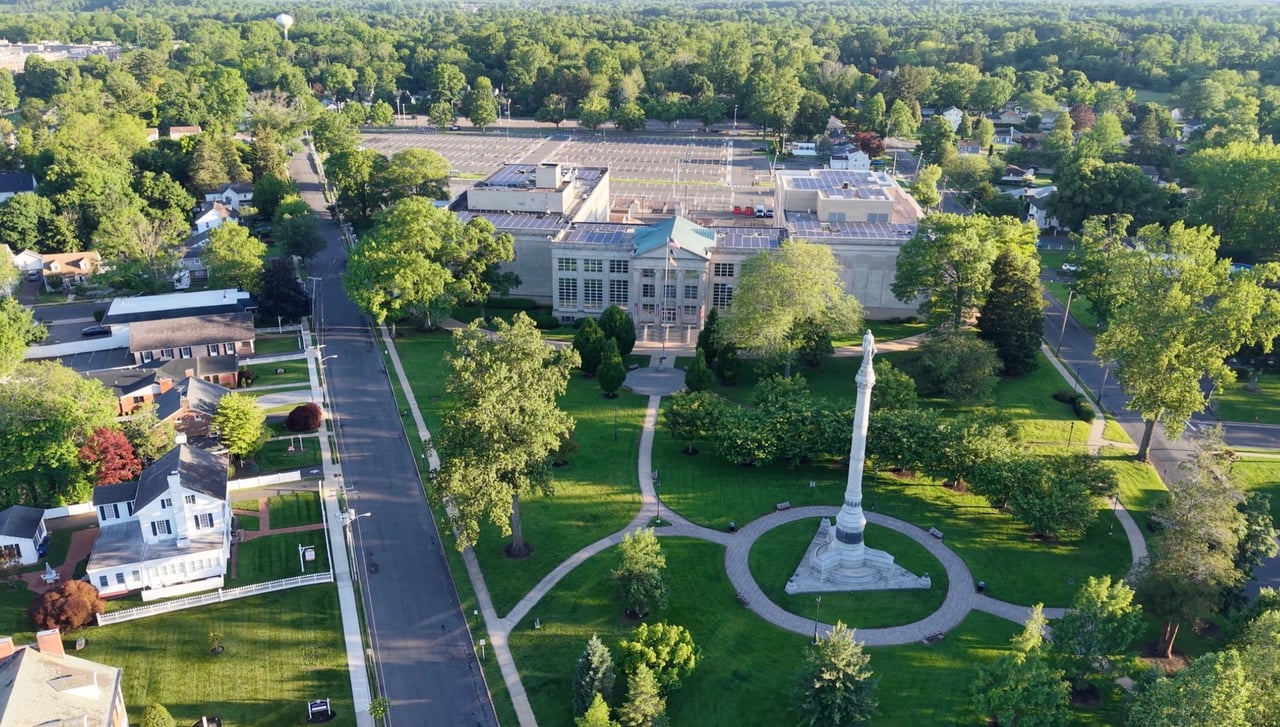
■ ABOVE THE STREETS: FREEHOLD NJ
Aerial footage of Freehold NJ shot by Prodigy Real Estate. Subscribe to the Above the Streets channel for more hyperlocal NJ market videos.
■ THE BOROUGH
Freehold Borough is 2.3 square miles. That's the whole thing. It was incorporated in 1869 and has spent most of the time since then as the civic and commercial center of Monmouth County — home to the county courthouse, a functioning downtown along Broad Street, and a concentrated residential fabric that developed primarily between 1880 and 1960. The bones of most Borough housing reflect that era: Victorian colonials, cape cods, craftsman bungalows, and mid-century ranches on tight lots with modest setbacks.
What that produces in 2026 is a neighborhood-feel market that is genuinely difficult to replicate at this price point in Monmouth County. Streets are walkable. The downtown is functional and improving — restaurants, shops, coffee, and nightlife are within walking distance of most Borough addresses. The population is diverse. The entry price is lower than nearly anything comparable within a 15-minute drive of the Jersey Shore's most desirable towns.
The realistic trade-offs are equally clear. Lots are small — in many cases under a quarter acre, sometimes significantly under. Privacy is limited. Older housing means older systems: some colonials in the Borough are carrying original plumbing, dated electrical panels, and roofs that haven't been touched since the prior decade. Infrastructure in dense urban cores ages differently than suburban construction. Buyers who want a fully renovated turnkey product at Borough prices are going to have to search carefully or be prepared to absorb near-term capital expenditure after closing.
BUYER NOTE
Freehold Borough is one of the few places in Monmouth County where a buyer coming out of a walkable urban environment — Brooklyn, Hoboken, Jersey City — can land without feeling like they've sacrificed their entire lifestyle at the altar of square footage. The downtown ecosystem is real, and it's improving. That's not marketing. It's what's driving demand among a buyer profile that most suburban NJ towns simply don't attract.
The condominium supply in the Borough adds a third option that the Township largely doesn't offer — attached housing under $400,000 that functions as a genuine entry point for first-time buyers or downsizers who want proximity without the maintenance responsibility of a detached home. That segment moves quickly and competes with investor buyers who recognize Freehold's rental market strength.
■ THE TOWNSHIP
Freehold Township is everything the Borough isn't. It covers roughly 41 square miles — nearly 18 times the Borough's footprint — and its residential fabric is almost entirely suburban in character. Large-lot single-family homes, newer construction subdivisions, and a well-established luxury estate tier define the Township's identity. If the Borough is the town, the Township is the land surrounding it.
The housing stock here is newer on average. Subdivisions built in the 1980s, 1990s, and 2000s make up the Township's mid-tier inventory, with four-bedroom colonials on half-acre to one-acre lots forming the core of what trades in the $600,000 to $850,000 range. Above that, the Township's luxury envelope opens up significantly. Gated enclaves like the Polo Club, estate corridors along Freehold Englishtown Road and Militia Hill Road, and custom builds on multi-acre parcels regularly change hands north of $1 million — with the top of the market clearing $1.22 million in the past 12 months.
The Township is also where most of Freehold's new construction pipeline has historically landed. Subdivisions approved under Mount Laurel and planned residential development ordinances have added significant inventory over the past two decades, giving buyers in the Township more options in the attached townhome and age-restricted community segments than anywhere in the Borough. Communities like the Wemrock Road corridor and the areas around Routes 537 and 33 are representative of the Township's dominant suburban character.
The honest trade-off is car dependency. Outside of a handful of commercial nodes, the Township requires a vehicle for virtually every errand. There is no downtown to walk to. The experiential amenity the Borough buyer gets from proximity to Broad Street simply doesn't exist at a Township address — though the Freehold Raceway Mall, with its ongoing transformation into an experiential retail and entertainment destination, is a meaningful Township-side asset that draws regional traffic.
■ PRICE COMPARISON
The combined Freehold market median sale price of $489,000 in early 2026 is a blended figure — and blended figures are only useful up to a point. The Borough and Township are not producing the same transactions. Separating the two gives a clearer picture of where each municipality's price floors and ceilings actually sit.*
In the Borough, attached housing and condominiums create genuine entry points below $400,000. Detached single-family colonials and cape cods in move-in condition typically trade in the $450,000 to $600,000 range. There is limited supply above $700,000 in the Borough, and anything that does push above that threshold is usually a fully renovated asset in a premium block location. In the Township, the entry point for a detached single-family home in acceptable condition starts closer to $550,000 to $600,000. The mid-tier — four-bedroom colonials on reasonable lots — lives between $650,000 and $900,000. The luxury tier is an open ceiling above $1 million, as evidenced by the eight transactions above $925,000 logged in the past 12 months.
| Factor | Freehold Borough | Freehold Township |
|---|---|---|
| Entry Price (detached SF) | ~$420K–$460K | ~$550K–$600K |
| Mid-Market Range | $460K–$650K | $650K–$900K |
| Luxury Ceiling | Limited above $750K | $1M+ active tier |
| Typical Lot Size | Under ¼ acre | ½ acre to 2+ acres |
| Housing Age | Primarily pre-1970 | Primarily 1980–2010 |
| Walkability | High (downtown access) | Low (car-dependent) |
| High School | Freehold Borough HS (standalone district) | Freehold Township HS (regional district) |
| Condo/Attached Supply | Yes — active, sub-$400K options | Townhomes and age-restricted communities |
* Price ranges reflect general market conditions as of Q1 2026 based on closed-sale data. Individual property values vary by condition, location, and specific block. Verify with your agent.
Tax rate differences compound the price gap. Both municipalities are running higher assessed values in 2026 than they were three years ago — the Township's ratable base expanded nearly 60% between 2019 and 2026, prompting a comprehensive reassessment. Buyers who are calculating carrying costs based on pre-reassessment tax data may be working with stale numbers. Get the current bill and effective rate on the specific property, not a general municipal estimate.
■ SCHOOLS
This is where the most expensive mistakes get made. Buyers assume that because both municipalities share the Freehold name, the 07728 zip code, and proximity to each other, their children will attend the same schools. They don't.
Freehold Borough operates its own standalone K–12 school district. Elementary students attend a Borough district school. Middle schoolers attend a Borough middle school. And high school students attend Freehold Borough High School — a standalone institution with its own administration, culture, athletics program, and academic profile. It is not part of the regional high school district.
Freehold Township feeds into the Freehold Regional High School District, which is a shared regional system covering multiple municipalities. Township elementary students attend Township-district schools. At the high school level, Township-addressed students attend Freehold Township High School — one of several schools within the regional district, each drawing from specific sending municipalities.
The two high school systems have different reputations, different program offerings, and different community identities. Buyers with school-age children need to evaluate both on the merits of their own family's priorities — AP course offerings, athletic programs, class size, and culture all factor in differently depending on what you're optimizing for. Neither system should be assumed superior without independent research specific to your child's academic and extracurricular profile.
The practical step: before you fall in love with a property, call the school district with the address and confirm the assignment. Don't rely on the listing, the IDX feed, or the seller's agent. Confirm it yourself. This takes five minutes and prevents a problem that takes years to undo.
■ COMMUTER PROFILE
Both municipalities share access to Central Jersey's highway spine. Routes 9, 18, and 33 run through or adjacent to both. New Jersey Turnpike Exit 8 is the primary logistics artery for the region and sits within reasonable driving distance. Garden State Parkway access is available to the east. For buyers driving to a transit hub — the Route 9 Amtrak corridor, NJ Transit bus lines, or park-and-ride lots — both Freehold and the Township offer reasonable access, though the Township's larger geography means specific addresses can add meaningful drive time to a transfer point.
The cleaner commuter advantage for public transit users goes to the Borough. NJ Transit bus service is more accessible from the Borough's denser core, and the walkability that makes the Borough attractive for errands also makes it more practical for car-light living. A Borough-based buyer who works in Manhattan via bus or train is not starting their commute from a cul-de-sac — they're starting it from a block where the bus stop is a 10-minute walk.
For buyers who drive to work or whose commute is within Monmouth County or central Jersey, the Township's highway access is equally strong and in some cases faster given the direct on-ramp geometry of Routes 33 and 18. The Township buyer is typically not trying to get to Penn Station on a bus — they're trying to reach a Monmouth County office park, a Shore hospital system, or a technology campus. For that profile, the Township delivers without the density premium the Borough carries.
Urban-to-suburb downshifter. Wants walkable errands without Manhattan pricing. Comfortable with bus transit and older housing. NYC or inner-suburb background. Values character over square footage.
Suburban lifestyle maximizer. Drives to work or to a park-and-ride. Wants land, newer construction, and good schools. Equity accumulated elsewhere, buying up. Prioritizes space and privacy over walkability.
■ DECISION FRAMEWORK
Four questions settle most buyer decisions between the Borough and Township. Work through them honestly before you start booking showings.
1. Do you need to walk to something? If your baseline quality of life requires walkable access to restaurants, coffee, errands, or nightlife — the Borough is your market. The Township will not provide that. If you're fully car-dependent and don't need pedestrian amenity, the Township opens up immediately.
2. How important is lot size and privacy? If you're buying partly for outdoor space — a real backyard, some separation from your neighbors, room for a pool or a garage — the Township delivers that at scale. The Borough's lot inventory will frequently disappoint a buyer who needs genuine private outdoor space. If you're fine with a smaller yard and a covered porch, the Borough works.
3. What's your budget ceiling? If you're working with a ceiling below $500,000 for a detached home, you are in the Borough by definition — the Township's entry-level detached supply starts higher. If your ceiling is $700,000 to $900,000 and you want newer construction, the Township opens significantly. If you're above $1 million, the Township is your only real option in this market.
4. Which high school are you buying into? Once you answer that question honestly — evaluating both systems on the criteria that matter for your family — the municipality often chooses itself. For many buyers, the school assignment decision is the decision. Let it be.
The hybrid buyer who wants Borough character at Township prices — walkable downtown feel with half an acre of privacy — is not well-served by either municipality at current valuations. That combination doesn't exist at scale in this market. The closest analog is a renovated detached home on a premium Borough block at the upper end of Borough pricing, or a Township property with easy access to downtown via a short drive. Neither is a perfect substitute for the other.
Freehold is worth understanding in context of the broader Monmouth County market. Buyers who need help thinking through where Freehold sits relative to neighboring towns like Howell, Manalapan, or the Shore communities should explore our full Prodigy neighborhood guide, or read how the NJ market is splitting across price tiers in 2026 — the dynamics affecting which segment you're shopping in are real and worth understanding before you're at the offer stage.
Both markets are moving fast. Median days to pending is 16 to 22 days across the Freehold area. That's not a market where you arrive at a decision slowly. The buyers who navigate it well are the ones who arrive knowing exactly what they're looking for — and which municipality that thing actually exists in. If you want to talk through the specifics before you start touring, call Anthony Licciardello at (718) 873-7345.
* Price range estimates based on closed-sale data, Freehold area, Q1 2026. Municipal population figures approximate. School district information reflects current district structure — verify directly with the relevant school district prior to any purchasing decision. Data is subject to change.
FAQ
Q
Are Freehold Borough and Freehold Township the same school district?
No — and this is one of the most common misconceptions buyers carry into this market. Borough students attend Freehold Borough High School, a standalone K–12 district entirely separate from the regional system. Township students attend Freehold Township High School within the Freehold Regional High School District. The two systems have different structures, reputations, and feeder progressions. A buyer's zip code does not determine their school assignment — the specific municipal address does. Verify directly with the district before making any assumptions.
Q
Is Freehold Borough or Freehold Township more expensive?
Freehold Township is the higher-priced municipality by a meaningful margin. The luxury estate tier in the Township — concentrated along Polo Club Drive, Freehold Englishtown Road, and Militia Hill Road — regularly transacts above $1 million. Entry-level in the Township starts around $550,000 to $600,000 for a modest single-family home. The Borough has a lower floor, with colonial and cape cod housing commonly found in the $420,000 to $580,000 range and condominiums available below $400,000. The blended Freehold median of $489,000 in early 2026 reflects both markets combined.
Q
Is Freehold Borough walkable?
By New Jersey suburban standards, yes. The downtown core along Broad Street puts restaurants, shops, and services within walking distance of most Borough addresses. It is not Manhattan walkability, but buyers relocating from denser urban environments will find the Borough's pedestrian accessibility meaningfully different from most NJ suburbs. Freehold Township is fully car-dependent outside of a handful of commercial nodes — there is no downtown to walk to from a Township address.
Q
What is the property tax difference between Freehold Borough and Freehold Township?
Both municipalities are running higher assessed values in 2026 than in prior years. Freehold Township completed a comprehensive reassessment for 2026 to realign assessed values with current market transactions following a near-60% expansion in its total ratable base since 2019. Effective tax rates differ between the two municipalities and are further influenced by the specific assessed value of the property in question. Buyers should request the current tax bill and effective rate on the specific property from their agent — not a general municipal estimate — before calculating their carrying costs.
Prodigy Real Estate is an innovative real estate company offering high-end video production, home valuation services, purchasing, and home sales. Serving New York and New Jersey.