
Anthony Licciardello | April 21, 2026
DEVELOPMENT PIPELINE
In most New Jersey markets, a single major redevelopment project arriving in a given decade is enough to reshape the surrounding residential landscape. Freehold in 2026 has three. They are operating simultaneously, at different stages of entitlement, serving different ends of the market — and together they represent the most concentrated transformation of Freehold's physical and economic identity since the post-war suburban expansion that built most of the township's housing stock.
Understanding what these projects are, where they stand legally and politically, and what they mean for the surrounding residential market is not optional context for serious buyers in Freehold. It is core due diligence. The market data — home values, absorption rates, rental premiums — captures where prices are today. These three projects are a significant part of the reason prices will be where they are five and ten years from now.
For baseline market context, see our Freehold NJ real estate market report for 2026. For the zoning and affordable housing context that intersects directly with two of these sites, see the Mount Laurel and overlay zone buyer guide. This post focuses on the development story itself.
■ PROJECT ONE
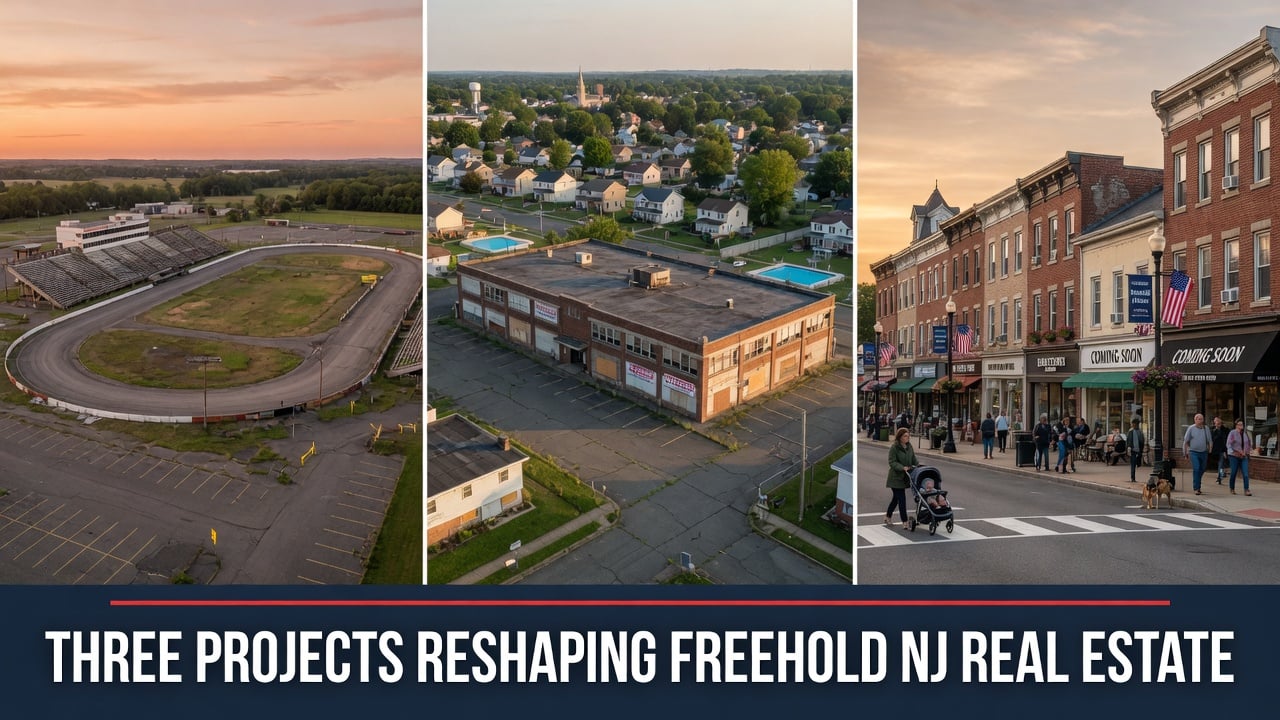
On December 28, 2024, Freehold Raceway ran its last race. The closure ended 171 years of harness racing on a site that had been a fixture of Central New Jersey's identity since before the Civil War. The immediate reaction from longtime residents was grief — and understandably so. What replaced that grief, fairly quickly, was the recognition that 58 acres of prime land sitting at 130 Park Avenue in the heart of Freehold Borough had just become available for something new.
In June 2025, the property was acquired by Raceway RE Partners, a development group led by Jake Lebowitz. The financial terms of the acquisition were not disclosed. What was disclosed — and what has been the subject of active planning conversations with Freehold Borough Mayor Kevin Kane and local stakeholders throughout 2026 — is the vision for what comes next. And it is a significant departure from anything the site has been in its entire history.
No live racing. That is the starting point and the non-negotiable. Raceway RE Partners has been explicit: the equestrian past of the site is being honored through design and acknowledged through the development narrative, but the business model of harness racing is not returning. What is being proposed in its place is a mixed-use lifestyle destination built around four anchors: a luxury boutique hotel, a private social club, chef-driven restaurant concepts, and curated high-end retail.
The design philosophy is articulated around walkability, family-centric programming, and long-term community benefit. The developer has publicly committed to generating value for local charities and first responders alongside the tax ratable contribution — which suggests an awareness that a project of this scale on a site with this history requires community goodwill, not just approvals. The planning conversations have also included evaluation of an entertainment and sports complex component, though that element remains in early-stage discussion.
As of March 2026, the Township's Planning Board was formally authorized to investigate whether specific lots within the Raceway site meet the statutory criteria for designation as an area in need of redevelopment — including evaluation via condemnation criteria. That authorization is a meaningful indicator of where the municipality stands: the Borough government is not passively watching this project unfold. It is actively using its legal tools to move the process forward.
The entitlement risks are real and worth naming. The site carries environmental remediation obligations — including the legacy of vehicle storage and potential petroleum contamination across parts of the 58-acre footprint — that must be addressed before vertical construction can begin. More significantly, the site's proximity to Old Bridge Airport imposes FAA-governed vertical height restrictions that will constrain the hotel's massing and limit certain building configurations. These are not deal-killers — they are engineering and permitting challenges that add cost and timeline to the development — but buyers near the site should understand that ground-breaking is not imminent.
BUYER NOTE
For buyers considering Borough properties within walking distance of the Raceway site, the development upside is real — a functioning boutique hotel and social club district in that location creates destination traffic that benefits surrounding retail, restaurants, and residential demand. The near-term reality is an active construction and entitlement timeline measured in years, not months. Price the opportunity, not the opening date.
The Freehold Borough residential market is already moving. Homes are going pending in 16 to 22 days. The downtown ecosystem is drawing buyers who want walkable suburban character at accessible prices. The Raceway site redevelopment is not the cause of that demand — but when it delivers, it transforms what the Borough's downtown offering actually is. A luxury hotel and social club destination in a market that currently tops out at independent restaurants and retail adds a category of amenity that previously didn't exist at this address. That kind of amenity addition has a measurable, documented effect on surrounding residential values in comparable markets across the country. Freehold Borough, once this project matures, will not be the same residential market it is today.
■ PROJECT TWO
The former Nestle manufacturing facility on Jerseyville Avenue in Freehold Township is a different kind of redevelopment story. No nostalgic history. No boutique hotel vision. What sits here is approximately 26.8 acres of vacant industrial land embedded in the residential fabric of the township — and a deeply contested negotiation about what the most productive use of that land actually is in 2026.
In February 2026, the Township Committee formally adopted an ordinance amending the Nestle Plant Site Redevelopment Plan, establishing the zoning requirements, design standards, and redeveloper obligations for the parcel. That action put the site on a formal redevelopment track. What it did not resolve is the central tension driving all planning conversations about the site: data center versus traditional use.
From a purely municipal planning perspective, a data center is an attractive outcome for a site like this. The existing industrial structures — heavily reinforced, purpose-built for manufacturing-scale operations — can be adapted for server infrastructure without the cost and disruption of full demolition and new construction. A data center generates virtually no daily truck traffic compared to a distribution facility or manufacturing operation. It produces strong, consistent tax ratables with minimal demand on roads, schools, or municipal services. For a township trying to grow its ratable base while managing infrastructure load, the financial profile of a data center is close to ideal on paper.
Strong tax ratables. Minimal truck traffic. Reuses existing industrial structure. Low demand on schools and municipal services. Minimal construction disruption relative to full demolition.
Extreme water and electrical consumption. Limited permanent job creation. Cooling systems generate ambient noise and heat. Potential strain on local utility infrastructure not designed for this load.
The opposition to a data center here is specific and substantive. The facility's water consumption for server cooling at the scale being discussed is not marginal — it is at a level that raises serious questions about whether Freehold Township's municipal utility infrastructure can absorb the demand without degrading service to existing residential and commercial customers. The electrical draw is similarly extreme. A large-scale data center operation requires power grid capacity that suburban New Jersey utility infrastructure, built for a different era of industrial load, may not be able to deliver without significant capital investment in grid upgrades — investment that does not automatically come from the developer.
The job creation concern is the political friction. Data centers employ relatively few permanent workers compared to manufacturing or distribution operations of equivalent square footage. For a working-class community with a history of manufacturing employment, the prospect of a massive industrial site converting to a facility that employs a handful of engineers and security staff is politically difficult — regardless of the tax ratable benefit. Township administrators have responded by pushing prospective developers to commit to substantial engineering investment in noise mitigation, environmental waste management, and utility infrastructure upgrades as conditions of approval. Whether those conditions can be met at a cost structure that still makes the project financially viable for the developer is the open question.
The Nestle Plant resolution will be one of the most consequential land-use decisions in Freehold Township's recent history. It is also a test case for a policy question playing out in municipalities across New Jersey: how do you capture the tax revenue of the digital economy without absorbing its physical costs onto aging suburban infrastructure? Whatever Freehold decides, the outcome will be studied by neighboring townships facing the same question with the same kinds of sites.
■ PROJECT THREE
The Hometown Redevelopment project in Freehold Borough operates at a smaller physical scale than the Raceway or Nestle sites, but its complexity per acre may exceed both. This is downtown urban assembly — the most difficult form of real estate development that exists in New Jersey municipal practice.
Urban assembly requires the sequential acquisition and clearing of multiple adjacent parcels — often held by different owners, operating different businesses, with different legal statuses and different timelines — to create a single contiguous redevelopable footprint. In Freehold Borough's case, the Hometown project requires the relocation of existing private businesses, the transfer of municipal-owned property, and the physical relocation of a functioning firehouse — all coordinated in a sequence that keeps the Borough operational and legally defensible at every step.
The designated developer is Viridian, operating under close monitoring from Borough council stakeholders including Councilmember Jordan. The political environment here is unusually transparent — Borough council votes on administrative steps in this project have been unanimous, running 6-0 and 7-0 at multiple stages. That unanimity is not an accident. It reflects a deliberate Borough strategy of building consensus at every step to insulate the project from the legal challenges that commonly derail complex urban assemblies in New Jersey.
The Borough's Relocation Assistance Program is the operational backbone of the project. Businesses displaced by the assembly process are being supported through a structured relocation framework — which serves both a legal compliance function and a community relations function. A Borough government that is seen as protecting its existing commercial base while pursuing redevelopment generates far less political resistance than one that appears to be displacing businesses for private developer benefit.
The Hometown project doesn't operate in isolation. Two adjacent projects in the same downtown corridor are advancing concurrently and represent the same planning philosophy: density that respects historical context, mixed-income by design, and architecture that references the Borough's 19th-century character rather than contradicting it.
The 500 Park Avenue transit-oriented development is a mixed-use project designed around the Borough's existing transit infrastructure — the kind of project the state's 2025 Development and Redevelopment Plan was explicitly written to encourage. Victory Court is a townhome development that carries a 20% affordable housing component built into its unit mix, satisfying a portion of the Borough's Mount Laurel obligation while producing market-rate housing in a historically referenced architectural style that fits the street fabric of the surrounding blocks.
IMPORTANT
The Hometown project, 500 Park Avenue, and Victory Court are all advancing simultaneously in the same corridor. For Borough buyers evaluating downtown-adjacent properties, the combined effect of these three projects is a fundamental transformation of several blocks that currently include underutilized or blighted parcels. When all three deliver, the downtown walkability profile — already the Borough's primary competitive advantage over the Township — improves materially.
■ WHAT BUYERS SHOULD DO
Three simultaneous redevelopment projects of this scale arriving in the same market at the same time is not a typical condition. Freehold in 2026 is not a market in equilibrium — it is a market in active transformation, and buyers who treat it like a static snapshot will be making decisions based on incomplete information.
The practical implication is straightforward. Every property search in Freehold — Borough or Township — should include a basic development context check. Is the target property within the visual or commute-time impact radius of the Raceway site? Does it sit adjacent to a corridor that carries the new overlay zoning that the Nestle Plant negotiations are likely to influence? Is it close enough to the Hometown assembly footprint to benefit from the downtown revitalization, or close enough to experience near-term construction disruption?
These are not exotic questions. They are the questions that separate buyers who own their decisions from buyers who discover six months after closing that the vacant lot next door just entered redevelopment study. Planning Board meeting minutes are public record. Redevelopment plans are on the township and borough websites. Your agent should be conversant in all three projects before they take you on a showing in this market.
The overall Freehold market is moving fast regardless of these projects — 16 to 22 days to pending, a sale-to-list ratio at 1.000, and a ratable base that expanded 60% in seven years. These three redevelopments are the structural argument for why the floor under those prices holds and likely rises over the decade ahead. For buyers who are weighing Freehold against other Monmouth County options, see how Holmdel's precision luxury market and the Long Branch market compare — the development pipeline context is different in each town, and it matters. For the full neighborhood map across the region, prodigyre.com/communities is the starting point.
Questions about how any of these projects affect a specific property you're considering — including what's in the planning pipeline for parcels adjacent to homes you're touring — call Anthony Licciardello at (718) 873-7345 before you're at the offer stage, not after.
Development status information reflects publicly available planning board records, township and borough committee actions, and developer statements as of early 2026. Project timelines, designs, and entitlement outcomes are subject to change. This post does not constitute investment advice. Buyers should verify all development and zoning information with the relevant municipal planning departments prior to making purchasing decisions.
FAQ
Q
What is being built on the former Freehold Raceway site?
The 58-acre site at 130 Park Avenue was acquired by developer Jake Lebowitz of Raceway RE Partners in June 2025 after the track closed permanently on December 28, 2024. The current vision centers on a luxury boutique hotel, a private social club, chef-driven dining, and high-end retail — with no live racing component in any current plan. The project is in active entitlement stages as of early 2026. Environmental remediation and FAA height restrictions from proximity to Old Bridge Airport are the primary near-term challenges. The Borough's Planning Board was authorized in March 2026 to formally evaluate parcels for redevelopment designation.
Q
What is happening with the Nestle Plant site in Freehold Township?
The former Nestle manufacturing facility on Jerseyville Avenue — approximately 26.8 acres of vacant industrial land — had its redevelopment plan formally amended by the Township Committee in early 2026. The site is currently the subject of active negotiation between a data center proposal and more traditional uses. The data center is attractive for its tax ratable profile and low traffic generation, but faces significant opposition over water consumption, electrical infrastructure demands, and limited permanent job creation. Township administrators are conditioning any approval on substantial engineering investment in utility and noise mitigation. The outcome is unresolved as of publication.
Q
What is the Hometown Redevelopment project in Freehold Borough?
The Hometown Redevelopment is a multi-parcel urban assembly initiative in Freehold Borough steered by designated developer Viridian. It requires sequential coordination of private business relocations, municipal property transfers, and firehouse relocation to unlock contiguous redevelopable parcels in the downtown core. The project has advanced through unanimous Borough council votes at each administrative stage. Related projects in the same corridor — including the 500 Park Avenue transit-oriented development and Victory Court townhomes — are advancing concurrently, collectively transforming several blocks of the Borough's downtown fabric.
Q
How will Freehold's redevelopment projects affect nearby home values?
The directional impact is broadly positive, though timing and proximity matter. The Raceway site redevelopment — if the boutique hotel and social club concept delivers — adds a regional destination amenity to the Borough with no current equivalent, which historically supports surrounding residential values. The Nestle Plant outcome depends on which use prevails: a data center generates strong tax ratables with minimal traffic, while a mixed-use redevelopment creates more community economic activity. The Hometown project directly strengthens the Borough's downtown character — the primary driver of Borough residential desirability. Buyers near any of these sites should evaluate specific proximity and project stage rather than applying a blanket assumption in either direction.
Prodigy Real Estate is an innovative real estate company offering high-end video production, home valuation services, purchasing, and home sales. Serving New York and New Jersey.